
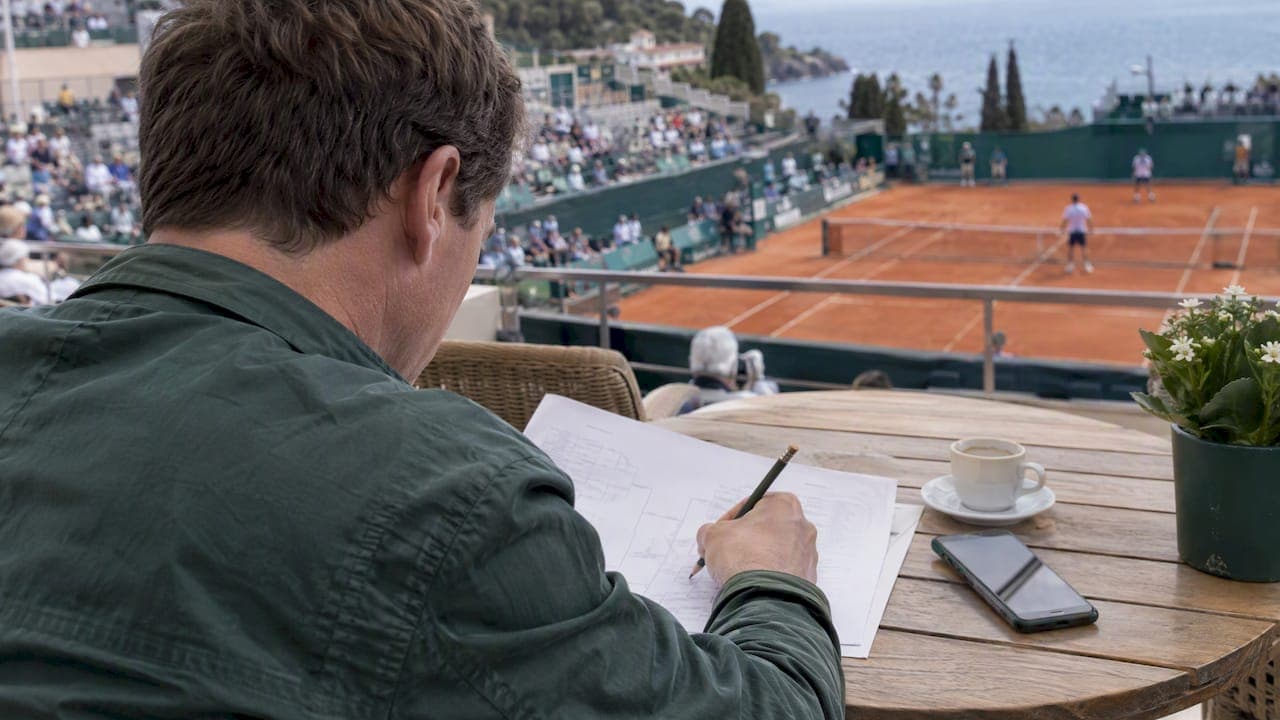
Search "Monte Carlo fantasy" and most results are about football drafts and Python scripts. That is the first meaning of the phrase: the Monte Carlo method, a way of running a messy situation thousands of times to see the range of outcomes. The second meaning is the Rolex Monte-Carlo Masters, the first big clay event of the European swing. For tennis fantasy, the two meet. If you want to pick a roster for Monte-Carlo, thinking like a simulator beats thinking like a fan with a favorite.
This guide covers both. You will learn what a Monte Carlo simulation actually does, how to run a rough version in your head or on a spreadsheet, and how to turn it into a lineup for a clay Masters draw.
TL;DR
- "Monte Carlo" in sports modeling means playing a tournament out thousands of times from win probabilities, then reading the spread of results, not a single prediction.
- In a Masters draw, a player's path (byes, likely opponents, how many matches he must win) often matters as much as his raw rating.
- You can approximate a simulation with basic math: multiply round-by-round win chances to get a title chance, then compare that with the price of the player in your game.
- Clay form, surface history and fatigue shift those probabilities. Seeding alone does not.
- Tweener is built for this kind of analytical play: dedicated ATP and WTA fantasy tennis, free and cash modes, and private leagues.
Table of Contents
- Two meanings of Monte Carlo, and why they belong together
- What a Monte Carlo simulation does, in plain words
- A worked example: why the draw matters more than the rating
- Turning simulation into a fantasy lineup
- What simulations miss (and where your edge lives)
- Perspective: why tennis needs a tournament-first fantasy game
- Playing this out on Tweener
- A clay-Masters checklist
- FAQ
- Sources
Two meanings of Monte Carlo, and why they belong together
The method got its name in the 1940s. Stanislaw Ulam and John von Neumann conceptualized it in 1947 as a way to estimate outcomes by repeated random sampling when an exact calculation is too hard. The code name was a nod to the casino district of Monaco, partly because of Ulam's gambling uncle.
The tournament sits in the same principality's orbit, though it is actually played at the Monte-Carlo Country Club in Roquebrune-Cap-Martin, France. The 2026 edition was the 119th, held April 5 to 12, with a 56-player singles draw. Jannik Sinner beat Carlos Alcaraz 7-6(5), 6-3 in the final, as tennis.com reported.
That final is a good reminder of what simulation is for. Alcaraz was the defending champion, and plenty of people treated the title as a two-man question. A simulation would have said something less comfortable: even a heavy favorite wins a seven-round-style gauntlet far less often than his match odds suggest.
What a Monte Carlo simulation does, in plain words
Take a bracket. For every match still to play, assign each player a win probability. Then let a computer flip weighted coins through the whole draw, round by round, and record who lifted the trophy. Do that 10,000 times. If a player wins the title in 1,500 of those runs, his simulated title chance is 15%.
The math underneath is simple: the method approximates an expected value by averaging many simulated outcomes. Why not just calculate it? Because a bracket branches. Every upset reshuffles who plays whom in the next round, and the number of possible draws explodes. Numerical analysts call Monte Carlo a tool for problems where direct calculation is out of reach, and a tennis bracket is a clean example.
Two points matter for fantasy players:
- The output is a distribution, not a verdict. A 20% title chance means the player loses the tournament four times out of five. That is still the best number on the board in a deep field.
- The output is only as good as the inputs. Garbage win probabilities in, garbage title odds out. Surface-adjusted ratings are the usual fix, which is why we like Elo-style ratings over raw rankings.
Does the tennis math actually hold up?
Researchers have been simulating tennis for a long time. A SIAM Review paper by Paul Newton and colleagues computes the probability of winning a game, set, match or single-elimination tournament from each player's chance of winning a point. Even when you allow for momentum effects such as the hot hand, the basic model, where points are independent and identically distributed, stays surprisingly sturdy for forecasting matches and tournaments. That is good news for you: a clean, simple model beats a complicated one you cannot maintain.
A worked example: why the draw matters more than the rating
Here is a hypothetical, simplified example. The numbers are invented to show the mechanics, not taken from any real forecast.
Suppose Player A has a 70% chance in every match he plays, regardless of opponent. Now compare two situations:
| Situation | Matches to win | Title chance |
|---|---|---|
| Seeded player with a first-round bye | 5 | 0.7^5 = 16.8% |
| Same player, no bye | 6 | 0.7^6 = 11.8% |
The bye alone is worth about five percentage points of title chance. That is a 43% relative jump from a single skipped match.
Monte-Carlo is a good place to see this in action. The draw has 56 players, not 64, so the top eight seeds skip the first round. The same logic applies when you compare a high seed to a dangerous unseeded player who might meet him in round two: the model knows the path, a headline ranking does not.
Now make it more realistic. A top seed will not have 70% in every round. Maybe he is 82% in round one, 74% in the next, 68% in the quarterfinal, 62% in the semifinal and 58% in the final against a rival.
Multiply: 0.82 x 0.74 x 0.68 x 0.62 x 0.58 is about 14.8%. A player you would call "the favorite" has under a one-in-six shot at the trophy. This is also why favorites are expensive in most fantasy formats and why the cheaper picks are where games are won.

Turning simulation into a fantasy lineup
You do not need code. You need a repeatable routine. Here is the one we would run before a clay Masters.
Step 1: Rate players on the surface, not overall
Start with surface-specific form. A hard-court monster can be an ordinary clay player; the reverse also happens. Look at the last 12 months on clay, and at results at this specific event. Monte-Carlo's slow, high-bouncing red clay rewards heavy topspin, patience and legs. Our guide to choosing tennis players for fantasy leagues walks through the filters we use.
Step 2: Estimate match win probabilities for the first two rounds only
Beyond round two, the bracket is too uncertain for your own estimates to matter. For early rounds you can usually find a defensible number: rating gap, head-to-head on clay, recent fatigue. Our matchup analysis piece covers how much a head-to-head record is really worth (less than people think when sample sizes are tiny).
Step 3: Run a back-of-envelope simulation
For each candidate, multiply the chances for the rounds he must win to reach the stage that scores well in your format. You are not after the title only. In most fantasy tennis formats you earn points per match, so the more useful number is expected matches won:
Expected matches won = P(win R1) + P(win R1 and R2) + P(win R1, R2 and R3) + and so on.
This single number is what a simulation hands you after thousands of runs, and you can build it in a spreadsheet in ten minutes. A player who is a modest favorite in every round can out-produce a fragile star who has a brutal quarter.
Step 4: Compare expected output with the cost of the player
This is where "+EV thinking" becomes useful, framed as a skill. If two players project to win a similar number of matches and one is much cheaper under your roster cap, take the cheaper one and spend the saved budget on a premium slot. Value is a gap between projection and price, not a gap between your hunch and the crowd.
Step 5: Re-check close to lock
Withdrawals, injuries and late scheduling change the numbers. Players who pull out after the draw is released hand opponents a walkover, which is a free "win" in many scoring systems. Our 30 to 60 minute pre-match check describes what to look at before the roster locks.
What simulations miss (and where your edge lives)
A model is a starting line. Here are the gaps you can exploit as a human.
- Fatigue and scheduling. Models using only ratings treat a player coming off three-set grinds the same as one who rolled through in straight sets. You do not have to.
- Early-clay adjustment. Monte-Carlo is the first clay Masters of the year, so players arrive with very different amounts of dirt under their feet. Someone who just played a clay swing in South America or Houston is further along than someone who switched surfaces last week.
- Style matchups. A big server can be nullified by slow clay and a deep returner. Ratings flatten these things.
- Scoring quirks. Some formats pay extra for aces, straight-set wins or bonus selections. Know what your game pays, then lean into players who produce it. Our breakdown of how fantasy tennis points are calculated shows how scoring shapes who is worth rostering.
Perspective: why tennis needs a tournament-first fantasy game
We built Tweener because tennis fans who love numbers had nowhere serious to put them. Football has mature daily fantasy products; tennis has been left with casual bracket challenges that reward the loudest guess. Monte Carlo thinking is the opposite of that. It rewards the person who asks how many matches a player will really win, what the draw does to him, and whether his price is fair.
That is also why we think fantasy tennis is a skill contest and not a coin flip. Nobody controls whether a player rolls an ankle in round two. But over a season, the manager who consistently reads paths, surfaces and form will beat the one who picks names. Simulations just make that discipline visible.
— Nathan
Playing this out on Tweener
Tweener is a mobile fantasy app built only for professional tennis, with real ATP and WTA players. You can play in Draft Mode or Pick'em Mode, score points from real match results, and join public leagues or private ones with friends. For Grand Slams, a private league holds you and up to 9 friends, which makes a good test of whose model is better.
There are two ways to play. The free mode uses virtual coins that you can earn in the app and redeem for rewards such as gift cards. The cash mode lets you deposit and enter paid contests for real-money payouts, where legally permitted; cash play is currently available in select US states. If you want to try the method on the next Masters draw, download the app and start in a free league. You can also see both game modes on the Tweener homepage.

A clay-Masters checklist
Before the next Monte-Carlo draw, run through this list:
- Pull the draw and mark the byes. Seeds with a bye need one fewer win.
- Rate each candidate on clay over the last 12 months, and note past results at the event.
- Estimate round-one and round-two win chances; ignore false precision after that.
- Compute expected matches won for your shortlist.
- Compare projection to price, then build around value.
- Check withdrawals and order of play right before lock.
- Write down your picks and reasoning, then review after the final. Over a season, that log is your real edge.
For deeper reading on the picks themselves, see our guides on building a winning lineup, picking ATP fantasy teams and tennis match prediction strategies. If you want to keep sharpening across the season, our pick optimization guide is a good next stop, and the same thinking carries into the ATP Finals.
FAQ
What is the Monte Carlo method in simple terms?
It is a way to estimate an answer by running a random process many times and averaging the results. For a tennis bracket, that means playing the draw out thousands of times using each player's win probabilities. The share of runs a player wins becomes his estimated title chance.
Can I use Monte Carlo simulations to pick a fantasy tennis team?
Yes, in a simplified form. You can multiply round-by-round win chances to estimate how many matches each player is likely to win, then compare that with his price or slot value. A full simulation is more precise, but the logic is the same, and it is still probabilistic: it improves your odds, it does not guarantee a result.
Does the Monte-Carlo Masters favor certain players in fantasy?
It is played on slow red clay, so players with strong clay records and good endurance tend to be safer than pure hard-court hitters. Past results at the event are worth checking too. Always weigh them against the current draw and recent form, because history alone does not decide matches.
Is fantasy tennis on Tweener free?
There is a free mode played with virtual coins, which can be earned in the app and redeemed for rewards like gift cards. A separate cash mode with real-money contests is available only where legally permitted, currently in select US states.
Sources
- Monte Carlo method (Wikipedia)
- Chapter 1: History of Monte Carlo (University of Michigan)
- 2026 Monte-Carlo Masters (Wikipedia)
- Jannik Sinner dethrones Carlos Alcaraz in Monte Carlo (tennis.com)
- Scientific Computing: Monte Carlo lecture notes (NYU)
- Monte Carlo Tennis (SIAM Review)