

TL;DR:
- Fantasy tennis scoring is driven by match actions like aces, double faults, and upsets, not just wins, requiring detailed understanding for strategic lineup building. The system rewards deep tournament progress, dominant performances, and specific in-match statistics while penalizing errors and upsets, making player form and draw strength critical. Success depends on analyzing scoring variance, tracking player performance patterns, and adapting lineups throughout tournaments, beyond just ranking considerations.
Most people assume fantasy tennis is simple: pick winners, collect points. That assumption will cost you matches. Fantasy points in ATP Fantasy are driven by in-match actions, not just wins, which means two players can finish a tournament with the same match record and completely different fantasy scores. Aces, double faults, bagel sets, and upset wins all move the needle in ways that pure match results never show. This guide breaks down exactly how points are calculated across ATP and WTA fantasy formats so you can stop guessing and start building lineups with real precision.
Table of Contents
- Understanding the basics: How fantasy tennis scoring works
- Breaking down ATP Fantasy point calculations
- Comparing ATP vs. other fantasy tennis scoring systems
- Making smart picks: Applying the scoring system to win
- The one thing most fantasy tennis players miss
- Ready to put your fantasy knowledge to work?
- Frequently asked questions
Key Takeaways
| Point | Details |
|---|---|
| In-match actions matter | Fantasy points aren't just about match wins; aces, upsets, and bagels add or subtract crucial points. |
| Know your scoring | Each league may tweak bonuses and penalties, so always confirm the rules before building your lineup. |
| Base points plus bonuses | Your fantasy score combines round progress, tournament weighting, and event-based adjustments. |
| Use strategy | Drafting for high ace or upset potential can push your team above competitors who focus only on rankings. |
Understanding the basics: How fantasy tennis scoring works
Fantasy tennis scoring has two layers that work together. Once you see them clearly, the whole system makes a lot more sense.
The first layer is base points. These are awarded for how far a player advances in a tournament. Winning a first-round match earns a set number of points. Advancing to the quarterfinals earns more. Reaching the final or winning the title earns the most. The tournament category also matters. A Grand Slam match carries more weight than a 250-level event, so a first-round win at the Australian Open is worth more than a first-round win at a smaller ATP 250 tournament. Understanding real match results in fantasy tennis and how they translate directly into point totals is the foundation of building any smart lineup.
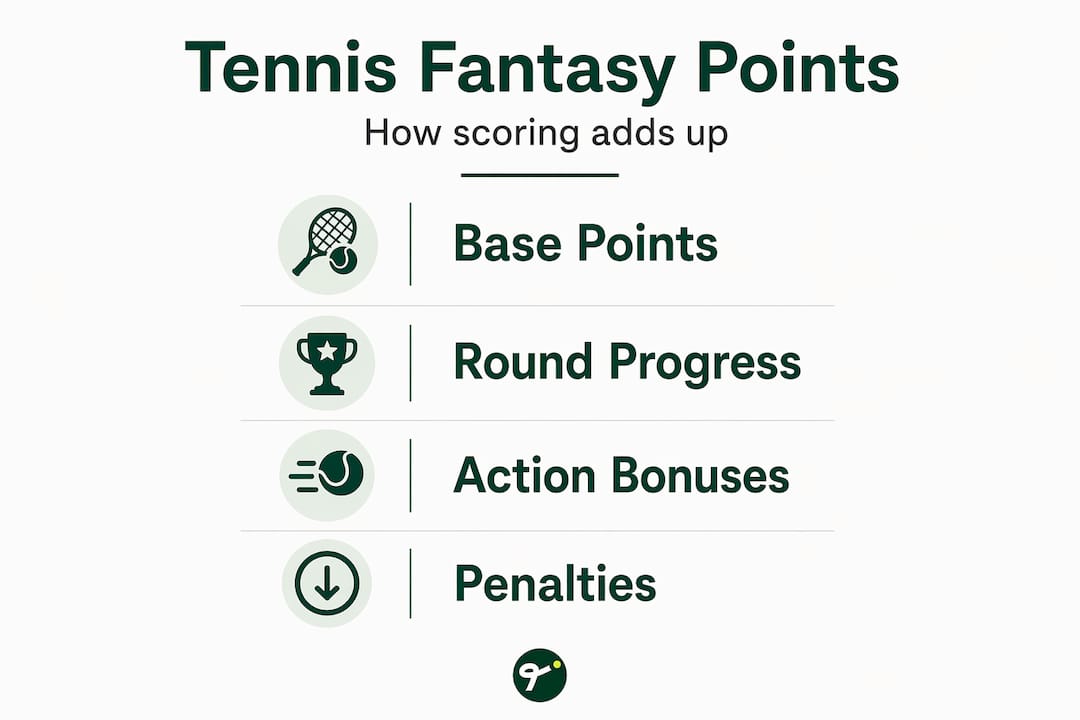
The second layer is bonuses and penalties. This is where the real variance comes from. Scoring includes points for round reached and tournament category, plus bonus and penalty actions that fire based on specific moments inside each match. An ace is a bonus. A double fault is a penalty. A straight-sets win adds points on top of your base total. Losing a set 6-0, called a bagel, is a penalty. These actions stack with your base total and create huge differences between players who look similar on paper.
Here is how the scoring system breaks down in a simple order:
- Tournament category multiplier sets the base value of each round.
- Round reached awards cumulative points as a player advances.
- Per-match bonuses reward clean, dominant wins.
- In-match stat bonuses add or subtract based on specific actions like aces and double faults.
- Situation bonuses and penalties cover upsets, bagels, and straight-sets outcomes.
Getting familiar with fantasy tennis terminology makes reading these scoring rules much faster. Terms like "bagel," "straight sets," and "upset" have specific definitions in the context of scoring, and knowing them cold gives you an edge before you even look at a draw.
Pro Tip: Read the full scoring rules for any league you join before drafting a single player. Bonus and penalty structures vary by platform, and a rule you miss in the fine print can cost you a whole week of competition.
Breaking down ATP Fantasy point calculations
With the basics out of the way, let's look specifically at how each point is awarded in ATP Fantasy.
The official ATP Fantasy game has a clear and consistent scoring system. Every action has a defined point value, which means there is no guesswork once you learn the rubric. Here is a breakdown of the core values:
| Action | Points |
|---|---|
| Ace | +2 |
| Double fault | -2 |
| Straight-sets win | +10 |
| Upset win | +20 |
| Upset loss | -20 |
| Bagel conceded (6-0 set lost) | -10 |
| Round of 64 win | +5 |
| Round of 32 win | +10 |
| Quarterfinal win | +20 |
| Semifinal win | +30 |
| Final win (title) | +50 |
These ATP Fantasy point values show exactly how much each action contributes: +2 per ace, +10 for a straight-sets win, +20 for an upset win, -2 per double fault, -10 for a bagel, and -20 for an upset loss. The combination of these values means a single match can swing dramatically depending on how it plays out.

Consider two scenarios. Player A wins in straight sets, hits 12 aces, and commits 2 double faults. Their match total would be: +10 (straight sets) + 24 (aces) minus 4 (double faults) plus their round-progress points. Player B wins the same round but in three sets with no aces and 6 double faults. They earn only their base round points minus 12 for the double faults. Same match result. Completely different fantasy outcomes.
A few key definitions help apply this correctly:
- Straight-sets win: Winning a best-of-three match 2-0 or a best-of-five match 3-0, without dropping a set.
- Upset win or loss: Defined by ranking differences. If a lower-ranked player beats a higher-ranked opponent, that is an upset win for the lower-ranked player and an upset loss for the higher-ranked one.
- Bagel: A set where the losing player wins zero games, scored 6-0. Each bagel conceded by your player costs 10 points.
The tracking of player performance across tournaments reveals clear patterns in these numbers. Big servers like John Isner or Taylor Fritz consistently generate ace bonuses that smaller-baseline players cannot match. Optimizing fantasy picks requires knowing which players are reliable ace producers and which ones rack up costly double faults.
Pro Tip: Look up each player's season ace rate and double fault rate before making picks. A player averaging 10 aces and 2 double faults per match gives you a net +16 in serve bonuses per game, which adds up fast over a deep tournament run.
The boom-or-bust dimension of this scoring system creates a real strategic choice. A massive server who goes on a deep run at a Grand Slam can generate enormous ace bonuses over seven matches. But if they drop a bagel in round two and get upset in round three, those bonuses disappear fast and the penalties pile on. Consistent, controlled performers often score more reliably week to week even if their ceiling is lower.
Comparing ATP vs. other fantasy tennis scoring systems
Knowing ATP Fantasy's structure helps, but not all games work the same. Here is how others differ.
Most fantasy tennis platforms share the same foundation: tournament progress earns base points, event category multiplies the value, and in-match stats create variance. What changes between platforms is which stats they track and how heavily they weigh specific actions.
Here is a comparison across common fantasy tennis formats:
| Feature | ATP Fantasy | WTA-style leagues | Custom/private leagues |
|---|---|---|---|
| Base scoring | Round reached + category | Round reached + category | Configurable |
| Ace bonus | +2 per ace | Varies (often lower) | Set by league admin |
| Double fault penalty | -2 per fault | Varies | Set by league admin |
| Upset bonus | +20 | Often +15 to +20 | Configurable |
| Bagel penalty | -10 | Varies | Configurable |
| Tiebreak tracking | Sometimes | Sometimes | Varies |
The ATP Fantasy scoring rubric is standardized, but other fantasy games may use variations. WTA-focused leagues often reduce ace bonuses since the women's game features fewer aces on average. Some leagues add tracking for break points converted or service games held, adding another layer of granularity.
The most common mistake new fantasy tennis players make is applying the ATP scoring logic they learned to a completely different platform without checking the rules. Always confirm the point values for your specific league before drafting.
Understanding different fantasy prediction games and how they differ from the ATP standard helps you shift your strategy based on the platform. For example, if a WTA league does not penalize double faults heavily, picking a player with inconsistent serving becomes much less risky than it would be in ATP Fantasy.
Before joining any fantasy tennis league, check for these five things:
- How are round-progress points structured?
- Which in-match stats earn bonuses or carry penalties?
- Are upset bonuses and penalties included?
- Does the league weight Grand Slams differently from 250-level events?
- Are there tiebreak or break-point bonuses that favor certain player types?
Getting comfortable with tennis scoring rules in general also helps. If you understand what a tiebreak means, what constitutes a bagel, and how sets work in best-of-five Grand Slams versus best-of-three events, you will read scoring tables much faster. Strong fantasy team management starts with knowing the rules inside and out across every format you compete in.
Making smart picks: Applying the scoring system to win
Once you know the scoring, it is time to use that info to build a true contender. Here is how.
Knowing the point values is step one. Turning that knowledge into lineup decisions is where strategy actually lives. The scoring structure rewards specific player profiles, and identifying those profiles before the tournament starts is how you stay ahead.
Upset wins score +20, and straight-sets wins score +10, making match scenario predictions a powerful tool for building lineups. A player you expect to win cleanly in straight sets gives you a reliable baseline. A player who has a realistic shot at an upset win can generate massive points if your read is correct.
Here is a three-step process for submitting smart lineups:
-
Analyze the draw. Look at which players have favorable early-round matchups. A top-10 player seeded to face qualifiers or lower-ranked opponents in the first two rounds has a strong path to multiple round-progress bonuses without upset loss risk.
-
Layer in serve statistics. Use current season stats to identify high-ace, low-double-fault players. A player in the top tier for aces per match who also has a favorable draw is your highest-floor, high-ceiling option.
-
Assess upset potential carefully. Identify one or two lower-ranked players who have beaten higher-ranked opponents recently, especially on a surface they favor. A correctly predicted upset win adds 20 points that no top-ranked player can match unless they hit double-digit aces in a single match.
Read the fantasy tennis tips on lineup construction and pair them with surface analysis. Clay courts slow the game down and often reduce ace counts, which means big servers are less valuable in fantasy on clay than on grass or hard courts. Picking ATP fantasy teams successfully means factoring surface into your serve-stat analysis, not just looking at season averages.
Also protect yourself from downside risk. A player with a history of bagels on a surface, or someone coming into a tournament with form issues, carries real penalty exposure. One upset loss at -20 combined with two bagels at -10 each wipes out almost every other bonus that player generates. Smart team selection means balancing your lineup across high upside picks and reliable point accumulators so a single bad performance does not collapse your entire week.
Pro Tip: Build at least half your lineup around players with very low upset-loss risk and clean serving records. Reserve the boom-or-bust spots for one or two players where you have a specific reason to believe in an upset win or a dominant straight-sets performance.
The one thing most fantasy tennis players miss
Here is a perspective that separates the players who win consistently from those who break even.
Most fantasy tennis players spend all their research time on rankings. They pick the world number one, add a couple of top-10 players, and fill in the rest by gut. That approach is comfortable but it leaves points on the table every single week.
The real edge comes from understanding scoring variance, not just player quality. A ranked-outside-the-top-30 player with an ace-heavy serve, a favorable draw, and a recent upset win over someone in the top 10 is worth far more in fantasy scoring terms than their ranking suggests. The real match results in tennis sometimes produce exactly these outcomes, and the scoring system rewards you massively when you predict them correctly.
The players who win fantasy leagues consistently are doing one extra thing: they track week-to-week scoring swings. When a player you owned scored 120 points in a tournament, they break down exactly where those points came from. Were they from aces? Straight-sets wins? An upset bonus? That analysis tells you whether the performance is repeatable or whether it was a one-week anomaly. Rankings stay relatively stable, but scoring patterns shift with form, surface, and draw quality.
Lineup flexibility is also underused. Most fantasy platforms allow transfers or roster adjustments between rounds. Players who update their lineups after each round, responding to draw changes and recent match performance, consistently outscore those who set their lineup and forget it. Adapting to tournament round weighting is one of the highest-leverage skills in the game, and most casual players skip it entirely.
Ready to put your fantasy knowledge to work?
You now know exactly how fantasy tennis points are calculated, from base round-progress totals to ace bonuses and upset penalties. That knowledge gives you a real advantage over players who are just guessing.

Tweener lets you put this strategy into action immediately. The Tweener platform supports both ATP and WTA fantasy leagues, public competition, and private leagues with friends, all built around the real results of live professional tournaments. Join a free league using virtual coins, or step into cash competition where legally permitted and test your lineup-building skills against real players. Download the Tweener app today and start applying everything you learned here to your first fantasy lineup. The draw is live, the points are counting, and your competition is already picking their teams.
Frequently asked questions
What counts as an upset win or loss in fantasy tennis?
An upset win occurs when a lower-ranked player defeats a higher-ranked opponent, earning a +20 bonus in ATP Fantasy, while an upset loss is the reverse and costs your player 20 points. The ranking comparison is made based on official ATP or WTA rankings at the time of the match.
Do fantasy point rules differ between ATP and WTA matches?
The overall framework is similar, but the scoring rubric can vary between ATP-based games and WTA or custom league formats, particularly for serve-related bonuses. Always review the specific point values for your league before setting your lineup.
Are aces and double faults always factored into fantasy points?
In ATP Fantasy and most major leagues, yes. Aces earn +2 per ace, double faults cost -2 per fault, making serve consistency one of the most important statistical factors when evaluating potential picks.
How do I maximize my team's fantasy tennis score?
Focus on players with strong serve stats, a favorable draw, and low upset-loss risk. Tracking player performance across tournaments reveals which players generate consistent bonus points and which ones carry high penalty risk based on their recent match patterns.