

TL;DR:
- ATP and WTA are separate professional tennis tours that organize different leagues, events, and rankings, providing structure to the entire season. Understanding how their event tiers, calendars, and point systems operate offers a strategic advantage for fantasy players. Analyzing season patterns, surface specialization, and event importance enables smarter lineup choices and improves overall success.
Most tennis fans use "ATP" and "WTA" the same way they'd refer to a single match or a specific tournament. That's a mistake that costs fantasy players real competitive ground. The ATP and WTA are the governing bodies behind two separate full-season professional tennis tours, each running dozens of events across the entire calendar year. Understanding how these leagues actually work, from event tiers to ranking systems to year-end championships, gives you a structural advantage that casual fans simply don't have when building fantasy teams.
Table of Contents
- What are the ATP and WTA? Key roles and structure
- ATP vs WTA: League structure and event calendars
- How rankings work: ATP and WTA points and tour finals
- Applying ATP and WTA insights to your fantasy strategy
- Why true fantasy success starts with understanding the leagues
- Enhance your tennis experience with Tweener
- Frequently asked questions
Key Takeaways
| Point | Details |
|---|---|
| ATP and WTA defined | The ATP and WTA are the main governing bodies for professional men’s and women’s tennis. |
| League structure matters | Each tour organizes its own season calendar with unique event tiers and major finals. |
| Ranking drives results | Players earn points at events, with championship tournaments offering the most impact on final standings. |
| Fantasy success uses league insights | Understanding the calendar and points is crucial for smart fantasy picks and seasonal strategy. |
What are the ATP and WTA? Key roles and structure
The ATP, which stands for Association of Tennis Professionals, runs the elite men's professional tour. The WTA, or Women's Tennis Association, governs the women's side. Both organizations do far more than just schedule matches. They set the rules for player conduct, manage ranking systems, negotiate broadcast deals, and determine how points are distributed across hundreds of events each year.
Think of each organization like a professional sports league. The ATP is to men's tennis what the NFL is to American football. It decides which events matter, how players qualify, and how the season ultimately crowns a world number one. The WTA does the same on the women's side. Neither organization runs Grand Slam tournaments directly; those fall under the ITF (International Tennis Federation), but both the ATP and WTA tours include Grand Slams as part of their official point structures.
Here's a quick breakdown of what each body actually manages:
- Player rankings: Updated weekly based on tournament results
- Event sanctioning: Approving and categorizing tournaments by tier
- Prize money minimums: Setting baseline payouts across all tour events
- Tour calendars: Building the annual schedule from January through November
- Player representation: Advocating for player interests in commercial deals
For fantasy players, understanding how the WTA fantasy leagues are structured within this broader organizational framework helps you see why certain tournaments matter more than others. Picking players for fantasy isn't random. It follows a logic that the ATP and WTA have built into the tour structure itself.
The ATP and WTA don't just organize tennis. They define the competitive ecosystem that every ranking point, every fantasy score, and every championship run flows through.
ATP vs WTA: League structure and event calendars
Both tours run year-round from roughly January through November, but the event types and their point values differ in important ways. Understanding the calendar structure is where casual fans start separating themselves from real strategists.

The ATP Tour calendar includes Grand Slams supervised by the ITF, the ATP Finals, ATP Masters 1000 events, ATP 500 events, ATP 250 events, and mixed team competitions like the United Cup. The WTA Tour calendar runs a parallel structure with Grand Slams, WTA Finals, WTA 1000, WTA 500, WTA 250 events, and the United Cup alongside the ATP.
Here's a side-by-side comparison of the two tour structures:
| Event tier | ATP equivalent | WTA equivalent | Frequency per year |
|---|---|---|---|
| Grand Slams | Australian Open, Roland Garros, Wimbledon, US Open | Same events | 4 |
| Top Masters/1000 | ATP Masters 1000 | WTA 1000 | 9 (ATP), 8 (WTA) |
| Mid-tier events | ATP 500 | WTA 500 | ~13 (ATP), ~6 (WTA) |
| Smaller events | ATP 250 | WTA 250 | ~35+ (ATP), ~14 (WTA) |
| Year-end Finals | ATP Finals (8 players) | WTA Finals (8 players) | 1 each |
| Team events | United Cup (mixed) | United Cup (mixed) | 1 combined |
The ATP runs significantly more events at the 250 level, giving male players more opportunities to accumulate points but also more scheduling choices to make. The WTA calendar is tighter, meaning each event carries slightly more weight in the overall rankings picture. For fantasy players tracking tennis tournament schedules, this distinction shapes which events to target and which players tend to show up fresh versus fatigued.
When you're entering tennis fantasy contests, knowing the event tier is essential. A Masters 1000 field will look completely different from an ATP 250 field. The top-ranked players often rest during smaller events, which means value picks open up. You can track the live tennis schedule to stay ahead of lineup decisions.
A numbered breakdown of how an ATP/WTA season flows for strategic planning:
- January: Hard court season opens with Australian Open and multiple 250/500 tune-ups
- February to March: Clay and hard court events; Miami and Indian Wells are Masters 1000 priorities
- April to June: European clay season peaks with Roland Garros; major ranking swings happen here
- June to July: Grass court season, with Wimbledon as the centerpiece
- August to September: North American hard court swing; US Open closes the major season
- October to November: Indoor hard court events; year-end Finals crown the season champion
Pro Tip: Watch for mixed-gender events like the United Cup at the start of the year. These competitions affect both tours simultaneously and can give you early data on player form before the main season heats up.
How rankings work: ATP and WTA points and tour finals
ATP and WTA rankings follow a rolling 52-week system. Every point a player earns comes from their results at sanctioned events, and those points expire exactly one year later. Win a tournament this week, and those points disappear from your total next year at the same time. This creates natural ranking volatility that smart fantasy players can exploit.
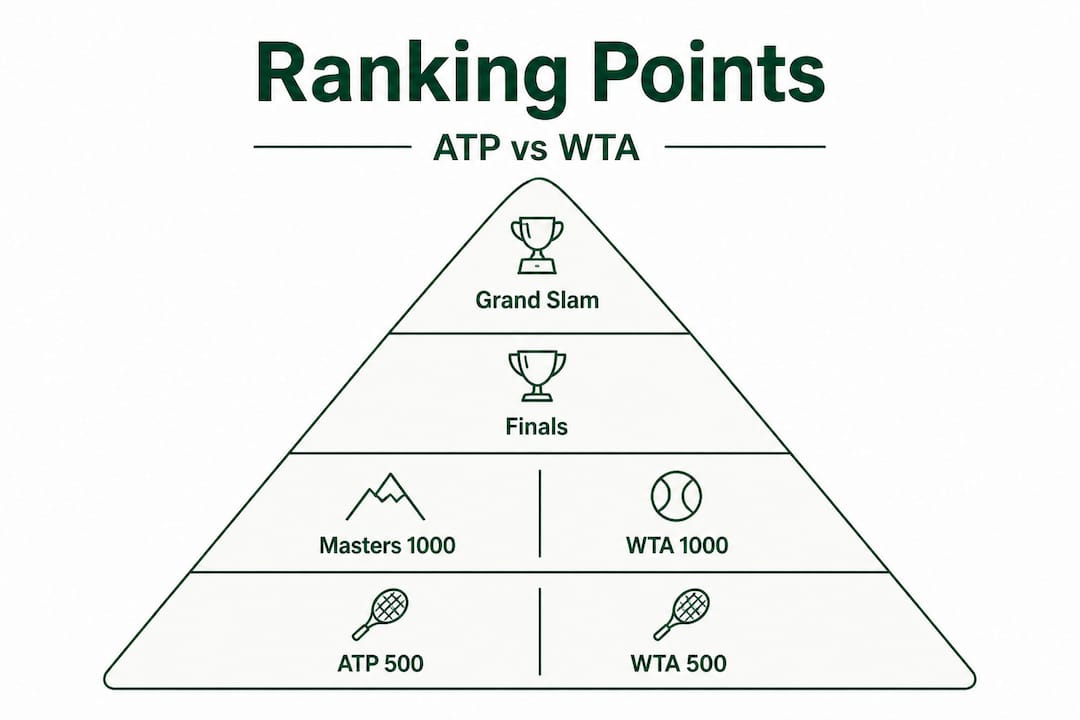
Points are not equal across all events. The table below shows approximate point values at each tier:
| Event | Winner's points (ATP) | Winner's points (WTA) |
|---|---|---|
| Grand Slam | 2000 | 2000 |
| Masters 1000 / WTA 1000 | 1000 | 1000 |
| ATP 500 / WTA 500 | 500 | 500 |
| ATP 250 / WTA 250 | 250 | 250 |
| ATP Finals / WTA Finals | 1500 | 1500 |
The year-end Finals deserve special attention. The ATP Finals and WTA Finals are invitation-only events that gather the top 8 singles players based on season performance. Only the best of the best qualify. Winning the Finals awards 1,500 points, which is enough to move a player up or down several spots in the final rankings. This is where season-long narratives get rewritten in a single week.
Here's what makes the Finals particularly important for fantasy:
- Small field, high drama: With only 8 players competing in round-robin format, every match matters
- Tired legs vs. peak motivation: Some players arrive exhausted, others arrive hungry to claim the season's final prize
- Ranking stakes: A player sitting just outside the top 5 may be chasing one final title to lock in seedings for the following year's Grand Slams
- Surprise upsets: The round-robin format means even the world number one can lose early without being eliminated
For fantasy power rankings at the Finals, form and motivation matter as much as raw talent. Check out top ATP and WTA picks for each major event cycle to stay informed. You can also follow ATP Masters 1000 events directly to track live match outcomes.
Pro Tip: End-of-year events can flip fantasy leaderboards in a single weekend. If your fantasy season runs through November, load up on players who historically perform well at indoor hard courts, since that's the surface for both year-end Finals.
Applying ATP and WTA insights to your fantasy strategy
Now that you understand how both tours are built, here's how to translate that structural knowledge into fantasy wins. The ATP Tour's men's elite circuit and the WTA women's circuit each offer distinct strategic windows throughout the year.
Follow these steps when building your fantasy lineup with league knowledge in mind:
-
Identify the event tier first: A Grand Slam attracts every top player. A 250-level event might see 6 of the top 10 sitting out. Adjust your picks based on who actually shows up.
-
Check the surface: Clay specialists perform differently than hard court grinders. Look at each player's historical record at the specific surface, not just their overall ranking.
-
Track point defense: Players who won big at this event last year will want to defend those ranking points. High motivation often translates to stronger performance.
-
Watch the draw: A strong player in the easy half of the bracket has a more realistic path to the quarterfinals than a similarly ranked opponent facing a gauntlet of tough matchups.
-
Follow injury reports: The ATP and WTA both publish withdrawal information, but results from the previous week are the best real-time signal of a player's physical condition.
-
Use the calendar rhythm: Players who skip smaller events to prepare for a Masters 1000 often arrive fresh and ready to perform. That pattern is predictable and repeatable.
When choosing tennis players for fantasy, these structural details matter more than surface-level name recognition. Use ATP fantasy team tips to get specific advice by event type and player profile.
Pro Tip: Focus on players with strong records at specific tournament types rather than just their current ranking. A player ranked 15th who has won three Masters 1000 titles on clay is far more valuable at Roland Garros tune-up events than a player ranked 8th with no clay pedigree.
Why true fantasy success starts with understanding the leagues
Here's an uncomfortable truth that most fantasy tennis guides skip: the players who consistently top leaderboards aren't just picking the top-ranked names each week. They're reading the calendar like a map.
Most newcomers to fantasy tennis treat every event the same. They see a familiar name in the draw and add them to their team. That approach works occasionally, but it falls apart during weeks when top players rest, or during surface transitions when form becomes unpredictable, or at year-end events where fatigue and motivation create chaos in the results.
The real edge comes from knowing that the ATP and WTA have built predictable rhythms into their seasons. The Miami Masters always follows Indian Wells. The clay season builds toward Roland Garros in a specific sequence. The indoor season tightens as the year-end Finals approach. These patterns aren't random. They're structural. And once you see them, you can plan several events in advance rather than reacting week to week.
We've seen this play out repeatedly in fantasy leagues: the users who think about schedule blocks, not just individual match odds, tend to make smarter multi-event picks. They draft players who have historically peaked during the clay swing, or they target under-the-radar contenders at 500-level events where the big names take the week off.
Understanding tennis player stats within the context of event tiers makes those numbers meaningful. A 65% win rate sounds impressive until you realize it's built entirely on 250-level events. Conversely, a player with a 58% win rate who consistently reaches Masters semifinals is a far better fantasy asset at the biggest events.
The leagues aren't just context for the matches. They are the strategic framework that determines who wins fantasy tennis over a full season.
Enhance your tennis experience with Tweener
You now understand the architecture behind professional tennis, from how the ATP and WTA structure their tours to how ranking points flow through event tiers and into year-end championships. That knowledge is only useful if you have a place to apply it.
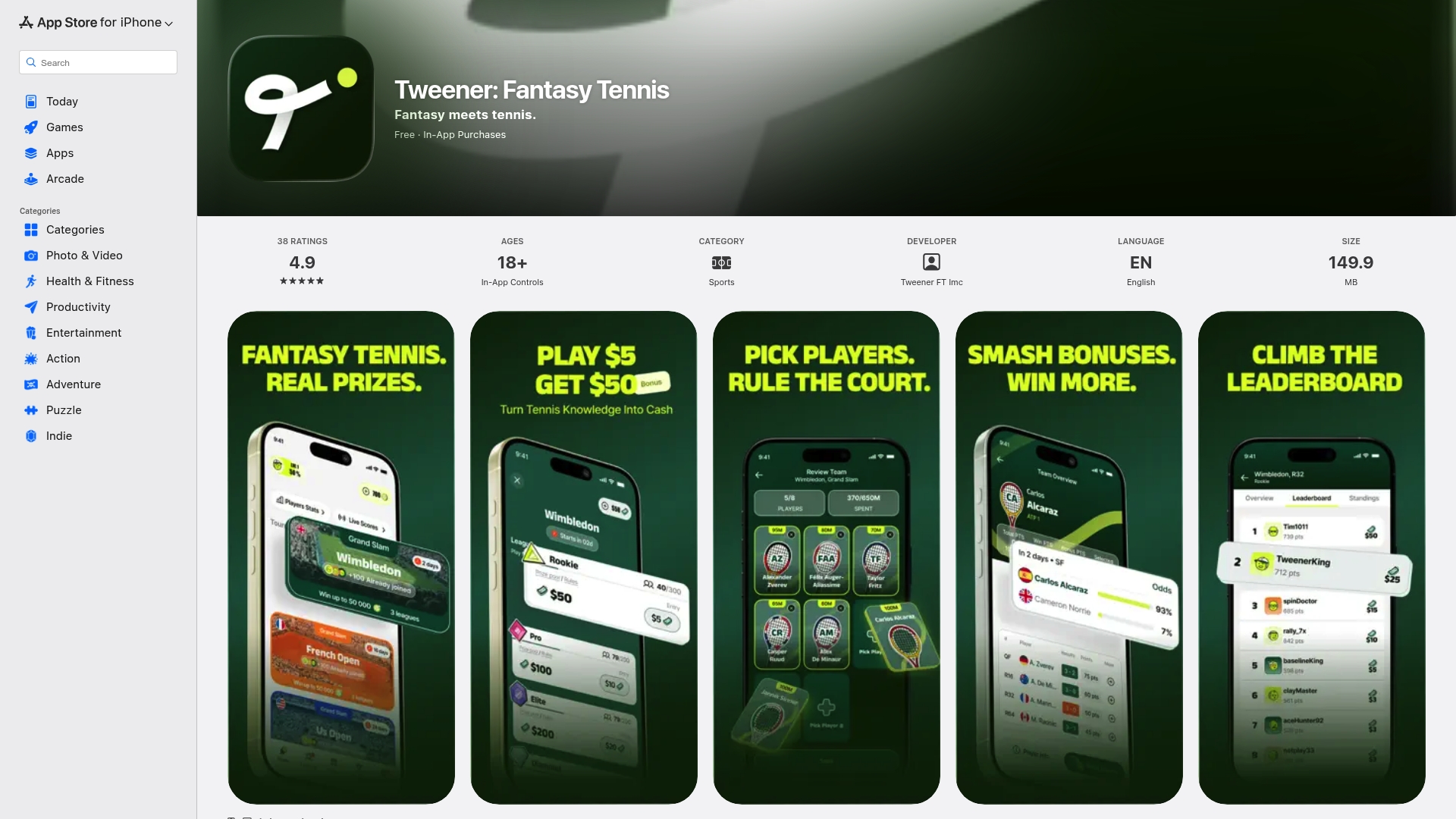
Tweener puts all of this into action. The Tweener fantasy tennis platform lets you build teams from real ATP and WTA players and compete based on their live match results across actual tournaments. Whether you prefer free-to-play contests using virtual coins or want to enter cash leagues for real-money payouts, Tweener gives you the competitive arena your league knowledge deserves. Download the Tweener app and start putting your understanding of ATP and WTA tour structure to work against other real tennis fans who are learning the same game.
Frequently asked questions
What is the main difference between ATP and WTA leagues?
The ATP governs men's professional tennis, while the WTA governs the women's elite tour. Each organization runs its own calendar, ranking system, and year-end championship.
How do ATP and WTA events affect player rankings?
Players earn ranking points at every sanctioned event, and the year-end Finals carry especially heavy point values that can shift rankings significantly in the final weeks of the season.
Are Grand Slams part of both ATP and WTA leagues?
Yes. Grand Slams count toward both ATP and WTA player rankings, and the WTA Tour includes all four Grand Slams as the highest point-value events in its calendar.
What are the most important tournaments in each league?
Grand Slams, Masters 1000 or WTA 1000 events, and the year-end Finals are the most critical, as the ATP calendar and WTA calendar both concentrate maximum points at these tiers.
Can men and women compete in the same ATP or WTA events?
Standard tour events are gender-specific, but mixed competitions like the United Cup combine both tours. The ATP Tour includes the United Cup as a team event, and the WTA Tour also participates in the same competition at the start of each calendar year.