

TL;DR:
- Understanding the ATP scoring system and budget constraints is crucial for effective lineup construction.
- Diversify picks by surface, tournament schedule, and player ownership to gain a competitive edge.
- Utilizing advanced mechanics and post-event analysis boosts your chances of winning in ATP fantasy tennis.
Picking the right ATP fantasy team feels straightforward until you're staring at a 100-credit budget, eight roster spots, and a field full of players in mixed form. Most fantasy managers get eliminated not because they pick bad players, but because they ignore the scoring nuances, mistime their chips, and copy everyone else's lineup. This article walks you through everything: how the budget and scoring system actually work, how to find hidden-value picks that outperform their price tags, how to use advanced mechanics like Bonus Ball and chips, and how to read surfaces and schedules before you lock in your squad.
Table of Contents
- Mastering the ATP fantasy budget and scoring system
- Evaluating top stars vs. hidden-value picks
- Leveraging advanced strategies: Bonus Ball, chips, and weekly transfers
- Factoring in surfaces, tournament schedules, and diversification
- A smarter way to outdraft your rivals in ATP fantasy
- Dominate your ATP fantasy season with Tweener
- Frequently asked questions
Key Takeaways
| Point | Details |
|---|---|
| Balance star picks with value | Combine top favorites and affordable talents for steady, high-scoring teams. |
| Use bonus and chips strategically | Maximize point multipliers by deploying the Bonus Ball and saving chips for big tournament weeks. |
| Focus on surface and schedule | Match player strengths to tournament type and diversify across events to reduce risk. |
| Adapt after each round | Review latest player form, injuries, and scheduling to update your lineup and stay ahead. |
Mastering the ATP fantasy budget and scoring system
With the goals clear, let's first tackle the two make-or-break game mechanics: working within your budget and mastering the scoring system.
The budget structure gives you exactly 100 credits to fill six starters and two alternates. Player prices come directly from PIF ATP Live Rankings, so the biggest names carry the biggest price tags. Jannik Sinner costs 36 credits, Alexander Zverev runs 33, and Carlos Alcaraz tops the list at 40. Lock in two of those top-tier names and you have 24 credits left for six more spots. That math forces smart decisions from day one.
The scoring system rewards deep tournament runs, but the bonuses and penalties are what separate the good managers from the great ones. You earn extra points for aces (+2 each) and straight-sets wins (+10). You lose points for double faults (minus 2 each) and bagels, meaning 6-0 sets conceded (minus 10). A player who aces opponents relentlessly and wins cleanly can outscore someone ranked higher who grinds through five-setters all week.
| Player | Price (credits) | Ace avg/match | Double fault avg | 2026 form |
|---|---|---|---|---|
| Carlos Alcaraz | 40 | 6.1 | 2.3 | Strong clay |
| Jannik Sinner | 36 | 5.4 | 1.8 | Dominant hard |
| Alexander Zverev | 33 | 4.8 | 2.9 | Consistent clay |
| Ugo Humbert | 12 | 7.2 | 3.1 | Hot form |
| Alejandro Tabilo | 9 | 5.0 | 2.2 | Value pick |
Common mistakes include spending 40 credits on Alcaraz and then scrambling with leftovers, picking alternates who never enter the draw, and ignoring serve stats entirely. Alternates only score if a starter withdraws, so choosing match-ready alternates with easy early draws is not optional. It is critical.
Here's what to evaluate before finalizing your core six:
- Ace rate: High ace rates compound fast across a deep tournament run
- Double fault frequency: A leaky serve bleeds points match after match
- Draw position: A soft quarter of the bracket can mean three extra wins
- Event level: Grand Slams and Masters 1000s award more progression points than 250s
Pro Tip: Before spending any credit on a star player, check their recent ace-to-double-fault ratio. A player averaging 7 aces and 2 double faults per match is worth far more than their price suggests. You can build a winning lineup around one or two of these serve-dominant players without breaking the budget.
Evaluating top stars vs. hidden-value picks
Once you understand your budget and the points landscape, the next step is actually picking your team's lineup, starting with the balancing act between megastars and budget gems.
Top stars like Alcaraz and Sinner offer high win probability, but they are also owned by almost every manager in your league. Owning the same players as everyone else is called having high ownership, and while it feels safe, it rarely wins leagues. When Sinner goes deep, everyone scores equally. To actually overtake rivals, you need at least one or two picks they do not have.

Hidden-value players are typically priced at 8 to 14 credits and carry real tournament pedigree on the right surface. Alejandro Davidovich Fokina, for example, has been priced at just 8 credits despite reaching a Monte-Carlo final. For your budget, that kind of past performance at a discount is exactly the return on investment you want.
| Category | Example player | Price | Ownership risk | Expected ROI |
|---|---|---|---|---|
| Megastar | Alcaraz | 40 credits | Very high | Steady but shared |
| Reliable seed | Zverev | 33 credits | High | Solid |
| Value specialist | Davidovich Fokina | 8 credits | Low | High upside |
| Serve weapon | Humbert | 12 credits | Medium | Bonus-heavy |
When deciding which players to choose for your fantasy team, ask three questions. First, does this player have a favorable draw early? Second, is this tournament on a surface where they historically overperform? Third, are there injury rumors in the news cycle? One early withdrawal from a starter who never plays is just dead weight without a quality alternate to cover.
A smart lineup typically looks like this:
- One premium star (Alcaraz or Sinner) to anchor your scoring floor
- One reliable seed (Zverev, Medvedev, or similar) for consistent progression points
- Two surface specialists priced between 12 and 20 credits with proven records
- Two value picks under 12 credits with low ownership and favorable draws
- Two high-quality alternates who are confirmed in the draw
Pro Tip: Diversify by surface role, not just price. Owning a grass-court specialist heading into Wimbledon weeks, even at a low price, beats owning a clay baseline grinder who hates fast courts. Check top fantasy picks each week to see which specialists are peaking at the right time.
Leveraging advanced strategies: Bonus Ball, chips, and weekly transfers
Beyond basic selection, game mechanics like Bonus Ball and special chips introduce layers of depth. The right timing can be a league-winner.
The Bonus Ball doubles the points for one starter you designate each week. If that starter does not play, the bonus cascades to the next eligible player on your roster. That cascade feature is key: always assign Bonus Ball to a player confirmed in the draw, not someone with a question mark over their participation. At big events like the French Open or US Open, a Bonus Ball on a finalist can produce a massive swing.
The three chip types each serve a distinct purpose. Alternates activates your bench players to score normally. Triple Bounce triples one player's points for a round. Swing Switch lets you make extra lineup changes mid-tournament. Using Triple Bounce on a favorite during a quarter they are expected to dominate is the highest-ceiling play in the game. Do not waste it on a first-round week at a smaller event when a Masters 1000 or Slam is weeks away.
Transfers follow a strict weekly limit: you get 2 free moves each week after the pre-season window closes. Unused transfers roll over to a maximum of 8, so hoarding them for clay season or the Slam stretch is a real competitive edge. Every extra transfer beyond your free allocation costs 50 points, which is a steep penalty that compounds quickly.
Here is a pre-tournament checklist to run through each week:
- Confirm all six starters are in the draw and their matches are scheduled
- Assign Bonus Ball to your highest-probability deep-runner
- Decide whether to hold your chip or play it based on draw bracket analysis
- Check if any remaining free transfers can improve a weak roster slot
- Verify that alternates are match-ready and ranked to enter if a starter drops out
Pro Tip: Save at least one chip for swing weeks during the clay season, when upsets run hot and surface specialists regularly outperform top seeds. The smart captain picks available to you during that stretch can swing 40 to 60 points in a single tournament. Learn more about the full ATP Fantasy game overview to see how each chip fits into a seasonal strategy.
Factoring in surfaces, tournament schedules, and diversification
Now that advanced mechanics are clear, maximizing returns also means factoring in real-world tennis variables: surfaces, schedules, and lineup diversity.
Surface matching is not optional. A clay specialist like Rafael Nadal in his prime would score far more at Roland Garros than at Wimbledon. In 2026, that logic still applies. When picking for a clay event, prioritize surface suitability alongside recent form and historical tournament results. A player who made the quarterfinal at the same event last year, on the same surface, has a statistically better chance of doing it again than someone arriving cold.
Injuries and withdrawals require constant monitoring. Locking in a player on Friday who withdraws Saturday before the draw clears is a costly mistake. Follow ATP injury news on match day and make your final transfers as close to the deadline as the rules allow.
"Surface statistics and draw position are the two most underused research tools in fantasy tennis. A player's average rank tells you who they are. Their surface win rate tells you who they become at this specific tournament." — Tennis analytics community insight
In weeks with two tournaments running simultaneously, many managers make the mistake of clustering all six starters at the bigger event. If there is an upset wave at that location, your whole roster collapses together. Spreading three or four players across both events hedges your scoring floor.
Before finalizing any lineup, run through these questions:
- What surface is this event played on, and who excels there this year?
- Are there notable seeds with tough draws in the first two rounds?
- Is it a dual-event week, and have I spread my risk accordingly?
- Have any players reported physical issues in the past 48 hours?
- Do my alternates have a realistic path to entering the main draw?
Using match prediction strategies alongside surface data gives you a structured way to answer each of those questions before your lineup locks.
A smarter way to outdraft your rivals in ATP fantasy
Here is something most fantasy tennis guides will never tell you: the managers who consistently finish in the top tier of their leagues are not the ones with the best player knowledge. They are the ones with the best differentiation strategy.
When 80% of your league picks the same two stars, those players become neutral. They cannot move your rank because everyone owns them equally. The real edge lives in your third, fourth, and fifth roster slots. Picking a low-owned surface specialist who runs deep at Monte-Carlo while your rivals skip him is where leagues are actually won.
Post-event analysis is another underused tool. After each tournament, review which players outscored their price, why they did it, and whether those conditions will repeat. Most managers set and forget. Managers who build winning fantasy lineups obsessively study post-event point breakdowns and adjust before the next week begins.
The boldest moves in fantasy tennis are also the most rewarding. A well-timed Triple Bounce on a 14-credit clay specialist at the right Masters event can produce more points than a Bonus Ball on Alcaraz at a 250-level tournament. Trust your surface research, back it with chip timing, and let the crowd follow the favorites while you quietly accumulate points where nobody is looking.
Dominate your ATP fantasy season with Tweener
With your strategy sharpened, it's time to gain a real advantage using the right platform.
Tweener is built specifically for tennis fantasy fans who want to put everything you just learned into practice. The app gives you access to up-to-date player stats, real tournament schedules, and an interface designed for fast lineup decisions before deadlines hit.
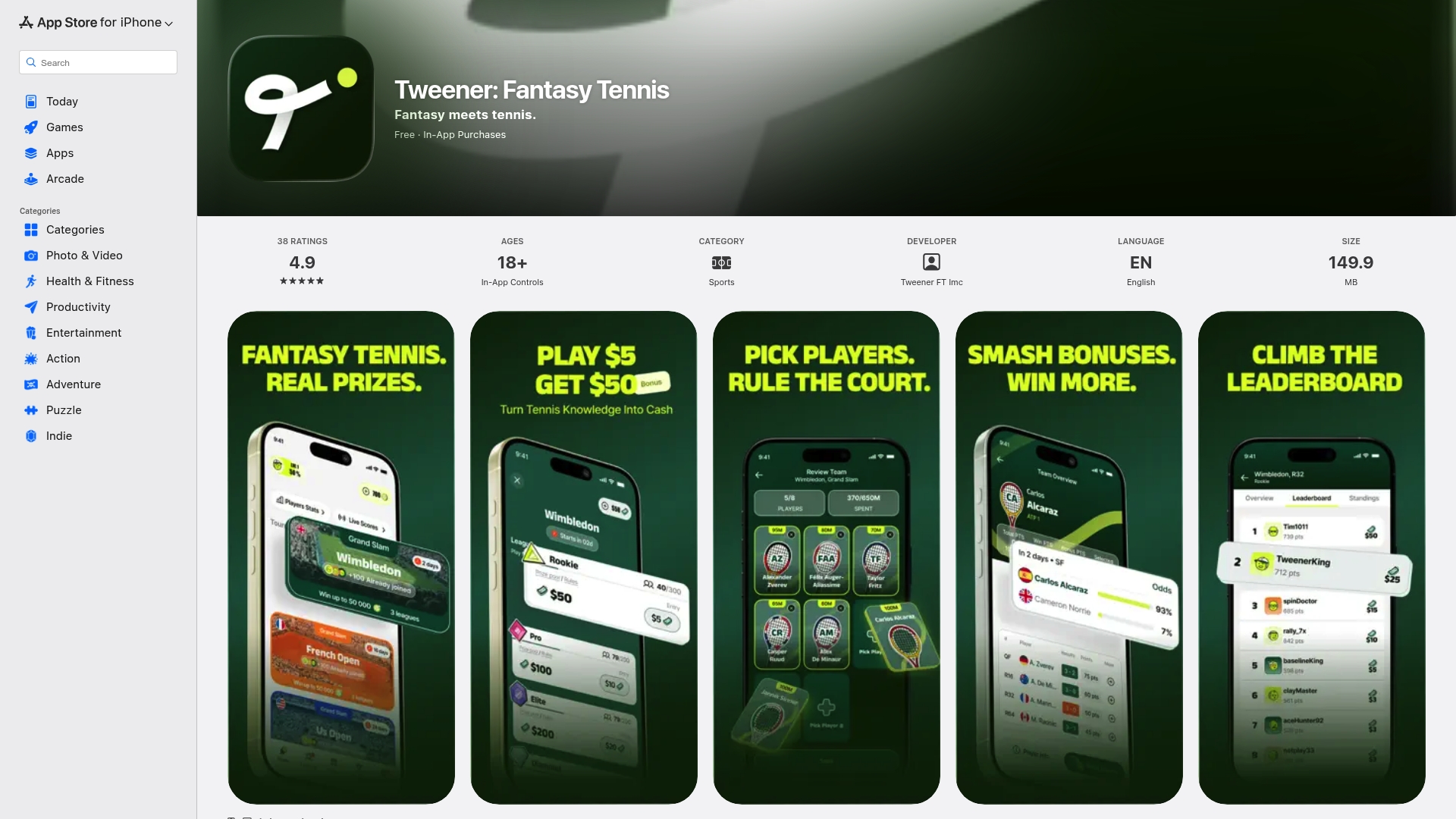
Whether you're competing in public leagues or running a private league against your tennis crew, Tweener's fantasy platform is where these strategies come to life. You can test your value-pick theory, time your chips against real draw brackets, and track how your roster performs match by match. Download the Tweener app today and start turning your ATP knowledge into a competitive edge every tournament week.
Frequently asked questions
How do I maximize my points in ATP fantasy?
Balance premium stars with in-form, affordable players, exploit bonus scoring mechanics, and deploy chips at high-leverage tournaments to multiply your total points output.
What does the Bonus Ball do in ATP fantasy?
The Bonus Ball doubles points for one designated starter each week, and if that player does not compete, the bonus automatically shifts to the next eligible player on your roster.
How many transfers can I use each week?
You receive 2 free transfers weekly, which roll over to a maximum of 8 banked moves, and each additional transfer beyond your free allocation costs 50 points.
How should I adjust for dual-event weeks?
Spread your roster across both tournaments rather than concentrating all starters at one location, which protects your total if an upset wave hits a single draw.
What are the best sources for ATP fantasy player research?
Combine ATP rankings data, surface-specific win rates, and recent tournament results with Tweener's weekly fantasy tips to build the most informed lineup possible before each event deadline.