

TL;DR:
- Success in fantasy tennis relies on evaluating form, matchups, and surface-specific stats, not just rankings.
- Building balanced lineups with consistent performers, high-ceiling players, and undervalued specialists increases winning chances.
- Mastering captain and Bonus Ball strategies, along with timely updates on player withdrawals, provides a competitive edge.
Picking a winning fantasy tennis lineup feels straightforward until you're staring at a field of 128 players, a dozen surfaces, and a tournament draw that shifts overnight. Most casual players rely on name recognition and gut feeling. The ones who consistently finish at the top of their leagues do something different: they build repeatable skills that cut through the noise. This guide breaks down the four must-have strategic skills that separate sharp fantasy tennis managers from everyone else, with practical frameworks you can apply starting with your very next lineup.
Table of Contents
- Skill 1: Player selection using form, matchups, and stats
- Skill 2: Building balanced lineups—stars, specialists, and budget picks
- Skill 3: Strategic use of captains and Bonus Ball plays
- Skill 4: Reading the field—insights from edge cases and fantasy data
- Why mastering these skills beats following the crowd
- Play fantasy tennis with pro-level tools
- Frequently asked questions
Key Takeaways
| Point | Details |
|---|---|
| Prioritize player stats | Focus on core metrics and recent form to select the most reliable fantasy performers. |
| Balance your lineup | Combine stars with underrated surface specialists and consistent scorers for depth and upside. |
| Leverage fantasy bonuses | Use captain and Bonus Ball features strategically by matching player strengths and timing. |
| Stay alert for changes | Last-minute injury and draw updates can make or break your lineup, so always check before deadlines. |
| Develop winning habits | Consistent application of these skills gives you a true edge over competitors who chase hype. |
Skill 1: Player selection using form, matchups, and stats
Every strong fantasy lineup starts with a disciplined evaluation process. The mistake most new players make is picking based on ranking alone. A world number five who just played three grueling five-setters and faces a clay specialist in round two is a much weaker pick than his ranking suggests. Effective player selection requires looking at multiple layers simultaneously.
Start with recent form. The last five to ten matches tell you far more than a player's season ranking. Look for momentum: back-to-back deep runs, consistent service holds, and low unforced error counts. A player peaking at the right moment is worth more than a fading champion.
Next, study the draw path. Draw paths, matchups, and tournament history are critical factors that directly shape how many fantasy points a player can realistically accumulate over a tournament. A top seed in the weaker half of the draw has a much cleaner road to the quarterfinals than one who faces a dangerous floater in round two.
Surface history matters more than most players realize. Clay, grass, and hard court specialists have wildly different win rates depending on the venue. A player who dominates on clay can look average on grass. Always cross-reference surface-specific win rates before finalizing picks.
Here are the key stats worth tracking:
- First serve points won: Winners typically land 70 to 80% of points when the first serve goes in
- Return points won: Elite returners win 38 to 45% of return points, a strong predictor of match outcomes
- Break point conversion rate: Top performers convert 40 to 50% of break point opportunities
- Unforced error rate: Lower is almost always better for fantasy consistency
For example, a mid-ranked player with a 75% first serve points won rate and a favorable draw path on his best surface is often a better value pick than a top-ten player facing a tough early matchup. These are the predictable outcomes sharp managers hunt for every week.
Pro Tip: Always run a final check within 24 hours of the lineup deadline. Injuries and late withdrawals can flip your entire strategy. Check the player stats guide for updated data before locking in your picks.
Skill 2: Building balanced lineups—stars, specialists, and budget picks
With player evaluation in hand, let's look at how to build a lineup that balances consistency, value, and star power.
The biggest trap in fantasy tennis is building a lineup full of expensive stars and hoping they all perform. That strategy works occasionally, but it creates massive variance. One early upset and your entire lineup collapses. Sustainable fantasy managers think in terms of floors and ceilings.

High-floor players are consistent point earners. They hold serve reliably, rarely lose in early rounds, and deliver steady fantasy scores even when they are not at their absolute best. Think of them as your lineup's foundation.
High-ceiling players are the boom-or-bust picks. They can deliver massive point hauls if they go on a run, but they carry more risk. You want a few of these, not an entire roster built around them.
Here is a simple framework for building winning lineups:
- 2 to 3 high-floor players who are strong on the tournament's surface
- 1 to 2 high-ceiling stars with favorable draw paths
- 1 to 2 budget specialists who are undervalued relative to their surface form
"Prioritize high-floor consistency through strong hold rates and fitness alongside ceiling attackers for optimal lineups."
Budget surface specialists are where real edges are found. A player like Davidovich Fokina on clay at a low cost can outperform heavily picked stars who are playing on a less favorable surface. The crowd chases big names. You should chase value.
Overvaluing popularity is one of the most common and costly mistakes in fantasy tennis. A player's social media presence or past Grand Slam titles have zero impact on this week's fantasy points. Focus on current form and matchup quality instead.
Pro Tip: When possible, stagger your roster so you have players from both halves of the draw. This gives you coverage even if one half produces early upsets. Check the lineup tips section for draw-specific strategies, and use optimized picks to sharpen your selections further.
Skill 3: Strategic use of captains and Bonus Ball plays
Solid lineups are great, but fantasy tennis margin often comes from mastering in-app bonuses and captains.
In most fantasy tennis formats, the captain slot or Bonus Ball feature can double or significantly boost your player's points for a given round. This is where a well-timed decision can leapfrog you past dozens of competitors in a single match. Used carelessly, it can also waste your biggest multiplier on a poor matchup.
Here is a step-by-step approach to smart captain picks:
- Identify surface fit. Only captain players who are genuinely strong on the current surface. A hard court specialist captained on clay is a gamble, not a strategy.
- Check the matchup. Captaining a player against a tough opponent with a great record against them is a classic mistake. Look for soft draws or opponents who struggle on the same surface.
- Consider serve and ace potential. Bonus Ball plays that leverage aces on specific surfaces can generate outsized fantasy points. Big servers on fast courts are prime candidates.
- Time it for the right round. Early rounds often have the clearest mismatches. Later rounds get more competitive. Use your Bonus Ball when the matchup is most favorable, not just when your best player is playing.
- Avoid doubling down on uncertainty. If a player is nursing a minor injury or has had a tough travel schedule, do not waste your multiplier on them regardless of their ranking.
The biggest mistake players make is automatically assigning the captain slot to their most expensive pick. Popularity and price do not equal matchup advantage. A well-rested mid-tier player with a perfect surface fit and a weak opponent is often a better Bonus Ball target than a top seed in a tricky draw.
Pro Tip: Save your Bonus Ball for rounds where you have a clear surface advantage or a notably weak opponent. One well-timed multiplier can be worth more than three average rounds combined. If you are looking for a fun way to celebrate a big fantasy win, tennis gifts make a great reward for yourself or a fellow fan.
Skill 4: Reading the field—insights from edge cases and fantasy data
Finally, even the best strategies need on-the-fly adjustments. Here is what separates attentive fantasy managers from the rest.
The fantasy tennis field is not static. Players withdraw. Travel schedules create fatigue. A player who looked like a lock on Monday can be a liability by Wednesday. Late withdrawals and travel fatigue require last-minute checks and the flexibility to pivot away from your original plan.
Here is a comparison of two common field-reading approaches:
| Approach | Risk level | Best used when |
|---|---|---|
| Lock in lineup early | High | Draw is stable and no injury news |
| Wait until deadline | Low | Injury news or weather disruptions |
| Monitor ownership data | Medium | Competing in large public leagues |
| Pivot from popular picks | Medium | High ownership on risky players |
One of the most underused skills in fantasy tennis is tracking field ownership. In large public contests, if 60% of lineups include the same player, you are not gaining an edge by picking them too. Differentiating your lineup with a well-researched alternative can be the difference between finishing in the top ten and finishing in the middle of the pack.
On the stats side, return stats outperform serve percentage as a predictor of match outcomes in real ATP data. This is a counter-intuitive insight that most casual fantasy players ignore. A player who wins return points consistently is more likely to win matches and accumulate fantasy points than a player who simply holds serve well.
Common field-reading mistakes to avoid:
- Ignoring ownership concentration in public leagues
- Failing to check lineup news within 12 hours of the deadline
- Overloading on underdogs without hedging with a reliable floor player
- Missing match prediction strategies that account for scheduling and fatigue
- Not understanding basic industry terms that affect how scoring works in your league format
Why mastering these skills beats following the crowd
Here is an uncomfortable truth most fantasy tennis content will not tell you: copying the popular lineup is not a strategy. It is a way to guarantee average results.
The players who optimize for consistent wins are not the ones chasing the hottest pick of the week. They are the ones who have built a process. Form evaluation, lineup balance, bonus timing, and field awareness are skills that compound over time. A new player who spends two months applying these frameworks will consistently outperform someone who has played for years on instinct alone.
We have seen it repeatedly: new players overstacking stars, ignoring surface specialists, and making last-minute panic moves based on social media buzz. These habits feel exciting in the moment but produce inconsistent results. The players who climb leaderboards week after week are the ones who trust their process even when it means missing one flashy pick. Trends fade. Skills do not. Build your toolkit and trust it.
Play fantasy tennis with pro-level tools
Ready to turn these must-have skills into fantasy tennis victories? Here is the fastest way to get started.
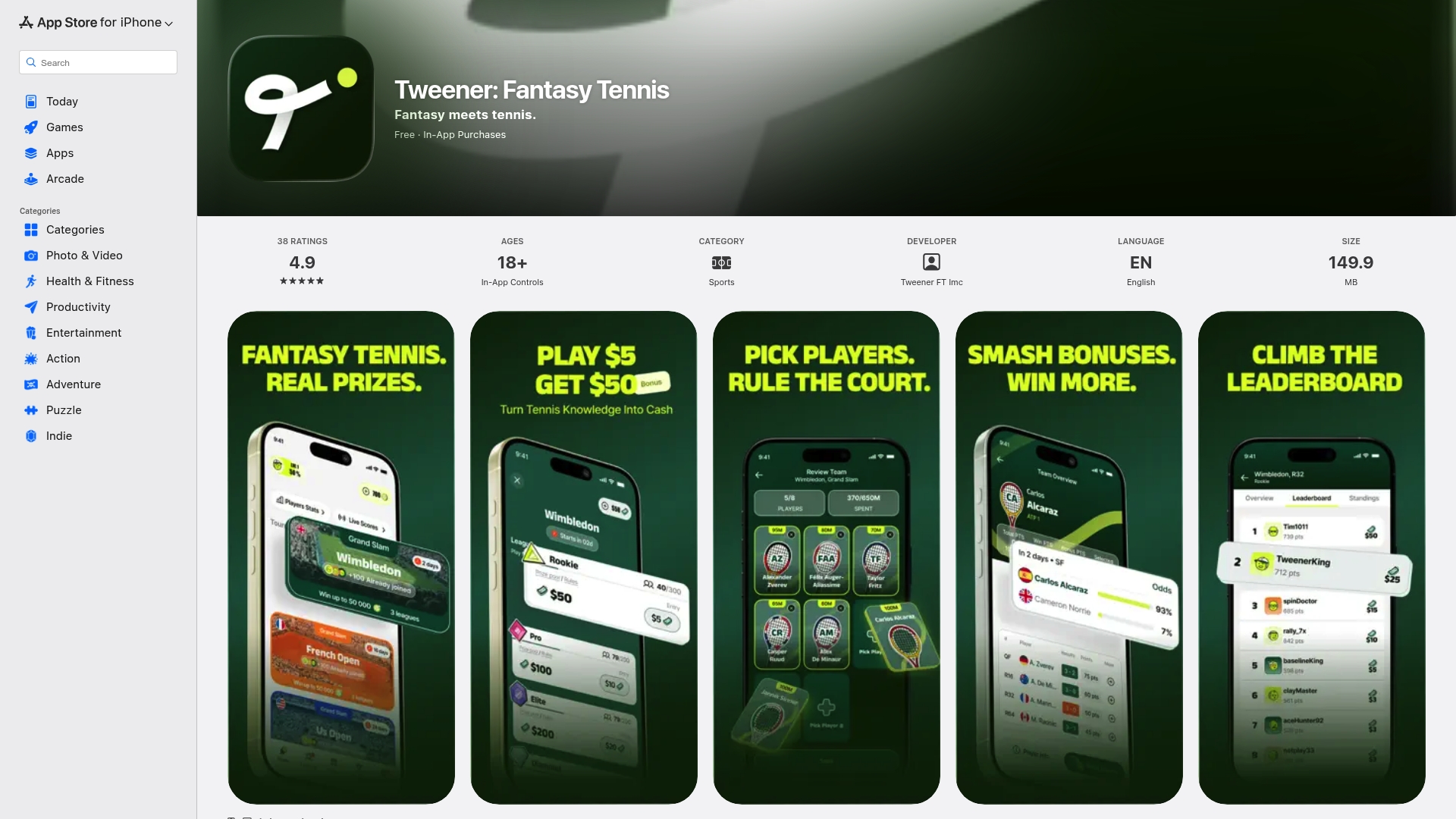
Tweener is the mobile fantasy tennis platform built for fans who want to compete at a higher level. You can build lineups using real ATP and WTA player data, join public leagues or compete against friends in private contests, and put every skill from this article into practice during live tournaments. The platform gives you the tools to track form, manage your roster, and make smarter picks in real time. Download the Tweener app today and start competing for rewards in free coin-based leagues or real-money contests where available. Your next winning lineup is one smart pick away.
Frequently asked questions
Which stats should I focus on when choosing fantasy tennis players?
Prioritize first serve points won, return points won, and break point conversion rates. These three metrics are the strongest indicators of consistent match-winning performance.
How do I make the most out of the captain or Bonus Ball feature?
Choose captains based on surface strengths, clean matchups, and current form. Bonus Ball plays tied to aces on specific surfaces can generate the biggest point multipliers.
How do I avoid surprises like late player withdrawals?
Always check for late withdrawals and injury updates within 12 to 24 hours of your lineup deadline. This single habit can save your entire fantasy week.
Is it better to pick stars or spread my budget across more players?
Balanced lineups with both stars and value surface specialists are more sustainable than loading up exclusively on big names. Depth and surface fit consistently outperform pure star power over a full tournament.