

Picking the right tennis players for your fantasy lineup feels straightforward until the results come in and your top pick exits in the second round. Most fantasy players rely on gut instinct or surface-level rankings, which leads to inconsistent results week after week. The good news is that structured, evidence-based prediction strategies can dramatically improve your accuracy and your standing in fantasy leagues. This guide walks you through the core mechanics, analytical tools, edge case adjustments, and practical fantasy tactics that separate consistent winners from frustrated guessers.
Table of Contents
- Core mechanics of accurate tennis match prediction
- Tools and models for tennis prediction
- Adjusting for edge cases and predictive nuances
- Applying predictions for fantasy league advantage
- What most guides miss about maximizing tennis predictions
- Boost your tennis fantasy lineup with Tweener
- Frequently asked questions
Key Takeaways
| Point | Details |
|---|---|
| Surface matters most | Analyzing performance on specific surfaces is critical for accurate tennis match predictions. |
| Advanced models outperform intuition | AI and machine learning models offer up to 85% predictive accuracy, far beyond traditional approaches. |
| Edge cases change outcomes | Factors like fatigue, qualifiers, and momentum regularly decide close matches and must be considered. |
| Fantasy league wins need strategy | Stacking correlated players and targeting high-confidence picks greatly improves fantasy performance. |
| Tweener app amplifies results | Using tools like Tweener connects strategy to actionable features that boost fantasy competitiveness. |
Core mechanics of accurate tennis match prediction
Building on the introduction, let's break down the critical factors that consistently affect tennis match outcomes. Most people start and stop at win-loss records, but that barely scratches the surface.
The core mechanics of prediction go well beyond simple records. You need to assess expectancy versus actual performance, meaning how a player performs relative to what their rating predicts. A player on a five-match win streak against weak opposition looks great on paper but may be masking real vulnerabilities. Surface-specific performance is equally critical. A clay specialist facing a grass court expert is a completely different matchup than their head-to-head record suggests. Always filter head-to-head data by surface and recency before drawing conclusions.
Here are the key factors to check before making any pick:
- Surface win rate: Compare clay, grass, and hard court records separately
- Serve hold percentage: A high serve hold rate signals dominance in tight sets
- Break point conversion: Reflects aggression and ability to capitalize under pressure
- Fatigue indicators: Back-to-back tournaments, long three-setters, travel schedules
- Environmental conditions: Ball type, altitude, humidity, and wind all shift match dynamics
- Style matchup: A grinder versus a big server plays out very differently than rankings suggest
For deeper context on how these numbers interact, the player stats for fantasy guide breaks down which metrics matter most for your picks. You can also reference betting strategies and statistics for a broader view of how sharp analysts weight these variables.
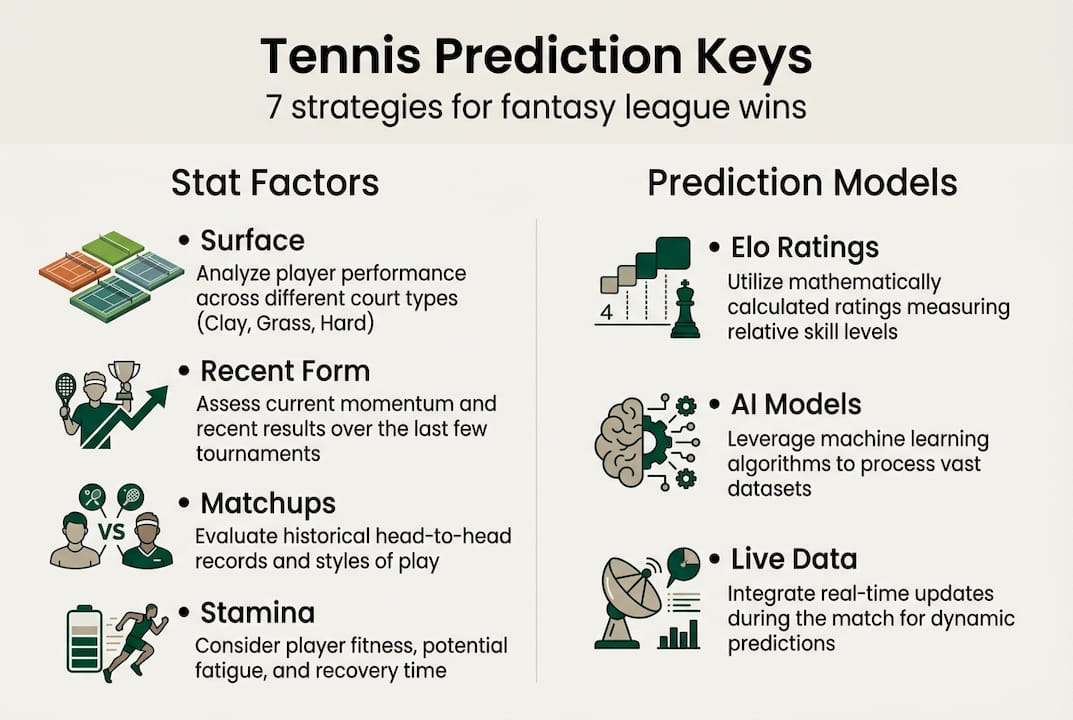
Here is a quick reference table for surface-specific performance factors:
| Surface | Key advantage factor | Stat to prioritize |
|---|---|---|
| Clay | Baseline consistency | Rally win rate |
| Grass | Serve dominance | Ace count, hold % |
| Hard | All-round balance | Break conversion % |
| Indoor hard | Return game | Second serve return pts |
When choosing tennis players for your fantasy team, this table gives you a fast filter to apply before going deeper into individual stats.
Pro Tip: Always pull surface-specific stats from the last 12 months rather than career averages. Recent surface form is far more predictive than lifetime numbers, especially after a player changes coaches or adjusts their game style.
Tools and models for tennis prediction
Once you know what to analyze, you'll want tools and models that offer measurable accuracy and actionable insights. The range of available approaches has expanded significantly, and understanding their strengths helps you pick the right one for your situation.
Statistical and machine learning prediction methodologies now span from classic Elo ratings to advanced neural networks. Each has a distinct accuracy profile and data requirement:
| Model type | Required inputs | Accuracy range | Best use case |
|---|---|---|---|
| Elo / WElo | Match history, surface | 62-67% | Quick baseline picks |
| Logit regression | Player stats, surface | 65-70% | Pre-match analysis |
| Random Forest / Gradient Boosting | Multi-variable datasets | 70-78% | Tournament modeling |
| Neural networks | Large historical datasets | 73-82% | Season-long prediction |
| Fuzzy logic (FIS) | Qualitative + quantitative | 68-75% | Edge case handling |
| AI ensemble | All combined inputs | 73-85% | High-stakes picks |
Here is a step-by-step approach to using a basic model for your predictions:
- Start with Elo ratings to establish a baseline probability for each player
- Adjust for surface by applying surface-specific win rate multipliers
- Layer in serve hold and break percentages from recent matches
- Cross-check with head-to-head records filtered by surface and last 18 months
- Apply any fatigue or scheduling adjustments based on draw analysis
- If two models agree on the same outcome, treat it as a high-confidence pick
"AI and ML models now outperform traditional rankings and expert intuition. Accuracy benchmarks consistently exceed 70% in backtests, making them far more reliable than gut-feel analysis."
For live tennis prediction accuracy, mid-match machine learning models fed with real-time point data can reach up to 97% accuracy, though that requires full live data access. For pre-match fantasy decisions, the 70 to 85% range from AI ensemble approaches is a realistic and powerful target. The AI match prediction research confirms that combining multiple model outputs consistently outperforms any single method.
Adjusting for edge cases and predictive nuances
Even with strong models, predictions can falter unless you account for these subtle but powerful variables. The numbers tell most of the story, but the story always has footnotes.

Recent form is one of the most overused and misunderstood signals in tennis prediction. A player winning three matches in a row against lower-ranked opponents does not indicate a trend. It may simply reflect a soft draw. Edge case research consistently shows that qualifiers and match-sharp players are undervalued by standard models, especially early in tournaments when they have already played multiple competitive matches.
WTA matches also carry more predictive nuance than ATP. Upsets happen more frequently, and the gap between ranked players is often smaller in practice than on paper. You can explore the tennis analytics on WTA vs ATP breakdown for a closer look at how these differences affect fantasy scoring.
Here are the most common prediction pitfalls and how to spot them:
- Overvaluing a hot streak: Check the quality of opposition. Three wins over qualifiers is not the same as three wins over top-20 players
- Ignoring match sharpness: A qualifier who has played five matches coming in is battle-tested. A seeded player returning from a bye may be rusty
- Underestimating fatigue in best-of-5: Physical wear compounds across rounds. A player who won a four-hour match two days ago is not the same player
- Missing psychological momentum: Third-set comebacks after losing the first set are more common than models predict, especially for mentally resilient players
- Ranking versus context: A top-10 player who just lost to a low-ranked opponent may have done so against weak opposition, inflating the upset's significance
For your ATP and WTA fantasy picks, always cross-reference the draw quality before committing to a player based on recent results alone.
Pro Tip: Assign extra value to match-sharp qualifiers in the first two rounds of major tournaments. Their rhythm and competitive edge often outweigh the ranking disadvantage, and fantasy platforms rarely price them at a premium.
Applying predictions for fantasy league advantage
Now that you understand predictions and edge cases, here is how to make them work for you in fantasy leagues. Knowing the theory is one thing. Translating it into points on the board is another.
Advanced models deliver real-world accuracy in the 63 to 73% range for pre-match predictions. That number matters because it tells you where to place your confidence. A 65% probability is not a lock, but it is a meaningful edge when applied consistently across a full tournament.
Here is a step-by-step framework for turning predictions into fantasy wins:
- Identify high-confidence picks: Look for matches where multiple models or methods agree on the same outcome. Agreement signals strength
- Stack correlated players: In formats that reward match length, pick players likely to play long matches together. Both players earn points from extended play
- Target surface specialists at the right events: A clay specialist at Roland Garros is not just a safe pick, they are likely underpriced relative to their ceiling
- Diversify across confidence tiers: Mix two or three high-confidence picks with one calculated risk on an undervalued player
- Monitor lineup closer to match time: Withdrawals, late scratches, and weather delays shift probabilities fast on mobile platforms
Stat callout: Advanced models offer 63 to 73% real-world accuracy. Focus on agreement patterns across methods for your best results.
For detailed fantasy lineup tips and a deeper look at roster construction, the building winning fantasy lineups guide walks through specific tournament strategies you can apply immediately.
What most guides miss about maximizing tennis predictions
Here is the uncomfortable truth most prediction guides skip: overconfidence in recent form and live rankings is the single biggest reason fantasy players underperform. Everyone sees the same leaderboards. Everyone knows who won last week. That information is already priced into public perception, which means it gives you no real edge.
The players who consistently win in fantasy leagues are not the ones who follow form the hardest. They are the ones who combine model outputs with contextual adjustments, stay alert to edge cases, and resist the pull of obvious picks. Stacking your lineup with the top three seeds feels safe, but it rarely wins leagues because everyone else is doing the same thing.
Real advantage comes from predicting outcomes for fantasy wins by blending analytic models with situational intelligence. As we see it, fantasy winners are not lucky. They are strategic, blending analytic models with context intelligence. That combination, not any single tool or shortcut, is what separates consistent performers from one-week wonders.
Boost your tennis fantasy lineup with Tweener
You now have a clear framework for smarter tennis predictions. The next step is putting it into practice with a platform built for exactly this kind of strategic play.
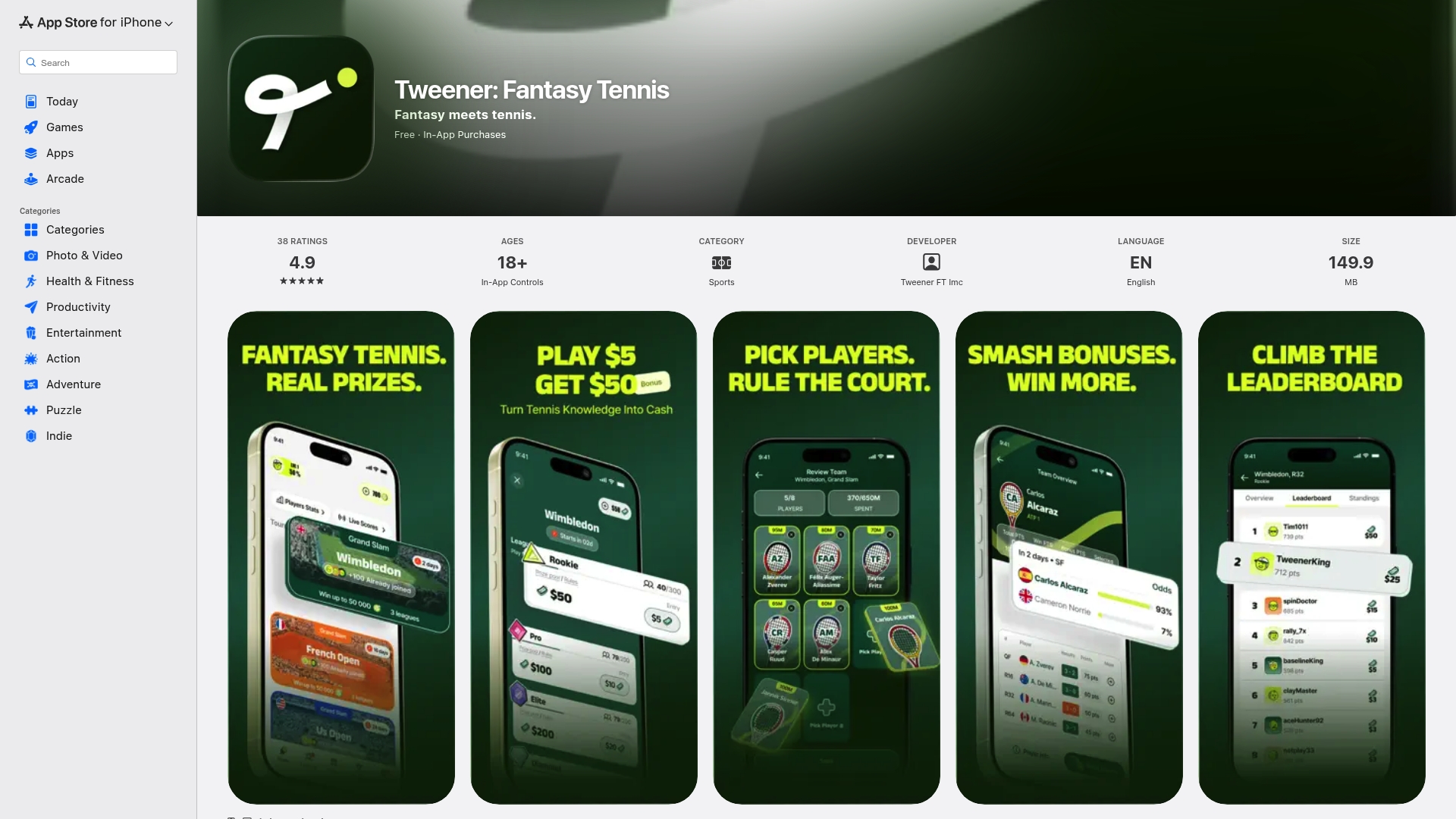
Download the Tweener app and start applying surface analysis, player form data, and high-confidence picks directly inside your fantasy leagues. Tweener gives you access to real ATP and WTA tournaments, public and private league formats, and a scoring system designed to reward strategic thinking. Before you build your next lineup, review the Tweener game rules to understand exactly how points are earned and where your prediction edge translates into real competitive advantage. Whether you play for virtual coins or cash prizes, sharper predictions mean better results.
Frequently asked questions
What is the most important factor in tennis match prediction?
Surface-specific performance and contextual player form have the biggest impact on predictive accuracy. Rankings alone rarely tell the full story without surface and recent match context.
How accurate are AI-driven tennis prediction models?
AI ensemble models achieve between 73 and 85% accuracy in backtests, but typical real-world pre-match accuracy lands in the 63 to 73% range.
What are edge cases in tennis predictions?
Edge cases include underrated qualifiers with match sharpness advantages, fatigue in best-of-5 formats, third-set comebacks, and psychological momentum effects that standard models underweight.
How can I use match predictions to win fantasy leagues?
Stack correlated players likely to play long matches and prioritize picks where multiple prediction methods agree. High-confidence agreements across models consistently outperform single-source picks.
Does player ranking matter more than ratings?
Ratings over rankings are more predictive when combined with surface context and style matchup analysis. Rankings without context can actively mislead your picks.