

Predicting live tennis matches accurately transforms how you watch and engage with professional tennis. Modern machine learning models achieve over 70% accuracy early in matches and nearly 97.5% mid-game, but mastering the prediction process requires understanding key features, tools, and real-time dynamics. This guide walks you through each step to improve your live prediction skills and fantasy team selections.
Table of Contents
- Understanding the challenges and key features of live tennis prediction
- Preparing the tools and data: hybrid models and rating systems
- Executing live predictions: leveraging momentum, live data, and simulations
- Verifying predictions and refining your live tennis strategy
- Enhance your tennis experience with Tweener
Key takeaways
| Point | Details |
|---|---|
| Hybrid models combine statistical and machine learning approaches | These systems integrate rule-based logic with gradient boosting and neural networks to capture complex patterns. |
| Critical features drive prediction accuracy | Recent form contributes 23%, head-to-head records 19%, surface performance 17%, player tier 15%, and fatigue 12%. |
| Live momentum metrics boost in-play predictions | Tracking unforced errors, winning shots, and momentum shifts significantly improves point outcome forecasts. |
| Monte Carlo simulations reduce prediction bias | Running thousands of match simulations generates probability distributions for more reliable score predictions. |
| Integrating live odds identifies value opportunities | Models using live betting data achieve 15% higher ROI by spotting market inefficiencies. |
Understanding the challenges and key features of live tennis prediction
Tennis prediction is challenging due to factors like different match formats, fatigue, head-to-head psychology, surface impact, and individual performance variance. Players who dominate on clay may struggle on grass, while a three-set tournament creates different stamina demands than a five-set Grand Slam. Understanding which factors carry the most predictive weight helps you focus your analysis.
Recent form stands out as the most powerful feature, accounting for roughly 23% of prediction accuracy. A player on a five-match winning streak brings confidence and refined technique that statistical models can capture. Head-to-head records contribute 19% because certain matchups create psychological edges or stylistic advantages that persist across meetings.
Surface performance deserves special attention since players' abilities shift dramatically across clay, grass, and hard courts. Rafael Nadal's clay court dominance versus his grass court performance illustrates how surface-specific data reveals hidden value. Player tier differences, fatigue levels from recent tournament schedules, and contextual variables like indoor versus outdoor conditions all add layers of complexity.
Consider additional context beyond raw statistics:
- Travel distance and time zone changes affect energy levels and adaptation
- Age and injury history influence consistency and risk of physical breakdown
- Tournament importance impacts motivation and mental approach
- Weather conditions alter ball speed and playing style effectiveness
Pro Tip: Build separate prediction models for each surface type rather than one universal model. Clay court specialists often underperform on grass, and hard court data won't accurately predict French Open outcomes. Your fantasy tennis cash mode guide strategy should reflect these surface distinctions when selecting players.
Preparing the tools and data: hybrid models and rating systems
TennisPredictor achieves over 70% accuracy using a hybrid system combining rule-based and machine learning models. This approach leverages the interpretability of statistical methods with the pattern recognition power of algorithms like logistic regression, gradient boosting, random forest, and neural networks. Each model type brings distinct strengths to the prediction process.

Rule-based systems follow clear logic paths based on historical patterns and expert knowledge. Machine learning models discover nonlinear relationships between features that humans might miss, such as how serve percentage interacts with opponent return position in specific game situations. Combining both approaches creates robust predictions that perform well across diverse match scenarios.
Elo ratings update dynamically after each match, factoring surface and match importance for predictions. These ratings provide a constantly evolving measure of player strength that adjusts faster than annual rankings. An Elo system might increase a player's rating by 32 points after defeating a higher-ranked opponent on their preferred surface, while reducing it by only 8 points for a loss to a lower-ranked player.
Here's how different features contribute to prediction accuracy:
| Feature Category | Predictive Importance | Example Metrics |
|---|---|---|
| Recent Form | 23% | Win rate last 10 matches, sets won ratio |
| Head-to-Head Records | 19% | Career meetings, recent encounters, surface-specific results |
| Surface Performance | 17% | Win percentage by surface, aces per match on surface |
| Player Tier Difference | 15% | Ranking gap, Elo rating difference |
| Energy and Fatigue | 12% | Matches played last 7 days, travel distance |
| Serve Statistics | 14% | First serve percentage, aces, double faults |
Machine learning models excel at capturing these feature interactions but require careful validation. Split your historical match data into training sets (70%), validation sets (15%), and test sets (15%) to prevent overfitting. A model that achieves 85% accuracy on training data but only 62% on test data has learned noise rather than signal.
Pro Tip: Update your Elo rating parameters quarterly to reflect shifting surface trends and player development patterns. Young players improve rapidly, while veterans may decline faster than annual ranking updates suggest. Your tournament prediction strategies should incorporate these dynamic rating adjustments for optimal results.
Executing live predictions: leveraging momentum, live data, and simulations
Machine learning models achieve 97.5% accuracy mid-match by processing live statistics and momentum indicators as matches unfold. This dramatic accuracy improvement over pre-match predictions comes from incorporating real-time performance data that reveals how players are actually executing on that specific day. A player might arrive with strong recent form but struggle with serve placement in windy conditions.
Follow these steps to execute effective live predictions:
- Collect live statistics including first serve percentage, return points won, unforced errors, and winners from the current match
- Calculate momentum metrics by tracking scoring runs, consecutive game wins, and shift intensity between players
- Apply your trained machine learning models to the updated feature set including both pre-match and live data
- Run Monte Carlo simulations generating thousands of possible match continuations based on current state and player probabilities
- Integrate live betting odds to identify where your model probability diverges from market consensus
Momentum and its characteristics significantly boost point outcome predictions beyond static player ratings. A player who wins three consecutive games often carries psychological advantage and refined shot execution into the next game. Track momentum through unforced error rates, percentage of winning shots versus forced errors, and emotional indicators like body language.
Compare prediction accuracy across different approaches:
| Prediction Method | Accuracy Rate | Key Limitation |
|---|---|---|
| Traditional Ranking-Based | 55-60% | Ignores recent form and surface context |
| Hybrid ML Pre-Match | 70-75% | Cannot account for day-of conditions |
| Mid-Match ML Predictions | 97.5% | Requires live data feed and processing |
| Pure Statistical Models | 62-68% | Misses nonlinear feature interactions |
Monte Carlo simulations and ensemble methods reduce bias by combining probabilities from different models. Run 10,000 simulations of remaining games based on current score state, then aggregate results to generate match win probability. This approach captures the range of possible outcomes rather than relying on a single deterministic forecast.
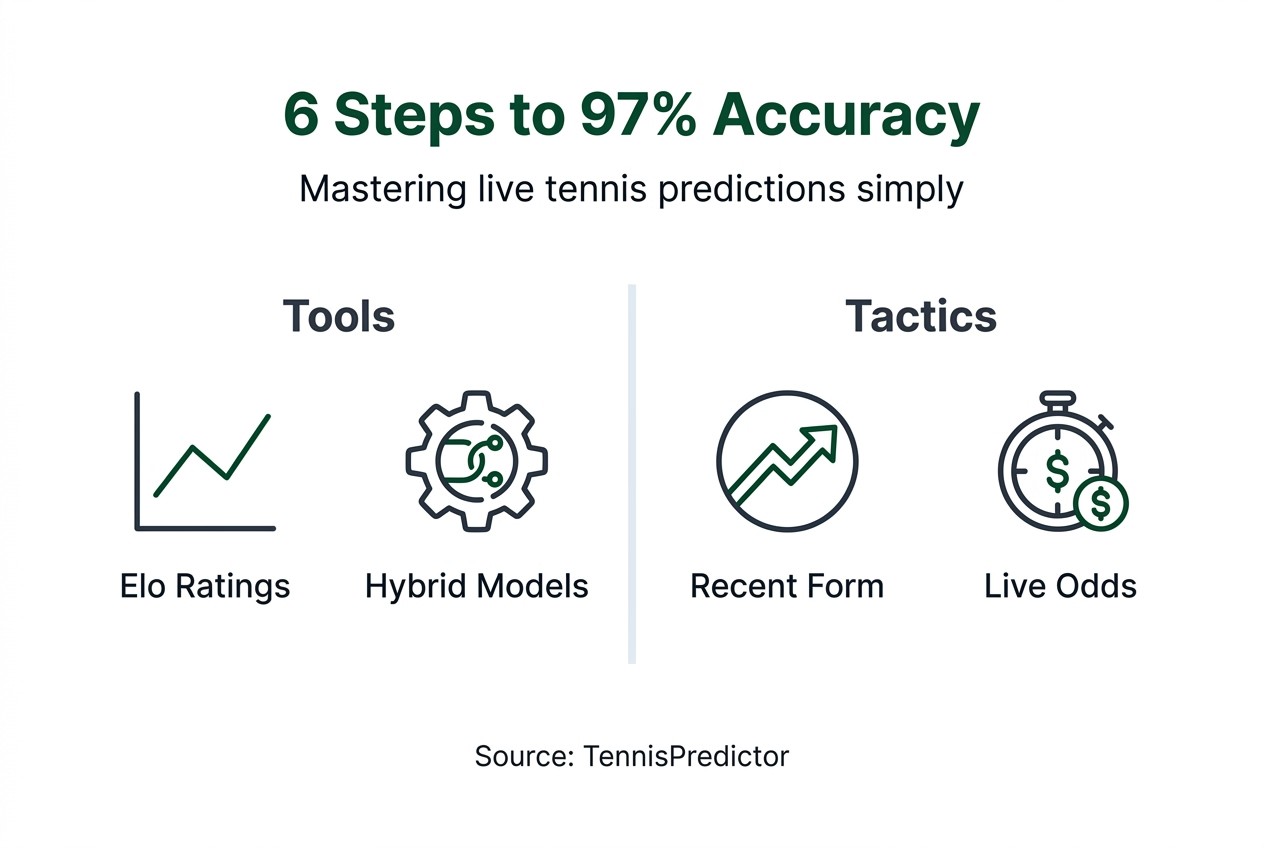
Live betting odds provide valuable market information that improves predictions. When your model shows 65% win probability but odds imply only 55%, you've identified potential value. Markets sometimes overreact to recent momentum or undervalue surface-specific advantages your model captures. Your fantasy tennis picks analysis should prioritize players where prediction confidence exceeds market consensus.
Pro Tip: Weight recent points more heavily than early match statistics when calculating momentum metrics. A player who dominated the first set but struggles in the third set presents different prediction challenges than one showing consistent performance throughout. Live adjustments separate accurate predictors from those relying solely on pre-match analysis.
Verifying predictions and refining your live tennis strategy
Evaluate prediction accuracy regularly by comparing forecasted probabilities to actual outcomes across multiple matches. A well-calibrated model predicting 70% win probability should see those players win roughly 70 times out of 100 similar situations. Track both overall accuracy and calibration to identify systematic biases in your approach.
Use feedback loops to adjust model parameters based on prediction errors. If your model consistently underestimates clay court specialists, increase the weight assigned to surface-specific performance metrics. If fatigue predictions prove inaccurate, incorporate more granular travel and match schedule data. Continuous refinement separates static systems from adaptive ones that improve over time.
Refine fantasy team selections by combining prediction confidence with player value metrics and injury status. A highly ranked player nursing a minor injury might carry lower actual win probability than your initial model suggests. Incorporating live odds improves predictions and helps identify profitable value bets with a 15% ROI advantage over models ignoring market information.
Follow betting odds movement throughout the day leading up to matches. Sharp money often moves lines based on injury news, court condition reports, or other information not yet reflected in public statistics. Significant line movement without obvious public news suggests informed bettors possess edge you should investigate.
Avoid these common prediction mistakes:
- Ignoring surface conditions and how they affect specific player styles
- Overvaluing outdated form from tournaments weeks earlier
- Neglecting match context like tournament importance or scheduling position
- Failing to account for head-to-head psychological dynamics
- Using equal weights for all historical matches regardless of recency
Continuous improvement requires systematic tracking of both successes and failures. Maintain a prediction log recording your forecasts, actual outcomes, and reasoning behind each prediction. Review monthly to identify patterns in your errors. Perhaps you consistently overestimate aggressive baseliners on slow courts or undervalue consistent defenders against volatile shotmakers.
Your tournament strategy refinement should evolve as you accumulate more prediction experience. Early tournament rounds with larger ranking gaps might require different model parameters than tight quarterfinal matchups. Grand Slams with five-set matches demand greater emphasis on fitness and stamina metrics compared to best-of-three tournaments.
Enhance your tennis experience with Tweener
Applying live prediction skills becomes dramatically easier with the right platform supporting your analysis and fantasy decisions. Tweener offers real-time analytics and live tennis prediction tools specifically designed for fantasy tennis players seeking competitive advantages. The platform combines comprehensive player statistics, match momentum tracking, and community insights to enhance your tournament viewing experience.

Access detailed player performance data across surfaces, recent form indicators, and head-to-head histories directly within the app as you build your fantasy lineups. Track live match statistics and momentum shifts to make informed in-game decisions about lineup adjustments and strategic positioning. The Tweener platform transforms prediction knowledge into actionable fantasy team management.
Get started instantly by visiting the download page for iOS and Android installation. Review comprehensive game rules to understand scoring systems and optimize your strategy. Join thousands of tennis fans turning professional tournament action into engaging fantasy competition through data-driven predictions and strategic player selection.
FAQ
How accurate are live tennis prediction models?
Accuracy varies by model type and match timing, but modern approaches significantly outperform traditional ranking-based predictions. Machine learning models achieve predictive accuracies above 70% using early match data and up to 97.5% mid-game when incorporating live statistics and momentum indicators. Hybrid systems combining statistical logic with machine learning pattern recognition deliver the most consistent results across diverse match scenarios.
What features matter most for live tennis predictions?
Recent form, head-to-head records, surface performance, player tier difference, and energy levels are the most impactful features. These elements contribute between 12% and 23% each to overall prediction accuracy in validated models. Momentum metrics and in-play statistics like serve percentage and unforced error rates grow increasingly important once matches begin, often determining point outcome predictions with greater precision than pre-match features alone.
Can live betting odds improve tennis match predictions?
Yes, integrating live odds data substantially enhances both prediction accuracy and value identification. Models incorporating live odds data identify value bets yielding a 15% ROI improvement over models without odds integration. Live odds reflect dynamic market sentiment, injury news, and court condition information that may not yet appear in public statistics. Sharp odds movement signals informed betting activity worth investigating for your predictions.
How can I start improving my fantasy tennis team using live predictions?
Analyze prediction confidence scores alongside player value metrics and current form when building lineups. Use platforms like Tweener for live match updates, momentum tracking, and comprehensive player statistics during tournaments. Monitor match dynamics including serve percentage trends, unforced error patterns, and physical condition indicators. Adjust your roster strategically based on real-time performance data rather than relying solely on pre-tournament rankings and projections.