

Predicting tennis tournament outcomes consistently feels impossible when you rely on gut feelings or rankings alone. You watch a favorite player lose unexpectedly, your fantasy picks underperform, and your strategy seems directionless. This guide delivers a structured, data-driven approach that leverages player form, surface analysis, and psychological factors to boost your prediction accuracy by up to 20% on platforms like Tweener in 2026.
Table of Contents
- Introduction to tennis tournament prediction
- Prerequisites and what you need
- Core steps in tournament prediction strategy
- Common mistakes and troubleshooting
- Expected results and outcomes
- Try Tweener for your tennis tournament predictions
- FAQ
Key takeaways
| Point | Details |
|---|---|
| Multi-factor analysis wins | Combining player form, surface type, and psychological factors improves accuracy by 15-20% over rankings alone. |
| Data access is essential | Current ATP/WTA rankings, injury reports, and head-to-head stats form the foundation of effective predictions. |
| Avoid common pitfalls | Ignoring surface effects, fatigue, or psychological momentum increases prediction errors by 10% or more. |
| Results take consistency | Applying these strategies systematically over 4-6 weeks produces measurable improvements in fantasy tennis performance. |
| Strategy beats guesswork | Structured prediction methods can increase fantasy points by up to 25% compared to random selections. |
Introduction to tennis tournament prediction
Successful tennis predictions require far more than glancing at rankings. Match outcomes depend on multiple variables including recent form, surface compatibility, physical condition, and mental state. Platforms like Tweener reward accurate predictions with higher fantasy points, making strategic analysis essential for competitive success.
Reliable data sources provide the foundation for informed predictions. ATP and WTA rankings offer baseline player strength, while match statistics reveal performance patterns across different conditions. Surface types like hard courts, clay, and grass dramatically affect player effectiveness, with some athletes excelling on specific surfaces while struggling on others.
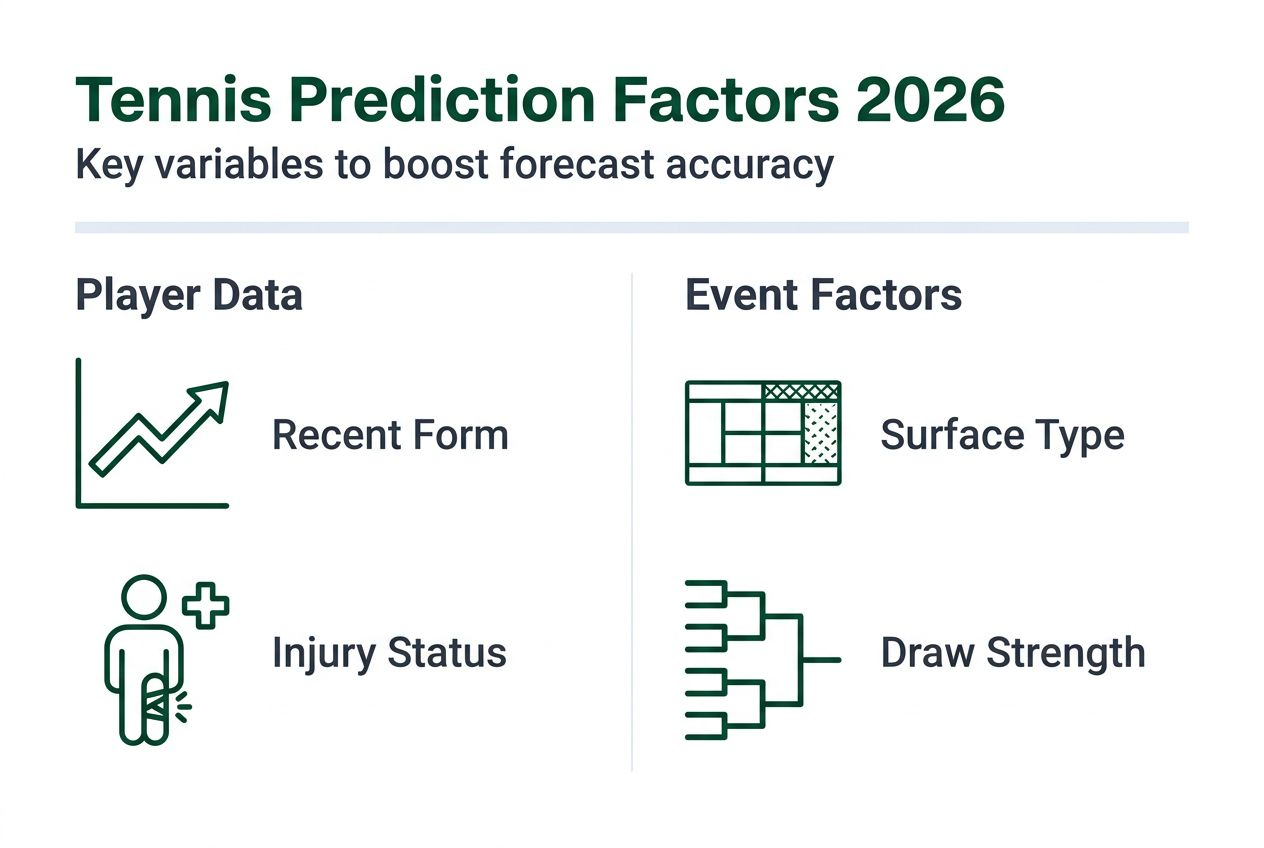
Key variables influencing match outcomes include:
- Player form over the last 6-8 matches
- Surface-specific win rates and historical performance
- Head-to-head records between opponents
- Current injury status and physical fitness
- Psychological momentum and confidence levels
- Tournament schedule intensity and fatigue factors
Understanding Tweener game rules helps you translate predictions into optimal player selections. The complexity of tennis means no single factor guarantees outcomes, but systematic analysis of multiple data points significantly improves accuracy. Building a prediction framework requires gathering comprehensive information and applying structured evaluation methods consistently.
Access ATP and WTA predictions analysis to stay current with expert insights. The goal is developing a repeatable process that accounts for all major performance drivers, not chasing perfect predictions on every match. Download the Tweener app to practice applying these strategies in real tournament scenarios.
Prerequisites and what you need
Before making predictions, gather essential data and build foundational knowledge. Current ATP and WTA rankings provide player strength baselines, but recent form impacts win probability dramatically. Access detailed match statistics showing service percentages, break point conversion, and performance across different surfaces.
Understanding tennis fundamentals is non-negotiable. Know how tournaments structure draws, seeding works, and scoring systems operate. Recognize the three main surface types and how they favor different playing styles. Hard courts suit aggressive baseliners, clay rewards defensive consistency, and grass benefits serve-and-volley specialists.
Essential prerequisites include:
- Real-time access to player rankings updated weekly
- Match history databases covering last 12 months minimum
- Injury and withdrawal reports from reliable sports news sources
- Surface-specific performance statistics for each player
- Head-to-head records between potential match opponents
Familiarize yourself with Tweener game rules to understand how predictions translate into fantasy points. Players earn different point values based on match performance, making accurate outcome prediction directly valuable.
| Prerequisite Element | Recommended Source | Update Frequency |
|---|---|---|
| ATP/WTA Rankings | Official tour websites | Weekly |
| Match Statistics | Tennis databases like Ultimate Tennis Statistics | After each match |
| Injury Reports | Sports news aggregators | Daily |
| Surface Performance | Historical match data platforms | Ongoing |
| Head-to-Head Records | Tennis statistics sites | After relevant matches |
Monitor player social media and press conferences for insights into mental state and confidence levels. These softer signals complement hard statistics. Check tournament schedules to identify players facing compressed match timing or long travel between events.
The Tweener platform simplifies tracking player performance during live tournaments. Combining official statistics with platform-specific scoring rules creates a complete prediction foundation. Invest time building your data collection routine before tournament predictions begin.
Core steps in tournament prediction strategy
Apply this five-step framework systematically to build accurate tournament predictions. Each step adds precision to your analysis, moving beyond simple ranking comparisons to comprehensive evaluation.
-
Start with baseline analysis combining current ATP/WTA rankings and recent form. Review the last 6-8 matches for each player, noting win-loss records and opponent quality. A top-10 player on a three-match losing streak may be less reliable than a rank 25 player winning consistently.
-
Evaluate surface-specific performance to adjust baseline probabilities. Check each player's historical win rate on the tournament surface. A clay specialist may struggle on grass despite higher overall ranking. Surface effects can shift win probability by 20-30% in either direction.
-
Analyze head-to-head statistics between match opponents for tactical insights. Some players consistently defeat higher-ranked opponents due to style matchups. A defensive baseliner might dominate an aggressive player whose strategy they neutralize effectively.
-
Incorporate injury and fatigue reports to assess physical readiness. Recent injuries reduce performance even after official clearance. Players competing in multiple tournaments consecutively face accumulated fatigue affecting late-round performance.
-
Evaluate psychological factors including confidence, momentum, and mental toughness. Players riding winning streaks often exceed statistical expectations through elevated confidence. Mental strength under pressure separates consistent winners from inconsistent talents.
AI-driven models improve prediction accuracy by approximately 15% compared to ranking-only approaches. Your manual analysis following this framework achieves similar gains through systematic factor integration.

| Prediction Approach | Average Accuracy | Strengths | Limitations |
|---|---|---|---|
| Rankings Only | 60-65% | Simple, quick | Ignores form, surface, psychology |
| Multi-Factor Analysis | 75-80% | Comprehensive, adaptable | Requires time, data access |
| Integrated Strategy | 80-85% | Highest accuracy | Complex, needs consistent application |
Pro Tip: Track player social media activity and post-match interviews to gauge psychological momentum. Confident players reference future goals positively, while struggling players focus on past disappointments. These subtle signals predict performance shifts before statistics reflect changes.
Apply your predictions on Tweener to test effectiveness in real fantasy scenarios. Review game rules to optimize player selections based on predicted match outcomes and scoring systems.
Common mistakes and troubleshooting
Avoid these frequent errors that undermine prediction accuracy. Recognizing mistakes early prevents compounding poor decisions across tournament brackets.
Most predictors overrely on player rankings alone, ignoring current form and surface compatibility. A rank 5 player may be less likely to win than rank 15 if they're returning from injury on their worst surface. Rankings reflect long-term performance, not immediate readiness.
Common prediction mistakes include:
- Neglecting surface-specific win rates when evaluating matchups
- Ignoring recent injury reports or assuming full recovery immediately
- Misinterpreting head-to-head statistics without considering context
- Overlooking tournament schedule intensity and travel fatigue
- Dismissing psychological factors like confidence and momentum shifts
Ignoring psychological momentum raises errors by approximately 10%. Players on winning streaks often outperform statistical expectations through elevated confidence and reduced anxiety. Conversely, slumping players underperform even when physically healthy.
Troubleshoot prediction failures by reviewing your data sources. Verify information currency and cross-reference statistics across multiple platforms. Outdated injury reports or incorrect surface classifications corrupt analysis. Reconsider assumptions about player readiness after breaks or schedule changes.
Successful tennis prediction requires acknowledging uncertainty and continuously refining methods based on outcomes. No strategy achieves perfect accuracy, but systematic improvement separates informed predictors from casual guessers.
Pro Tip: Maintain a prediction journal documenting your reasoning for each major pick. Review wrong predictions monthly to identify recurring blind spots. Common patterns like consistently overvaluing aggressive players on clay or underestimating fatigue effects become apparent through systematic review.
When predictions consistently miss on specific players or scenarios, adjust your factor weighting. Some players consistently exceed or underperform statistical expectations due to unique characteristics. Incorporate these patterns into future analyses rather than treating each prediction as independent.
Use Tweener performance tracking to measure prediction effectiveness objectively. Fantasy points earned directly reflect prediction quality, providing concrete feedback for strategy refinement.
Expected results and outcomes
Consistent application of multi-factor prediction strategies produces measurable improvements within 4-6 weeks. Early results may seem modest, but accuracy compounds as you refine factor weighting and data interpretation skills.
Integrated strategies yield 15-20% higher accuracy compared to ranking-only methods. Fantasy tennis players applying these approaches see up to 25% more points through better player selections and match outcome predictions. These gains translate directly to improved league standings and contest winnings.
Realistic expectations for improvement include:
- Initial 4-6 weeks: 5-10% accuracy improvement as you systematize data collection
- Weeks 7-12: 10-15% gains as pattern recognition improves and mistakes reduce
- Beyond 12 weeks: 15-20% sustained improvement with continued refinement
- Fantasy performance: 20-25% more points through strategic player selections
- Confidence growth: Reduced anxiety about predictions as framework proves reliable
Consistent strategy application shows improvement over 4-6 weeks of tournament cycles. Track your predictions and outcomes systematically to measure progress objectively. Some tournaments may underperform expectations due to unpredictable upsets, but overall accuracy trends upward with practice.
Set incremental goals rather than expecting immediate perfection. Target 70% accuracy initially, then push toward 75-80% as your skills develop. Even professional analysts rarely exceed 85% accuracy given tennis's inherent unpredictability.
Benefits extend beyond raw accuracy numbers. Strategic thinking improves your understanding of tennis dynamics, making matches more engaging to watch. You'll notice tactical patterns and player tendencies casual fans miss. Fantasy competition on Tweener becomes more rewarding as your selections reflect genuine insight rather than guesswork.
Maintain realistic expectations about prediction limits. Individual match outcomes remain somewhat random, but tournament-level patterns become increasingly predictable with experience. Focus on process quality rather than perfect results, trusting that systematic analysis produces superior long-term outcomes.
Try Tweener for your tennis tournament predictions
Ready to apply your improved prediction skills in competitive fantasy tennis? Tweener provides the perfect platform to test strategies against real tournament outcomes and compete with other knowledgeable fans.

The app's scoring system rewards accurate predictions through player performance points. Review Tweener game rules to understand how match results translate into fantasy points, optimizing your selections based on predicted outcomes. Both free and cash modes let you compete at your comfort level while building prediction expertise.
Pro Tip: Download the Tweener app for convenient real-time access during tournaments. Mobile notifications keep you updated on player performance and match results, enabling quick strategy adjustments as conditions change. The combination of structured prediction methods and responsive platform tools maximizes your competitive advantage.
FAQ
What data is most important for tennis tournament predictions?
ATP/WTA rankings, recent player form over 6-8 matches, surface-specific win rates, current injury status, head-to-head records, and psychological momentum indicators are all critical. Comprehensive, current data across these categories produces the most accurate predictions. No single factor dominates, making multi-source analysis essential for success.
How long does it take to improve prediction accuracy?
Most predictors see measurable improvement within 4-6 weeks of consistent strategy application. Initial gains appear modest but compound as pattern recognition improves and common mistakes reduce. Patience and continuous learning through systematic outcome review accelerate skill development and maximize long-term accuracy gains.
Can I rely on rankings alone for my tennis predictions?
Rankings provide useful baselines but ignoring form, surface compatibility, and psychological factors reduces accuracy by 15-20%. Multi-factor approaches consistently outperform ranking-only methods in both casual predictions and competitive fantasy scenarios. Integrated analysis is strongly recommended for anyone seeking above-average results.
What are common mistakes to avoid when predicting tennis outcomes?
Avoid ignoring surface effects on player performance, overlooking recent injuries or fatigue accumulation, and dismissing psychological momentum shifts. Never rely solely on head-to-head statistics without considering current form and match context. Cross-verify data sources and maintain systematic review processes to minimize recurring errors in your prediction framework.