

TL;DR:
- Power rankings reflect current form and surface-specific performance better than official ATP and WTA standings.
- They help fantasy players identify underrated players trending upward, not just those with high traditional rankings.
- Applying surface-specific, recent, and momentum-based data leads to smarter, more competitive fantasy tennis lineups.
Official ATP and WTA rankings tell you who won the most over the past year. They don't tell you who's hot right now. For fantasy tennis players, that gap can be the difference between winning your league and finishing last. Official rankings lag recent form and can push you toward players who peaked months ago. Power rankings flip that script. They spotlight current momentum, surface specialists, and players whose games are trending upward right now. This guide walks you through exactly how to read, interpret, and apply tennis power rankings to build smarter fantasy lineups and gain a real competitive edge.
Table of Contents
- Understanding tennis power rankings vs. official rankings
- Components and calculation: How tennis power rankings are made
- How to apply power rankings for fantasy tennis picks
- Troubleshooting and edge case analysis: Avoiding common mistakes with power rankings
- Power rankings: The essential tool fantasy players overlook
- Supercharge your fantasy wins with Tweener
- Frequently asked questions
Key Takeaways
| Point | Details |
|---|---|
| Power rankings reflect current form | They highlight players' recent performance and surface strengths for smarter fantasy picks. |
| Official rankings lag real trends | ATP/WTA rankings are slow to adapt, so relying on them alone can miss breakout athletes. |
| Use weighted scoring systems | Fantasy games often factor in aces and upsets, requiring lineups based on up-to-date power rankings. |
| Watch for edge cases | Injuries, schedule changes, and surface switches can skew both official and power rankings. |
| Tweener boosts fantasy results | Tweener's platform and app streamline power ranking use for more competitive, winning lineups. |
Understanding tennis power rankings vs. official rankings
Official ATP and WTA rankings are built for consistency, not prediction. The ATP system counts a player's best 19 results over 52 weeks, including mandatory majors and Masters events, with points expiring after a full year. The WTA uses a similar model with 18 results. That structure rewards durability across a long season. It does not reward a player who just won three straight tournaments after a slow start to the year.
Power rankings work differently. They blend recent form, surface-specific pedigree, and expected future performance into a single snapshot of where a player stands right now. A player who lost early at the Australian Open but has since won two clay titles will rank much higher in a power ranking than in the official standings. That's the kind of signal fantasy players need.
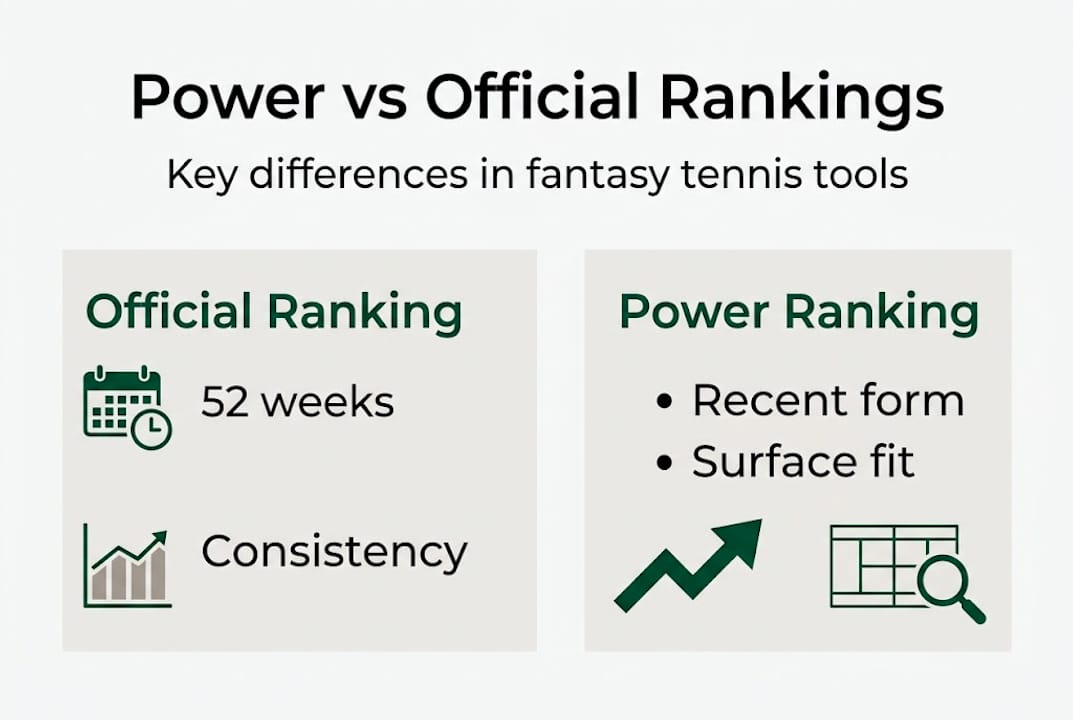
Here's a quick comparison to make the difference concrete:
| Factor | Official ATP/WTA ranking | Power ranking |
|---|---|---|
| Time window | 52 weeks | Recent weeks/months |
| Surface weighting | None | High |
| Injury impact | Delayed | Immediate |
| Future outlook | Not included | Core component |
| Fantasy utility | Low | High |
Empirical models like the Tennis Abstract Elo rankings take this even further. Elo systems assign ratings based on win probability against each opponent, updating after every match. They capture momentum in real time and have proven more accurate than official rankings for predicting outcomes.
For fantasy tennis, the takeaway is straightforward:
- Official rankings tell you who has been good
- Power rankings tell you who is good right now
- Elo models tell you who is likely to win next
"The best fantasy picks aren't always the highest-ranked players. They're the players whose form is climbing while everyone else is still looking at last year's points."
If you want a deeper foundation before diving into power rankings, check out these fantasy tennis tips for 2026 to sharpen your overall approach first.
Components and calculation: How tennis power rankings are made
Knowing that power rankings exist is one thing. Understanding how they're built is what separates good fantasy players from great ones. Most credible power rankings use a mix of three core inputs.
Power rankings blend recent form, 2025/2026 surface results, and overall career record on a given surface. A typical clay power ranking, for example, might weigh Carlos Alcaraz's 2026 clay results, his 2025 clay season, and his career clay win percentage together to produce a single score. Each publisher weights these differently, which is why rankings can vary across sources.

Here's an example of how a clay power ranking might be structured:
| Player | 2026 clay record | 2025 clay titles | Career clay win % | Power score |
|---|---|---|---|---|
| Alcaraz | 14-2 | 3 | 87% | 97 |
| Sinner | 11-3 | 1 | 79% | 91 |
| Zverev | 10-4 | 2 | 76% | 86 |
Elo-based models add another layer. They calculate expected win probability for every match and adjust a player's rating based on whether they beat or lost to expectations. Elo models predict outcomes roughly 5% better than official rankings, which sounds small but compounds significantly across a full fantasy season. You can explore the Elo ranking methodology in detail to see how win expectations are calculated match by match.
Here's a step-by-step breakdown of how most power rankings are assembled:
- Collect recent match results across the past 4 to 12 weeks
- Filter results by surface to build surface-specific scores
- Apply career win percentage on that surface as a baseline
- Adjust for opponent quality using something similar to Elo
- Factor in upcoming schedule and likely matchups
- Assign a final weighted score and rank players accordingly
Understanding player roles in fantasy tennis helps you apply these scores more effectively, since different roles benefit from different ranking inputs. And when it comes to drafting tennis players, knowing a player's power score on the upcoming tournament surface is one of the most valuable inputs you can have.
Pro Tip: Always check the methodology behind any power ranking you use. If the source doesn't explain how they weight recent form versus career stats, treat the ranking with caution.
How to apply power rankings for fantasy tennis picks
Now that the mechanics are clear, here's how to turn power rankings into actual fantasy wins.
The core principle is simple. Use power rankings for picks over official standings because recent form predicts near-term performance far better than cumulative points. In ATP Fantasy formats, players score based on ATP ranking points earned plus bonuses like aces (+2 points each) and upsets (+20 points). A player on a hot streak is more likely to earn those bonuses than a player coasting on last year's results.
Power rankings give you a competitive edge by surfacing hot form and surface matchup advantages that official rankings completely miss. Here's how to build that into your process:
- Start with the tournament surface. Pull surface-specific power rankings for that week's event.
- Identify the top 5 players by power score on that surface.
- Cross-reference with their recent form over the past 4 weeks.
- Check their draw position. An elite player in an easy bracket is a strong pick.
- Allocate your budget (usually 100 credits) by weighting toward players with the best power score to price ratio.
- Lock in your lineup and monitor for late injury news before the tournament starts.
For example, drafting Carlos Alcaraz for a clay event based on his Sinner clay power rankings comparison gives you a clearer picture of which player is actually peaking at the right moment. Jannik Sinner on hard courts carries a similarly strong power score. Matching the right player to the right surface is where fantasy points are won.
- Look for players ranked inside the top 10 in power rankings but outside the top 5 in official standings. These are undervalued picks.
- Avoid players returning from injury even if their official ranking is high. Power rankings will reflect the rust faster.
- Prioritize players with three or more matches on the upcoming surface in the past month.
For more targeted strategies, optimizing fantasy tennis picks covers lineup decisions in depth, and building winning tennis lineups walks through the full construction process. If you're still deciding who to target this season, choosing tennis players for 2026 leagues is worth a read.
Pro Tip: Set a calendar reminder to check power rankings 48 hours before each tournament draw. That's when the most useful pre-tournament data is available and before prices adjust in your fantasy platform.
Troubleshooting and edge case analysis: Avoiding common mistakes with power rankings
Power rankings are powerful, but they're not perfect. Knowing where they break down is just as important as knowing how to use them.
The most common trap is surface blindness. A player ranked first in overall power rankings may be ranked eighth on clay. If you're entering a clay tournament fantasy contest and you draft based on the overall list, you're making a costly mistake. Always filter by surface before finalizing any pick.
Surface shifts, injuries, limited schedules, and defending points anomalies can all produce misleading power rankings. A player like Novak Djokovic playing a partial schedule still carries elite power scores in some systems, even though his match volume is low. That limited data makes his ranking less reliable than a player who has competed consistently.
Defending points are another trap. A player who won a big title last year will drop significantly in official rankings when those points expire, even if they've been winning recently. Power rankings can sometimes overcorrect for this, making a player look weaker than they actually are. Always cross-check with 2026 clay power rankings from multiple sources before trusting a single list.
Here are the most frequent mistakes fantasy players make with power rankings:
- Using overall power rankings instead of surface-specific ones
- Trusting rankings that haven't been updated in more than two weeks
- Ignoring injury reports and assuming a listed player is fully healthy
- Overlooking schedule density, a player playing five tournaments in six weeks may be fatigued
- Drafting based on name recognition instead of actual power score
"Even the best players in the world can look ordinary when they're fatigued, playing on an unfamiliar surface, or coming back from time off. Power rankings reflect this faster than official standings, but only if you're reading them correctly."
For sharper decision-making, match prediction strategies will help you layer power rankings with matchup analysis. And if you want to build the full skill set, essential skills for fantasy tennis covers everything you need to compete at a high level.
Power rankings: The essential tool fantasy players overlook
Here's the uncomfortable truth most fantasy tennis players won't admit. They spend hours researching official rankings, head-to-head records, and tournament history, then make picks based on a player's reputation rather than their current form. That approach feels safe. It rarely wins.
The players who consistently win fantasy leagues are the ones who treat power rankings as their primary input, not a secondary check. Official rankings are stable but lag form; power rankings are forward-looking and built for exactly the kind of short-term prediction that fantasy sports demand. Elo-driven models add empirical rigor on top of that, giving you a probabilistic edge on every pick.
The players who get overlooked in fantasy drafts are often sitting in the top five of surface-specific power rankings. That gap between perception and reality is where points are made. Understanding fantasy tennis terms like Elo, surface weighting, and form windows will help you read these rankings faster and act on them with confidence.
"Winning fantasy requires seeing what the numbers can't capture on their own: recent momentum and matchup advantages that only power rankings reveal."
Stop treating power rankings as a tiebreaker. Start treating them as your first filter.
Supercharge your fantasy wins with Tweener
You now have a clear framework for using power rankings to build smarter fantasy tennis lineups. The next step is putting it into practice on a platform built specifically for tennis fans.
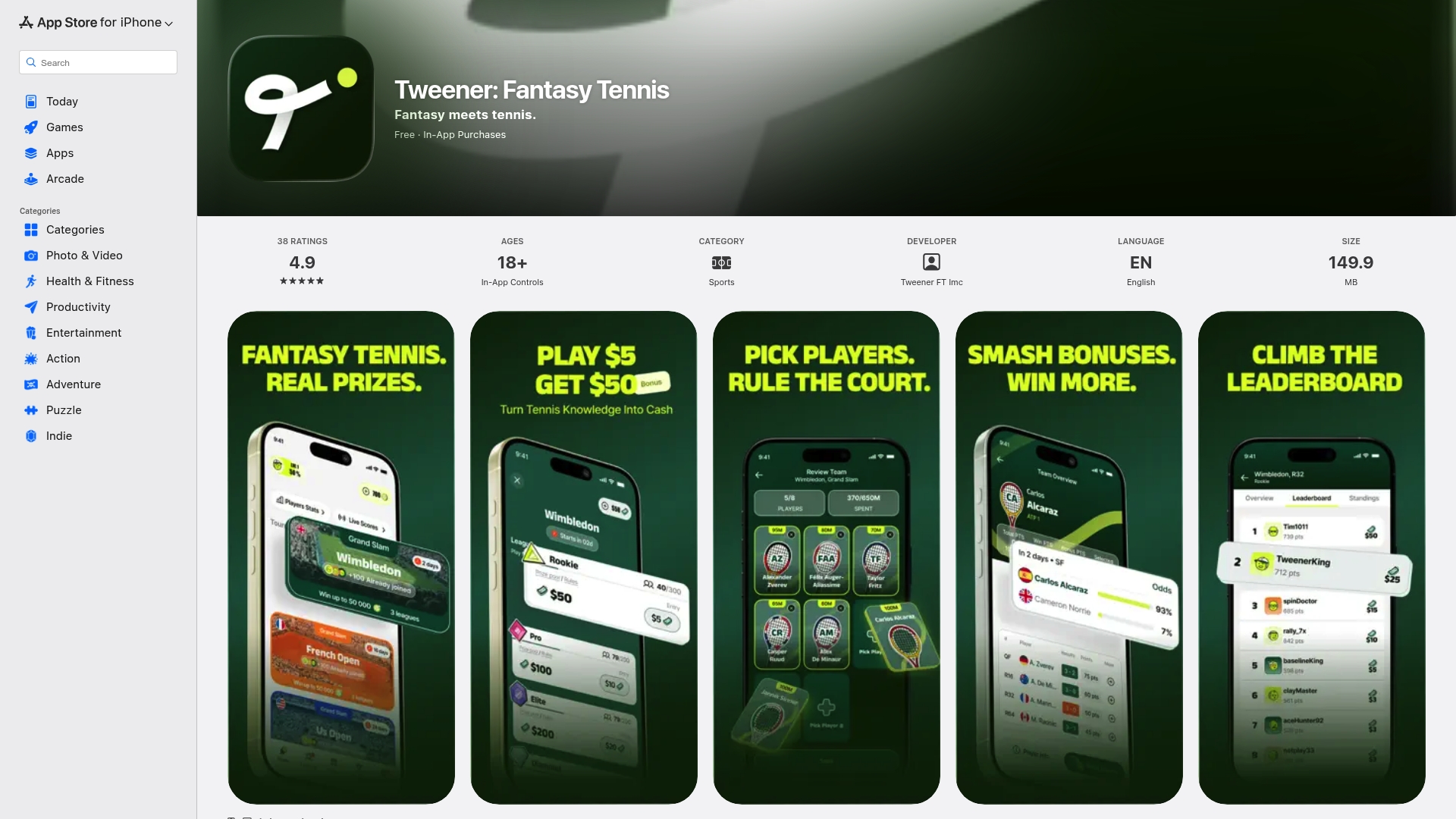
Tweener is the fantasy tennis app that turns every ATP and WTA tournament into a live competition. You pick real players, earn points based on their actual match results, and compete in public or private leagues with friends. Whether you play in free mode with virtual coins or enter cash contests for real payouts, Tweener gives you the tools to act on your power ranking research in real time. Download the Tweener app today and start building lineups that actually reflect who's playing well right now. Visit the Tweener fantasy platform to explore leagues, check player pricing, and get your first team on the board. Your edge starts here.
Frequently asked questions
How do tennis power rankings differ from ATP/WTA rankings?
Power rankings focus on recent form and surface-specific performance, while ATP/WTA rankings use the best results over a rolling 52-week window. Official rankings reward consistency across a full year, not current momentum.
Which factors make power rankings superior for fantasy picks?
Recent form, surface pedigree, and projected performance make power rankings the most useful tool for fantasy selections. They reflect where a player is trending right now, not where they were six months ago.
How are fantasy point values determined in ATP Fantasy games?
In ATP Fantasy formats, points combine ranking points, aces (+2), and upset bonuses (+20), with a typical budget of 100 credits to build your team.
Can power rankings predict match outcomes better than official rankings?
Yes. Elo-based models predict outcomes about 5% better than official rankings, and that margin adds up significantly over a full fantasy season.
What are common mistakes when using power rankings?
Ignoring surface shifts, injuries, and schedule changes are the most frequent errors. Using outdated rankings or overall lists instead of surface-specific ones will also cost you points.