

Most fantasy tennis managers spend hours studying ATP and WTA rankings before a tournament, then wonder why their picks keep falling flat. Rankings tell you who has been good over the past year. They don't tell you who is hot right now, who struggles on clay, or who folds under pressure in a deciding set. Data tracking reveals surface mismatches, form trends, and clutch performance that casual fans completely miss. If you want to win more consistently in fantasy tennis, tracking player performance is the skill that separates the top managers from everyone else.
Table of Contents
- What does tracking player performance mean?
- Key performance stats every fantasy manager should track
- Advanced tracking: Surface, context, and opponent effects
- How tracking creates real fantasy tennis advantages
- Pitfalls and best practices in tracking player stats
- Ready to level up your fantasy tennis game?
- Frequently asked questions
Key Takeaways
| Point | Details |
|---|---|
| Track key performance stats | Surface stats, hold percentages, and recent form drive accurate fantasy picks. |
| Context matters | Adjust for surfaces, opponents, and match conditions to find real edges. |
| Avoid common pitfalls | Don’t rely on small sample sizes—combine stats with player context. |
| Gain a competitive advantage | Consistent tracking outperforms intuition in fantasy tennis over the long run. |
What does tracking player performance mean?
Tracking player performance means going beyond the scoreboard to monitor the specific numbers that actually drive match outcomes. It's not just about wins and losses. It's about understanding why a player wins, and whether those conditions are likely to repeat in the next round.
The most important player stats for fantasy managers to follow include:
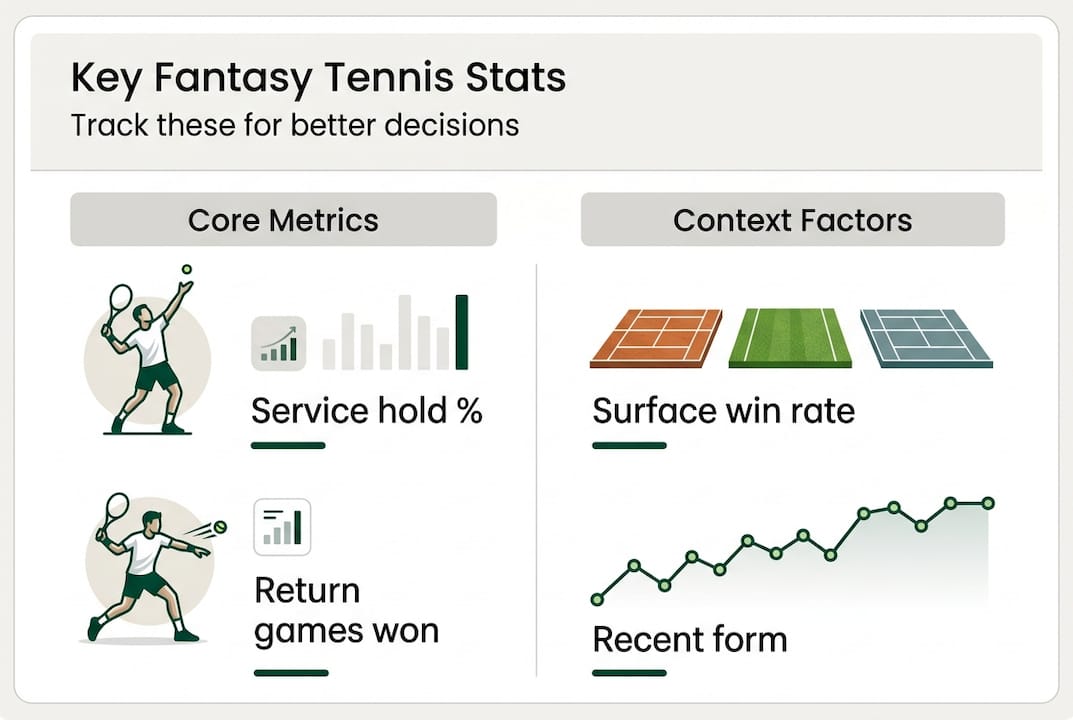
- Service hold percentage: How often a player holds their serve. High holders are more consistent and generate reliable fantasy points.
- Break point conversion: How often a player converts break point opportunities. This directly impacts sets won and total points scored.
- Return games won: A strong return game is one of the best predictors of match victories and fantasy output.
- Surface-specific stats: Performance on hard courts, clay, and grass can vary wildly from player to player.
- Head-to-head records: Some players consistently struggle against specific opponents regardless of ranking.
- Recent form: The last 5 to 10 matches reveal momentum and confidence that season-long stats can hide.
Core methodologies like surface stats, service hold percentage, break point conversion, return games won, head-to-head records, and recent form are the foundation of any serious performance tracking system.
"The difference between a good fantasy pick and a great one is almost always found in the details that rankings don't show."
Understanding fantasy team management means treating each tournament as a fresh puzzle, not just a popularity contest. The stats above are your puzzle pieces.
Key performance stats every fantasy manager should track
Not all stats carry equal weight. Some numbers look impressive but don't actually predict fantasy outcomes. Others are quiet game-changers that most managers overlook entirely.
Here's a breakdown of the stats that consistently matter most:
| Stat | What it measures | Fantasy impact |
|---|---|---|
| Service hold % | Reliability on serve | Consistent point scoring |
| Return games won | Offensive pressure | Predicts break opportunities |
| Break point conversion | Efficiency under pressure | Sets and match wins |
| Recent form (last 5-10) | Current momentum | Short-term reliability |
| Surface win rate | Adaptability by court type | Matchup advantage |
| Head-to-head record | Psychological edge | Upset prediction |
The numbers that matter most are often the ones tied to total points won. Winning 51% of total points gives a player an 85% chance of winning the match. That's a staggering edge, and it's built almost entirely on serve and return performance.
Return games won is especially underrated. Most casual managers focus on big servers, but players who consistently break serve create more scoring opportunities and win more sets. That translates directly into fantasy points.
Pro Tip: Before each tournament round, check a player's surface win rate for the current year, not their career average. Players evolve. A clay specialist who has been working on their hard court game may be far more dangerous than their historical numbers suggest.
When building your fantasy lineup tips, prioritize players with high service hold percentages and strong return games on the specific surface being played. These two stats together are your most reliable compass.
For deeper matchup analysis, improving live predictions requires understanding how these stats shift during a tournament as players gain or lose momentum. And if you're thinking about the bigger picture, tournament prediction strategies can help you plan your roster across multiple rounds, not just one match at a time.
Advanced tracking: Surface, context, and opponent effects
Once you've mastered the core stats, the next level is understanding context. The same player can look like a completely different competitor depending on the surface, the opponent, and how many matches they've played in the past week.

Here's how surface type affects performance across the three main court types:
| Surface | Favors | Key stat to watch |
|---|---|---|
| Hard court | All-around players | First serve percentage |
| Clay | Baseline grinders | Break point conversion |
| Grass | Big servers | Ace count and hold % |
Context factors that expert trackers monitor include:
- Opponent-adjusted stats: A 70% service hold rate looks different against a weak returner versus a top-10 return specialist.
- High-pressure performance: How does a player perform in tiebreaks and deciding sets? Some players thrive; others collapse.
- Match fatigue: A player who just survived a three-hour, five-set battle is not the same player the next day.
- Momentum shifts: Winning streaks and confidence levels affect performance in ways that raw stats can't fully capture.
- Surface-adjusted Elo ratings: These ratings recalibrate a player's skill level based on surface-specific performance, giving a more accurate picture than standard rankings.
Expert nuances like opponent-adjusted statistics, high-pressure performance in tiebreaks and deciding sets, fatigue from recent match length, and surface-adjusted Elo ratings are what separate casual trackers from serious fantasy strategists.
AI-driven models are now a real tool for superfans. Advanced models achieve 70-75% accuracy in match prediction using features like player form (which accounts for 23% of predictive importance), surface performance, head-to-head records, and energy levels. That's a meaningful edge over simply trusting rankings.
Pro Tip: When evaluating a player mid-tournament, check their total match time over the past three days. A player who has spent 8 or more hours on court in three days is a significant fatigue risk, even if their recent results look strong.
For a broader view of how analytics can sharpen your edge, tennis analytics benefits covers why data-driven thinking is becoming essential for serious fans. You can also explore mastering prediction strategies to apply these advanced concepts to your full tournament roster. And for edge cases where variance plays a big role, advanced strategies offer additional frameworks for thinking about unpredictable outcomes.
How tracking creates real fantasy tennis advantages
All of this tracking has one goal: making better decisions than the other managers in your league. Here's exactly where that advantage shows up.
Smarter draft picks. When you know a player's surface win rate and recent form, you stop reaching for big names and start finding value. A player ranked 40th who is 8-2 on clay in the past two months is often a better pick than a top-10 player who hasn't won a clay match all season.
Better in-tournament substitutions. Tracking fatigue and momentum lets you swap out players before they crash, not after. This is one of the biggest edges in fantasy tennis and it's almost entirely invisible to managers who only check rankings.
Predicting upsets. Upsets aren't random. They follow patterns. A lower-ranked player with a strong head-to-head record, playing on their best surface, against a fatigued opponent is a genuine upset threat. Tracking makes these situations visible.
Avoiding popular traps. High-profile players attract heavy ownership in fantasy leagues. When everyone picks the same star and that player loses early, the managers who spotted a better-value pick gain a massive points advantage.
"Tracking reveals what rankings hide: the player who is actually playing the best tennis right now."
Data tracking provides a competitive edge by revealing surface mismatches, form trends, and clutch performance that casual fans overlook, enabling smarter drafting and mid-tournament adjustments. Platforms that reward active analysis for predicting upsets and injuries boost both engagement and prize potential in fantasy leagues.
Your fantasy competition strategy should always include a tracking routine before and during each tournament. For practical frameworks on applying this, winning lineup insights and building winning lineups are both worth bookmarking.
Pitfalls and best practices in tracking player stats
Tracking stats is powerful. But done wrong, it can actually hurt your decision-making. Here are the most common mistakes fantasy managers make.
Common pitfalls to avoid:
- Small sample sizes: A player going 3-0 in their last three matches sounds great. But if those were against low-ranked opponents on a surface they dominate, it tells you very little about what happens next.
- Overfitting to one stat: Fixating on a single number, like ace count, while ignoring return performance creates blind spots.
- Ignoring motivation: A player who has already clinched their seeding may not be pushing hard in the final group stage match. Rankings and stats won't tell you that.
- Missing injury signals: A player who won their last match but was visibly protecting a shoulder is a very different pick than someone who won cleanly.
Best practices for smarter tracking:
- Use at least three to four stats together, not just one.
- Always check recent form over the last 5 to 10 matches, not season averages.
- Cross-reference surface-specific stats with the current tournament's court type.
- Factor in schedule density: how many matches has the player played in the past week?
- Read post-match interviews and press notes for injury or motivation clues.
While stats are powerful, small sample sizes can mislead. Combining stats with context like motivation and playing conditions is essential. No model guarantees wins, but consistent tracking beats intuition over the long run.
Pro Tip: Build a simple tracking sheet before each major tournament. List your top candidate players and score them across five categories: recent form, surface win rate, service hold %, return games won, and fatigue level. The player with the highest combined score is usually your safest pick.
Understanding the limitations of pure stats is just as important as knowing which stats to use. The best fantasy managers combine data with context, and they stay curious about what the numbers aren't showing.
Ready to level up your fantasy tennis game?
You now have a real framework for tracking player performance: the core stats, the advanced context factors, the common pitfalls, and the best practices. The next step is putting it into action during a real tournament.
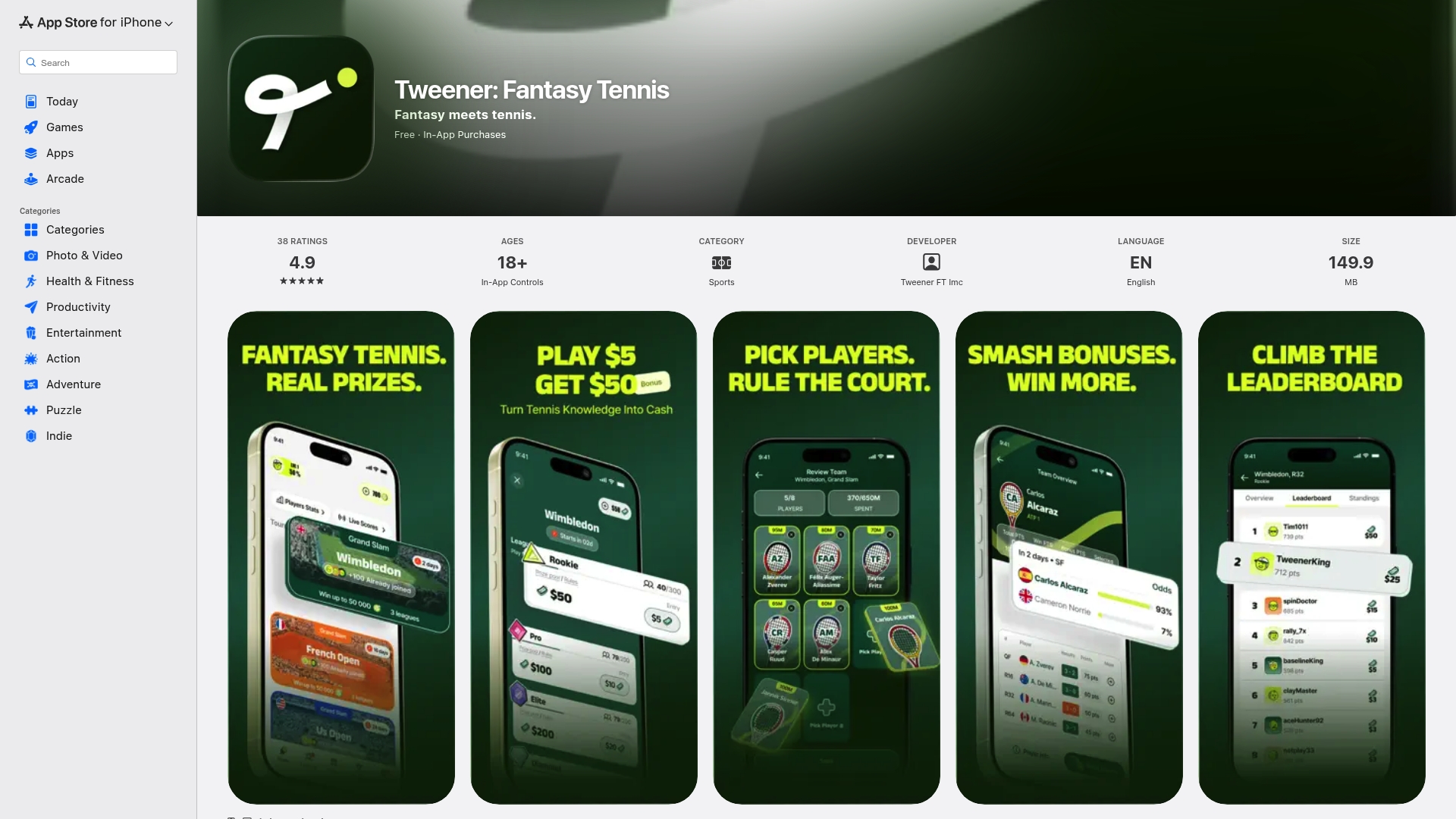
Tweener is built exactly for this. The Tweener fantasy platform lets you apply everything you've learned here by selecting real ATP and WTA players, competing in public or private leagues, and earning points based on live match results. You can play in free mode using virtual coins or enter cash contests for real-money prizes where permitted. Check out the Tweener game rules to understand exactly how points are scored, so your tracking translates directly into smarter picks. Download the Tweener app and start your next tournament with a genuine edge.
Frequently asked questions
Which tennis stats most strongly predict fantasy points?
Service hold percentage, return games won, and recent match form are the top predictors of fantasy points, with winning just 51% of total points giving a player an 85% match win probability.
How is tracking player performance different from just reading rankings?
Rankings reflect long-term results, while tracking reveals recent form, surface strengths, and matchup trends that rankings completely miss, which is why advanced models weight player form at 23% of predictive importance.
Can tracking help with mid-tournament lineup changes?
Absolutely. Following stats like fatigue levels and momentum shifts enables smarter in-tournament substitutions, and mid-tournament adjustments based on tracking are one of the clearest edges available to active fantasy managers.
What are the risks of relying solely on stats?
Small sample sizes can mislead, and stats alone miss critical context like player motivation, injury status, and playing conditions. Combining data with context consistently outperforms either approach on its own.