

TL;DR:
- Team selection before the tournament drives 80 to 100% of fantasy tennis results.
- Accurate scoring relies on understanding serve stats, surface effects, and upset probabilities.
- Strategic use of chips, alternates, and lineup structure provides a competitive edge.
Most fantasy tennis players chalk up a bad week to unlucky draws or a favorite player's surprise exit. But the data tells a different story. Expert simulations consistently show that team selection drives nearly all outcome variance in fantasy tennis, not late transfers, not chip timing, and not gut instinct the morning of a match. The players you pick before the tournament even starts determine your ceiling more than anything else. This guide breaks down the mechanics, scoring leverage points, and strategic principles that separate consistent winners from frustrated also-rans.
Table of Contents
- How team selection shapes fantasy tennis performance
- Understanding the fantasy points system: Rewards, risks, and bonuses
- Adapting your picks: Surfaces, swings, and schedule
- Expert insights: Differentiate for an edge in competitive leagues
- Team management: Getting the most from chips, switches, and alternates
- Our take: The uncomfortable truth about team selection in tennis fantasy
- Take your fantasy game to the next level with Tweener
- Frequently asked questions
Key Takeaways
| Point | Details |
|---|---|
| Selection parity drives outcome | Expert analysis confirms that team selection determines almost all variance in fantasy tennis results. |
| Maximize scoring with smart bonuses | Strategically assigning Bonus Ball and chips to high-upside players yields major point swings each week. |
| Surface and schedule adaptability | Adapting your roster to swings, dual events, and court surfaces is key for sustained fantasy success. |
| Differentiate for league edge | Outperform the crowd by exploiting pricing nuances, avoiding popular traps, and playing to your players' statistical strengths. |
| Effective weekly management | Use chips wisely, manage switches, and never underestimate the value of engaged alternates for lineup flexibility. |
How team selection shapes fantasy tennis performance
If you have ever assumed that swapping one mid-table player for another barely moves the needle, think again. Fantasy team management in tennis is built on a structure where every credit matters, and the players you commit to before week one define your range of outcomes before a single ball is struck.
According to the official ATP Fantasy rules, team selection is the core mechanic of ATP Fantasy, where managers use 100 credits to select 6 starters and 2 alternates priced by PIF ATP Live Rankings. That budget forces real tradeoffs. Spending big on three elite names means your remaining spots must be filled carefully with value picks, and those decisions compound over a 23-week season.
Here is what your selections directly control:
- Match progression points: Every round a player advances, you score
- Aces and double faults: Serve-heavy players are double-edged swords
- Straight-set wins: A clean 6-3, 6-2 win earns a significant bonus
- Upsets: When your lower-ranked player beats a higher seed, points spike sharply
- Bagels: A 6-0 set win adds a special bonus, but giving one costs you dearly
Your two alternates are not just insurance. They actively score points when a starter withdraws, which happens far more often than most managers plan for. Injuries, walkovers, and late scratches are a regular feature of the ATP and WTA calendars.
| Selection element | Impact on points |
|---|---|
| Top-3 seed starter | High floor, lower upset bonus potential |
| Mid-ranked value pick | Lower floor, high upset bonus ceiling |
| Alternate (active) | Scores full points if starter withdraws |
| Alternate (inactive) | Contributes zero unless starter exits |
Team selection drives approximately 80 to 100% of performance variance, according to expert simulations. Everything else is fine-tuning.
This is why managers who refresh their lineup every week based on last week's results often underperform those who build a thoughtful structure at the start and adjust deliberately.
Understanding the fantasy points system: Rewards, risks, and bonuses
Knowing how points are earned and lost gives you a sharper lens for evaluating every pick. The scoring system rewards aggressive, high-upside selections but punishes passive or careless ones.
Core scoring events include:
- Check your player's serve statistics. High ace rates create reliable point upside. Players averaging 12 or more aces per match are prime targets.
- Estimate round progression. Multiply expected rounds by per-round points. A player reaching the quarterfinal scores more than one exiting in round two, obviously, but the math still catches many managers off guard.
- Factor in straight-set bonus potential. A dominant clay-court grinder who closes out matches efficiently is worth more than raw ranking suggests.
- Assess upset probability. Lower-ranked starters facing seeded opponents early carry real bonus upside. That asymmetry is often mispriced in the credit system.
- Subtract risk. High double-fault players and those prone to giving bagels (like shanking returns under pressure) reduce your expected total.
The Bonus Ball mechanic is where smart managers separate themselves. The Bonus Ball designation doubles points for one starter each week, cascading to the next eligible player if inactive, meaning a well-placed Bonus Ball on a deep-running player can transform an average week into a top-10 finish in your league.
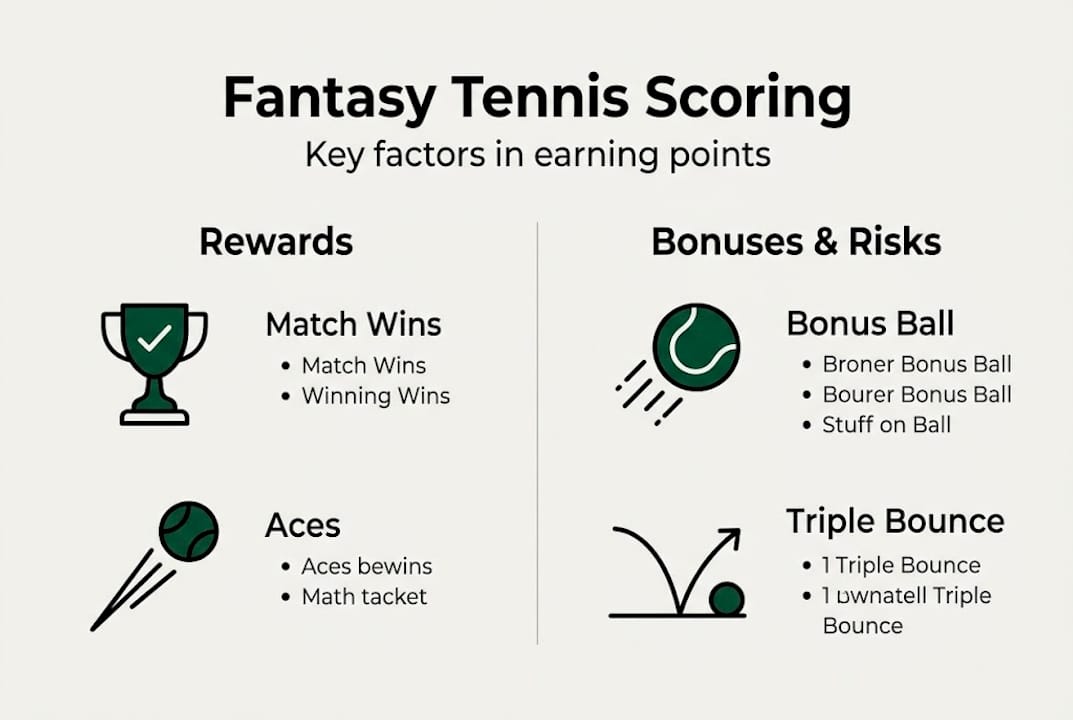
Pro Tip: Give your Bonus Ball to your highest-upside server or the top seed most likely to reach the final. Do not default to your most expensive pick. Upside matters more than reputation when bonus multipliers are involved. You can build a winning lineup around this mechanic alone if you master Bonus Ball placement, and pairing it with smart captain picks compounds that edge across multiple weeks.
Chips like Triple Bounce (which triples the Bonus Ball effect) can swing entire standings. One well-timed chip in a major event week can vault you from mid-table to first place. Save these for congested weeks or when your Bonus Ball target is drawing favorable early rounds.
Expert fantasy tennis analysis consistently highlights the scoring system's nuances as the most underused lever in competitive leagues. Most casual players never model out expected point totals before selecting their roster.
Adapting your picks: Surfaces, swings, and schedule
Having a points-optimized roster is step one, but real advantage comes from adapting as the season unfolds. The ATP calendar is not uniform, and treating every week the same is one of the most expensive mistakes in fantasy tennis.

The season spans 23 weeks across four swings including Clay, Grass, North American Hard, and Race to Finals, requiring surface-adapted selections. Dual-event weeks, where two tournaments run simultaneously, create unique roster challenges that most managers handle poorly.
Key factors to evaluate before each week:
- Surface specialty: Some players transform on clay. Others collapse. Check head-to-head records on the specific surface, not just overall ranking.
- Travel and schedule load: Back-to-back weeks with heavy travel favor rested alternates over potentially fatigued starters.
- Field strength: A 250-level event has weaker opposition than a Masters 1000, which affects upset potential and straight-set bonus probability.
- Draw position: An elite player in the weak half of a draw is worth more than one likely to meet three top-10 opponents before the quarterfinal.
- Injury flags: Monitor pre-tournament press conferences. Players managing niggles rarely say so directly, but practice session reports tell the story.
Pro Tip: During dual-event weeks, spread your roster across both tournaments rather than concentrating on the bigger draw. A player winning the smaller event scores comparably to a quarterfinalist at the Masters. Spreading risk also keeps your alternates relevant.
Adapting picks when choosing tennis players in 2026 means thinking beyond rankings. A hard-court serve specialist like a big-hitting American is a completely different asset on Wimbledon's grass than on Roland Garros clay. Surface-blind selection is the single biggest structural mistake in casual fantasy leagues.
Expert insights: Differentiate for an edge in competitive leagues
Knowing the fundamentals and context is powerful, but applying high-level strategy can separate you from the rest of your league. The managers consistently finishing in the top 10% of competitive leagues do something most others refuse to do: they go against the crowd.
Expert nuances reveal that pricing flaws favor top-heavy teams. Because of credit compression in the pricing system, rostering both Carlos Alcaraz and Jannik Sinner together is viable, and pairing them with smart value picks in the remaining slots often outperforms balanced rosters. This counters conventional wisdom that you must spread credits evenly.
Ways to build a genuine edge:
- Exploit serve and return stats: The ace-to-double-fault differential is consistently underweighted in casual team selection. Target players with elite ace rates and low fault numbers.
- Avoid popular traps: When a fan-favorite player like Dominic Thiem is widely selected, winning your league requires differentiating. If everyone picks the same players, you can only match the field, never beat it.
- Identify undervalued picks: Players returning from injury or ranked outside the top 20 after a strong pre-tournament run often carry better credit-to-points ratios than their current price suggests.
- Balance ceiling vs. differentiation: Chasing pure ceiling every week can backfire. A mix of high-floor picks plus one contrarian high-upside selection tends to outperform all-or-nothing rosters over a full swing.
You can optimize fantasy picks by studying ownership trends in your league and deliberately avoiding the most popular mid-tier picks. It also helps to draft for winning leagues with differentiation as a core principle from the start, not an afterthought.
Team management: Getting the most from chips, switches, and alternates
Once high-level strategic decisions are made, sharpening your week-to-week management ensures you capitalize on every edge. The official rules confirm that team management includes 2 free weekly switches (rolling over to a maximum of 8), plus chips like Alternates (adds alternate points to total), Triple Bounce (triples Bonus Ball), and the Swing Switch for major roster resets.
Optimal chip use across a tournament swing:
- Save the Swing Switch for the transition between clay and grass. Surface swings dramatically alter player value, and a full reset at peak timing beats incremental weekly switches.
- Deploy the Alternates chip during congested weeks when injury risk peaks. If two of your starters are doubtful, activating this chip locks in alternate scoring without burning a switch.
- Use Triple Bounce when your Bonus Ball target is drawn against weak opposition in a final or semifinal. Tripling an already doubled score in a deep run is the highest-leverage play in the entire game.
- Accumulate switches during stable weeks and spend them aggressively when form shifts sharply, like after a surface change or a player's sudden injury return.
Pro Tip: Do not burn all your chips before the final swing. The Race to Finals weeks feature condensed fields with top players, which means higher stakes, more predictable matchups, and the best environment for chip impact.
Strong management of essential fantasy tennis skills like alternate deployment and chip sequencing is what separates managers who plateau at mid-table from those who consistently challenge for top spots.
Our take: The uncomfortable truth about team selection in tennis fantasy
Here is what years of sim data and player tracking consistently show: the managers who obsess over weekly transfers are usually the ones finishing in the middle of the pack. The instinct to react to every headline, every surprise exit, and every hot streak feels productive. It rarely is.
The real edge in fantasy tennis is built before the first ball is hit. Your initial team structure, credit allocation, and differentiation choices at the start of a swing determine your outcome distribution more than any in-week decision. Overmanaging your roster introduces noise, not signal.
Most competitive leagues are won by managers who built winning tennis lineups early, held their structure through short-term variance, and deployed chips surgically rather than reactively. The long-term metagame rewards patience and structural intelligence far more than panic transfers. If your team is consistently set up to score in multiple categories regardless of which player is hot that week, you have already won the strategic battle.
Take your fantasy game to the next level with Tweener
Everything you just read, the points mechanics, the surface adaptation, the chip strategy, it all works best when you have the right platform supporting your decisions.
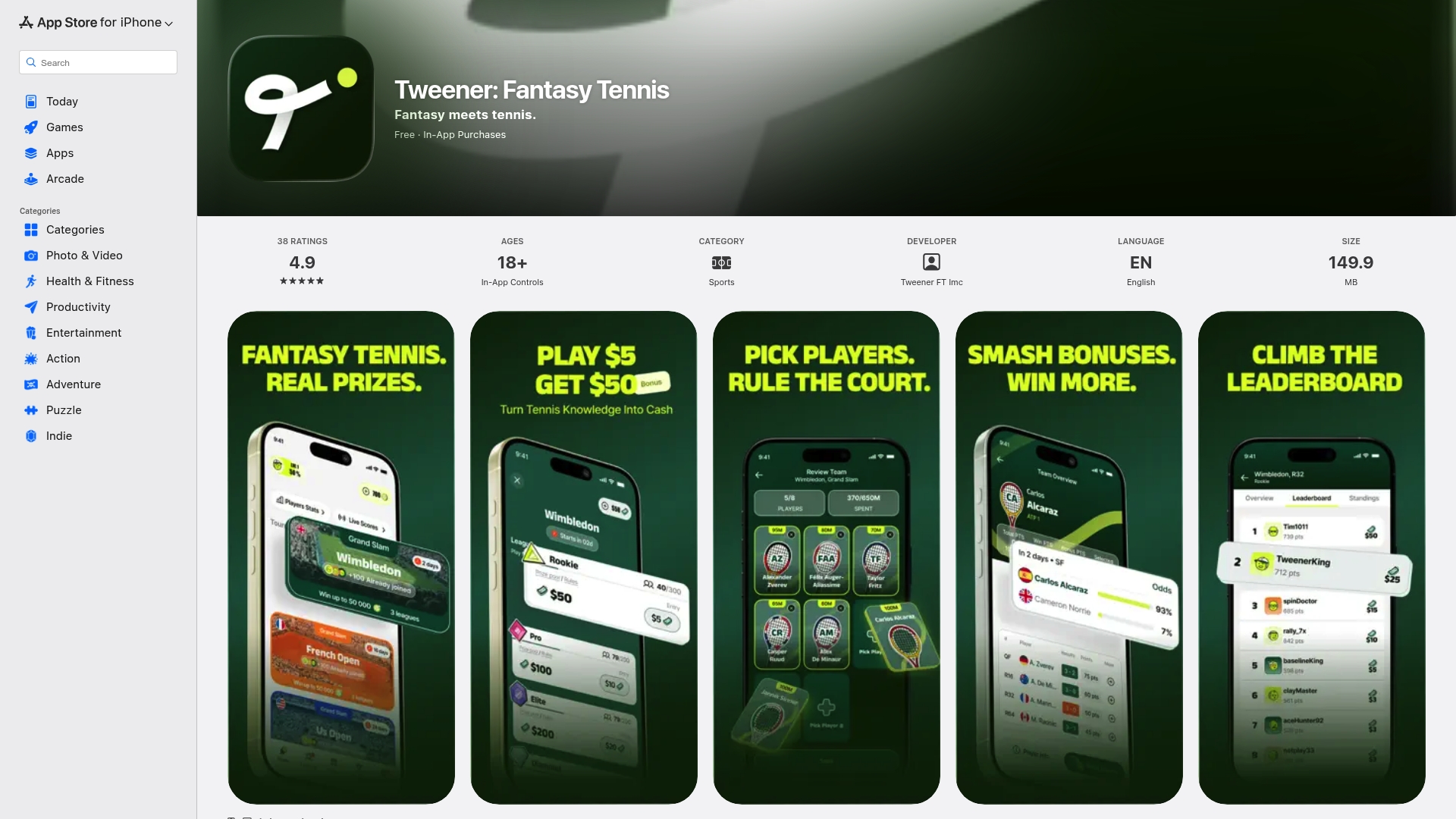
Tweener is built specifically for tennis fantasy fans who want more than a passive viewing experience. With intuitive team selection tools, live scoring tied to real ATP and WTA matches, and competitive leagues for every skill level, Tweener puts strategy into action every week. Whether you prefer playing for fun with virtual coins or competing for real payouts in cash mode, the Tweener app keeps your fantasy season sharp, social, and deeply connected to live tennis. Your next great pick is one lineup away.
Frequently asked questions
How many players should I select for my ATP fantasy team?
You select six starters and two alternates, all within a 100-credit limit based on current ATP Live Rankings prices. Alternates score full points if a starter withdraws before or during the event.
What is the Bonus Ball and how should I use it?
The Bonus Ball doubles points for one starter each week and should go to the player with the highest scoring upside, typically a top seed or serve leader with a favorable draw.
How do chips and weekly switches work in ATP fantasy?
You receive two free switches weekly (rolling over to a maximum of eight), plus special chips including Alternates, Triple Bounce, and Swing Switch, each designed for specific high-impact moments in the season.
Why do experts recommend top-heavy lineups in fantasy tennis?
Because of credit compression in pricing, you can roster multiple superstars together and still fill the remaining slots with viable value picks, maximizing your ceiling without sacrificing roster depth.
How should I adjust my team during dual-event weeks?
Spread your starters across both concurrent events and activate alternates to hedge against surprise withdrawals, since player value at a smaller tournament can match or exceed a quarterfinal result at the larger draw.
Recommended
- Essential skills every fantasy tennis player needs to win
- How to optimize tennis fantasy picks for consistent wins
- Maximize your fantasy tennis wins with smart captain picks
- Advantages of fantasy team competitions for tennis fans
- Benefits of Team-Based Games for Workplace Success - Blog