

Tennis scoring confuses even dedicated fans at first glance. The progression from love to deuce, the jump from 30 to 40, and the tie-break rules all seem designed to mystify newcomers. Understanding tennis scoring fundamentals transforms your viewing experience and sharpens your fantasy league strategy. This guide breaks down points, games, sets, and matches while showing you how scoring knowledge directly improves your Tweener performance. You'll learn the terminology, special situations, and practical applications that turn confusion into competitive advantage.
Table of Contents
- The basics of tennis scoring: points, games, sets, and matches
- Common tennis scoring terms and special situations explained
- How understanding scoring improves fantasy tennis league performance
- Tips for following tennis scoring live and using analytics for better predictions
- Experience fantasy tennis scoring with Tweener
- What does 'love' mean in tennis scoring?
- How is a tennis set won?
- What is 'deuce' in tennis?
- How does tie-break scoring work?
Key takeaways
| Point | Details |
|---|---|
| Scoring hierarchy | Tennis progresses from points to games to sets to matches with unique terminology at each level. |
| Critical terms | Understanding love, deuce, advantage, and tie-breaks removes confusion during live matches. |
| Fantasy connection | Match progress and scoring phases directly affect fantasy point accumulation and team strategy. |
| Predictive value | Scoring patterns reveal momentum shifts that inform smarter fantasy picks and adjustments. |
The basics of tennis scoring: points, games, sets, and matches
Tennis scoring progresses through four distinct levels that build on each other. Points form games, games form sets, and sets form matches. This hierarchical structure creates the strategic depth that makes tennis compelling for both viewers and fantasy players.
Points follow a peculiar sequence: 0, 15, 30, 40, and game. The zero point gets called love, a term likely derived from the French word for egg due to its oval shape resembling zero. When you win your first point, the score becomes 15. Your second point brings it to 30, and your third to 40. Winning a fourth point typically wins the game, unless your opponent also has 40.
Games require winning at least four points with a two-point advantage. If both players reach 40, the game enters deuce. From deuce, you must win two consecutive points: one for advantage, another for the game. This back-and-forth can continue indefinitely until someone achieves the two-point margin. Pro Tip: Watch for deuce situations in live tennis predictions because they often signal momentum shifts that affect fantasy scoring.
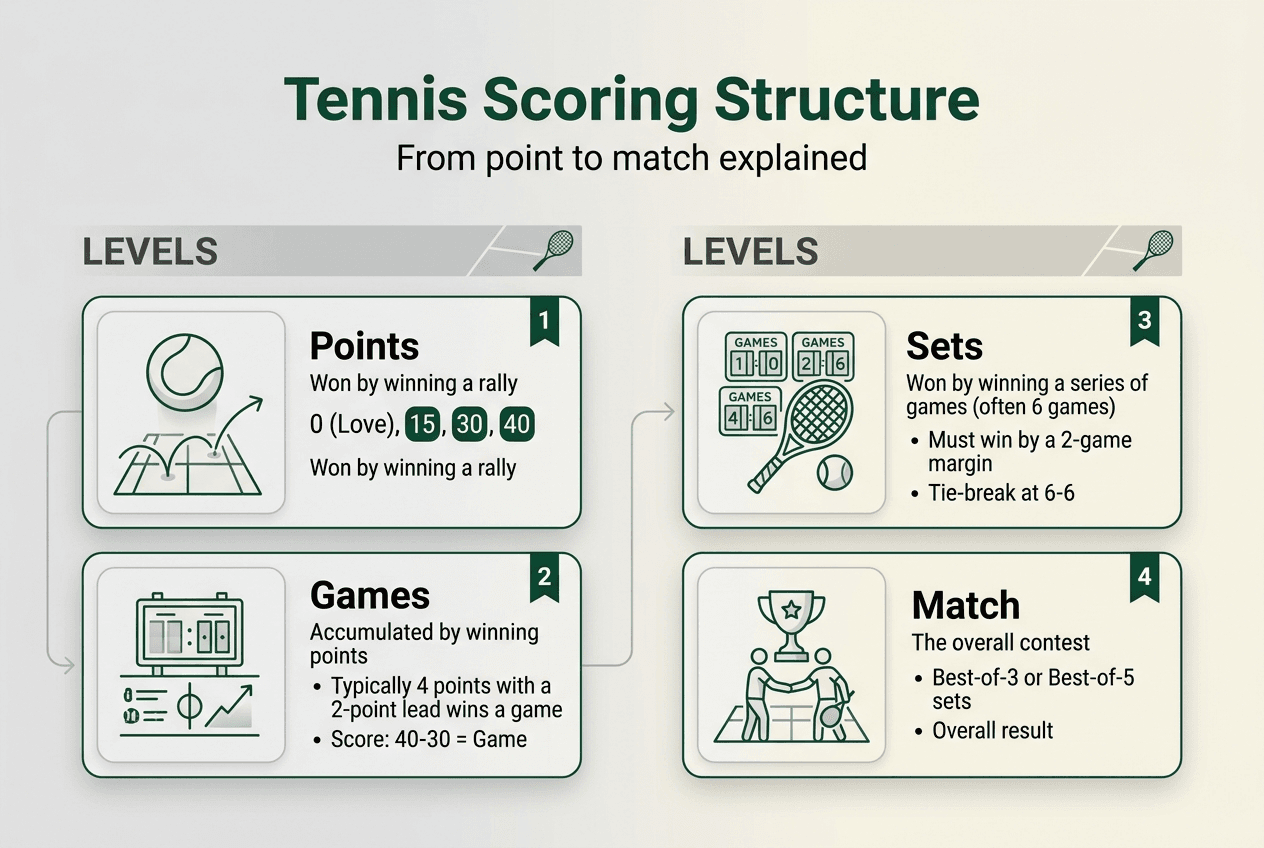
Sets demand winning six games with at least a two-game lead. If the score reaches 5-5, play continues until someone leads by two games (7-5, 8-6, etc.). Most tournaments use a tie-break at 6-6 to prevent endless sets. The tie-break operates differently: players score 1, 2, 3 instead of 15, 30, 40, and the first to reach 7 points with a two-point margin wins the set 7-6.
Matches use either best-of-three or best-of-five set formats. Men's Grand Slam tournaments require five sets, while most other professional matches use three. Women's matches universally use best-of-three sets. Understanding these formats helps you gauge match length and player fatigue, both crucial for tennis analytics and fantasy decisions.
Here's the scoring progression at a glance:
- Point level: 0 (love), 15, 30, 40, game
- Game level: First to 4 points with 2-point margin
- Set level: First to 6 games with 2-game margin
- Match level: Best of 3 or 5 sets
The serving player's score always gets announced first. If Djokovic serves at 30-15, he has 30 points and his opponent has 15. This convention helps you track who's serving and their current advantage, essential information for fantasy team management during live tournaments.
Common tennis scoring terms and special situations explained
Tennis terminology includes several unique expressions that initially baffle new fans. Love, deuce, and advantage represent the most common terms you'll encounter, but understanding break points and match points adds crucial context for fantasy league performance.
Love simply means zero. Whether announcing 15-love or love-30, you're hearing that one player has no points in the current game. The term applies only to game-level scoring, never to sets or matches. You'll never hear "love sets" because set scores use standard numbers.
Deuce occurs when both players reach 40-40 in a game. This tie triggers the two-point advantage rule. After deuce, winning one point gives you advantage (often shortened to "ad"). If you win the next point while holding advantage, you win the game. If your opponent wins, the score returns to deuce. This cycle continues until someone converts their advantage into a game win.

Advantage gets called "ad-in" when the server holds it and "ad-out" when the returner leads. Some tournaments use "no-ad" scoring where the first player to reach four points wins the game, eliminating deuce situations entirely. Fantasy players should note which scoring system applies because no-ad formats produce shorter, less predictable games.
Break point represents a critical moment when the receiving player has a chance to win the server's game. Since holding serve (winning your service games) is expected at professional levels, breaking serve shifts match momentum dramatically. A single break often decides an entire set. Fantasy implications are significant because players who convert break points typically accumulate bonus points in most fantasy scoring systems.
"Understanding when break points occur helps you anticipate scoring runs that multiply fantasy point totals during crucial game stretches."
Set point means the leading player needs one more point to win the set. Match point indicates one point away from winning the entire match. These high-pressure moments often produce spectacular tennis and disproportionate fantasy point swings. Players who perform well under pressure at set and match points tend to overperform their seeding in fantasy leagues.
Tie-breaks deserve special attention because their scoring differs completely from regular games. Players alternate serves every two points instead of holding serve for entire games. The first to seven points with a two-point margin wins the tie-break and the set 7-6. Tie-breaks compress tension into rapid-fire exchanges that can flip match outcomes and fantasy fortunes in minutes.
Key terms summary:
- Love: Zero points in a game
- Deuce: Tied at 40-40, requiring two-point advantage to win
- Advantage: One point ahead after deuce
- Break point: Opportunity for receiver to win server's game
- Set point: One point from winning the set
- Match point: One point from winning the match
How understanding scoring improves fantasy tennis league performance
Fantasy tennis scoring rewards players based on match progression and individual performance metrics. Knowing how points, games, and sets accumulate lets you predict which players will generate maximum fantasy value during specific tournament stages.
Traditional tennis viewing focuses on who wins matches. Fantasy scoring adds layers by awarding points for sets won, games won, and sometimes even individual service holds. A player who wins 6-4, 6-4 earns more fantasy points than one who wins 6-0, 6-0 because the longer match generates more game victories. This counterintuitive dynamic means competitive matches often produce better fantasy returns than blowouts.
Set progress directly impacts fantasy team management decisions. If your player wins the first set comfortably, they're likely to accumulate steady points in the second set even if they lose it. Conversely, a player down 0-6 in the first set might rally to win the match but will have sacrificed significant fantasy points in that opening set.
Here's how different match scenarios affect fantasy scoring:
| Match Scenario | Fantasy Point Impact | Strategic Consideration |
|---|---|---|
| Straight sets win (6-2, 6-3) | Moderate points, efficient victory | Reliable but not maximum value |
| Three-set battle (4-6, 6-4, 6-3) | High points, extended play | Maximum game accumulation |
| Tie-break victories (7-6, 7-6) | Very high points, close sets | Bonus points for tie-break wins |
| Retirement/walkover | Minimal points, incomplete match | Avoid players with injury concerns |
Game momentum within sets reveals crucial information for in-tournament adjustments. A player who breaks serve early and holds throughout demonstrates consistency that translates to reliable fantasy scoring. Players who constantly face break points, even if they save them, show vulnerability that might limit their tournament run and your fantasy returns.
Pro Tip: Monitor players who excel in tie-breaks because most fantasy platforms award bonus points for tie-break victories. These specialists often outperform their ranking in fantasy picks during Grand Slams where five-set matches create multiple tie-break opportunities.
Common scoring scenarios and their fantasy implications include:
- Early break of serve: Indicates dominant performance, expect high game win totals
- Multiple deuces per game: Suggests competitive match, likely three sets with maximum point accumulation
- Quick service holds: Efficient but may limit total games played and fantasy points
- Frequent break point conversions: Sign of clutch performance, often correlates with tournament advancement
Understanding these patterns helps you make informed decisions about captain selections, bench rotations, and weekly lineup adjustments. The player who grinds out three-set victories consistently might outscore the dominant champion who wins in straight sets every round.
Tips for following tennis scoring live and using analytics for better predictions
Tennis analytics combined with live scoring awareness creates a powerful toolkit for fantasy success. Following matches in real time while interpreting scoring trends gives you advantages over competitors who only check final results.
Tracking live scores effectively requires understanding the display format. Most platforms show the current game score first, then set scores in chronological order. A display reading "Alcaraz 4-3 (40-15) Sinner, 6-4, 3-6" means Alcaraz leads the current set 4 games to 3, leads the current game 40-15, won the first set 6-4, and lost the second set 3-6.
Follow these steps for accurate live score interpretation:
- Identify who's serving by checking the game score position (server's score listed first in the game)
- Note the set score progression to gauge match momentum and fatigue levels
- Watch for critical moments like break points, set points, or tie-breaks that signal potential swings
- Compare current performance to pre-match statistics to spot overperformance or underperformance
- Adjust fantasy lineups based on injury timeouts, weather delays, or visible momentum shifts
Scoring trends reveal player momentum better than any single statistic. A player who wins three consecutive games after dropping serve demonstrates mental resilience. This pattern often predicts strong tournament runs and fantasy value. Conversely, a player who wins sets 7-6, 7-6 shows competitiveness but might lack the dominance to survive deep tournament draws.
Key analytics metrics that complement scoring knowledge include first serve percentage, break point conversion rate, and points won on second serve. These numbers predict future game outcomes. A player winning 75% of first serve points will likely hold serve consistently, limiting opponents' game win totals and fantasy scoring opportunities.
Here's how match states translate to fantasy implications:
| Match State | Typical Duration | Fantasy Point Potential | Prediction Indicator |
|---|---|---|---|
| Dominant straight sets | 75-90 minutes | Moderate | Favorite performing as expected |
| Competitive three sets | 150-180 minutes | High | Evenly matched, high game totals |
| Five-set marathon | 240+ minutes | Very high | Extreme endurance, fatigue factor |
| Early retirement | 30-60 minutes | Very low | Injury risk, avoid in future picks |
Pro Tip: Set up score alerts for your fantasy players during live matches so you can make real-time substitutions before lineups lock for the next round. Many fantasy platforms allow changes between tournament days, giving informed players significant edges.
Integrating live observations with fantasy decisions means watching not just who wins but how they win. The player who battles through three tie-breaks might be exhausted for their next match, affecting your lineup choices. The player who cruises in 75 minutes preserves energy for deep tournament runs, making them valuable fantasy holds even if they scored fewer points in that particular match.
Experience fantasy tennis scoring with Tweener
Now that you understand how tennis scoring works and its fantasy implications, put your knowledge into action with Tweener. Our platform transforms every serve, break point, and tie-break into strategic decisions that test your tennis expertise against fans worldwide.
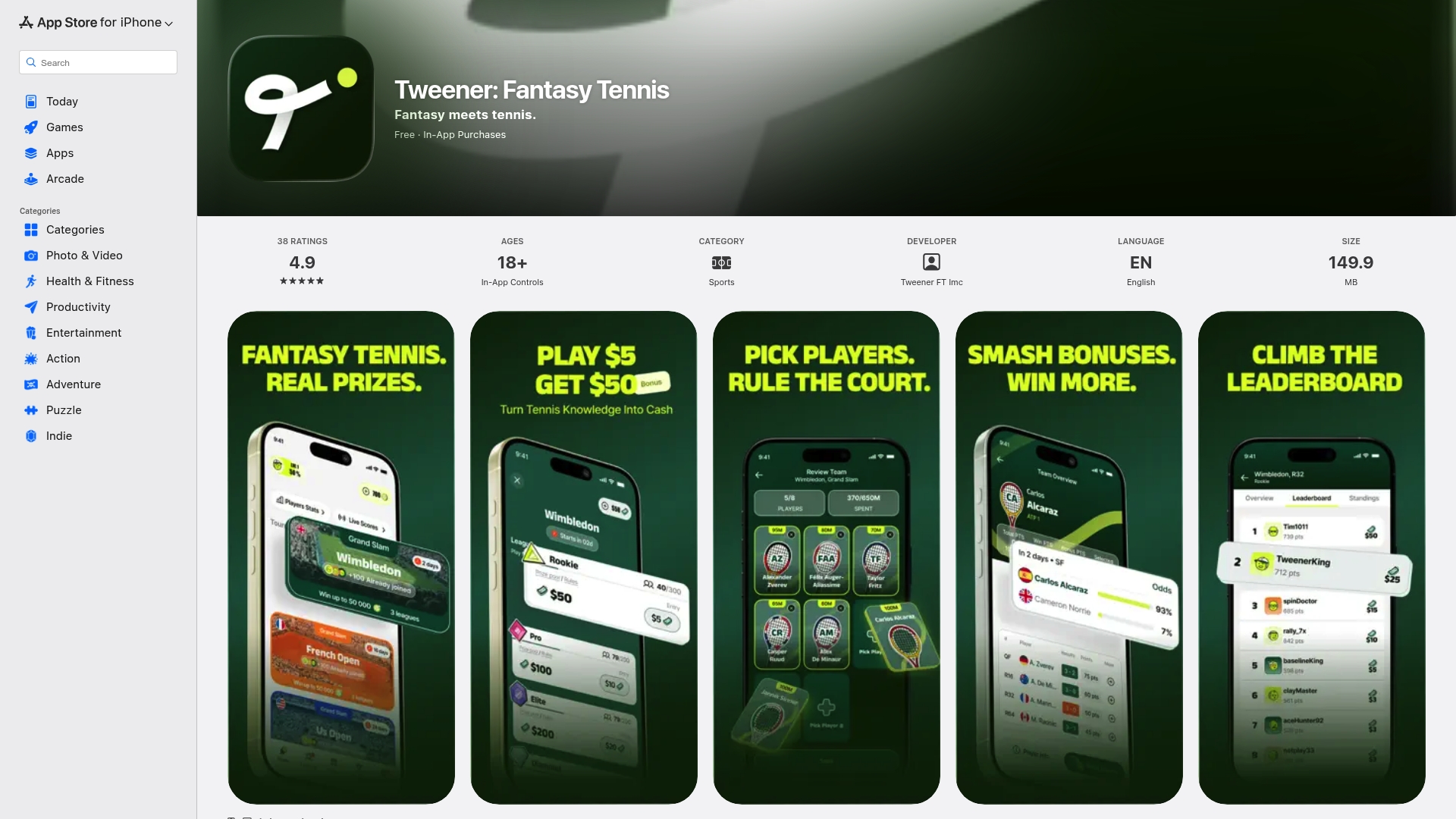
Tweener's fantasy leagues reward players who grasp scoring nuances. You'll draft ATP and WTA players, manage your roster through tournament rounds, and earn points based on real match results. The scoring knowledge you've gained here directly translates to smarter picks, better captain choices, and more successful fantasy campaigns.
Download the Tweener app to join thousands of tennis fans competing in free and cash leagues. Whether you're tracking Grand Slams or ATP 250 events, understanding how points become games and games become sets gives you the edge needed for fantasy success. Check our detailed game rules to see exactly how match scoring converts to fantasy points and start building your championship team today.
What does 'love' mean in tennis scoring?
'Love' means zero points in tennis game scoring. When an announcer says "30-love," one player has 30 points while the other has zero. The term likely originated from the French word for egg, "l'oeuf," because zero resembles an egg's oval shape. Love applies only to game-level scoring, never to sets or matches, so you'll always hear numerical scores like 6-0 for sets rather than "6-love."
How is a tennis set won?
A player wins a set by reaching six games with at least a two-game advantage over their opponent. If the score reaches 5-5, play continues until someone achieves the two-game margin, resulting in scores like 7-5 or 8-6. When the set reaches 6-6, most tournaments employ a tie-break to decide the set winner, with the final score recorded as 7-6. The tie-break format prevents sets from extending indefinitely and adds dramatic tension to closely contested matches.
What is 'deuce' in tennis?
Deuce occurs when both players reach 40-40 in a game, creating a tied situation. From deuce, a player must win two consecutive points to claim the game: one point for advantage, then another to win. If the player with advantage loses the next point, the score returns to deuce. This cycle can repeat multiple times in competitive games, creating extended battles that significantly impact match momentum and fantasy point accumulation.
How does tie-break scoring work?
A tie-break is played when a set reaches 6-6 to determine the set winner efficiently. Unlike regular games, tie-break points are counted as 1, 2, 3, 4 instead of 15, 30, 40. The first player to reach 7 points with at least a two-point lead wins the tie-break and the set 7-6. Players alternate serves every two points rather than holding serve for entire games. If the tie-break reaches 6-6, play continues until someone establishes the required two-point margin, potentially extending to scores like 10-8 or 12-10.