

TL;DR:
- Fantasy tennis scoring mirrors ATP points, with bonuses for aces, straight sets, and upsets.
- Strategic management of chips and team switches optimizes performance across tournament swings.
- Differentiating picks by surface and active weekly adjustments are key to winning leagues.
Most tennis fans who try a fantasy prediction game for the first time walk away confused. The scoring feels arbitrary, the bonuses seem random, and nobody explains why picking a clay specialist over a top seed can actually win you a swing. Fantasy tennis is not complicated once you understand the logic behind it. This guide breaks down how scoring works, how to manage your team through each swing, and what separates players who climb leaderboards from those who stall out after the first week. Whether you play for fun or compete for real prizes, these mechanics apply directly to your results.
Table of Contents
- How fantasy tennis prediction games work
- Breaking down the scoring rules, bonuses, and penalties
- Team management, chip usage, and live pricing strategies
- Advanced strategies: maximizing your picks for each swing
- What typical tennis fantasy guides miss: Real-world lessons from expert play
- Get started with Tweener: Your gateway to fantasy tennis
- Frequently asked questions
Key Takeaways
| Point | Details |
|---|---|
| ATP-based scoring | Fantasy tennis games reflect ATP tournament points, with bonuses and penalties for key match events. |
| Strategic switches and chips | Weekly switches and chips let you optimize your team and score big during critical swings. |
| Surface adaptation matters | Adapting picks for clay, grass, or hard courts boosts your odds in each tournament swing. |
| Continuous management wins | Active team updates and chip timing outperform static bracket picks for fantasy success. |
| Differentiation is key | Picking unique specialists rather than just top stars helps climb leaderboards and win prizes. |
How fantasy tennis prediction games work
Fantasy tennis prediction games are built around one simple idea: your fantasy team earns points based on how your selected real-world players actually perform in live ATP and WTA matches. When your picked player wins a match, earns an ace, or pulls off an upset, your team scores. When they double fault repeatedly or get bageled, your score takes a hit. It mirrors the sport itself, which is exactly what makes it intuitive for tennis fans.
The advantages of prediction games go beyond just watching matches with a stake in the outcome. You start analyzing serve statistics, surface performance, and draw brackets in ways you never did before. The game forces you to think like a coach.
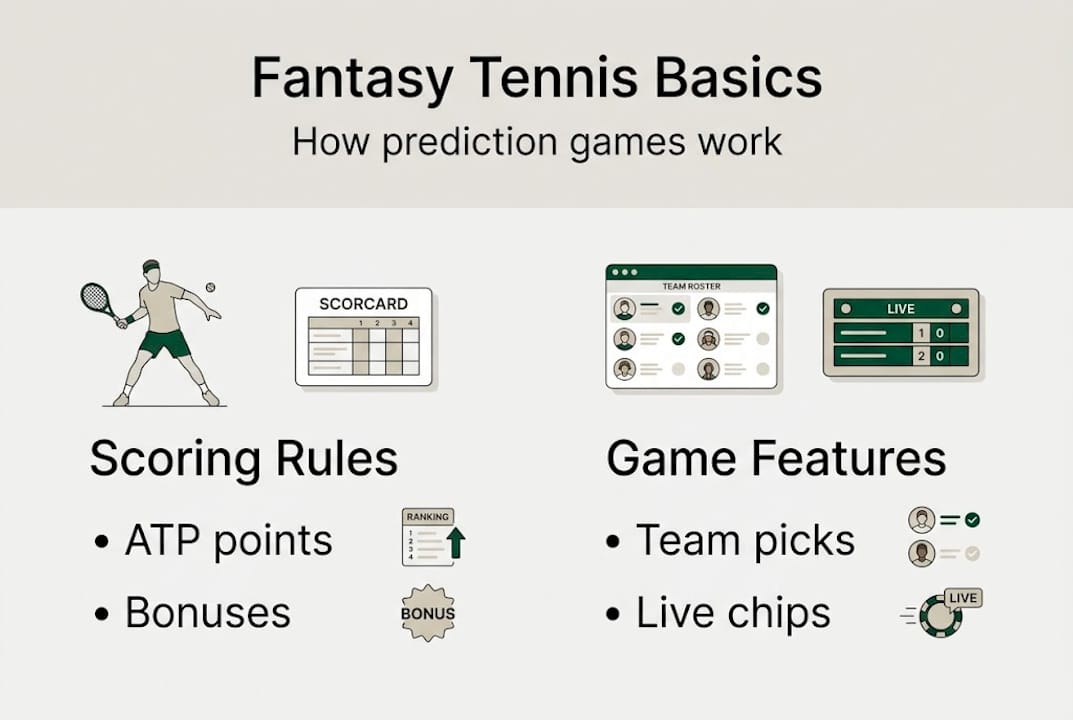
Understanding tennis scoring explained is your first step, because fantasy scoring is layered on top of it. The base points reflect ATP ranking points for each round a player reaches. From there, bonuses and penalties are applied based on specific match events.
Here is what the core scoring structure looks like:
- Round progression: Points awarded for each round your player advances
- Ace bonus: +2 points per ace
- Straight-sets win bonus: +10 points for winning without dropping a set
- Upset win bonus: +20 points when an unseeded player beats a seeded opponent
- Double fault penalty: -2 points per double fault
- Bagel penalty: -10 points when your player loses a set 0-6
- Upset loss penalty: -20 points when a seeded player loses to an unseeded opponent
As noted in the ATP Fantasy ultimate guide, scoring mirrors ATP ranking points for rounds reached, with bonuses like ace +2, straight-sets win +10, and upset win +20, alongside penalties including double fault -2, bagel -10, and upset loss -20. This structure is what separates fantasy tennis from something like football betting basics, where outcomes are binary. In tennis fantasy, every single game within a match can affect your score.
Stat callout: An upset win bonus of +20 points is the single highest one-match bonus available, making upset predictions one of the most powerful tools in your fantasy arsenal.
Breaking down the scoring rules, bonuses, and penalties
Now that you know games mirror ATP points, let's explore how bonuses and penalties shape fantasy strategy.
The scoring system rewards aggressive, high-impact play. A player who fires 15 aces and wins in straight sets can generate massive bonus points even if they are ranked outside the top 20. That is the beauty of this format. You are not just picking winners. You are picking players likely to dominate in a specific way.
Here is a quick reference table for the core scoring events:
| Event | Points |
|---|---|
| Round win (base ATP points) | Varies by round |
| Ace | +2 |
| Straight-sets win | +10 |
| Upset win (unseeded vs. seeded) | +20 |
| Double fault | -2 |
| Bagel (0-6 set loss) | -10 |
| Upset loss (seeded vs. unseeded) | -20 |
The fantasy tennis scoring terms guide is worth bookmarking if you want to stay sharp on every definition.
One critical nuance: the upset bonus only applies when an unseeded player beats a seeded player. Two seeded players playing each other does not trigger the upset mechanic, even if the lower seed wins. This distinction matters enormously when you are scanning the draw for upset candidates.
Here are the most common mistakes players make with scoring:
- Ignoring bagel risk: Picking a player likely to get dominated on a surface they hate can cost you -10 points per set, wiping out a round win bonus entirely.
- Overweighting favorites: A seeded player who wins in five sets earns no straight-sets bonus and risks double fault penalties.
- Missing upset opportunities: The +20 upset win bonus is the highest single-event score available. Picking one correct upset per swing can separate you from the pack.
- Underestimating ace specialists: Big servers on fast surfaces can rack up +2 per ace across an entire tournament, adding up to 20 or 30 bonus points over multiple matches.
"The scoring structure is praised for mirroring ATP points intuitively, but it has quirks, including no break-point bonuses and pricing compression that favors top picks."
Understanding these mechanics turns you from a passive picker into a strategic player.
Team management, chip usage, and live pricing strategies
With scoring rules covered, it's time to look at team management and strategic tools for fantasy players.

Managing your fantasy team is an ongoing job, not a one-time decision. The fantasy team management basics come down to understanding switches, chips, and pricing.
According to the ATP Fantasy guide on team mechanics, you receive 2 free switches per week with a maximum of 8 banked, and extra switches cost 50 points each. Chips including Alternates, Triple Bounce (which multiplies a player's bonus by 3), and Swing Switch (unlimited free switches) reset each swing.
Here is a comparison of the main chip types:
| Chip | Effect | Best used when |
|---|---|---|
| Alternates | Swap injured/withdrawn players | Early in a swing with injury uncertainty |
| Triple Bounce | 3x bonus points for one player | High-upside match for an ace specialist |
| Swing Switch | Unlimited free switches | Major surface or draw changes |
Live pricing is another layer. Player values shift based on performance, but top players ranked 1 through 16 tend to have compressed pricing, meaning the cost difference between a top-5 and a top-15 player is smaller than you might expect. This actually creates opportunity: you can sometimes fit two mid-tier specialists into your team for the same price as one elite name, and if both deliver bonuses, you come out ahead.
Key team management rules to remember:
- Bank your free switches early in the season to give yourself flexibility during high-stakes swings
- Use the Swing Switch chip when a major surface change hits, like moving from clay to grass
- Save Triple Bounce for a player you are confident will win in straight sets with multiple aces
- Avoid burning extra switches (50 points each) unless the replacement player offers significant upside
Pro Tip: Do not activate Triple Bounce on a player facing a tough draw. Save it for a swing where your pick has a clear path to multiple dominant wins.
Knowing the essential fantasy tennis skills around chip timing is what separates mid-table managers from leaderboard contenders. Even managing athlete injuries is relevant here, since withdrawals can force you to burn a switch at the worst possible moment.
Advanced strategies: maximizing your picks for each swing
Effective team and chip management give you tools. Now let's apply advanced strategies to maximize your league results.
The biggest mistake most fantasy tennis players make is copying expert picks without differentiating. If everyone in your league picks the same top seed, nobody gains an edge. The fantasy tennis prediction strategies that actually work rely on finding value where others are not looking.
Here is how to build a smarter approach:
- Balance stars and differentials: Pick one or two elite players for baseline points, then fill your roster with specialists who can deliver bonus-heavy performances
- Target surface specialists: A clay court grinder during the clay swing can outscore a grass-court ace machine by a wide margin. Surface adaptation is undervalued by most casual players
- Activate chips on high-upside swings: Save Triple Bounce for tournaments where your pick faces weak early-round opponents and has a realistic path to straight-set wins
- Monitor the draw: A favorable bracket section means your player avoids top seeds until the quarterfinals, giving you more rounds of bonus accumulation
- Use AI tools as a starting point, not a final answer: Predictive analytics in fantasy sports can identify trends, but real success requires active weekly adjustments based on live conditions
As the ATP Fantasy strategy breakdown confirms, balancing stars with differentials and using chips on high-upside swings consistently outperforms passive roster management.
Pro Tip: Look for players who are known big servers on fast indoor courts during the fall swing. Ace bonuses accumulate fast, and if they also win in straight sets, you are looking at +12 or more bonus points per match.
The winning fantasy tennis tips always come back to the same principle: weekly attention beats one-off decisions. Fantasy tennis is a season-long game. Players who check in every week, adapt to surface changes, and use chips at the right moment consistently outperform those who set their roster and forget it. Even tracking how athlete performance boosters affect player recovery can give you an edge when predicting who shows up fresh after a tough week.
What typical tennis fantasy guides miss: Real-world lessons from expert play
Most fantasy tennis guides cover the basics well enough. They tell you to pick top seeds, watch the draw, and use your chips wisely. What they rarely address is the uncomfortable reality that following consensus advice puts you exactly where everyone else is, which is the middle of the leaderboard.
One of the most overlooked factors is pricing compression. The fantasy scoring quirks that get criticized most often include the fact that top-ranked players have compressed pricing, so the value gap between picking a top-5 player and a top-15 player is smaller than it looks. This means loading up on elite names is not always the optimal move.
Another blind spot: there are no break-point bonuses in most fantasy tennis scoring systems. This matters because players who win tight matches by converting break points get zero extra credit for that skill. You should be looking at ace counts, straight-set potential, and surface fit instead.
Surface adaptation is genuinely undervalued. Picking a clay specialist during the clay swing, even if they are ranked 40th in the world, often beats defaulting to a top seed who prefers hard courts. The optimizing fantasy picks approach that works long-term is one that treats each swing as its own mini-season with its own logic.
Finally, embrace volatility. The players who win fantasy leagues are not the ones who play it safe every week. They take calculated risks on upsets, activate chips at unconventional moments, and differentiate from the crowd. Continuous management always beats a one-off bracket approach.
Get started with Tweener: Your gateway to fantasy tennis
You now have a clear picture of how scoring, team management, and advanced strategy work in fantasy tennis prediction games. The next step is putting it into practice with a platform built specifically for tennis fans.
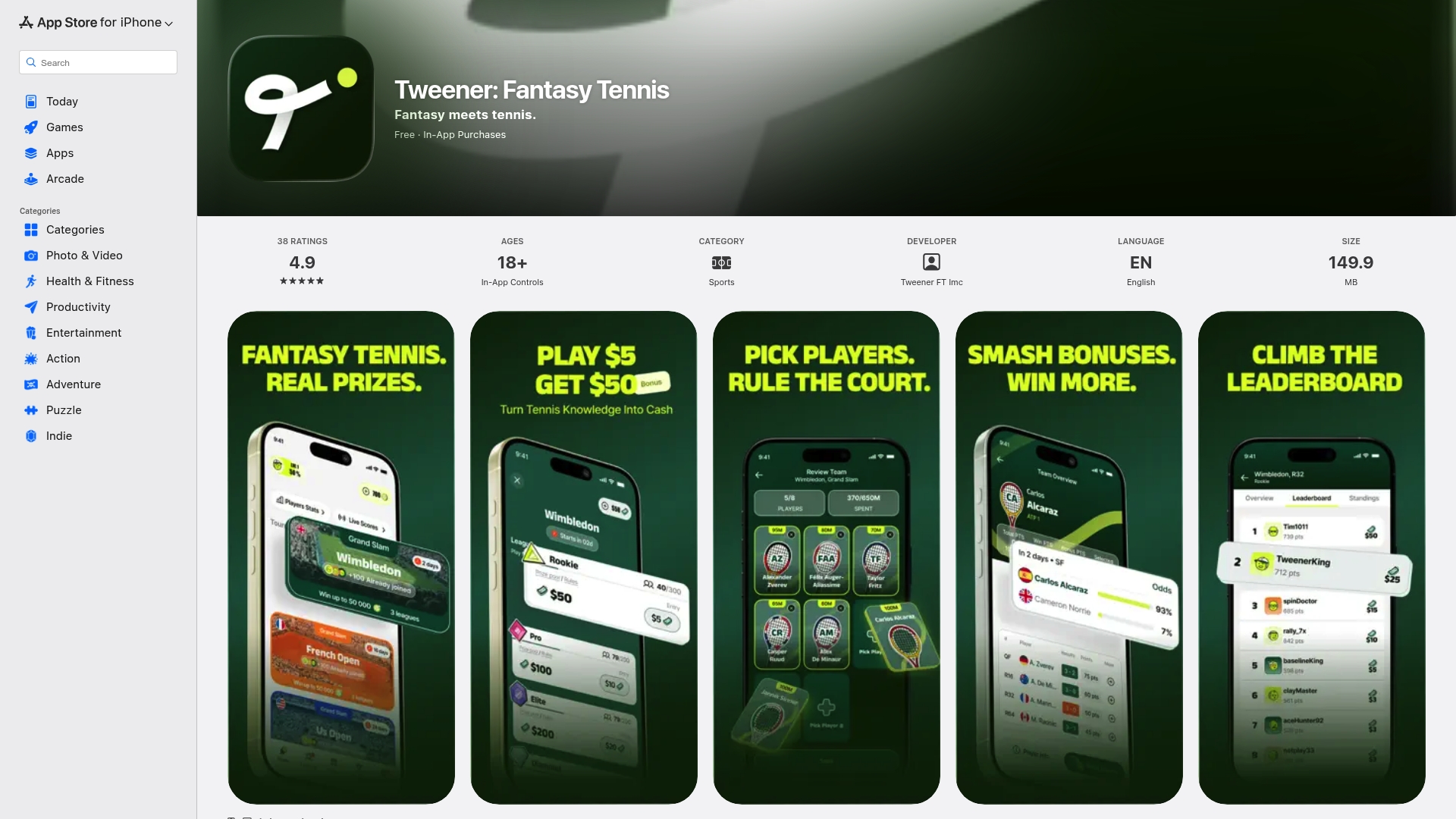
Tweener is a mobile fantasy sports app where you build teams from real ATP and WTA players and compete in public or private leagues tied to live tournaments. You can play in free mode using virtual coins redeemable for gift cards, or enter cash contests for real-money payouts where permitted. Check the Tweener game rules to understand exactly how scoring and chips work on the platform, then download the Tweener app and join your first swing. Your picks are waiting.
Frequently asked questions
How is scoring calculated in tennis fantasy prediction games?
Scoring mirrors ATP points for rounds reached, with bonuses for aces (+2), straight-set wins (+10), and upsets (+20), plus penalties for double faults (-2), bagel losses (-10), and upset losses (-20).
How do team switches and chips work?
You get 2 free switches per week with up to 8 banked, and extra switches cost 50 points each. Chips like Alternates, Triple Bounce, and Swing Switch offer tactical boosts and reset at the start of each swing.
What makes tennis prediction games different from other fantasy sports?
Tennis prediction games use dynamic bonus mechanics tied to surface performance and match events, require active weekly management across swings, and reward strategic chip use in ways that one-off bracket formats simply do not.
How can I win in tennis fantasy leagues?
Balance elite players with surface specialists, activate chips during swings where your picks have clear bonus potential, and differentiate from consensus picks to gain a leaderboard edge. Chips on high-upside swings consistently outperform passive roster management.
When does the tennis fantasy season run?
The official season covers 23 weeks from April to November 2026, divided into four swings covering Clay, Grass, North American Hard, and the Race to Finals, each with its own leaderboards and prizes.
Recommended
- Fantasy tennis tips: build a winning lineup in 2026
- Why predict tennis outcomes to win fantasy leagues in 2026
- Tennis match prediction: 7 strategies for fantasy wins
- Top ATP and WTA fantasy tennis picks for 2026
- Grand National 2026 Pundit Chris Wright Picks His Top Six Tips For Aintree / Naijatipsland
- How to manage sports injury patients effectively in 2026