

TL;DR:
- Tennis prediction games increase match engagement by making fans active participants.
- Playing improves strategic thinking and deepens knowledge of tennis through stats and analysis.
- These games foster global community connections and teach valuable data-driven decision skills.
Watching tennis is already one of sport's great pleasures, but let's be honest: sitting back and passively observing a match leaves a lot of excitement on the table. Tennis prediction games flip that experience completely. Instead of just watching, you're actively invested in every serve, break point, and tiebreak. Prediction games enhance viewing by raising the stakes on every single point. In this article, we'll walk through the top advantages of playing tennis prediction games, from sharpening your knowledge to connecting with fans worldwide, and show you exactly why this is the best way to follow the sport.
Table of Contents
- Boost your match engagement and excitement
- Sharpen your tennis knowledge and strategic thinking
- Connect with a global community and compete socially
- Develop analytical skills with stats and prediction tools
- The real secret: Why prediction games will reshape how you watch tennis
- Ready to try tennis prediction games?
- Frequently asked questions
Key Takeaways
| Point | Details |
|---|---|
| More engaging matches | Prediction games turn every tennis match into a must-watch event by raising the stakes and encouraging active participation. |
| Deeper tennis expertise | Players learn advanced stats, strategic analysis, and develop a coach-like mindset with each pick. |
| Social competition | Joining leagues or leaderboards builds community, sparks rivalries, and makes watching tennis even more fun. |
| Better analytical skills | Using stats and AI tools to make predictions helps fans sharpen decision-making both inside and outside the game. |
Boost your match engagement and excitement
There's a huge difference between watching a match and being in a match. Prediction games create that second feeling without you ever picking up a racket. When you've selected a player for your fantasy lineup or made a bracket pick, every ace they hit and every break they convert feels personal. You stop watching tennis and start experiencing it.
The ATP and WTA tour runs for roughly 11 months of the year, covering dozens of tournaments across multiple continents. That's an enormous amount of tennis to stay engaged with. Prediction games give you a reason to care about a first-round match in a 250-level event just as much as a Grand Slam final. Early rounds matter because your picked players are on the line. Lesser-known players become must-watch names because they might be the underdog pick that earns you a huge points swing.
Fantasy and prediction games turn every match into a must-watch moment and keep fans engaged year-round. That's not an exaggeration. Here's what changes when you play:
- Every ace, winner, and double fault carries fantasy weight
- Upsets become thrilling opportunities rather than disappointments
- You follow players you'd normally ignore
- Match momentum shifts feel like plot twists you predicted or missed
- The final score matters, but so does how the match was played
"The moment you have a player picked in your lineup, a routine third-round match becomes unmissable television."
The fantasy team competitions benefits go beyond just excitement. There's also a real sense of reward when your research pays off and your pick outperforms everyone else's. And if you want to understand what kinds of fantasy sports rewards are actually available, the range might surprise you. Prediction games enhance your viewing experience in ways that passive watching simply can't match.
Sharpen your tennis knowledge and strategic thinking
Engagement goes beyond excitement. Prediction games actually make you a smarter tennis fan, and the learning happens naturally as you compete.
To win consistently, you can't just pick the highest-ranked player and hope for the best. You need to think about surface. Clay specialists like Rafael Nadal historically dominate Roland Garros, while grass court experts thrive at Wimbledon. You need to check recent form, not just season rankings. A player coming off an injury layoff is a very different pick from one who just won back-to-back titles.
Strategic team building and understanding scoring nuances deepen your knowledge faster than years of casual watching. Most fantasy tennis platforms score based on specific stats, and scoring based on aces, winners, and breaks demands genuine analysis of player style, not just reputation.
Here's a sample of how fantasy scoring typically breaks down:
| Stat | Points awarded |
|---|---|
| Ace | 2 pts |
| Winner | 1 pt |
| Break of serve | 3 pts |
| Match win | 20 pts |
| Set win | 5 pts |
| Double fault | -1 pt |
Once you understand this structure, you start watching matches differently. A big server who racks up aces but loses in four sets might still outscore a grinder who wins in three. That kind of nuance is invisible to casual fans but obvious to prediction game players.
Here's how to build your analytical approach:
- Study head-to-head records before picking for a specific matchup
- Check surface win percentages, not just overall rankings
- Look at recent tournament results over the past 8 weeks
- Factor in scheduling: back-to-back tournaments drain players fast
- Review stats like first-serve percentage and break point conversion rates
Pro Tip: Start with building a winning fantasy lineup by focusing on one or two players you know well, then expand your research as you get comfortable with the scoring system.
The more you play, the more you'll find yourself naturally applying tennis lineup strategies and optimizing your fantasy picks based on real data. Resources on choosing tennis players for leagues can accelerate that process significantly.
Connect with a global community and compete socially
Individual enjoyment is powerful, but the social dimension truly sets tennis prediction games apart from any other way of following the sport.
When you join a prediction league, you're not just competing against an algorithm. You're competing against real people, friends, coworkers, and tennis fans from around the world who are all making the same difficult picks you are. That shared experience creates conversation, rivalry, and genuine community.

Prediction games foster competition and social connections with fans worldwide, and the stakes can be serious. Some competitions offer prizes exceeding $5,850 to top finishers. That kind of reward motivates players to research harder, engage more deeply, and stay invested throughout an entire tournament.
Here's how the social experience compares across different formats:
| Format | Social element | Competitive level |
|---|---|---|
| Private friend leagues | High personal rivalry | Casual to moderate |
| Public global leagues | Wide community feel | Moderate to high |
| Tournament brackets | Head-to-head drama | High |
| Season-long fantasy | Deep strategy and loyalty | Very high |
The social benefits of team competitions for tennis fans include:
- Leaderboard rivalries that keep you checking scores daily
- Group chats that turn match nights into shared events
- Friendly trash talk that makes every upset more dramatic
- A reason to watch matches you'd otherwise skip
"There's nothing like the moment your dark horse pick beats a top seed and you jump three spots on the leaderboard."
The community aspect also makes you more accountable. When your friends can see your picks, you're motivated to do your homework rather than guess. That accountability loop is one of the underrated drivers of learning in prediction games.
Develop analytical skills with stats and prediction tools
Competing with others is fun, but the real secret is how prediction games sharpen the way you think about tennis, and about data-driven decision making in general.
Playing prediction games forces you to weigh logic against instinct constantly. Your gut says pick the fan favorite. The stats say their recent form on this surface is poor. That tension is where real analytical thinking develops. Over time, you start trusting the numbers more, and your predictions get sharper.
54% of sports fans say real-time stats improve their sports enjoyment, and AI-powered tools now use over 500 features to generate tennis predictions. That's a massive leap from simply checking a player's ranking before making a pick.
The accuracy gap is real. Traditional rankings are only about 55% accurate in predicting match outcomes, while advanced AI-based models reach 70 to 85% accuracy. That difference can be the margin between winning and losing your fantasy league.
Here's a practical progression for developing your prediction skills:
- Start with basic stats: serve percentage, break points saved, and recent win rate
- Add surface-specific data to your research routine
- Use head-to-head records to identify psychological edges between players
- Incorporate real-time injury and fatigue reports before finalizing picks
- Experiment with AI tools to cross-check your instinct-based picks
Pro Tip: Learning to predict tennis outcomes accurately is a skill that builds over months. Track your picks in a simple spreadsheet so you can review what worked and what didn't after each tournament.
The analytical habits you build through prediction games also transfer. You'll find yourself reading tennis analytics for improvement more naturally and applying tennis match prediction strategies that go well beyond surface-level opinions. These are skills that make you a genuinely informed tennis observer, not just a casual viewer with opinions.
The real secret: Why prediction games will reshape how you watch tennis
Here's something most articles won't tell you: the biggest benefit of tennis prediction games isn't the prizes or the community. It's what losing teaches you.
When you pick a player confidently and they collapse in the third set, you don't just feel disappointed. You start asking why. Was it fatigue? A surface mismatch? A tactical adjustment by their opponent? That curiosity is exactly what turns a casual fan into someone who actually understands tennis at a deep level.
Most fans assume prediction games reward people who already know the sport well. The truth is the opposite. They reward people who are actively curious and willing to be wrong. The fantasy outcomes perspective shifts from rooting for favorites to analyzing probabilities, and that shift changes everything about how you watch a match.
Over time, you'll start noticing things coaches notice: momentum shifts after a missed break point, a player's body language in a tight third set, the tactical adjustments between sets. Prediction games create the motivation to look for those signals. And once you see them, you can't un-see them. That's the real transformation.
Ready to try tennis prediction games?
If everything above sounds like the kind of tennis experience you've been missing, Tweener is built exactly for this. The Tweener fantasy tennis platform lets you create teams from real ATP and WTA players, join public leagues or private competitions with friends, and earn points based on live match results across real tournaments.
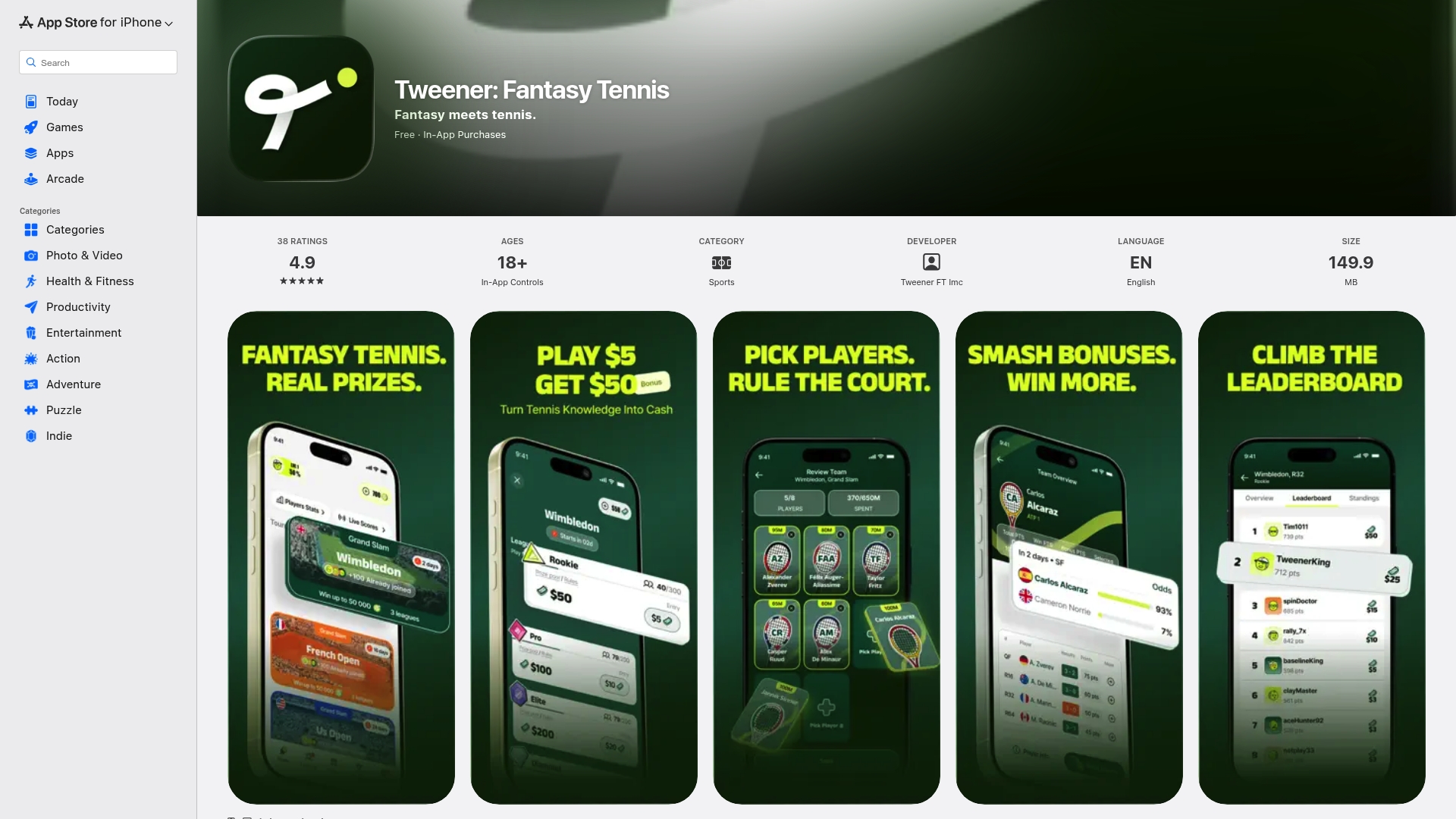
Getting started takes minutes. You can play in free mode using virtual coins, which can be redeemed for rewards like gift cards, or enter cash contests for real-money prizes where available. Whether you want to test your picks against strangers worldwide or settle a rivalry with your tennis crew, the Tweener app has a format for you. Every tournament becomes your tournament when you have skin in the game.
Frequently asked questions
Are tennis prediction games suitable for beginners?
Yes, most games offer simple formats and beginner-friendly tips so new players can jump in and learn as they compete. You don't need to be an expert to start having fun and improving.
Can tennis prediction games really improve my knowledge of the sport?
Absolutely. Playing games that use stats, player form, and surface data naturally deepens your strategy, and advanced stats and player tendencies become second nature the more you play.
How do AI-powered prediction tools enhance fantasy tennis?
AI improves prediction accuracy to between 70 and 85%, giving you a meaningful edge over gut-feel picks and helping you make smarter lineup decisions throughout a tournament.
What can I win by playing tennis prediction games?
Prizes range from bragging rights to real cash, and some competitions offer over $5,850 to top finishers, making the competitive stakes very real for serious players.