

TL;DR:
- Predictive analytics generally outperform gut instinct in fantasy sports decision-making.
- Models use historical data, features, and validation to project player performance accurately.
- Combining analytics with human insights and contextual understanding leads to lasting success.
Most fantasy sports players assume their best weapon is gut instinct. Pick the hot player, follow the buzz, trust the vibe. But the data tells a different story. Managers who apply even basic predictive analytics to their team selections consistently outperform those who rely on hunches alone. In tennis fantasy especially, where surfaces, schedules, and player form shift constantly, the gap between data-driven decisions and gut picks is enormous. This guide breaks down how predictive analytics actually works, which models deliver real results, where the numbers can mislead you, and how to apply all of it to your fantasy tennis lineup today.
Table of Contents
- How predictive analytics transforms fantasy sports
- Popular models and methods: Which approaches deliver results?
- Edge cases and model limitations: When the numbers lie
- Winning with analytics: Practical applications for fantasy tennis
- The nuance experts know: Blending analytics and intuition for lasting success
- Try analytics-powered fantasy tennis with Tweener
- Frequently asked questions
Key Takeaways
| Point | Details |
|---|---|
| Analytics boost consistency | Using data-driven models gives fantasy players a more reliable edge than pure gut instinct. |
| Models have blind spots | Analytics struggle with small sample sizes and unpredictable human factors, so smart judgment is still crucial. |
| Best results mix data and intuition | Top managers combine predictive insights with personal observation to fine-tune every pick and trade. |
| Tennis requires context | In tennis fantasy, pay special attention to surface, schedule, and player form, not just model rankings. |
How predictive analytics transforms fantasy sports
Predictive analytics sounds technical, but the core idea is straightforward. You use historical data to build a model that estimates how a player will perform in the future. In fantasy sports, that means turning raw stats into actionable projections before you ever set your lineup.
The process has several key stages. Predictive models in fantasy sports rely on feature engineering, historical baseline construction spanning at least three seasons, model training using methods like OLS regression and XGBoost, probability distribution assignment, and validation metrics like MAE and RMSE. Each step builds on the last.
Here is what each stage actually means for you as a fantasy manager:
- Feature engineering: Identifying which stats actually predict future performance. In tennis, that might be first-serve percentage on clay, break point conversion rate, or recent win streaks.
- Historical baseline: Building a reliable picture of a player's typical output over multiple seasons, not just last week's match.
- Model training: Feeding that data into algorithms that find patterns. OLS regression finds linear relationships. XGBoost handles more complex, nonlinear patterns. Think of OLS as a straight ruler and XGBoost as a flexible curve.
- Validation: Testing whether the model actually works on data it has never seen before. MAE (mean absolute error) and RMSE (root mean square error) measure how far off predictions tend to be.
"The best models don't just predict averages. They assign probabilities to a range of outcomes, so you know not just who is likely to score well, but how confident you should be in that projection."
Why does this matter for tennis fantasy specifically? Because tennis has more variables than most sports. Surface type, opponent ranking, tournament round, travel fatigue, and even altitude all influence outcomes. If you want to follow tennis analytics seriously, understanding these mechanics is the foundation.
The good news is that you do not need to build models yourself. Plenty of tools and platforms surface these projections for you. Your job is to understand what the numbers mean and how to apply them, which is exactly what the next sections cover.
Popular models and methods: Which approaches deliver results?
With the basics in mind, it becomes crucial to understand which tools actually work. Here's how top models stack up in practice.
Different modeling approaches suit different fantasy contexts. Here is a comparison of the most widely used methods:
| Model | Strengths | Common use cases | Typical performance |
|---|---|---|---|
| OLS regression | Simple, interpretable | Baseline projections, linear stats | Moderate accuracy |
| XGBoost | Handles complex patterns, fast | Player scoring predictions | High accuracy |
| Random forest | Robust to noise, avoids overfitting | Multi-variable player profiles | High accuracy |
| ARIMA | Captures time trends | Form streaks, rolling averages | Good for sequences |
| MIP optimization | Budget-aware team building | Full roster construction | Consistent returns |
For fantasy soccer, linear regression and XGBoost applied to features like expected goals achieve strong accuracy, while ARIMA with rolling windows and budget constraints produces consistent out-of-sample results in team selection. In daily fantasy football, AI models turn profit in 81.3% of game-weeks across four seasons, with RMSE between 5 and 8 points per player.
Those are impressive numbers. But how do you actually apply this to your fantasy tennis decisions? Follow these steps:
- Gather projections: Find a reliable source that publishes player projections for the upcoming tournament, factoring in surface and draw.
- Rank by value: Compare projected points to the player's cost or roster percentage. High projection at low ownership equals high value.
- Filter by surface: Prioritize players with strong records on the current surface. A clay specialist at Roland Garros is worth far more than their ranking suggests.
- Check recent form: Use rolling window data, not season averages. A player who won three of their last four matches carries more momentum than their yearly stats show.
- Finalize with budget logic: MIP-style thinking means building the best possible team within your constraints, not just picking the top five names.
For more specific fantasy tennis tips on applying these steps to your lineup, it helps to see real player examples broken down by surface and form.
Pro Tip: Do not just look at who the model projects highest. Look at the ratio of projected output to roster cost or ownership. That ratio is where real edges hide.
Edge cases and model limitations: When the numbers lie
Of course, analytics aren't infallible. Let's see where common traps lie and the crucial role for human insight.
Every model has a breaking point. In tennis, those breaking points come up more often than you might expect. Understanding them is just as important as understanding the models themselves.

Small sample sizes cause overfitting, where complex models fit noise instead of real patterns. Tennis seasons are short compared to team sports, meaning a player might have only 15 to 20 matches on a given surface per year. That is not much data to build reliable projections from.
Here are the most common scenarios where analytics break down:
- Injury surprises: No model predicts a mid-tournament withdrawal or a player managing a hidden physical issue.
- Lineup and draw changes: A favorable draw can inflate projections. A tough early-round matchup can destroy them.
- Recency bias: Models that weight recent matches too heavily can overreact to a single strong performance.
- Emotional and mental factors: Pressure, personal circumstances, and rivalry dynamics are nearly impossible to quantify.
- Low-data matchups: When two equally ranked players meet on a neutral surface, no model beats a baseline prediction. The data simply does not differentiate them well enough.
"AI is superior in consistency and consensus, but humans hold the edge in situational awareness. The best fantasy managers use both."
This is where your judgment matters. You can predict tennis outcomes more accurately when you combine model outputs with what you actually know about a player's current situation. Is a top seed coming off a long clay swing before a hard-court event? Has a player been vocal about fatigue in press conferences? Models miss these signals entirely.
Pro Tip: Treat model projections as a starting point, not a final answer. Use them to narrow your options, then apply your own knowledge to make the final call. Learning to optimize tennis fantasy picks means knowing when to trust the data and when to override it.
Winning with analytics: Practical applications for fantasy tennis
Armed with this knowledge, here's exactly how you can put analytics to work in fantasy tennis for a consistent edge.
The gap between knowing about analytics and actually using them is where most fantasy managers get stuck. Here is a concrete framework for turning projections into better picks.
Start with value-based drafting. Instead of picking the highest-ranked player, pick the player whose projected fantasy points most exceed their expected cost or ownership. This is how you build lineups that outperform the field, not just mirror it.
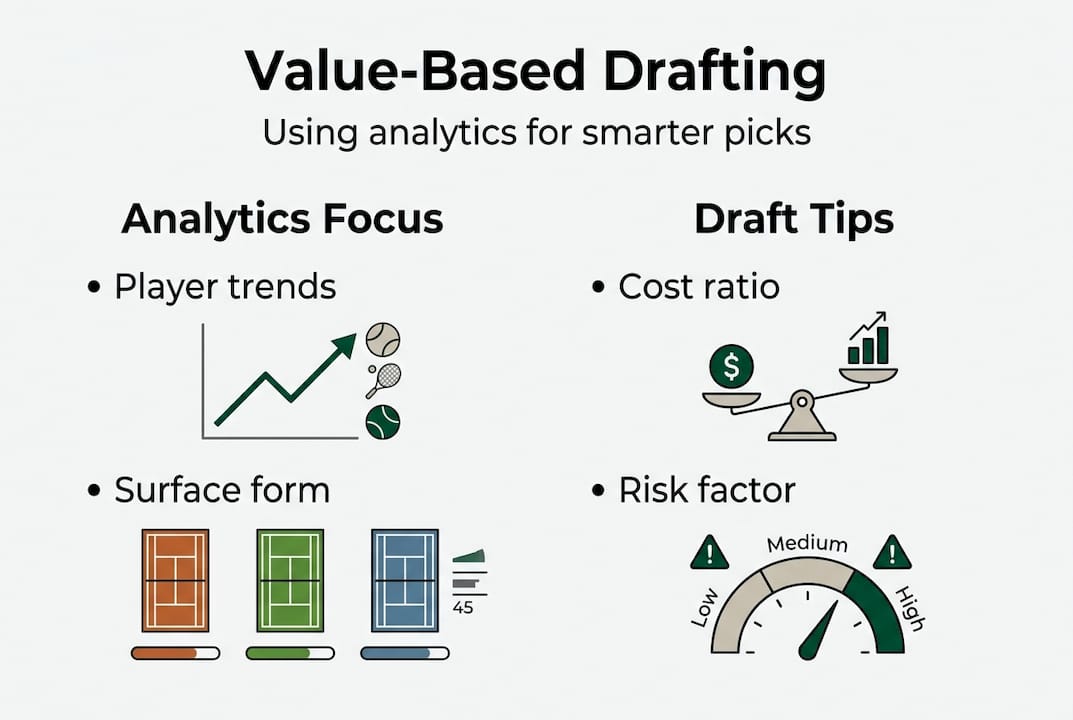
Here is an example player profile breakdown:
| Player | Surface record | Recent form | Projected points | Risk factors |
|---|---|---|---|---|
| Clay specialist (top 20) | 68% win rate on clay | Won last 4 clay matches | High | Low draw difficulty |
| Hard court all-rounder (top 30) | 55% win rate on hard | 2 wins, 2 losses last month | Medium | Potential fatigue |
| Grass specialist (top 50) | 72% win rate on grass | Strong Wimbledon history | High | Early round volatility |
Use this kind of breakdown when making your picks. The numbers tell you who is likely to perform. The risk column tells you where you need to think harder.
For weekly adjustments, follow these steps:
- Review the draw early: Identify which players have favorable first and second-round matchups based on head-to-head data.
- Check waiver targets: Look for players with high opportunity but recent underperformance. They often bounce back fast.
- Trade on narrative, not just stats: Sell players riding a lucky streak. Buy players whose underlying numbers are strong but results have not followed yet.
- Plan around Grand Slams: The best fantasy value often comes from tennis match prediction strategies built around deep runs in majors, where points accumulate across multiple rounds.
Pro Tip: Spend more analytical energy on second-tier players than on the top five seeds. Everyone picks the stars. The edge is in finding the value picks at positions 10 through 30 in the rankings. Learning how to choose tennis players at those tiers is where leagues are won. And do not overlook smart captain picks as a multiplier for your best analytical call each round.
The nuance experts know: Blending analytics and intuition for lasting success
Here is the uncomfortable truth most analytics content skips. Copying model outputs without understanding them is one of the most common mistakes fantasy managers make. You end up chasing projections that were already priced in by the rest of the field, which means no edge at all.
Elite fantasy managers do something different. They use analytics as guardrails, not gospel. They look at what the model says, then ask why. If a projection seems off, they investigate. Maybe the model does not account for a player's poor record against left-handers. Maybe it missed a scheduling quirk. That kind of critical reading of data is a skill, and it takes practice.
The best players also build narratives around the numbers. They combine surface data, form trends, and draw analysis into a coherent story about why a player is likely to outperform. That story guides decisions even when the data gets noisy. Understanding fantasy tennis terms deeply enough to question projections is what separates consistent winners from lucky ones. Analytics give you the map. Judgment tells you when the road has changed.
Try analytics-powered fantasy tennis with Tweener
Ready to put these strategies to work? Here's the simplest way to get started.
Tweener is built for exactly the kind of data-aware fantasy tennis player this guide is speaking to. The platform lets you build teams from real ATP and WTA players, compete in public and private leagues, and earn points based on live tournament results.
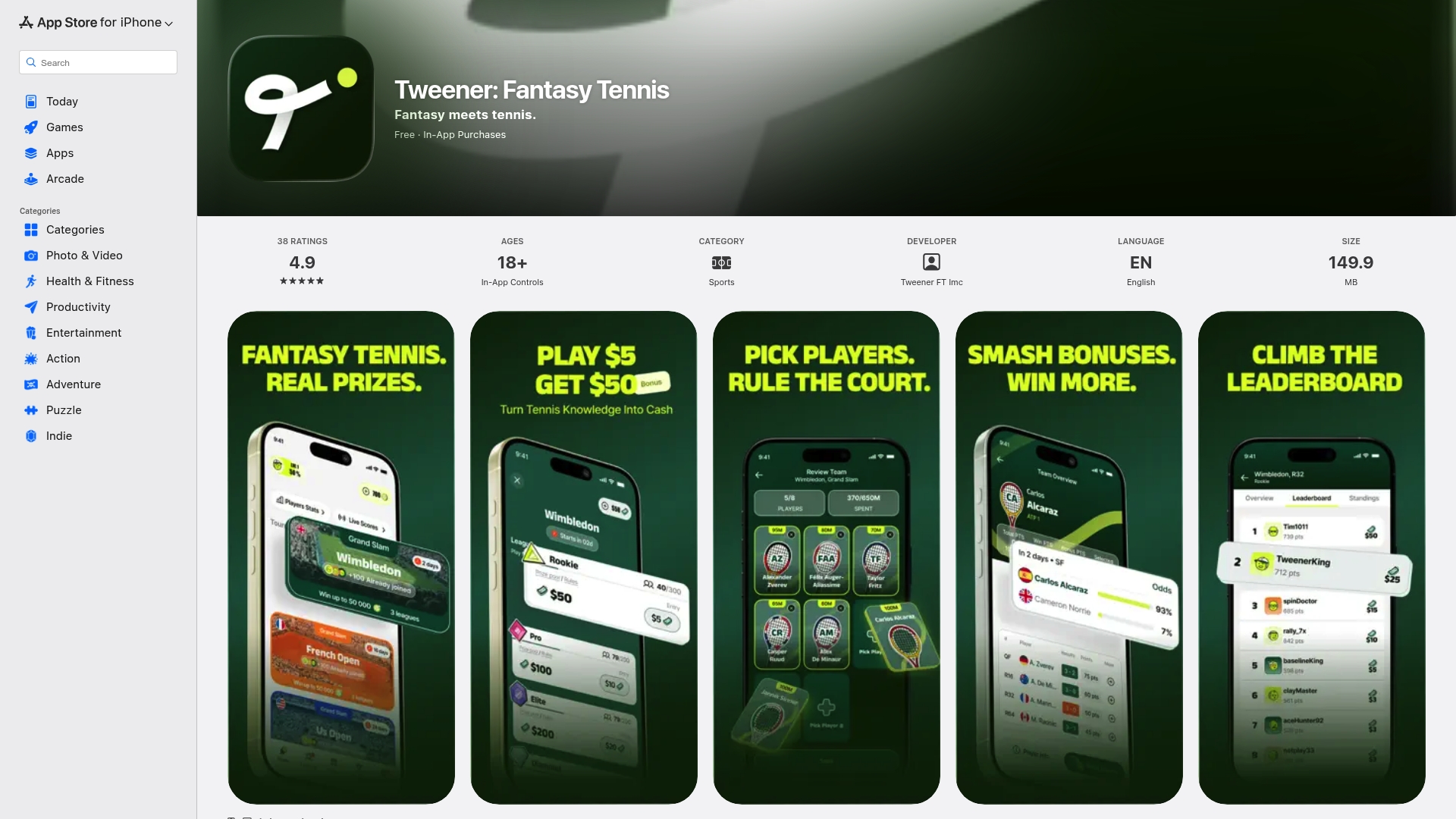
Whether you want to test your analytics skills risk-free using virtual coins or compete for real-money prizes in cash contests, Tweener gives you the arena to do it. You can join today on the Tweener fantasy platform or grab the Tweener app and start applying everything you have learned here to a real lineup before the next tournament begins.
Frequently asked questions
What types of data power predictive analytics in fantasy sports?
The main inputs include opportunity metrics, player statistics, historical performance, and event-specific features. In tennis fantasy, surface type, head-to-head records, and recent form are among the most important predictive model features.
How accurate are predictive models for fantasy sports outcomes?
AI models in daily fantasy typically achieve RMSE between 5 and 8 points per player and generate profit in over 80% of game-weeks when optimized. Accuracy drops significantly in volatile or low-data scenarios.
How can predictive analytics help in tennis fantasy compared to other sports?
Analytics are especially useful for identifying surface specialists and form trends, though they struggle in matchups between equally ranked players. Prioritizing surface specialists and Grand Slam scheduling gives tennis fantasy managers a clear analytical edge.
What is the biggest pitfall when using predictive analytics in fantasy sports?
The biggest risk is overfitting, where a model learns noise instead of real patterns due to small sample sizes. Ignoring situational context like injuries, draw changes, and player fatigue compounds the problem significantly.