

TL;DR:
- Fantasy tennis scores are directly influenced by real match results and match-specific events.
- Understanding platform-specific scoring rules and triggers is essential for building effective lineups.
- Deep analysis of surface performance, recent form, and match data provides a strategic advantage.
Most fantasy tennis players spend hours debating which big names to pick, convinced that star power alone wins leagues. That instinct is understandable but wrong. Every point you earn or lose in fantasy tennis traces directly back to what happens on the court: whether your player aced their opponent on the first serve, dropped a set, or made a deep run at a Masters 1000 event. The real match is not a backdrop to your fantasy experience. It is the engine that runs the whole thing. This article breaks down exactly how live results feed into fantasy scoring and how you can use that knowledge to make sharper decisions every single week.
Table of Contents
- How real match results shape fantasy tennis scoring
- Key scoring systems and their real-match triggers
- Strategic team selection: Using real match data for an advantage
- Edge cases, quirks, and expert tactics
- Why the details of real match results matter more than most fantasy managers realize
- Take your fantasy tennis strategy further with Tweener
- Frequently asked questions
Key Takeaways
| Point | Details |
|---|---|
| Live matches drive scoring | Every swing and result in real tennis determines fantasy points for your team. |
| Know the scoring system | Understanding platform-specific scoring rules is the key to smart team building. |
| Data boosts strategy | Using real-world stats, like ace-to-double-fault ratios and recent form, gives you a real advantage. |
| Beware rule quirks | Edge cases and special bonuses can change outcomes—read the fine print before drafting. |
How real match results shape fantasy tennis scoring
Fantasy tennis is not built on vibes or reputations. Every point in your fantasy lineup flows from something that actually happened during a live match. A player bagels an opponent in the first set? That difference shows up in your game-by-game score. A top seed exits in the second round? Your carefully chosen pick starts bleeding points. Understanding this connection is the first and most important step toward becoming a consistently competitive fantasy manager.
The tournament progression points mirror ATP/WTA ranking points, meaning a Masters 1000 title is worth 1000 fantasy points while an ATP 250 finalist earns around 165. This structure rewards players who go deep in higher-prestige events far more than those who make early exits at small tournaments. Picking a player who consistently reaches semifinals at big events will outperform a flashier name who crashes out in the opening rounds week after week.
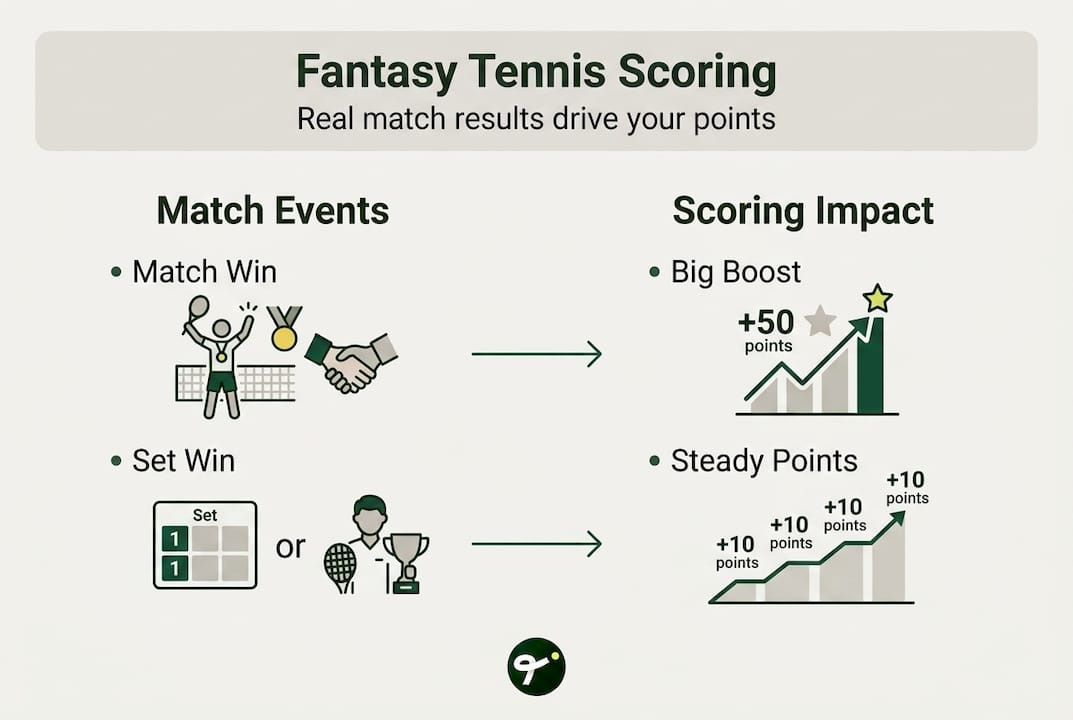
Most platforms track scoring across several categories. Here is a breakdown of the core stats that translate directly into fantasy points:
| Real match event | Fantasy scoring impact |
|---|---|
| Match win | Large positive boost |
| Set win | Moderate positive points |
| Set loss | Moderate negative points |
| Game won | Small positive per game |
| Game lost | Small negative per game |
| Ace served | Small positive per ace |
| Double fault | Small negative per fault |
For a practical example, consider this PrizePicks scoring breakdown: a match played earns +10, each game won adds +1, each game lost subtracts 1, a set win gives +3, a set loss takes away 3, an ace adds 0.5, and a double fault removes 0.5. Match wins heavily boost totals across the board.
Key stats that most directly shape your fantasy score:
- Match wins and losses are the highest-leverage events in almost every scoring system
- Sets won and lost create a substantial swing, especially in five-set Grand Slam matches
- Games won and lost accumulate quickly and can separate two otherwise similar players
- Aces matter most for big servers on fast surfaces like grass and indoor hard courts
- Double faults quietly drain points from players who struggle with serve consistency
"The difference between a player who wins 6-3, 6-2 and one who grinds through 7-6, 4-6, 7-6 is not just a reflection of match quality. In fantasy terms, it can mean a swing of 15 or more points depending on the platform."
This is why the best fantasy managers follow live scores rather than just checking results the next morning. Real-time data changes how you think about your lineup and your understanding of the fantasy prize structures available on competitive platforms.
Key scoring systems and their real-match triggers
Every fantasy platform applies its own weighting to the same real-world events. Two managers watching the exact same match can walk away with completely different fantasy scores depending on which platform they are using. This is one of the most overlooked factors in fantasy tennis, and it creates a significant gap between casual players who treat all platforms the same and serious competitors who read the rulebook carefully before building any lineup.
Each stat in PrizePicks tennis fantasy is tied directly to real play and weighted by the platform's specific rules. That means a serve-heavy player who racks up 20 aces might score extremely well on one platform and only moderately on another that weighs aces less aggressively.
Here is a comparison of how common real-match triggers translate across different fantasy tennis scoring approaches:
| Scoring trigger | Points-heavy system | Stat-based system |
|---|---|---|
| Match win | +25 to +50 | +10 to +15 |
| Tournament advancement | Tiered by round | Often flat bonus |
| Ace served | +1 per ace | +0.5 per ace |
| Double fault | Varies | -0.5 per fault |
| Upset bonus (seeded over unseeded) | +10 to +20 | Varies or absent |
To get ahead of the curve, follow these steps when evaluating any new fantasy tennis platform before your next draft:
- Read the full scoring rules, not just the summary. Platforms often bury important details like upset bonuses or surface-specific modifiers deep in their FAQ pages.
- Identify the highest-value triggers for that specific system. If tournament advancement gives huge bonuses, deep-run players become premium picks.
- Calculate the ace-to-double fault ratio impact by running the math on a typical match for your target player.
- Compare the scoring between match formats, since Grand Slams with best-of-five sets create very different point totals than best-of-three ATP 250 events.
- Check for platform updates before each tournament, as some systems adjust rules between events without major announcements.
Pro Tip: Before you lock in a single pick, spend ten minutes reading your platform's complete scoring rules. You will almost certainly find at least one trigger you had not considered, and that discovery could change your top selection entirely.
Strong fantasy tennis lineup tips always start with this foundation. No amount of player analysis will save you if you are optimizing for the wrong scoring categories.
Strategic team selection: Using real match data for an advantage
Once you understand how scoring works, the real strategic layer kicks in. This is where you shift from passive fan to active analyst. You are no longer just watching a match for entertainment. You are reading it as a data source that tells you which players are trending up, who has found their serve rhythm, and who is quietly falling apart under pressure.

The most important principle in strategic team selection is prioritizing players likely to make deep runs, with emphasis on surface-specific performance, ace-to-double-fault ratios, and recent form heading into the tournament. This is a framework, not a checklist. It requires you to think holistically about each pick.
Here is how to build that analysis into your selection process:
- Surface performance matters enormously. Big servers on grass and fast indoor surfaces generate far more aces and shorter points, which directly pumps up your scoring. A player who averages 12 aces per match on grass might average only 5 on clay, meaning your expected fantasy score shifts dramatically just based on where the tournament is played.
- Recent form tells you more than rankings. A player ranked 15th in the world who has won three of their last five tournaments is in significantly better shape than a top-10 player returning from a three-week injury layoff. Rankings reflect long-term history; recent results reflect current reality.
- Head-to-head match data reveals psychological advantages. Some players consistently outperform their ranking when facing specific opponents, which creates predictable upset opportunities worth targeting.
- Draw analysis unlocks hidden value. A player in a weak section of the draw has a realistic path to the quarterfinals without meeting a top-5 seed. That deep run is worth far more fantasy points than a first-round exit against the world number one.
Stat to know: Players in the top 10 of their surface-specific rankings win approximately 68% of their matches on that surface, compared to 52% on their least-favored surface. Picking a player on their best surface is not just intuition. It is statistical edge.
Pro Tip: Always check prior tournament results on the same surface before finalizing your team. If a player consistently exits before the quarterfinals at clay court events, that pattern is unlikely to reverse itself just because you picked them.
You can sharpen your edge further by studying resources on drafting tennis players and understanding the frameworks behind choosing tennis players that consistently outperform their seed in fantasy formats.
Edge cases, quirks, and expert tactics
Even experienced fantasy managers leave points on the table by ignoring the finer details of how scoring systems behave at the edges. These quirks are not bugs. They are features of the system that reward managers who take the time to understand them fully.
The most important edge case to understand is how upset bonuses actually work. Most people assume any upset earns bonus points, but that is not how it works. Upset bonuses apply only for seeded vs. unseeded matchups, and lower seeds face significant penalties if they lose to unseeded players, sometimes as harsh as minus 20 points at ATP 250 events. This means picking a fringe seeded player at a small tournament carries more risk than picking that same player at a Grand Slam.
Key edge cases every serious fantasy manager should know:
- No reward for break points or return quality. Most fantasy platforms score only serve statistics, which heavily favors players who rely on their serve rather than their return game. Rafael Nadal-style returners may be undervalued in serve-heavy scoring systems.
- Bagel sets earn no special bonus. Winning 6-0 earns game points but no additional reward for the shutout, so the extra domination is only reflected incrementally rather than with a special multiplier.
- Bonus Ball or equivalent multipliers can double a single player's value. Platforms that include a "Bonus Ball" or "Captain" feature allow you to double the points earned by one player. Choosing the right player for this slot is often the single biggest decision in your lineup.
- Scoring rules can shift between tournaments. Some platforms adjust their rules at Grand Slams versus ATP 1000 events. A rule that applied at Wimbledon may not apply the same way at the US Open.
"The biggest mistake intermediate managers make is assuming the rules that worked at one tournament apply everywhere. Checking the rules before each event is not optional. It is the minimum requirement for serious play."
Surface context matters for ace production too, with grass court events generating substantially higher ace totals than clay. A serve-heavy player's ace-to-double-fault differential essentially doubles in value on grass compared to clay, so recalibrate your picks with every new surface.
For optimizing tennis fantasy picks, developing a pre-tournament checklist that includes a review of the scoring rules, the draw, and surface-specific stats will consistently outperform gut instinct. You can also refine your match prediction strategies by tracking how specific players perform in different rounds rather than just looking at their overall win-loss record.
Why the details of real match results matter more than most fantasy managers realize
Most fantasy managers spend the majority of their preparation time debating star players. Big names, famous rivalries, marquee matchups. It feels productive. It almost never is. The players who consistently win competitive fantasy leagues are not the ones who picked the biggest stars. They are the ones who understood, in precise detail, how their platform rewarded specific real-match events.
The ATP Fantasy structure mirrors official rankings but has drawn criticism for lacking break-point rewards and featuring asymmetric bonuses, such as no special recognition for winning a bagel set. These are not minor footnotes. They are structural features that systematically undervalue certain types of players and overvalue others. Managers who know this tilt their lineups accordingly. Those who ignore it keep picking the same stars everyone else is picking and wondering why they finish in the middle of the standings.
True competitive edge in fantasy tennis comes from knowing where the scoring system creates gaps between real-world excellence and fantasy value. A player who wins ugly through break-point conversions may be elite on tour but mediocre in a serve-focused fantasy system. Recognizing that disconnect is a skill. Building your team around it is a strategy. Ignoring the essential skills for fantasy tennis that separate casual play from serious competition will keep you from reaching your potential as a manager. The players who genuinely love studying this sport and its statistics are the ones who unlock the biggest advantages.
Take your fantasy tennis strategy further with Tweener
Knowing the theory behind fantasy tennis scoring is one thing. Actually applying it across multiple tournaments, tracking live match data, and making smart picks before deadlines requires the right platform. Tweener brings all of that together in one place.
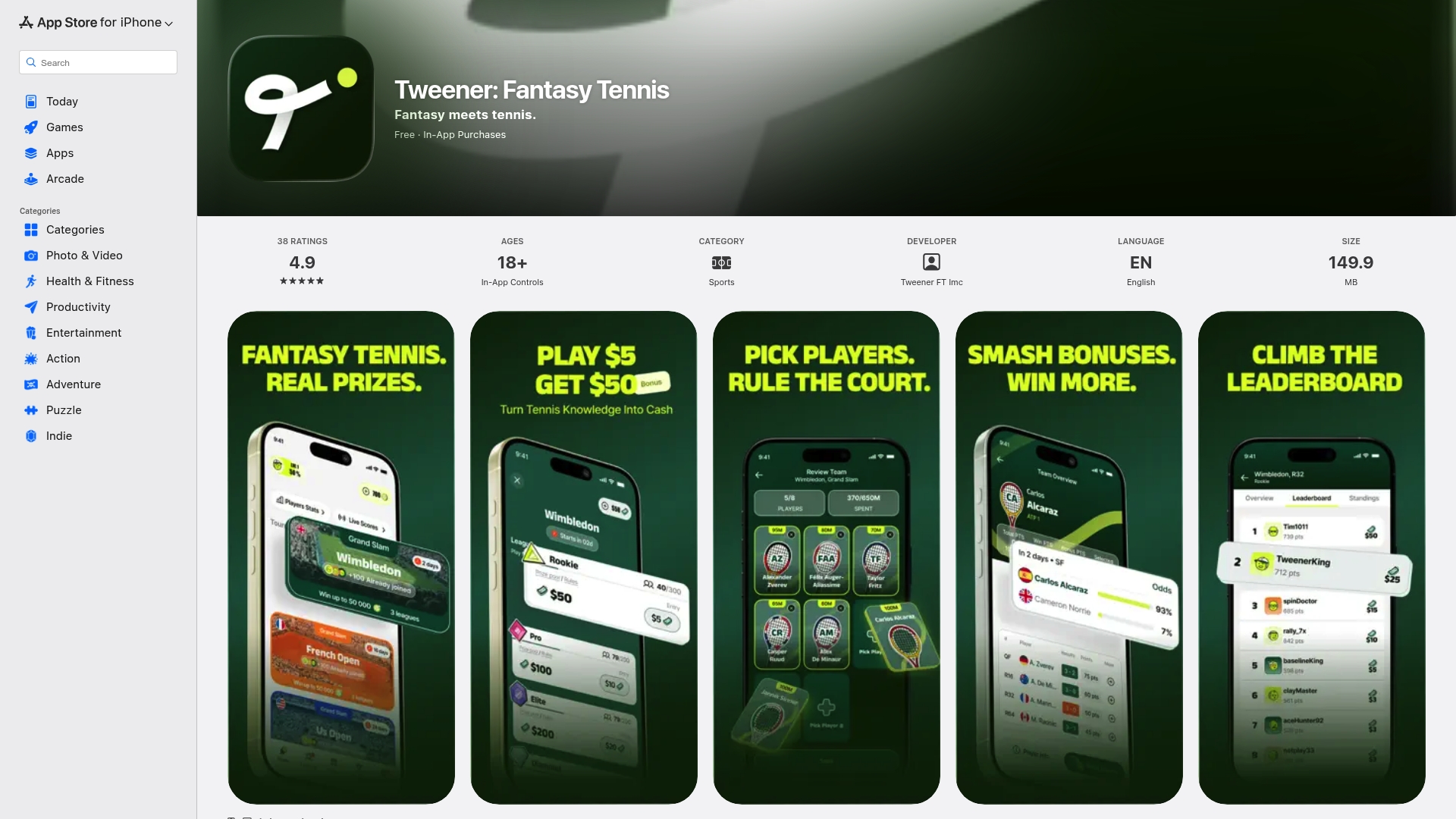
With Tweener, you can build your team from real ATP and WTA players, compete in public leagues or private leagues with friends, and earn points based on live match performance. The platform supports both free-to-play competition using virtual coins and cash contests for real-money prizes where permitted. Every strategic insight in this article becomes immediately actionable when you have a platform that tracks live results in real time. Download the Tweener app today and see how the Tweener fantasy platform turns every live match into a competitive opportunity.
Frequently asked questions
How do real tennis match results affect fantasy scores?
Fantasy tennis scores are determined directly by match events such as wins, sets, games, aces, and double faults based on the fantasy platform's rules. Tournament progression points mirror ATP/WTA ranking points, meaning a Masters 1000 title generates far more fantasy value than a first-round exit at a smaller event.
What happens in fantasy if my player loses in an upset?
Many fantasy systems add bonuses for upsets but may penalize lower seeds heavily if they lose to unseeded players. Lower seeds at ATP 250s can face up to a minus 20 penalty for losing to unseeded opponents, making fringe seeded picks riskier than they appear.
Which real statistics matter most for fantasy tennis?
Match wins, ace-to-double-fault ratios, and surface-specific performance are the most impactful for scoring and team selection. Prioritizing deep runs on appropriate surfaces for each player type consistently outperforms simply picking high-ranked names.
Are all platforms' fantasy scoring rules the same?
No, each platform uses different scoring triggers and weighting, so always check the official rules before drafting your lineup. For example, PrizePicks scores tennis fantasy with a match played earning +10, game wins adding +1, and aces contributing +0.5, which differs significantly from other platform structures.