

Winners build their squads before the week starts, not during it. The teams that top ATP Fantasy leaderboards get their credit allocation and player roles locked in early, then deploy chips and switches at specific, high-leverage moments rather than reacting to every headline. That's the entire game in one sentence, but the details of how to do it well are where most managers leave points on the table.
A few micro-rules separate consistent winners from streaky ones:
- Save Triple Bounce for a player with a realistic deep-run path at a major swing event, not a random mid-tier week.
- Put Bonus Ball on your highest-upside starter, not automatically your most expensive one.
- Treat your two free weekly switches like savings, not spending money. Let them roll before burning one reactively.
- Build your floor first with high-hold-rate anchors, then spend leftover credits on volatility.
- Run a post-mortem after every winning week. Luck and skill look identical in the moment. They don't look identical a week later.
Team selection alone drives roughly 80 to 100 percent of scoring variance across a season, according to Tweener's own analysis of fantasy tennis outcomes. That single number should reframe how you spend your time each week.
Key Takeaways
Winning ATP Fantasy managers build structurally sound lineups before the week starts and reserve chips for specific, high-leverage tournament moments instead of reacting mid-week.
| Point | Details |
|---|---|
| Structure beats reaction | Team selection accounts for most scoring variance, so build your roster carefully before the week, not during it. |
| Use roles, not reputation | Anchor with high-hold-rate players, then spend leftover credits on one volatile ceiling attacker. |
| Save chips for leverage | Deploy Triple Bounce and Swing Switch at genuine deep-run or surface-transition moments, not casually. |
| Respect switch economics | Let your two free weekly switches roll toward the cap of eight instead of paying 50 points reactively. |
| Run a real post-mortem | Break down attribution, credit allocation, and chip impact after every strong week to separate skill from variance. |
| Practice it in Tweener | Tweener's private leagues and analytics tools give you a repeatable place to apply and test this framework each swing. |
Table of Contents
- How Learning From ATP Fantasy Wins Starts With Scoring Mechanics
- Building A Squad: Anchors, Attackers, Stacks, And Alternates
- Timing Chips And Switches So They Actually Pay Off
- Planning A Swing: Surface Fit And Draw Analysis
- What To Check In The Final Hour Before Lock
- How Winners Break Down A Winning Week
- Mistakes That Quietly End Winning Runs
- What Discipline Actually Looks Like Over A Season
- Put These Rules To Work In Tweener
- Where To Verify The Rules And Dig Deeper
- Sources
- FAQ
How Learning From ATP Fantasy Wins Starts With Scoring Mechanics
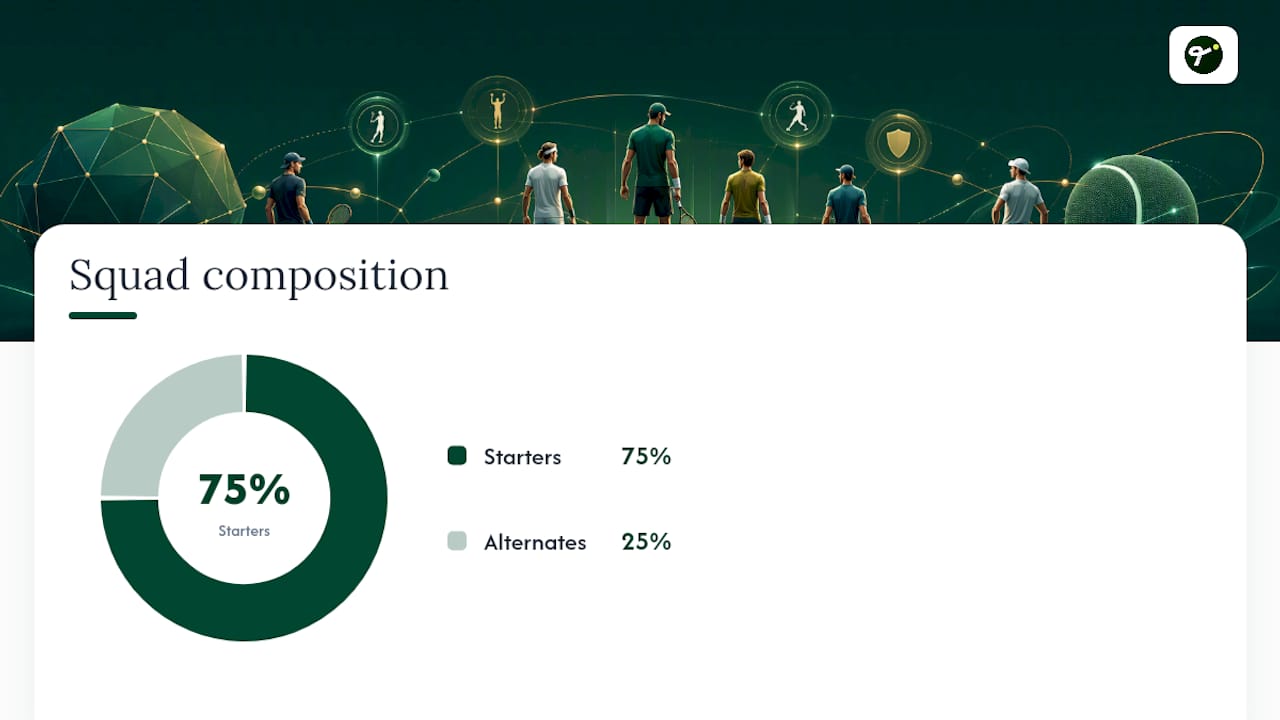
You can't learn from a winning lineup if you don't understand what actually generated the points. ATP Fantasy gives every manager 100 credits to build a squad of six starters plus two alternates, and those alternates aren't bench decoration. When a starter withdraws or gets scratched, an alternate steps in and scores full points, which means alternates function as insurance and as a second bite at value.
The scoring itself rewards specific in-match behavior, not just winning. Aces typically add a small bonus per shot, straight-sets wins carry a bigger bonus, and there's extra upside built into upset wins, while double faults and bagel sets carry penalties. That structure matters because it tells you which player types generate asymmetric returns. A big server racking up aces in a routine straight-sets win can outscore a grinder who needed three tight sets to advance.
Switches add another layer of strategy. Managers get two free switches per week that roll over to a cap of eight, and any switch beyond your free allotment costs 50 points.
| Mechanic | Rule |
|---|---|
| Squad budget | 100 credits total |
| Roster size | 6 starters plus two alternates |
| Free switches | 2 per week, rolling cap of 8 |
| Extra switch cost | 50 points each |
| Ace bonus | Small bonus per ace served |
| Straight-sets bonus | Larger flat bonus for a clean win |
That 50-point penalty is steep. It's often worth more than a single ace bonus, which is why reactive mid-week trading quietly wrecks otherwise solid weeks.
Pro Tip: Read the scoring table like a job description for each roster slot. If a player's game generates lots of aces and quick sets, they're built for a "ceiling" role. If they grind out long, close matches, they're a floor piece, not a points machine.
Building A Squad: Anchors, Attackers, Stacks, And Alternates
Every winning lineup breaks down into four roles, and mixing them intentionally is what separates a repeatable process from guesswork. Anchors are your dependable, high-floor picks, usually players with hold rates above 80 percent who rarely blow up a week. Ceiling attackers are the volatile, high-upside servers or underdogs who can post a monster score if their match breaks right. Game stacks are picks chosen because their likely match length (a tight three-setter, a possible fifth set at a Slam) inflates raw game and point counts. Alternates round it out as both insurance and a second lane for scoring.
A workable credit split under the 100-credit cap looks something like this: commit roughly 45 to 55 percent of your budget to two anchors you trust to deliver every week, set aside another 20 to 25 percent for one ceiling attacker who could single-handedly win you the week, and spread the rest across value picks and your two alternates. That's not a rigid formula, but it's a useful starting ratio before you adjust for a specific draw.
Pricing compression changes this math more than most managers realize. When the game's algorithm prices multiple top players closer together than their actual skill gap suggests, rostering two or three superstars together becomes viable instead of forcing an artificially balanced spread across price tiers. Ignoring that compression and spreading credits evenly "for safety" is one of the more common ways cautious managers underperform.
To screen candidates fast, focus on a short list of numbers instead of reputation:
- Hold rate: percentage of service games won, a strong floor indicator.
- Ace-to-double-fault differential: separates players who win free points from those who give them away.
- Surface-specific win percentage: a player's clay results tell you nothing about their grass ceiling.
Dominic Thiem, serving as the game's official fantasy coach, has pointed to tournament-specific history and surface fit as more predictive than raw ranking, and that lines up with how the framework above is built.
Pro Tip: Keep a running shortlist of 15 to 20 players scored against these three metrics before each swing. Refreshing that list weekly beats scrambling for stats an hour before lock.
Timing Chips And Switches So They Actually Pay Off
Chips reset at the start of every swing, which is a design choice that rewards saving them for the right moment instead of firing them off in week one. Here's how the main tools tend to work best in practice:
- Bonus Ball. Doubles a starter's points. Place it on upside and match path, not price. A top seed with a soft draw beats a pricier player facing a brutal quarter, since smart placement follows probability, not sticker cost.
- Triple Bounce. Best deployed on a Bonus Ball pick you're fairly confident will make a deep run, ideally at a Grand Slam or a marquee Masters event where the points ceiling is highest.
- Alternates chip. Use it when your bench options have believable paths to actual playing time, not as a late-week panic move after a withdrawal already happened.
- Swing Switch. Hold it for genuine surface transitions, like moving from clay into the grass swing, rather than spending it mid-swing on a single bad week.
- Weekly switches. Let your two free switches accumulate toward the eight-switch cap during stretches where your roster is performing. Spend them deliberately when a real surface or schedule shift justifies a rebuild.
The 50-point cost for an extra switch is the detail casual managers underweight. Spending it to chase a single week's headline rarely pays for itself once you account for the points lost elsewhere.
Pro Tip: Before burning a Swing Switch, ask whether the change is driven by one bad match or a genuine surface mismatch. If it's the former, hold the chip.
Planning A Swing: Surface Fit And Draw Analysis
Winning consistently across a season means thinking a swing ahead, not just a week ahead. Surface changes everything about which stats matter. Big servers with strong ace-to-double-fault numbers thrive on fast hard courts and grass, while grinders with high break-point conversion rates perform better on clay, where rallies run longer and serve dominance shrinks.

Recent surface-specific form matters more than career totals here. A player's overall win percentage tells you almost nothing about how they'll perform in their first week back on clay after a hard court stretch.
Draw study is the other half of swing planning. Look for mid-tier players sitting in a weak quarter, someone ranked 25th to 40th who's drawn a soft path to the quarterfinals or semis. That's where a lot of surprise fantasy points come from, since the scoring rewards match wins and progression regardless of seed number.
Dual-event weeks, when two tournaments run concurrently, are worth handling carefully too. Spreading your starters across both events instead of loading up on one reduces the risk that a single bad draw wrecks your whole week, and it keeps your alternates genuinely useful rather than sitting idle.
What To Check In The Final Hour Before Lock
The best managers run the same short routine before lineups lock, and it takes less time than scrolling social media for takes.
- Check for late withdrawals, retirements, or scratches across every tournament you're drafting from.
- Scan practice reports and any fitness or injury chatter for your starters, especially anyone coming back from a layoff.
- Confirm your Bonus Ball is still on the right player given any last-minute draw news.
- Verify your alternates are realistic contingencies, not just names you forgot to update.
- Decide now whether a reactive switch is worth the 50-point cost or whether it can wait for your free weekly allotment.
Most of these checks are free. The only one that costs you anything is an unplanned mid-week switch, so treat that decision with real weight.
How Winners Break Down A Winning Week
A winning week means nothing if you can't explain why it happened. The managers who stay consistent run a short post-mortem after every strong result, and the process looks roughly like this: summarize the outcome, attribute points to specific picks, review whether your credit allocation matched the results, assess what your chips actually contributed, and separate variance from genuine decision quality before planning the next swing.
Here's what that looks like applied to a hypothetical winning lineup built around two anchors, one ceiling attacker, a game stack pick, and two alternates, with Bonus Ball placed on the ceiling attacker and Triple Bounce saved for that same pick during a Masters event:

The ceiling attacker outperforming expectations, combined with Triple Bounce landing on that exact pick, accounts for most of the week's win. That's the attribution step doing its job: it shows the win came from one correctly identified high-upside pick amplified by chip timing, not from six players all overperforming at once.
The credit allocation review asks whether spending roughly half the budget on two anchors was justified given they combined for a modest 103 points, while a single ceiling attacker outscored both of them. The chip impact analysis confirms Triple Bounce roughly doubled an already strong score, which is exactly the kind of moment the chip is designed to reward.
Pro Tip: One useful gut check for separating skill from luck: would this lineup have scored well against a normal week's draw, or did it need one specific upset to work? If the answer only holds under a rare outcome, treat the win as a lesson in variance, not a repeatable strategy.
Structural planning, not week-to-week reactivity, remains the dominant factor across a full season. A single flashy week can mask a shaky process, which is exactly why the post-mortem matters more after a win than after a loss.
Mistakes That Quietly End Winning Runs
Surface mismatches sink more lineups than bad luck does. Rostering a clay grinder for a hard court swing because they were hot last month is a common, avoidable error. Overtrading is the other big one: burning switches reactively after one disappointing set, when the free-switch rollover was built specifically to reward patience.
Misplacing Bonus Ball on your priciest player instead of your highest-upside one wastes the chip's real value. Ignoring alternates until a withdrawal forces your hand leaves easy points on the table. And chasing headlines, jumping onto whichever player is trending after one big win, usually means buying high right before a letdown.
Recovery is straightforward: rebuild around your anchor framework, preserve any chips you haven't burned, and use your next post-mortem to adjust which roles specific players fill rather than abandoning the whole system.
What Discipline Actually Looks Like Over A Season
The gap between a good week and a good process is bigger than most managers admit. A single Triple Bounce landing perfectly can carry a mediocre lineup to the top of a leaderboard, and it's tempting to mistake that outcome for proof your picks were sharp. They weren't necessarily. They were lucky, or they were sound, and only a real post-mortem tells you which.
What actually compounds over a 23 week season is the boring stuff: sticking to the anchor framework even after a bad week, letting switches roll instead of spending them out of frustration, and treating every chip as a scheduled decision rather than an emergency button. Tweener's private leagues are a good place to build that discipline, since you're competing against the same small group of friends week after week and every process mistake shows up fast.
Put These Rules To Work In Tweener
Tweener is where these lessons actually get tested, since you're building lineups against real ATP and WTA fields with the same credit-cap, chip, and switch mechanics this whole guide is built around. You get analytics-first tools to screen hold rate and surface splits, full support for Bonus Ball and chip timing decisions, and private leagues where you can invite up to nine friends and compare post-mortems tournament by tournament.
If you've been managing reactively, the fastest fix is running your next lineup through the anchor, attacker, stack, and alternate framework before the week locks, not during it. Head to Tweener to set up your team for the next swing and start tracking whether your wins come from structure or from luck.
Where To Verify The Rules And Dig Deeper
Check the official ATP Fantasy rules directly for the current credit cap, scoring bonuses, and chip details before every new swing, since rules can shift between seasons. For mechanics like switch rollover and chip resets, the Tennisnerd breakdown is a solid plain-language reference.
For deeper strategy, Tweener's own guides cover lineup construction and pick optimization in more detail, and Tennis Majors offers a probabilistic framing worth reading alongside your own post-mortems. For projection modeling outside tennis, FP Predictor is a useful reference for how probability-based prediction tools structure their logic.
Sources
- ATP Fantasy: How to play, choose your team, win points & climb leaderboards
- Tennisnerd
- How to maximize your tennis daily fantasy sports strategies - Tennis Majors
FAQ
What's the single biggest lesson from learning from ATP Fantasy wins? Structure beats reaction. Winning lineups are built carefully before the week starts, with clear anchor, attacker, and alternate roles, rather than assembled reactively after news breaks.
How much does initial team selection really matter compared to in-week management? Analysis of fantasy tennis outcomes suggests initial team selection drives most of the scoring variance across a season, which means your pre-week build matters far more than mid-week tweaks.
When should I use my Triple Bounce chip? Save it for a Bonus Ball pick with a believable deep-run path at a major swing event, ideally a Grand Slam or Masters event, since chips reset each swing specifically to reward that kind of saving.
Is it worth paying 50 points for an extra switch? Rarely, unless a genuine surface transition or major schedule shift justifies it. The free rollover to eight switches exists so you don't need to trade impulsively after one bad set.
How do I know if a winning week was skill or luck? Run a post-mortem: check whether your win depended on one rare outcome (an unlikely upset run) or held up under a normal week's results. If it only works in the rare case, treat it as variance, not a repeatable edge.