

Prioritize surface-fit anchors paired with one or two low-owned attackers, then run a final news check 30 to 60 minutes before lock. That single sequence, matching player strengths to court conditions before chasing name value, separates lineups that cash from ones that bust. Before you lock anything, confirm the platform's scoring rules, check the surface and draw, and scan for late withdrawals.
TL;DR:
- The most valuable scoring actions are aces, straight-set wins, and upsets, with surface-specific factors boosting or lowering their impact.
- Fast surfaces like grass and indoor hard courts favor big servers, while slow courts like clay reward returners and grinders, affecting player selection.
- Building a balanced lineup involves anchoring with a high-floor player, adding one or two high-ceiling attackers, and including value picks and game-stacks based on match length.
- Final pre-lock checks should verify player withdrawals, injuries, weather conditions, and lineup confirmations to prevent avoidable lineup failures.
- Contrasting lineup strategies are necessary: cash games favor stability with multiple anchors, whereas tournaments reward high-risk, high-reward hybrids with more attackers and contrarian value picks.
Table of Contents
- How Does Fantasy Tennis Scoring Actually Work?
- Which Surface and Matchup Signals Actually Matter?
- How Do You Build a Balanced Fantasy Tennis Lineup?
- Cash Games vs. Tournaments: How Should Your Approach Change?
- What Should You Check in the Final Hour Before Lock?
- How Tweener Applies These Rules on a Real Slate
- The Part Most Fantasy Tennis Advice Gets Wrong
- Ready to Put This Strategy to Work?
- Sources
- FAQ
How Does Fantasy Tennis Scoring Actually Work?
Every fantasy tennis strategy starts with the scoring sheet, not the player pool. Most platforms build points around a few core actions: aces, straight-set wins, upset bonuses for beating a higher seed, and games won across the match. Penalties hit the other side of the ledger, docking points for double faults, bagel sets (losing a set 6-0), and upset losses.
That structure rewards dominant, low-variance styles. Big servers rack up ace bonuses and often close matches in straight sets, which is why they tend to post the highest ceilings on a given slate. Players prone to long, error-filled battles rack up double faults and occasionally donate a bagel set, which caps their upside and raises bust risk.
- Aces: fixed bonus per ace, rewarding big servers
- Straight-set wins: bonus for closing in two sets
- Upset bonus: extra points for lower seed beating a higher seed
- Games won: baseline scoring across the whole match
- Penalties: double faults and bagel sets subtract points
Scoring values differ by platform, so check the ATP Fantasy rules or your app's own scoring page before you draft. A related breakdown lives in this ATP and WTA scoring guide, which walks through platform variations in more detail.
Statistical focus: Hold percentage, break percentage, and ace rate correlate more directly with fantasy scoring than overall ranking does, according to DFS Build's tennis guide. A top-20 player with a mediocre serve on a fast surface can score worse than a journeyman who serves lights out that week.
Which Surface and Matchup Signals Actually Matter?
Court surface changes who scores and how much, and it's one of the biggest levers in any fantasy tennis strategy. Grass and indoor hard courts amplify serve dominance, so ace-heavy players see their fantasy ceilings rise. Clay slows things down, extends rallies, and rewards grinders and returners who rack up games-won points over three or four hours rather than finishing fast, according to Tweener's lineup-building guide.
- Grass and fast hard courts: favor big servers, reward ace bonuses and quick straight-set finishes
- Clay: favors returners and grinders, rewards games-won volume over dominance
- Indoor hard: amplifies serve-based scoring similarly to grass
Casual players tend to draft off overall ranking instead of surface-specific form, which is exactly why surface splits remain one of the most underpriced edges in tennis DFS. Cross-reference hold percentage and break percentage against recent surface results and head-to-head history before locking a pick. A matchup analysis breakdown can help you weigh recent form against career H2H when the two disagree.
Pro Tip: Target game-stacks, drafting multiple players from a match projected to go three sets, when both competitors have similar surface splits and neither owns a clear rest advantage. Avoid stacking a match where one player is heavily favored, since a quick two-set finish caps the volume points for both sides.
Parents and coaches who want a primer on how surface affects shot selection at the developmental level can find useful context in this junior tennis surface guide, which explains the same physical principles that drive pro-level scoring patterns.
How Do You Build a Balanced Fantasy Tennis Lineup?
Think of your roster like a small portfolio. Anchors are the bond-like holdings, stable and dependable. Attackers are the equity position, higher risk, higher ceiling. Value picks and game-stacks round things out, according to Tweener's fantasy tennis tips.
- Anchor: a high-floor player with strong surface fit and a favorable draw. This slot should almost never bust.
- Attacker: a higher-variance player capable of a big ace or upset-bonus game, used to create separation in larger fields.
- Value pick: an underpriced player whose points-per-dollar ratio beats the field, often a returner on a slow surface nobody else is rostering.
- Game-stack piece: a player drafted specifically because their match projects to go long, adding correlated upside.
For cash games, lean toward two or three anchors and one value pick, since the format punishes variance. For tournaments, flip that ratio: one anchor for stability, two attackers for ceiling, and a contrarian value pick nobody else has.
- Run a quick points-per-dollar check on every player before locking: divide their recent average fantasy score by salary or budget cost
- Never fill more than one slot with a boom-or-bust server on a bad surface fit
- Reserve at least one roster spot for a game-stack piece when the slate has a marquee three-set candidate
A worked example: on a hard-court semifinal slate, anchor with a top server holding a clean draw, attack with a streaky ace machine facing a shakier returner, and grab a clay-honed grinder at a discount price who profiles better than his ranking suggests. That structure mirrors the anchor-attacker balance detailed in this lineup construction guide.
Cash Games vs. Tournaments: How Should Your Approach Change?
Contest format should dictate your roster construction as much as scoring rules do. Cash games, where a large percentage of entries cash, reward consistency. Tournaments (GPPs), where only the top few percent get paid, reward differentiation. A lineup built for one format usually loses value in the other.
- Cash games: draft anchor-heavy, avoid low-ownership fliers, prioritize floor over ceiling
- Tournaments: mix in at least one attacker and a couple of low-owned value plays to separate from the field
- Bankroll: cap any single entry at a small, fixed percentage of your total bankroll rather than sizing up after a hot week
- Multi-entry: diversify roster combinations across several entries in large-field tournaments rather than submitting nine copies of the same lineup
The variance math behind this split is well established in daily fantasy sports generally, not just tennis, and the format distinctions matter because contest structure directly shapes optimal strategy. Betting-style thinking applies here too: think in terms of expected value per entry fee, not just win probability. A tournament lineup with a lower chance of cashing but a much higher ceiling can carry better expected value than a safe cash lineup, depending on the payout structure.
What Should You Check in the Final Hour Before Lock?
Most lineup disasters are preventable. They come from skipping a five-minute check, not from bad analysis.
- Confirm every rostered player is actually in the confirmed draw and hasn't withdrawn.
- Check injury reports and pre-match warmup news for any late scratch signals.
- Look at weather for outdoor matches. Wind kills ace rates; heat favors big servers over grinders in best-of-three.
- Reconfirm any chip, captain, or bonus selections match your intended roster.
This routine, checking withdrawals, injuries, weather, and confirmed lineups, cuts catastrophic failures and often surfaces late value nobody else caught.
Pro Tip: If your anchor gets a walkover or a scratch, pivot to your next-best surface-fit option immediately rather than downgrading to whoever's cheapest. A rushed downgrade usually costs more equity than the salary it saves.
A strategic punt, a live-underdog attacker at a discount, is fine in a tournament lineup. It's a mistake in cash.
How Tweener Applies These Rules on a Real Slate
Tweener's scoring engine mirrors the fundamentals covered above: ace bonuses, straight-set bumps, and penalties for double faults and bagel sets all factor into your team total. The app layers in chips and captain-style bonus multipliers that reward well-timed picks, similar to the Bonus Ball mechanics that reshaped ATP Fantasy strategy timing.
On a hard-court quarterfinal slate, a Tweener build might look like this:
- Anchor: a top server with a clean, winnable draw on a fast hard court
- Attacker: a big hitter matched against a shaky returner, capable of an ace-heavy blowout
- Value pick: an underpriced grinder whose hold percentage outperforms his seed
- Bonus chip: saved for a marquee quarterfinal where the multiplier has the highest expected payoff
Free-coin mode lets you test that exact structure with zero financial risk before touching a cash contest, which is the fastest way to learn how your reads translate into real points. Tweener's own guide to building winning lineups walks through additional slate examples.
The Part Most Fantasy Tennis Advice Gets Wrong
Most fantasy tennis content treats scoring rules and lineup strategy as two separate conversations, one section on how points work, another on "who to pick." That split is the problem. Every roster decision should trace back to a specific scoring mechanic. If you're rostering a grinder on a fast grass court, you're fighting the scoring system, not using it.

The bigger blind spot is contest format. A lot of casual players build one lineup and enter it into both a cash game and a tournament, not realizing that the anchor-heavy roster that cashes consistently is usually the wrong shape for a large-field tournament, and vice versa. Ownership and ceiling matter enormously in GPPs and barely matter in cash games.
If there's one thing to prioritize above everything else in this guide, it's surface fit. Ranking, name recognition, and recent headlines pull casual drafters toward the wrong players constantly. The hold percentage, break percentage, and surface-specific form numbers tell a quieter, more accurate story, and they're sitting there for anyone willing to check before the draw locks.
— Nathan
Ready to Put This Strategy to Work?
Tennis has never had its own version of a DraftKings or FanDuel, built specifically around ATP and WTA data instead of borrowed from football or basketball scoring templates. Tweener fills that gap directly, with scoring built around the same aces, straight-sets, and upset bonuses covered in this guide, so the strategy you just read maps one-to-one onto real contests.
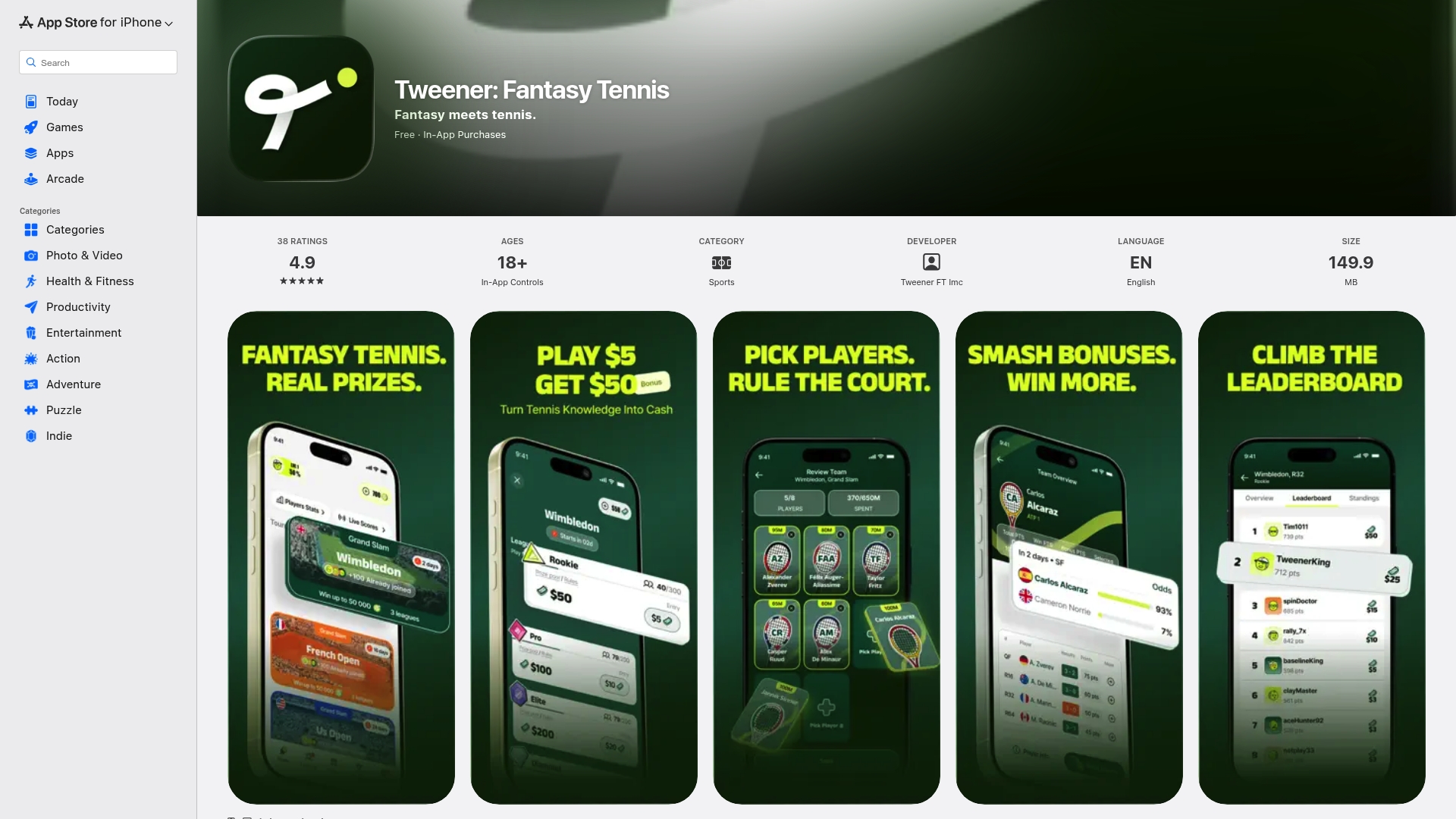
You can practice every rule above, anchor selection, surface fit, game-stacking, in free coin mode with zero financial risk, then move into cash contests once your reads are sharp. Private leagues let you compete head-to-head with up to nine friends during Grand Slams, turning your surface analysis into bragging rights instead of just a spreadsheet. Check the full scoring breakdown on the official game rules page before your next slate, then grab the app and build your first lineup.
Sources
For platform-specific scoring values, check the ATP Fantasy rules. For lineup-building examples, see Tweener's top ATP and WTA picks and its drafting guide.
- ATP Fantasy: How to play, choose your team, win points & climb leaderboards | ATP Tour
- How to Build a Winning Tennis DFS Strategy: From Beginner Picks to Advanced Tactics
FAQ
What Is the 80/20 Rule in Fantasy Tennis?
It's the idea that a small share of scoring events, mainly aces, straight-set wins, and upset bonuses, drive most of a lineup's points, while games-won volume fills in the rest. Prioritizing players who generate those high-value events over pure ranking is the core of a strong fantasy tennis strategy.
What Makes Fantasy Tennis Scores Go Up?
Aces, straight-set wins, upset wins against higher seeds, and total games won all add points, while double faults and bagel sets subtract them. Surface fit amplifies or suppresses these events depending on whether a player's game matches the court speed.
What Is the Best Strategy for a Fantasy Tennis Lineup?
Balance high-floor anchors with one or two higher-ceiling attackers, weight your allocation toward anchors in cash games and toward attackers in tournaments, and always run a pre-lock check for withdrawals and weather. Tweener's lineup-building templates walk through this allocation in more detail.
What Are the Basic Rules of Fantasy Tennis?
Players draft a roster of real ATP or WTA competitors within a salary cap or budget, then earn points based on how those players perform in live matches, with bonuses for dominant wins and penalties for lopsided losses. Exact scoring values and roster sizes vary by platform, so check your specific game's rules page before drafting.
How Do You Manage Risk in a Tennis DFS Lineup?
Cap any single cash contest entry at a small percentage of your total bankroll, diversify roster builds across multiple entries in large tournaments, and avoid stacking a match that's likely to end quickly in straight sets. A final withdrawal and weather check 30 to 60 minutes before lock catches most of the disasters that wreck an otherwise solid lineup.