
In tennis, an Elo rating is a probability-based measure of current player strength, and it updates after every match based on who you beat and how surprising that result was. A 100-point Elo gap translates to roughly a 64% win probability in a best-of-three match, according to Tennis Abstract's own leaderboard data. That single number is the most useful thing you can carry into any match forecast, whether you're building a betting-style model or setting a fantasy lineup on Tweener.
Unlike the ATP points table, Elo has no fixed floor or ceiling and no expiration date tied to a calendar year. It just tracks who's actually beating whom, right now, adjusted for the quality of the opponent.
Three sources dominate the public Elo landscape, and you should bookmark all three:
- Tennis Abstract publishes weekly ATP and WTA Elo leaderboards with overall and surface columns.
- TenELOs offers live, sortable, surface-adjusted leaderboards for quick lookups.
- Ultimate Tennis Statistics documents the actual math (K-factors, tournament weighting) behind its own Elo variants.
Key Takeaways
Elo ratings measure current playing strength through match-by-match probability updates, while ATP rankings track a full season of accumulated points, which makes Elo the stronger tool for short-term match forecasts and fantasy picks.
| Point | Details |
|---|---|
| Core probability rule | A 100-point Elo gap implies about a 64% win probability in best-of-three matches. |
| Elo vs. ATP rankings | ATP points reward a 52-week season total; Elo reflects current form and reacts within a single match. |
| Surface Elo matters | hElo, cElo, and gElo isolate surface-specific form and catch specialists overall Elo misses. |
| Combine, don't rely on one number | Pair Elo with head-to-head data, recent form, and surface filters before making a pick. |
| Check the source's methodology | K-factors, tournament weighting, and minimum-match filters vary across leaderboards and change the rankings. |
Table of Contents
- What Are Tennis Elo Ratings and How Do They Update?
- How Do Elo Ratings Differ From ATP Rankings?
- Why Do Surface-Specific Elo Ratings Matter?
- How Do You Turn an Elo Gap Into a Win Probability?
- Where Can You Find Live Elo Leaderboards and Data?
- How Do Analysts Turn Elo Into Fantasy Tennis Picks?
- What Should You Watch Out for When Reading Elo Data?
- Putting Elo to Work: Applying These Ratings to Your Fantasy Contests
- Why Elo Deserves More Attention Than It Gets
- Sources
What Are Tennis Elo Ratings and How Do They Update?
Elo works on a simple premise: every match has an expected outcome based on the rating gap between the two players, and the actual result nudges both ratings toward reality. Beat someone you were "supposed" to beat, and your rating barely moves. Beat someone rated 300 points above you, and you take a real jump.
The mechanics break down into three moving parts:
- Expected score. Before the match, the model calculates each player's probability of winning based on the rating difference. A favorite with a 200-point edge is expected to win about 76% of the time.
- The K-factor. This determines how many points shift after the match. A higher K-factor produces faster, more volatile ratings; a lower K-factor produces smoother, more conservative ones. Most tennis implementations use a base K-factor somewhere around 32, then scale it by tournament tier.
- The transfer. Points move from loser to winner in proportion to how unlikely the result was. This exchange is zero-sum: whatever the winner gains, the loser loses, dollar for dollar in rating terms.
Say a player rated 1,850 upsets an opponent rated 2,100. Because the actual result diverged so far from the prediction, the underdog's rating jumps sharply, often 20 to 30 points in a single match, while the favorite's rating takes a comparable hit.
New and rarely active players complicate this. Most public leaderboards, including Tennis Abstract's, only display a player once they've logged a minimum of 10 matches in the last 52 weeks, which filters out small-sample noise from players who just came off injury or a long layoff.
Pro Tip: Don't treat a player's Elo as gospel the week they return from a long absence. Some models apply a decay penalty for inactivity, but the rating still needs a handful of matches to fully reflect current form.
How Do Elo Ratings Differ From ATP Rankings?
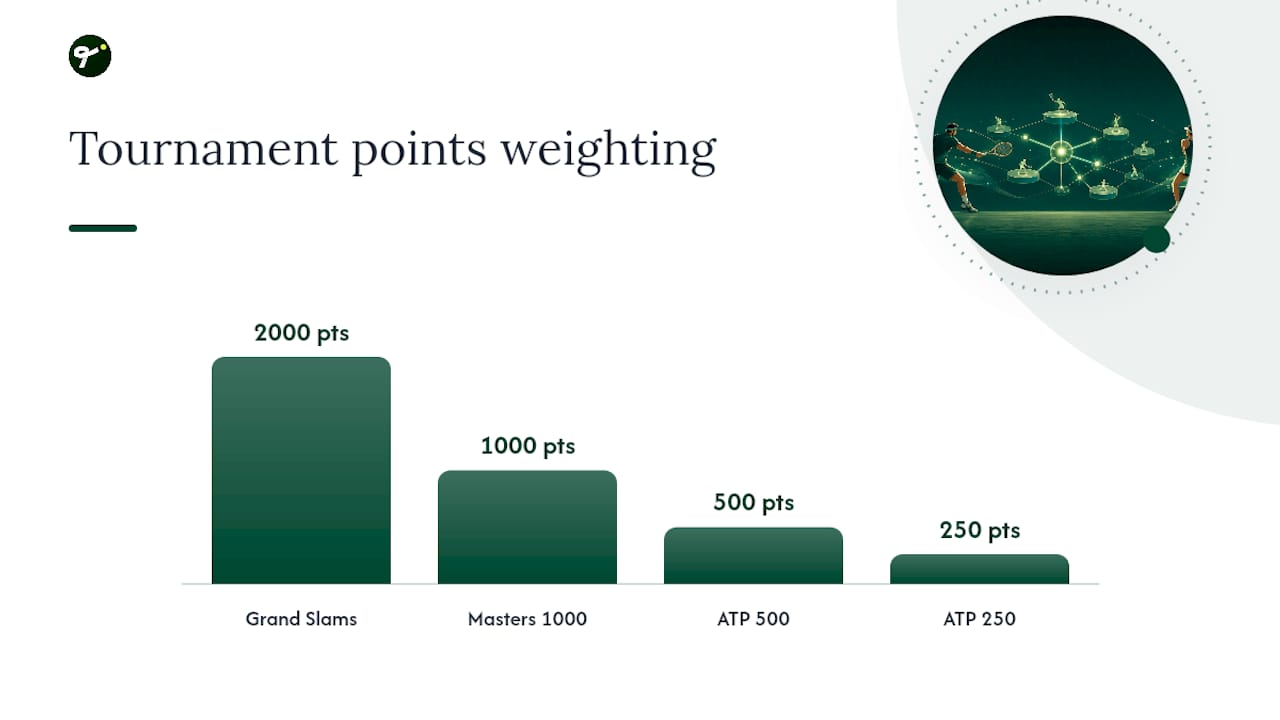
These two systems answer different questions, and mixing them up is the single most common mistake casual fans make. The ATP ranking is a 52-week points accumulation: it counts a player's best 18 or 19 tournament results, with Grand Slams worth 2,000 points, Masters 1000 events worth 1,000, ATP 500s worth 500, and ATP 250s worth 250. It's a points race, rewarding volume and consistency over a full season.
Elo asks a narrower question: who is playing better right now? It's continuous, credits you more for beating strong opponents, and reacts within a single match rather than waiting for a ranking update cycle.
That difference creates real divergence:
- A player recovering from injury can sit high in the ATP rankings on points banked months earlier while their Elo has quietly cratered from a string of early-round losses.
- A young player on a hot streak can rocket up the Elo boards weeks before the ranking points catch up, since ATP points often lag actual form by a full tournament cycle.
- A clay specialist might hold a modest ATP ranking overall but carry an elite Elo number the moment the tour hits European clay.
If you're forecasting a specific match this week, whether for a prediction model or a Tweener lineup, Elo is the sharper tool. The ATP ranking tells you about the season. Elo tells you about right now.
Why Do Surface-Specific Elo Ratings Matter?
Overall Elo blends every surface a player has competed on into one number, which flattens out real specialization. Surface-specific Elo ratings, commonly labeled hElo (hard), cElo (clay), and gElo (grass), fix that by filtering the match pool down to results on that surface alone, then running the same probability-based updates within that narrower dataset.

This matters because surface specialists routinely get mispriced by overall Elo. A grinder who struggles on hard courts but dominates on clay will show a middling overall number that undersells how dangerous they are once Roland Garros starts.
A few practical rules for using surface Elo:
- Weight surface Elo more heavily as a tournament gets closer to a surface transition, like the run-up to the clay swing or grass season.
- Blend overall and surface Elo for players with limited matches on a given surface. A pure surface number built on eight matches is noisy.
- Watch for players whose surface Elo and overall Elo diverge by 100+ points. That gap is usually the tell for an under-the-radar contender.
For fantasy purposes, this is where real edges hide. A clay-court specialist with an unremarkable overall ranking but a top-15 cElo is exactly the kind of value pick that wins you a private league bracket your friends overlooked. The same logic applies to grass-court gap-year specialists who show up for three weeks a year and quietly outperform their seeding.
How Do You Turn an Elo Gap Into a Win Probability?
The conversion from Elo difference to win probability follows a fairly clean curve, and memorizing the rough shape of it is more useful than any spreadsheet. Tennis Abstract's own numbers put it this way: a 100-point gap implies about 64% probability, 200 points implies roughly 76%, 300 points climbs to about 85%, 400 points reaches around 91%, and a 500-point gap pushes past 95%.
- 100 points ≈ 64%
- 200 points ≈ 76%
- 300 points ≈ 85%
- 400 points ≈ 91%
- 500 points ≈ 95%
That curve was built primarily on best-of-three data, so best-of-five majors need a small adjustment. More sets mean more chances for the stronger player's edge to compound, which typically pushes the true probability a few points higher than the best-of-three number would suggest.
For anyone thinking in expected-value terms rather than just picking favorites, the useful zone sits in the middle of that curve. Heavy favorites above 90% rarely offer value because everyone already knows they're favored.
None of this accounts for a wrist tweak announced an hour before first serve, a player who just changed coaches, or a first-round jitters factor for someone returning from a long injury layoff. Elo is a strong baseline, not a complete forecast.
Where Can You Find Live Elo Leaderboards and Data?
Each of the three major public sources serves a slightly different purpose, and knowing which one to open depends on what you're trying to do.
- Tennis Abstract remains the reference point for most analysts. Its ATP and WTA Elo leaderboards update weekly, include surface-specific columns, and come with methodology notes written by the site's own analysts explaining exactly how the ratings are built.
- TenELOs is built for speed. Its surface-adjusted leaderboards are sortable and update close to live, making it the fastest place to check a player's current number before a match starts.
- Ultimate Tennis Statistics goes deepest on methodology. It documents specific K-factor values and tournament-tier adjustment scales, which makes it the go-to source if you're building your own model rather than just reading a number off a leaderboard.
Before leaning on any feed for serious modeling, check four things: how often it updates, whether it breaks out surface Elo, whether it offers CSV or API export, and what minimum-match filter it applies to new or returning players. Skipping that last check is how you end up trusting a rating built on four matches.
How Do Analysts Turn Elo Into Fantasy Tennis Picks?
The sharpest tennis analysts rarely rely on a single number. A typical analytic stack layers an Elo baseline with head-to-head history, a recent-form multiplier weighting the last four to six weeks more heavily, and a surface filter that swaps in hElo, cElo, or gElo depending on the event. That combination catches signals that Elo alone misses, like a player who's technically rated higher but has lost three straight to their next opponent.
- Start with overall Elo to rank the field.
- Layer in head-to-head tennis stats for the specific matchup you're evaluating.
- Swap in the relevant surface Elo once you know the tournament's surface.
- Apply a recent-form check to catch injury returns or hot streaks Elo hasn't fully absorbed yet.
For fantasy scoring formats specifically, this stack changes how you pick a captain or anchor player. A player with a strong Elo but a rough recent-form multiplier is a riskier captain choice than a slightly lower-rated player on a genuine hot streak. If you're diversifying a private league roster during the clay swing, hElo is the tool for finding the specialist who's quietly outperforming their seed. That's the same logic behind matchup-driven roster construction that separates a lucky bracket from a repeatable strategy.
Pro Tip: When two players in your pool have similar overall Elo but one owns a big surface-Elo edge for the week's tournament, take the surface specialist. It's one of the cleanest, most repeatable value plays in fantasy tennis.

Athletic training research on surface-specific adaptation backs up why this works: movement patterns and shot tolerances genuinely differ by surface, which is part of why some players' results split so sharply between clay and hard courts.
What Should You Watch Out for When Reading Elo Data?
No two Elo feeds are built identically, and treating any single number as gospel is a mistake. Ultimate Tennis Statistics documents tournament and round-level multipliers, meaning a win at a Grand Slam moves the rating more than an identical win at a smaller event. Change those multipliers and you get a meaningfully different leaderboard from the same raw match data.
A few things worth checking before you trust a number:
- Non-playing penalties. Some models apply a decay to a player's rating during long absences so an inactive star doesn't sit artificially high; others don't, which can overstate a returning player's current form.
- Start-rating logic. New tour players enter with a default starting rating that takes real matches to correct, so brand-new names on the leaderboard deserve skepticism.
- Small-sample volatility. Early-career players and those just past the 10-match minimum show far more rating swing than established top-20 regulars.
- Cross-referencing. Before committing to a pick, check the surface Elo against the overall number, glance at recent form, and confirm the actual draw. A great Elo number against a stylistic nightmare matchup isn't a safe bet.
Tournament-level tuning that improves predictions in one season can overfit if it's never cross-validated against a different season's data, so treat any single site's ranking as a strong opinion, not a verdict.
Putting Elo to Work: Applying These Ratings to Your Fantasy Contests
Ready to turn this into actual picks? Tweener is built for exactly the kind of analytical fan who reads a surface-Elo table for fun. You draft real ATP and WTA players into fantasy teams, join public leagues or set up private ones with up to nine friends for a Grand Slam, and score points based on how your picks actually perform on court. Tennis has never had a real DFS equivalent to what Fanduel or DraftKings built for football and basketball. Tweener is that platform for tennis, built specifically for fans who think in H2H stats and surface splits rather than gut feelings.
Free mode lets you compete with virtual coins that convert to real rewards. Cash mode lets you enter paid contests for real-money payouts where legally permitted, rewarding the same skill-based edge, surface-Elo reads, recent-form checks, head-to-head data, that this whole article just walked through. If you don't have the app yet, download Tweener and put your next Elo-informed pick to the test in a live contest.
Why Elo Deserves More Attention Than It Gets
Most casual tennis coverage treats the ATP ranking as the final word on who's "better," and that's a mistake the data doesn't support. The ranking is a bookkeeping exercise; Elo is a live read on form. Anyone forecasting a specific match, whether for a prediction model, a betting-style decision, or a fantasy roster, is working with worse information if they lean on ranking position alone.
The bigger blind spot is surface Elo. Most fans check the overall number, see nothing unusual, and move on, missing exactly the kind of specialist mismatch that decides clay and grass tournaments every year. That's the gap Tweener's most successful players exploit: they're not smarter about tennis in general, they're just looking one layer deeper than everyone drafting off name recognition and last month's ranking.
If you take one thing from this: stop trusting a single number. Cross-reference the surface Elo, sanity-check the head-to-head, and confirm the draw before you commit a roster spot. That habit, more than any formula, is what separates a lucky bracket from a repeatable edge.
— Nathan