

TL;DR:
- Live tournaments are essential as they directly influence fantasy scoring and engagement.
- Scoring rewards players for advancement, aces, upsets, and penalizes mistakes, shaping strategic picks.
- Active participation enhances enjoyment, scouting, and community bonds beyond passive watching.
Watching tennis and actually competing through it are two completely different experiences. When you have real players on your fantasy roster during a live tournament, every ace, every upset, and every tiebreak carries personal weight. Live tournament results form the direct backbone of fantasy tennis scoring, which means the sport stops being something you watch and becomes something you participate in. This guide breaks down how that system works, how to take advantage of it, and how to stop being a passive spectator.
Table of Contents
- How live tournaments drive fantasy tennis engagement
- Fantasy scoring: Linking real-world performance to your team
- Strategies for maximizing your fantasy picks during live events
- Comparing fantasy formats: Season-long vs daily play
- Our perspective: What most fantasy fans miss about live tournaments
- Ready to join the action? Enhance your fantasy tennis experience
- Frequently asked questions
Key Takeaways
| Point | Details |
|---|---|
| Live tournaments power fantasy tennis | All fantasy scoring and engagement relies on real-time live tennis results. |
| Strategic picks matter | Choosing players by surface, form, and tournament category can boost your fantasy scores. |
| Engagement is elevated | Fantasy platforms turn viewers into active participants, increasing excitement and retention. |
| Format impacts your strategy | Season-long fantasy rewards consistency while daily formats demand flexible, fast decision-making. |
| Pro tips unlock success | Expert strategies—like diversifying your roster and using special chips—help maximize your fantasy advantage. |
How live tournaments drive fantasy tennis engagement
Fantasy tennis does not exist in a vacuum. Every point you earn on your fantasy roster comes directly from what happens on a real court, during a real match, at a real tournament. That connection is not incidental. It is the entire engine.
When a player you drafted wins a tight three-setter, you feel it. When a lower-ranked opponent pulls off an upset against your star pick, you feel that too. This is what makes fantasy team competitions so addictive: the live tournament schedule keeps delivering fresh moments to react to, week after week.
"Fantasy tennis enhances viewing by making fans coaches, selecting teams within 100-credit budgets based on live ATP rankings, with real-time updates on performances during 23 tournament weeks across four swings."
That quote captures something important. You are not just picking favorites. You are operating within a budget, analyzing rankings, and managing a roster across multiple event windows. That is genuine strategy, not just fandom.
Here is what live tournament engagement looks like in practice for fantasy players:
- Real-time scoring updates keep you checking your app throughout match days, not just at final score notifications
- Leaderboard shifts happen mid-tournament as upsets ripple through your league standings
- Rival rosters become fascinating once you see which players others selected versus your own picks
- Injury news and weather delays create last-minute decision points that reward attentive fans
- Round-by-round progression means your interest compounds rather than resets between weekends
The ATP Fantasy platform was specifically designed to deepen engagement with fans aged 18 to 45, recognizing that this demographic responds strongly to interactive layers on top of live sports. Fantasy sports research consistently shows that people who participate in fantasy leagues watch significantly more games and follow statistics more closely than non-participants. The live tournament calendar is not just background noise. It is the product itself.
Fantasy scoring: Linking real-world performance to your team
Once you understand that live tournaments drive engagement, the next step is understanding how they actually convert into points on your fantasy roster. This is where strategy starts to matter.
ATP Fantasy uses a layered scoring system that rewards more than just "pick the best player." According to the official ATP Fantasy scoring rules, the point structure works like this:
Bonuses:
- Aces earned: +2 points each
- Straight-set win: +10 points
- Upset victory (beating a higher-ranked opponent): +20 points
Penalties:
- Double faults: -2 points each
- A "bagel" (winning or losing a set 6-0): -10 points
- Upset loss (losing to a lower-ranked opponent): -20 points
Beyond these modifiers, players also earn points for each round they advance through, and the amount scales with tournament category. A quarterfinal run at a Grand Slam pays out more than the same result at an ATP 250 event. That scaling matters a lot when building your roster.
| Scoring event | Points | Strategic implication |
|---|---|---|
| Round advancement | Varies by category | Prioritize players at bigger events |
| Straight-set win | +10 | Dominant players earn faster |
| Upset win | +20 | Underdogs carry jackpot potential |
| Ace bonus | +2 each | Big servers add consistent bonuses |
| Double fault | -2 each | Erratic servers are risky picks |
| Upset loss | -20 | Top seeds at 250s face real penalty risk |
| Bagel conceded | -10 | Avoid players in bad form slumps |
This structure does something clever. It discourages you from always picking the top-ranked player and calling it a day. A world number one who struggles on a slow clay court and drops a set 6-0 can actually cost you points. Meanwhile, a rising player who beats a seed in straight sets at the right moment can massively outperform their draft cost.
Pro Tip: Target big servers on fast surfaces like grass and indoor hard courts. Players like John Isner or Reilly Opelka-style hitters rack up ace bonuses that pile up quietly throughout a tournament without you needing them to win the title.
Thinking about predicting tennis outcomes through this scoring lens changes how you evaluate players. You stop asking "will they win?" and start asking "how will they win, and what will it cost if they don't?"
Strategies for maximizing your fantasy picks during live events
Understanding the scoring system is only half the equation. Applying that knowledge during live events, when draws are set, surfaces are known, and player form is visible, is where real gains happen.
Here is a breakdown of the most effective strategies by category:
Surface analysis
Clay, grass, and hard courts each produce dramatically different statistical profiles. Surface-specific picks, such as clay specialists at Monte-Carlo or Roland Garros, consistently outperform players who are merely ranked higher but uncomfortable on the surface. A player who moves beautifully on clay and grinds down opponents in long rallies is going to win more sets convincingly, triggering straight-set bonuses, than a hard-court specialist forced into unfamiliar conditions.

Budget balancing
The 100-credit budget forces real trade-offs. You cannot fill your roster with top-five players. The smart approach is identifying one or two premium picks and filling the remaining slots with well-priced players who have clear paths through their section of the draw.
| Strategy | Best for | Risk level |
|---|---|---|
| Star-heavy roster | High-scoring Slams | Low variance, moderate ceiling |
| Underdog-focused | ATP 250 upset hunting | High variance, high ceiling |
| Balanced budget | Most weekly tournaments | Medium variance, reliable |
| Surface specialist stack | Clay/grass swing weeks | Low risk if form is current |
Using special chips wisely
Many fantasy platforms include chips, which are one-time-use multipliers or special actions. The Triple Bounce chip in ATP Fantasy, for example, is best saved for Grand Slams where best-of-five match formats dramatically raise scoring ceilings. Players go deeper, play more games, and generate more scoring events across every category. Using a multiplier chip at a 250-level event is often a wasted opportunity.
Spreading risk across concurrent tournaments
Some weeks on the ATP calendar feature overlapping tournaments. When that happens, putting all your picks into one event is dangerous. One early exit from your top player and your entire week collapses. Spreading picks across both events, even if it means slightly weaker individual choices, smooths out the variance.
Pro Tip: Watch for price fluctuations tied to live rankings. A player who performs poorly one week often drops in price before the next event, creating a buying window if you still believe in their ability. These price dips can let you upgrade your roster significantly without busting your budget.
The combination of surface knowledge, budget discipline, chip timing, and roster spreading forms the foundation of smart fantasy lineup construction. Add in real-time monitoring of match prediction strategies during the event itself, and you are operating at a level most casual players never reach.
Comparing fantasy formats: Season-long vs daily play
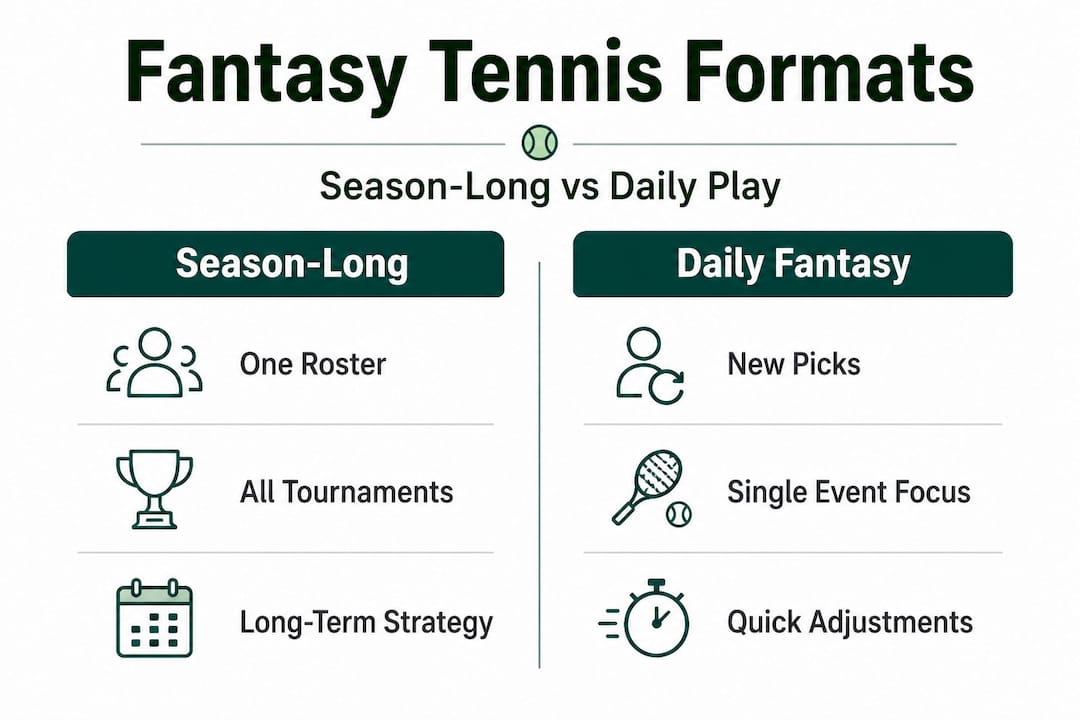
Not all fantasy tennis is structured the same way. Two formats dominate the space, and live tournaments interact with each of them differently.
Season-long fantasy
Platforms like ATP Fantasy operate across an entire season, running through 23 tournament weeks. You manage a single roster across the full calendar, making transfers between events within set limits. The season-long model rewards consistency. A player who goes deep at multiple events throughout the year delivers sustained value. You benefit from correctly identifying breakout players early in the season before their prices rise.
Daily fantasy sports (DFS)
Platforms like DraftKings structure contests around individual tournament slates. You build a fresh roster for each event or even each round. The real-time updates during live matches are critical here because daily formats reward quick decisions. A withdrawal, a surprising first-round exit, or an unexpected draw reshuffle can change the entire value landscape overnight.
| Feature | Season-long (ATP Fantasy) | Daily fantasy (DFS) |
|---|---|---|
| Roster reset | Between tournaments | Every slate |
| Strategic focus | Long-term consistency | Short-term matchup analysis |
| Chip/bonus tools | Yes | Lineup stacking, ownership |
| Budget flexibility | Transfer-limited | Full reset each time |
| Engagement frequency | Weekly | Daily |
| Barrier to entry | Lower | Higher (ownership strategy) |
Both formats share one thing: live tournaments are not optional context. They are the entire game. Without matches happening in real time, there are no scores, no leaderboard swings, and no reason to check your roster.
Some critics point out that ATP Fantasy currently lacks ownership pricing or direct ATP ranking point linkage, which DFS platforms handle through more sophisticated salary structures. That is a fair critique. Season-long formats can feel blunt at times compared to the fine-tuned matchup analysis that daily fantasy allows. But for most fans, the season-long format is a better entry point because it rewards tennis knowledge over pure lineup optimization math.
Exploring the real money fantasy guide and understanding the top fantasy sports rewards available across both formats can help you decide which suits your time commitment and competitive appetite.
"Platforms provide live scoring and real-time updates, increasing engagement as fans track their fantasy teams during live matches." This is not a feature. It is the emotional core of why fantasy tennis works.
Our perspective: What most fantasy fans miss about live tournaments
Most guides stop at strategy. Pick good players. Watch the surface. Use your chips wisely. That advice is not wrong, but it misses the deeper value of live tournaments in a fantasy context.
The real power of a live tournament is not just the scoring opportunity. It is the information density it creates in real time. A player's body language in the third set, a coach's visible frustration during a changeover, the way a server adjusts their toss after two double faults in a row. These signals matter. They tell you whether to panic-transfer before the next match or hold steady.
Most fantasy players treat live tournament data as a score feed. The smarter approach is treating it as a scouting session. Predictive fantasy strategies built on real-time observation outperform ones built purely on pre-tournament rankings. Rankings tell you who was good last month. Live matches tell you who is good right now.
The social dimension is equally underrated. Private leagues among friends who all watch the same tournament together create a layer of shared experience that goes far beyond tennis. You develop opinions, debate picks, trash-talk poor selections, and celebrate upsets together. That is community built around sport, which is genuinely rare and valuable.
We also think most casual fantasy players underestimate how much live tournaments transform passive viewing into active participation. When you have a roster stake in a match, you do not look away during a second set draught. You are tracking player performance metrics in your head, calculating if the current score affects your fantasy position, and genuinely invested in every game. That is a completely different and more rewarding experience than simply watching.
The opportunity most people miss is in adapting to tournament swings mid-event rather than just setting a roster and hoping for the best. React, adjust, and stay engaged across the full two weeks. That is where the real wins happen.
Ready to join the action? Enhance your fantasy tennis experience
You now have the tools to approach live tournaments with a strategic mindset rather than a casual one. Knowing how scoring works, why surface analysis matters, and how to time your chips and transfers puts you well ahead of the average fantasy player.
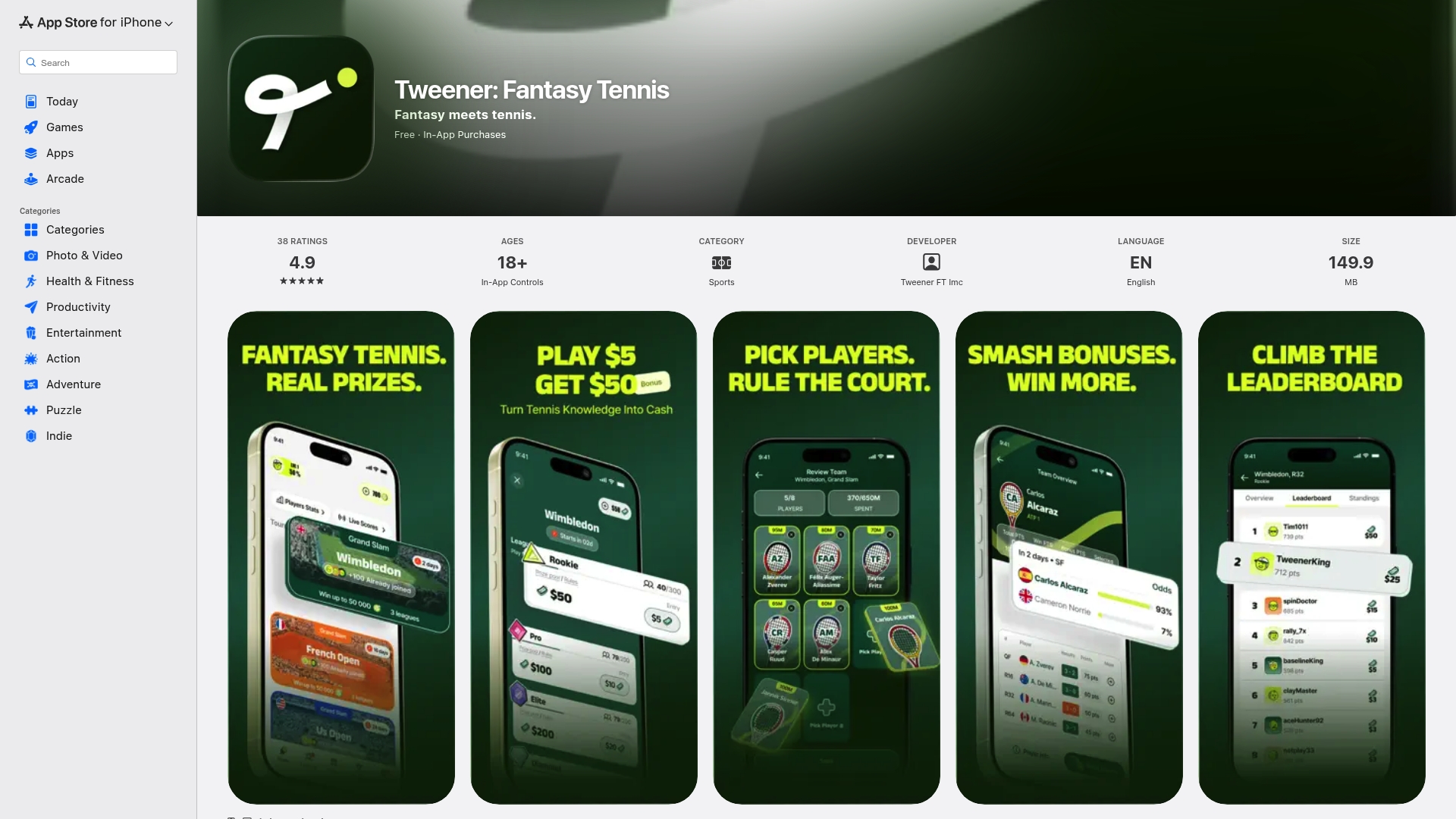
Tweener is built exactly for this kind of engagement. The app lets you build fantasy teams from real ATP and WTA players, join public leagues or compete privately with friends, and earn points based on live tournament results as they happen. There is a free mode using virtual coins that can be redeemed for rewards like gift cards, and a cash mode for fans ready to compete for real-money payouts where permitted. Whether you are tracking Grand Slam drama or a weekly 500-level event, Tweener keeps you connected to every result that matters for your roster. Download the app, build your first team, and turn the next tournament you watch into a competition you are actually part of.
Frequently asked questions
How does scoring work in ATP Fantasy during live tournaments?
Players earn points for each round they advance, scaled by tournament category, with bonuses for aces, straight-set wins, and upsets, plus penalties for double faults, bagels, and upset losses.
What makes live tennis tournaments essential for fantasy sports?
Live tournaments deliver the real-time results that directly fuel scoring across all fantasy tennis platforms, making them the foundation rather than just a backdrop for the game.
Are daily fantasy tennis and season-long fantasy both tied to live tournaments?
Yes. Both formats depend entirely on live matches, but daily fantasy rewards quick pivots while season-long fantasy rewards consistent player performance across the full calendar.
How does surface type affect fantasy picks?
Surface-specific strategies are critical because clay specialists in Monte-Carlo or grass-court experts at Wimbledon consistently outperform higher-ranked players uncomfortable on that particular surface.
Can fantasy tennis help me enjoy tournaments more, even if I'm a beginner?
Absolutely. Even a basic roster gives you a personal stake in live results, and platforms like Tweener make the setup simple so you can focus on the real-time tournament action rather than complex mechanics.