

Most fantasy sports players assume the game is simple: pick good players, watch them win, collect points. But that assumption leaves a massive competitive edge on the table. The format of a fantasy tournament shapes every decision you make, from which players you draft to how aggressively you manage your roster mid-tournament. In fantasy tennis specifically, where player performance can swing wildly based on surface, draw, and fatigue, understanding the format you're playing in isn't just helpful. It's the difference between finishing first and finishing frustrated.
Table of Contents
- Why tournament formats matter in fantasy tennis
- The three core fantasy tournament formats explained
- Which format fits your style? Strategic impacts and player profiles
- Fantasy platforms and tournament variations: Where to play
- How to choose (and master) your ideal fantasy tournament format-your-ideal-fantasy-tournament-format)
- Level up your play with Tweener
- Frequently asked questions
Key Takeaways
| Point | Details |
|---|---|
| Format drives strategy | The tournament format you pick shapes your approach and odds of winning in fantasy tennis. |
| Match format to style | Choose a format that fits your engagement level, risk tolerance, and preferred play experience. |
| Platforms offer variety | Major fantasy tennis apps let you try multiple formats to match your evolving strategy. |
| Balance and flexibility win | Adapting to your format’s quirks and rules gives you the best chance to enjoy and succeed. |
Why tournament formats matter in fantasy tennis
Format is the invisible rulebook running underneath every fantasy league. It determines how points are calculated, how often you can adjust your team, and what kind of risks are worth taking. Ignore it, and you're essentially playing a different game than everyone else at the table.
Here's what actually changes depending on the format you're in:
- Scoring style: Some formats reward raw point totals, others rank you across multiple statistical categories.
- Team management frequency: Head-to-Head leagues often reset weekly, while Roto leagues demand season-long consistency.
- Risk tolerance: Certain formats reward bold, high-variance picks. Others punish them.
- Opponent awareness: In Head-to-Head, you're always playing against one specific person. In Roto, you're competing against the entire field.
As noted in fantasy scoring breakdowns, the three core formats are Head-to-Head (weekly category matchups), Roto (season-long category rankings), and Points leagues (total points accumulation). Each one demands a completely different mindset.
Understanding the benefits of team competitions in fantasy tennis goes hand in hand with knowing which format you're competing in. The format is the foundation. Everything else is built on top of it.
The three core fantasy tournament formats explained
Let's get specific. Here are the three formats you'll encounter most often, and what each one actually means for how you play.
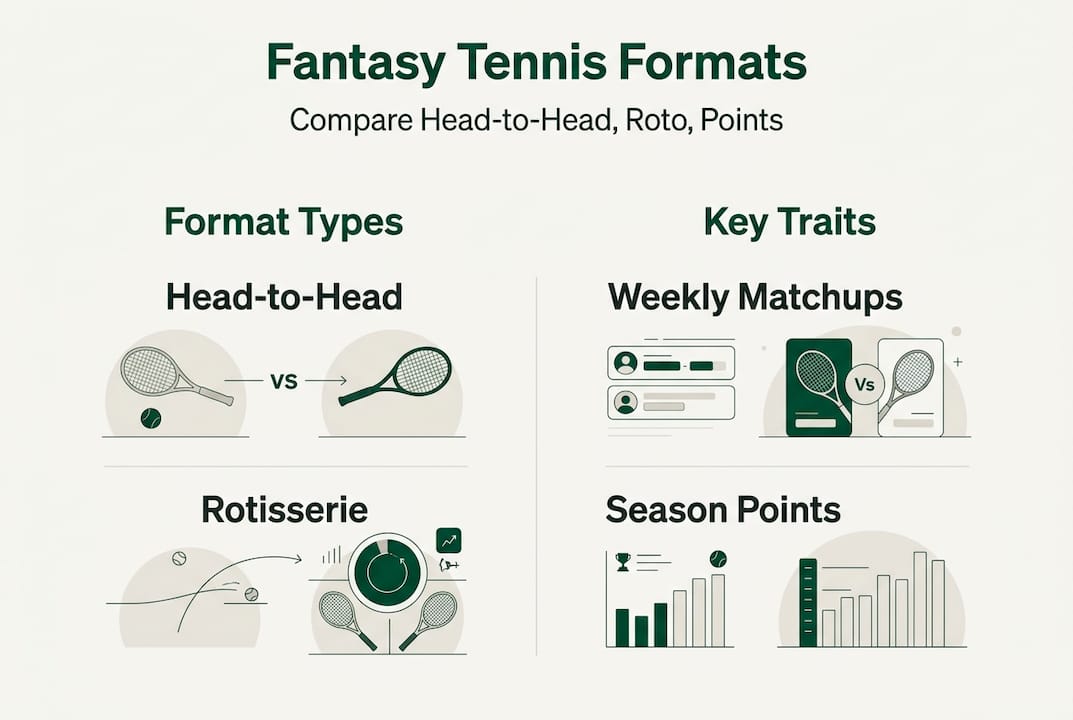
Head-to-Head (H2H): You face one opponent per scoring period, usually a week or a single tournament round. Win that matchup, and you advance or earn a win. Lose it, and you take the L regardless of how well you did against the rest of the field. It's direct, personal, and fast-moving.
Rotisserie (Roto): You're ranked across multiple statistical categories, and your final standing is the sum of those rankings. If there are ten categories, you want to finish near the top in as many as possible. One dominant category won't save you if you're last in five others.
Points leagues: Every player action earns a set number of points. Aces, winners, games won, matches won, all of it adds up. Your total score is compared directly against other teams. Simple math, but the strategy behind it is anything but simple.

Here's a quick comparison to make the differences concrete:
| Format | Scoring style | Season flow | Team-building focus |
|---|---|---|---|
| Head-to-Head | Win/loss per period | Weekly resets | Matchup-specific picks |
| Roto | Category rankings | Season-long | Balanced across all stats |
| Points | Total points | Cumulative | High-volume scorers |
Now, the pros and cons:
- Head-to-Head pros: Fast feedback, exciting weekly drama, easier to understand for beginners.
- Head-to-Head cons: A great week can still result in a loss if your opponent had a better one.
- Roto pros: Rewards deep knowledge and consistent management over time.
- Roto cons: One bad category can drag your entire season down.
- Points pros: Transparent scoring, easy to track in real time.
- Points cons: High-scoring players get overvalued, making differentiation harder.
Familiarizing yourself with core fantasy tennis terms before you start will help you navigate these formats without confusion. And when it comes to building tennis lineups, the format you're in should be the first thing you consider.
Pro Tip: Many new players misjudge Roto's demand for balance. They load up on one or two elite players and ignore weaker statistical categories entirely. That approach tanks your season ranking fast.
Which format fits your style? Strategic impacts and player profiles
Knowing the formats is one thing. Knowing which one fits you is where the real advantage lives.
Here's a breakdown of which player types thrive in each format:
- Head-to-Head: Best for competitive, matchup-obsessed players who love the weekly grind. You need to scout your opponent and adjust your picks accordingly.
- Roto: Perfect for stats nerds and long-term thinkers. You need patience, depth knowledge, and the discipline to manage weak categories instead of ignoring them.
- Points leagues: Great for players who follow live matches closely and want immediate feedback on every pick. High engagement, high reward.
- Daily or bracket formats: Ideal for casual players or those with limited time. Low commitment, high excitement.
Strategic pitfalls to watch out for:
- In H2H, "punting" a category (intentionally ignoring it to dominate others) can work, but it's a calculated gamble. Do it wrong and you hand your opponent easy wins.
- In Roto, going all-in on one superstar while neglecting roster depth is a classic mistake.
- In Points leagues, going too "chalky" (picking only the most popular, obvious players) means you'll never separate yourself from the pack.
The building a winning lineup approach shifts significantly based on format. And smart captain picks in formats that use a captain multiplier can swing your score dramatically.
Pro Tip: In Points leagues, tracking live player stats during a tournament lets you spot scheduling advantages. A player with three matches in four days on a surface they dominate is a goldmine.
Fantasy platforms and tournament variations: Where to play
Now that you know the formats, where do you actually play? The platform you choose shapes your experience as much as the format itself.
Here's a look at the main options in the fantasy tennis space:
| Platform | Format offered | Entry method | Special rules | Mobile experience |
|---|---|---|---|---|
| Deuce | Bracket + season | Free and paid | Bracket-style progression | Strong |
| GameSetMatch | Points and H2H | Free | Weekly resets | Moderate |
| FanSlam | Points leagues | Free and paid | Daily contests available | Good |
| SmashIt | Roto and Points | Free | Category-based scoring | Moderate |
| WTA Pick'Em | Streak-based | Free | Match prediction focus | Strong |
As top fantasy tennis platforms show, options like Deuce combine bracket and season formats, while WTA's official Pick'Em focuses on streaks and predictions rather than traditional team management.
A few hidden twists you'll often find on mobile platforms:
- Daily vs. season-long: Some apps let you play a single tournament, others lock you into a full season.
- Public vs. private leagues: Public leagues drop you into competition with strangers. Private leagues let you play against friends.
- Salary cap systems: Some platforms give you a budget to build your team, forcing tradeoffs between elite and value picks.
- Bonus scoring events: Certain platforms add multipliers for upsets or specific match outcomes.
If you're exploring your options, checking out Underdog Fantasy alternatives, DraftKings alternatives, or Sleeper alternatives can help you find the platform that matches your preferred format and play style.
How to choose (and master) your ideal fantasy tournament format
With all these options, picking the right format comes down to a few honest questions about yourself and your schedule.
Follow this simple decision framework:
- How much time do you have? If you can check in daily, Points or H2H leagues reward that attention. If you're more of a set-it-and-check-weekly player, Roto or bracket formats work better.
- Do you prefer head-to-head competition or beating the field? H2H is personal and direct. Roto and Points pit you against everyone at once.
- Are you a stats person or a gut-feel player? Roto rewards deep statistical analysis. H2H and Points can be played more intuitively.
- What's your risk appetite? High-variance picks pay off more in H2H and Points. Roto punishes inconsistency.
- Do you want a short burst or a long season? Daily and bracket formats are quick. Roto is a marathon.
Once you've picked your format, here's how to master it:
- Learn the specific scoring quirks. Every platform weights stats differently, so read the rules before you draft.
- Adjust your lineup based on the tournament draw, not just player rankings.
- Manage risk actively. Don't set your roster and forget it.
- Experiment. Try a different format each season to build a broader strategic toolkit.
Solid fantasy team management habits, like tracking injuries, surface preferences, and recent form, apply across all three core formats. The format just tells you how to prioritize that information.
Level up your play with Tweener
Ready to put your new format knowledge into action? Tweener is built specifically for tennis fans who want more than just watching. The platform offers flexible tournament options with clear, transparent game rules so you always know exactly how your score is calculated and what you're competing for.
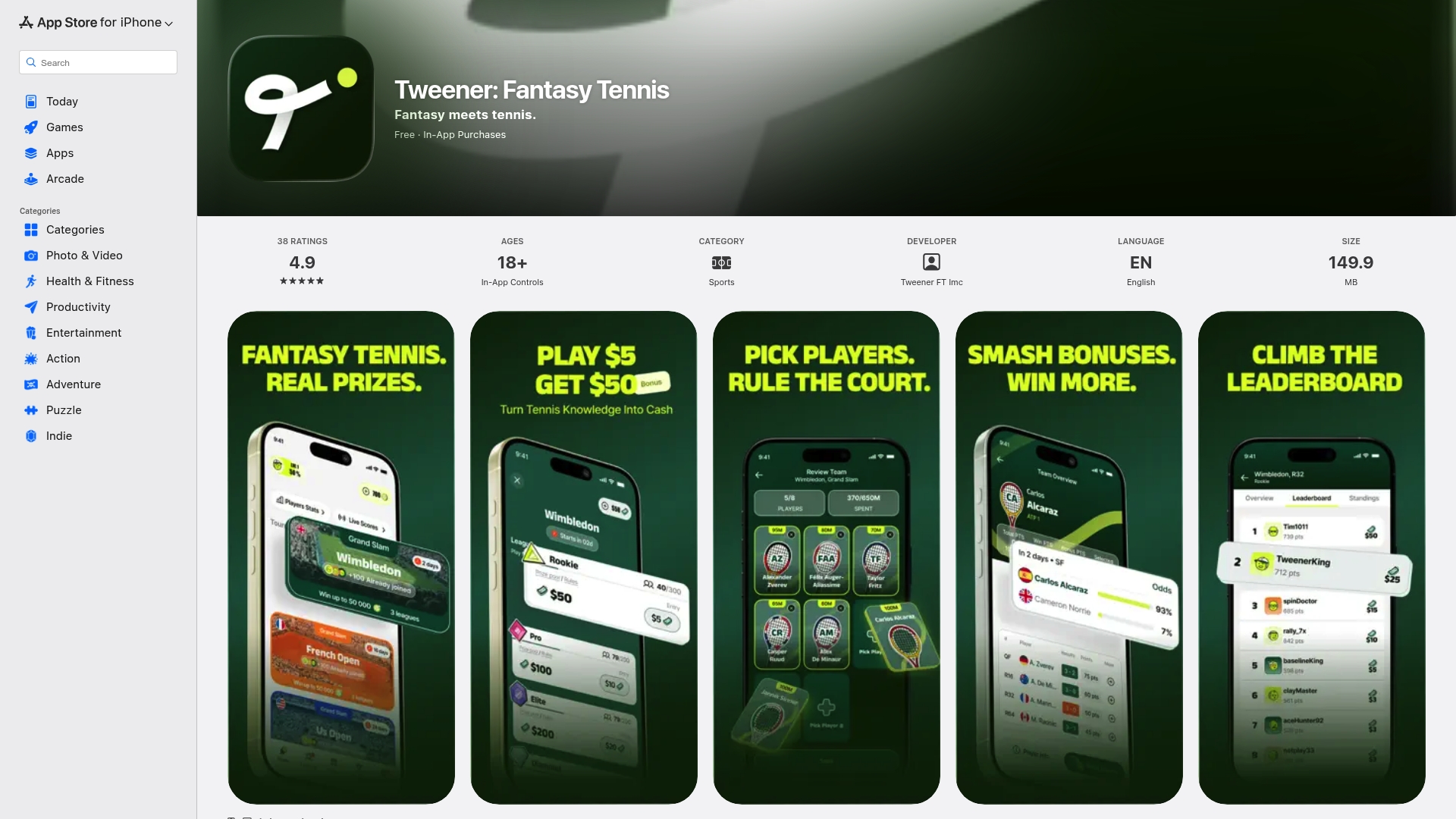
With Tweener, you can jump into public leagues instantly or set up a private league with friends to test your strategies head-to-head. The mobile-first design means you can manage your team, track live scores, and make lineup decisions from anywhere during a tournament. Whether you prefer free play with virtual coins or want to compete in cash contests for real payouts, the Tweener platform has a format that fits your style. Download the app and start competing today.
Frequently asked questions
What is the easiest fantasy tournament format to start with?
Head-to-Head is the most beginner-friendly format because it focuses on weekly matchups with clear win/loss outcomes and fast feedback after each scoring period.
How do Roto and Points leagues differ in strategy?
Roto requires balancing all categories for consistent season-long results, while Points leagues reward targeting high-volume, high-scoring player actions to maximize your total score.
Do mobile fantasy tennis platforms let you try different formats?
Yes, most major platforms offer multiple formats including Head-to-Head, Roto, Points, and bracket-style competitions, so you can experiment before committing to one style.
What's a common mistake when choosing a fantasy format?
Many players overlook their own time commitment and play style, jumping into a season-long Roto league when their schedule only allows for short-burst daily contests.
Can you switch tournament formats in the middle of a fantasy season?
No, once a tournament or league starts, its format is fixed. You'll need to wait for the next competition or season to try a different structure.