
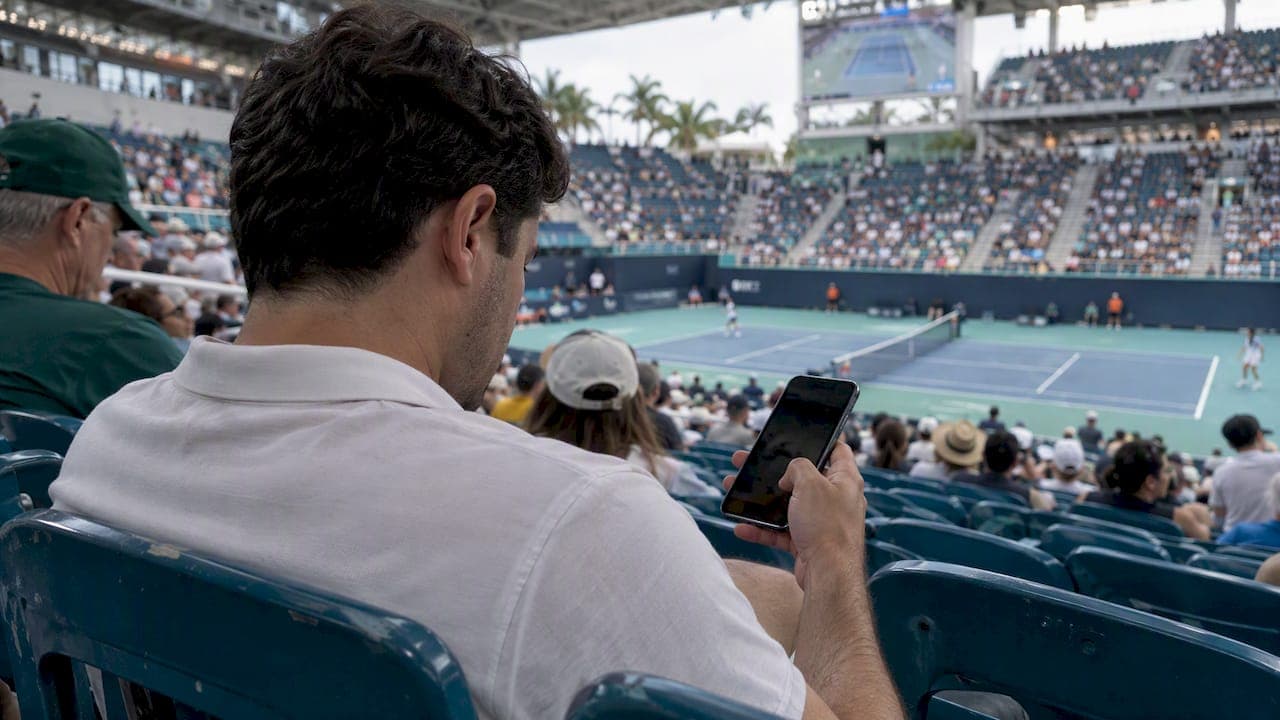
The Miami Open is the best fantasy tennis tournament of the spring. It has a 96-player singles draw, ATP and WTA fields at the same venue, and two weeks of matches on one hard-court surface. The next edition is scheduled for March 14 to 28, 2027 at Hard Rock Stadium, subject to change. That gives you five months to learn how this event plays before you pick a single name.
This guide covers what the 2026 tournament taught us, how conditions in Miami shift the value of players, and how to set up your picks, whether you play free for coins or in a cash contest where it is legal.
TL;DR
- Miami is a 15-day Masters 1000 and WTA 1000 event on hard courts at Hard Rock Stadium, so surface form matters more than ranking or name recognition.
- On the ATP side, lean toward strong servers. On the WTA side, return games and break frequency carry more weight.
- Night sessions tend to play slower, which can trim the edge of big servers. Check the order of play before you lock a roster.
- Fantasy tennis rules differ by state. Check your state's rules before you deposit any money, and use free play if cash contests are not available to you.
- Tweener lets you play Draft Mode and Pick'em Mode on real ATP and WTA results, in public leagues or private leagues with friends.
Table of Contents
- What the 2026 Miami Open looked like
- Why Miami rewards a different kind of research
- ATP and WTA need different rosters
- A pre-tournament process for Miami
- Finding tournament coverage and picks
- Perspective: why tennis needed its own fantasy game
- Playing Miami Open fantasy on Tweener
- Is it legal where you live?
- FAQ
- Sources
What the 2026 Miami Open looked like
The 2026 event ran from March 15 to 29 at Hard Rock Stadium in Miami Gardens, with a total prize pool of $9,415,725. Each singles champion earned $1,151,380. It is both an ATP Masters 1000 and a WTA 1000 event, so the top of both tours show up.
On the men's side, Jannik Sinner beat Jiri Lehecka 6-4, 6-4 in the final without dropping a set all tournament. The same page shows how fragile the other big names were. Carlos Alcaraz, the No. 1 seed, went out in the third round, and Lorenzo Musetti withdrew. Alex de Minaur, a top-five seed, lost in the second round.
That is the first lesson for any Miami Open fantasy player: the draw is large, early rounds are volatile, and a roster built around two or three famous names can be gutted by Tuesday. Depth and surface fit protect you better than star power.
Why Miami rewards a different kind of research
Most fantasy tennis players pick on ranking. Ranking is a lagging, career-long number. In Miami you want something more current.
Recent form on hard courts
The analysis we publish on how to choose tennis players for fantasy leagues argues that the last 5 to 10 matches on the relevant surface predict fantasy output better than long-term ranking. Players get caught relying on name recognition instead of current physical condition and how well someone is adapting to conditions like Miami's hard-court speed.
A practical way to apply it: pull each candidate's recent hard-court results, and look at who they played, not just the win-loss line. A player who went 4-1 against top-30 opposition is a different asset than one who went 5-0 against qualifiers.

Attacking and defensive metrics
The ATP's own match notes use metrics like Conversion Score and Steal Score. The ATP Miami media notes are a good place to see how the tour frames those numbers. Conversion Score tracks how well a player wins points when in an attacking position. Steal Score does the opposite for players who flip points when on defense. Neither shows up on a ranking list, and both tell you something about how a player copes with Miami's courts.
Humidity and night sessions
Our strategy notes flag that many players underestimate how humidity and night play at Hard Rock Stadium change ball speed. Night matches tend to play slightly slower than afternoon sessions. That can dull big servers and help players with strong defensive numbers. The habit to build is simple: check the official order of play for session time before you finalize a daily roster.
ATP and WTA need different rosters
The two tours are not the same game from a fantasy angle.
| Factor | ATP approach | WTA approach |
|---|---|---|
| Break rate | About 1.7 breaks per set | About 3.2 breaks per set |
| Value profile | Serve-dominant players | Return-game aggression, mental resilience |
| Variance | Lower, favorites hold more often | Higher, more upsets and swings |
| Form weighting | Surface form plus serve stats | Last five matches at 60%, career surface stats at 40% |
The break-rate figures and the 60/40 weighting come from our player-selection guide. They are a starting framework, not a law. Use them to organize your thinking, then adjust for the matchups in front of you.
If you want to go deeper on women's data, our rundown of WTA stats every fantasy gamer should know covers the numbers that separate return specialists from the pack. And for the scoring side, see how fantasy tennis points are calculated for ATP and WTA.
A pre-tournament process for Miami
Here is how we would prep, starting when the draw comes out.
- Read the draw, not the seeds. Find the quarters where a top seed has a tricky early opponent. In 2026, a No. 1 seed lost in round three. Mark those spots.
- Build a recent-form list. For each player you are considering, note the last 5 to 10 hard-court matches and the quality of the opposition.
- Split by tour. Choose ATP servers who hold comfortably. For WTA, favor players who generate break chances.
- Check session times. If a big server is scheduled at night, consider whether a better returner or defender offers more value.
- Balance chalk and value. Combine reliable favorites with underpriced players, as our guide recommends. One or two anchors, then upside around them.
- Have backups. Withdrawals and retirements happen. Our piece on reacting fast with backup picks at the Madrid Open uses the same logic, and it transfers directly to Miami.
For a fuller framework on roster construction, our fantasy tennis strategy guide on anchors and attackers shows how to split a roster between safe and high-upside players. Our daily fantasy tennis strategies for 2026 go further on contest selection.
Finding tournament coverage and picks
Good fantasy decisions need a steady supply of information: draw analysis, injury news and matchup breakdowns. Independent analytics and picks sites can help you cross-check your thinking. For example, this AI-driven picks and market analysis platform publishes daily reports and keeps a public, graded track record across sports, which is a useful way to see how others read a slate. Treat any outside pick as one input. Your roster is your own call.
Perspective: why tennis needed its own fantasy game
We built Tweener because tennis fans who love numbers had nowhere serious to play. Football and basketball have deep daily fantasy ecosystems. Tennis, despite having some of the richest public data in sport, mostly got casual bracket games.
Miami is a good illustration. A fan who knows that a player's hard-court form is climbing, that the night session slows the ball, and that the WTA break rate is nearly double the ATP's has a real edge over someone who just picks famous names. That is skill, not luck. Your result depends on the combined performance of several players across a tournament, not the outcome of a single match.
That difference is also why we think of fantasy as a different thing from a single-match wager. You are judged on how well you read form, surfaces and matchups across a roster. We would rather give fans a way to turn analysis into competition, with friends in private leagues or against the field.
— Nathan
Playing Miami Open fantasy on Tweener
Tweener is a mobile fantasy app built only for professional tennis. You pick real ATP and WTA players, and your points follow what they do in actual matches. There are two ways to play:
- Draft Mode: build a team of players and compete in a league over a tournament or a shorter contest.
- Pick'em Mode: make predictions on real matches, with scoring based on actual results.
You can join public leagues or create a private league with friends. For Grand Slams, a private league holds up to 9 friends. Free play uses virtual coins that you earn through gameplay and other in-app activities, and the coins can be redeemed for rewards such as gift cards. A cash mode with paid contests and real-money payouts is available in select US states.
Ready to try it before the next Miami Open? Get the Tweener app and start with a free league, or see the two modes on the Tweener home page.
Is it legal where you live?
In the US, fantasy sports law is state by state. According to the Chambers gaming law guide, many states, including New York, Pennsylvania and New Jersey, treat daily fantasy as a game of skill and permit it. States such as Washington, Nevada and Montana may prohibit it or require specific licensing. The same guide notes that the federal UIGEA exempts certain fantasy sports as long as outcomes reflect participants' skill and knowledge rather than a single sporting event.
The New York Court of Appeals addressed this in White v. Cuomo (2022), a case about interactive fantasy sports. Our research notes summarize the reasoning: these contests are skill-based because results depend on the aggregate performance of multiple players you select.
Before you deposit, do two things. First, check the current rules for your state on our guides to fantasy tennis legal states and how to check state rules for fantasy sports cash. Second, if cash contests are not open where you live, play the free mode. If you have questions about your own situation, a licensed attorney in your state is the right person to ask. Our risks of fantasy sports betting piece is worth reading too, and so is the five-check list before you deposit.
The federal picture is also described in a Congressional Research Service report on daily fantasy sports, which describes the industry as operating in a gray area of the law. That is a good reason to check rather than assume.

FAQ
When is the next Miami Open?
The Miami Open's official schedule lists March 14 to 28, 2027 at Hard Rock Stadium, subject to change. Check that page again closer to the event for the final dates and the order of play.
Is there a free way to play Miami Open fantasy?
Yes. In Tweener's free mode you compete with virtual coins that you earn through gameplay and other in-app activities. The coins can be redeemed for rewards such as gift cards, and you do not need to deposit money.
Should I pick the top seeds?
Use them as anchors, not as your whole roster. In 2026, the No. 1 seed lost in the third round, as the men's draw page shows. Pair one or two reliable names with in-form players who fit the surface.
Do ATP and WTA picks work the same way?
No. Our analysis puts the ATP at roughly 1.7 breaks per set and the WTA at about 3.2. That favors serve-dominant men and return-aggressive women in your fantasy lineup.
Can I play with friends?
Yes. You can create a private league and invite friends. For Grand Slams, a private league holds up to 9 friends. Public leagues are also open if you want to compete against the wider field.
Sources
- Miami Open 2026 411, WTA Tennis
- Miami Open tournament schedule
- 2026 Miami Open men's singles, Wikipedia
- ATP Miami Open media notes
- How to choose tennis players for fantasy leagues in 2026
- Gaming Law 2025, USA, Chambers
- White v. Cuomo, New York Court of Appeals
- Daily Fantasy Sports, Congressional Research Service