

Play Madrid Open fantasy on Tweener, where round-by-round scoring covers both ATP and WTA draws and rewards managers who actually pay attention to the schedule. This is not a set-it-and-forget-it game. The tournament runs on clay, seeds fall constantly, and players who check locks before every round beat those who don't. Download the app or open a tournament lobby, build your first lineup, and line up two backup picks per slot before the draw even lands.
TL;DR:
- Effective management requires checking the daily order of play and lock times frequently, especially after withdrawals or schedule changes.
- Prioritize active lineups by adjusting your team every round based on form, matchups, and surface-specific performance, especially on clay.
- Use two backup players per slot in case of withdrawals, with one being a safe fallback and the other a value pick for potential upsides.
- Keep in mind that Madrid's shorter format means one bad lock or withdrawal can significantly impact overall success.
- Play in private leagues with clear rules, deadlines, and prize splits to avoid disputes and maximize your chances on this fast-paced, round-by-round contest.
Table of Contents
- What Is Madrid Open Fantasy and How Does Scoring Work?
- Where Can You Play Madrid Tennis Fantasy?
- How Do Private Leagues and Prizes Work?
- Madrid Clay Strategy: Who to Draft and When to Take Risks
- How Do You Handle Withdrawals and Last-Minute Roster Changes?
- How Does Madrid Compare to Other Tennis Fantasy Formats?
- Why Madrid Is the Best Week to Play Fantasy Tennis
- Quick Start: Download Tweener and Join a Madrid Open Contest
- Sources
- FAQ
What Is Madrid Open Fantasy and How Does Scoring Work?
Madrid Open fantasy is a round-by-round game, not a season-long roster you set once and forget. The official Mutua Madrid Open fantasy format asks fans to pick a player for each of eight key stat categories, then build a fresh lineup every round. That structure matters because it rewards active managers over passive ones. A team that crushed Round 1 can fall apart by the quarterfinals if you don't touch it.
Scoring generally tracks what actually happens on court:
- Round points for simply advancing (bigger jump for upsetting a higher seed)
- Bonus points for aces, break points won, and straight-set victories
- Penalties for retirements or lopsided losses
- Extra weight for underdogs who knock out seeded players
The ATP's own official fantasy game uses a team-of-eight, credit-budget model where points come from rounds reached plus in-match stats like aces and clean sets. It's a useful reference point because Madrid's categories overlap with it heavily, even though the formats differ.
Lock deadlines are where things get tricky. Madrid often finalizes daily order of play the night before matches, so a lineup that looked safe at noon can be scrambling by dinner. Always confirm rules and lock times through the official Mutua Madrid Open FAQ rather than assuming last year's schedule holds.
Where Can You Play Madrid Tennis Fantasy?
Tweener is built specifically for tennis, which matters more than it sounds like it should. General fantasy apps bolt tennis onto a football or basketball skeleton. Tweener starts with surface splits, head-to-head records, and live substitution tools baked in, which is exactly what a clay-court tournament like Madrid demands.
Getting started takes about two minutes:
- Grab the app from the Tweener download page
- Pick Draft Mode (build a full roster against a salary cap) or Pick'em Mode (faster, matchup-style picks)
- Join a public lobby for the Madrid Open or set up a private league with friends
Draft Mode rewards deep prep. Pick'em Mode suits someone checking scores between meetings. Both run on free virtual coins that convert to gift cards, with cash contests available where permitted by law. Check your jurisdiction before depositing anything.
Pro Tip: If you're new to Madrid specifically, start in free coin play. Clay-court results swing harder than hard-court results, and you'll want a tournament or two to calibrate before you put money on the line.
How Do Private Leagues and Prizes Work?
Private leagues turn Madrid week into something closer to a group chat with stakes attached. The platform lets you build a private league and invite friends, with room for multiple competitors per tournament, similar to how Grand Slam pools run. Public leaderboards run alongside, open to anyone, with prize pools scaled to entry fees and the size of the field, where applicable.
A few habits keep private leagues from turning into arguments by the semifinals:
- Lock in scoring rules before Round 1, not after someone's pick gets a bonus nobody expected.
- Set one deadline for the whole league (usually mirroring the official lock) so nobody scrambles a lineup after matches start.
- Decide the prize split in advance, whether that's virtual coins, gift cards, or a cash pot, and confirm whether it's winner-take-all or split across the top three.
- Double-check that everyone understands the difference between public contest scoring and any custom rules your private group added.
Winners in public contests typically take home a mix of virtual coins redeemable for gift cards, with cash contests paying out real money where permitted by law. The format rewards consistency across rounds more than one lucky pick in the final.
Madrid Clay Strategy: Who to Draft and When to Take Risks
Clay changes everything about how you should draft. Players who struggle on hard courts can dominate at the Caja Mágica, and head-to-head records on clay specifically matter more than overall rankings. Preview coverage ahead of the tournament has flagged players like Aryna Sabalenka and Alexander Zverev as favorites with strong Madrid pedigrees, and that kind of surface-specific form should carry real weight in your rankings, not just seed number.

Balancing your roster comes down to one tension: expensive seeds are safe but capped, while cheaper players carry upset upside that pays huge in round-progression scoring. Our guide on choosing tennis players for fantasy leagues breaks down how to weigh surface stats against price.
A pre-lock checklist saves you more points than any single "smart pick":
- Confirm the day's match order (it often posts the night before)
- Check injury reports and recent retirements, not just seedings
- Weigh travel and altitude adjustment for players coming straight from other clay events
- Compare your value picks against the field's most-owned players to find leverage
Statistic Callout: The ATP's own fantasy model scores bonus points for aces and straight-set wins on top of round advancement, so a big server who closes matches fast often outscores a grinder who wins the same number of rounds through three-setters, according to the ATP's official fantasy rules.
How Do You Handle Withdrawals and Last-Minute Roster Changes?
Madrid 2026 delivered a brutal reminder of why active management matters. Both Carlos Alcaraz and Novak Djokovic withdrew before the official draw, Alcaraz with a wrist issue and Djokovic with a shoulder problem. Anyone who had either player locked into a lineup needed a replacement plan within hours, not days.
Here's a workflow that actually holds up under pressure:
- Set alerts on official tournament social channels and ATP press updates the moment the draw drops.
- Check the Mutua Madrid Open FAQ page for confirmed schedule changes before trusting secondhand reports.
- Rank two backup players per roster slot ahead of time, prioritizing whoever inherits the easier next-round matchup.
- Swap immediately once a withdrawal is confirmed. Waiting for "official" news after a credible report often costs you the lock window.
Our step-by-step roster update guide walks through the in-app process for making these swaps fast.
Pro Tip: Keep two backup tiers, not one, for every slot: a "safe floor" pick who's reliably in the draw, and a "value" pick who benefits directly if a seed above them withdraws. When news breaks, you already know exactly who moves in.
How Does Madrid Compare to Other Tennis Fantasy Formats?
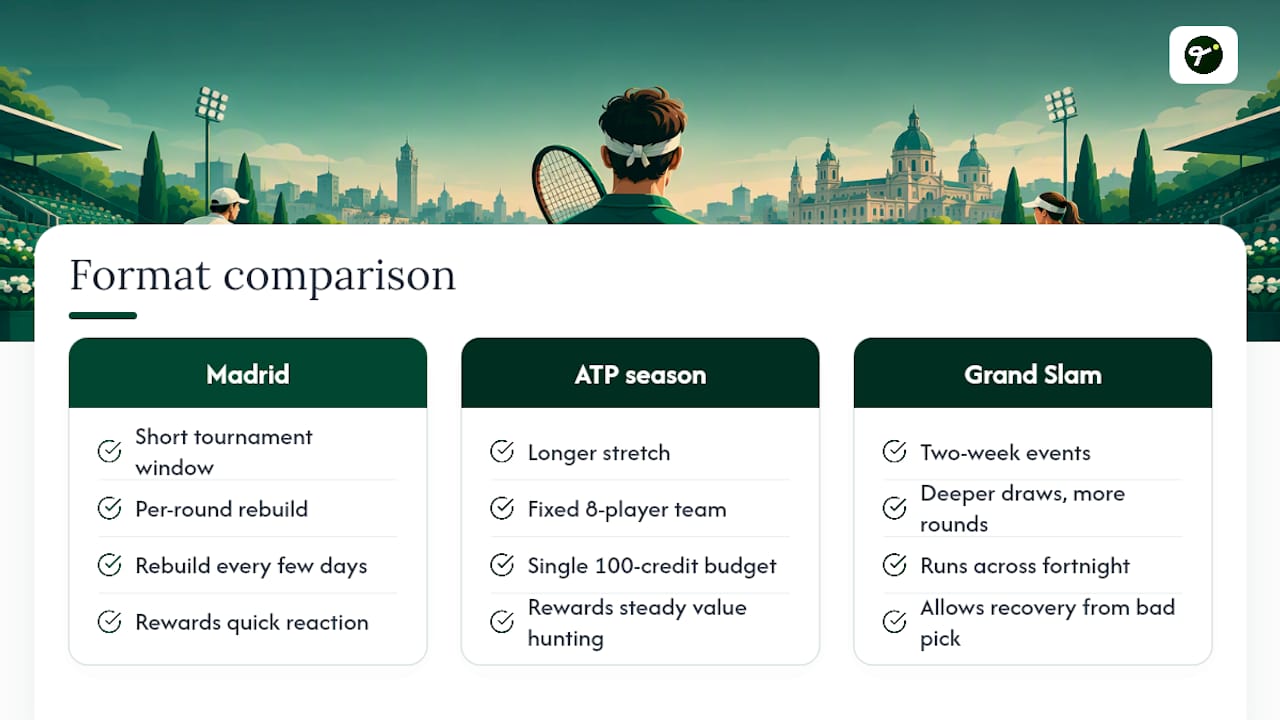
Madrid's fantasy game sits closer to the round-by-round, stat-selection style than to a season-long build, and that distinction changes how you should approach it compared to other tennis fantasy formats you may have played. The ATP's official fantasy uses a fixed team of eight within a 100-credit budget across a longer stretch, which rewards steady value hunting over an extended run. Madrid's per-round rebuild rewards something different: reading form and matchups fresh every few days.
Grand Slam fantasy contests, by comparison, usually run over two weeks with deeper draws and more rounds to recover from a bad pick. Madrid's shorter window means one missed lock or one unnoticed withdrawal costs proportionally more. If you've played a Slam fantasy pool before, treat Madrid as the sprint version. There's less room to average out a rough round, and more reward for managers who stay glued to the schedule the entire week.
Previous Madrid editions have shown the same pattern: whoever wins usually isn't the manager with the flashiest Round 1 team, but the one who reacted fastest to the two or three inflection points every tournament produces, an injury, an upset, a surprise finalist. That consistency, more than any single genius pick, is what separates the top of the leaderboard from the middle.
Why Madrid Is the Best Week to Play Fantasy Tennis
Madrid hits at the perfect point in the clay swing, when form is shifting fast and seeds are genuinely vulnerable. That volatility is exactly what makes round-by-round play and private leagues so satisfying. You're not locked into one draft for two weeks. You're reacting, adjusting, and needling your friends every few days.
Stay sharp around locks, treat withdrawals as opportunities rather than disasters, and the tournament rewards you for actually watching it.
— Nathan
Quick Start: Download Tweener and Join a Madrid Open Contest
Tweener is built specifically for tennis, addressing a gap many fantasy apps overlook. It incorporates surface stats, head-to-head data, and live substitution tools designed around how tennis tournaments unfold, round by round, upset by upset.
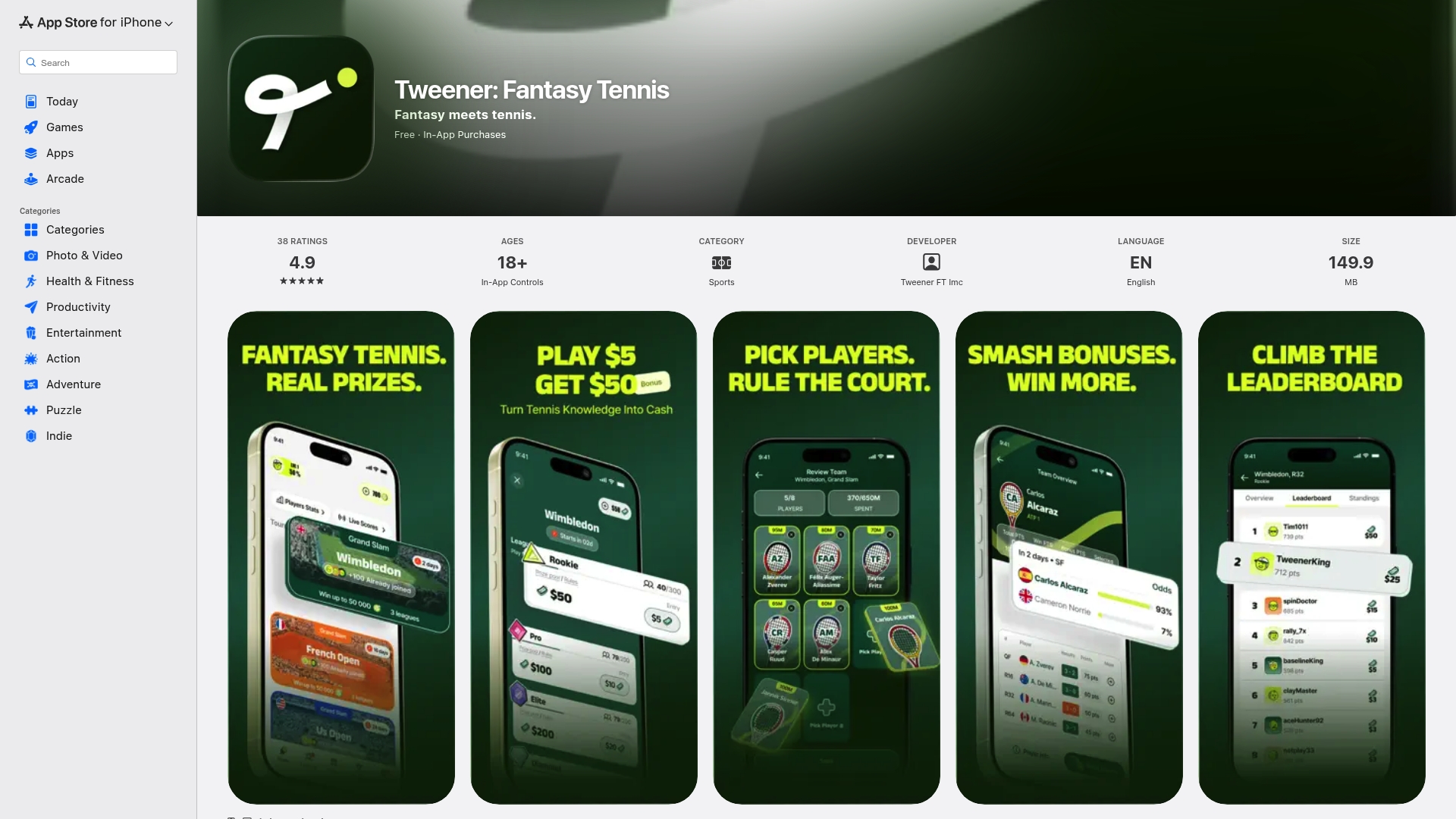
Getting into a Madrid Open contest takes three steps. First, grab the app from the Tweener download page or the App Store listing. Second, open the app and choose Draft Mode or Pick'em Mode depending on how much prep time you want to put in. Third, join a public Madrid lobby or create a private league and send the invite code to up to nine friends. Free coin play works for anyone testing the format; cash contests are available where local law permits them, so confirm eligibility in your state before depositing. Once your first lineup is set, the real work starts: watching the draw and reacting before every lock.
Sources
- Carlos Alcaraz and Novak Djokovic both pull out of Mutua Madrid Open due to injury | Sky Sports
- Play the game, Feel the rush: Introducing the Mutua Madrid Open Fantasy on Perfectplayer! - Mutua Madrid Open
- ATP LAUNCHES OFFICIAL FANTASY GAME
FAQ
Is There a Fantasy League for Tennis?
Yes. The Mutua Madrid Open runs an official round-by-round fantasy game covering both ATP and WTA draws, and the ATP tour runs its own season-long fantasy format. Tweener offers a tennis-specific app with Draft Mode and Pick'em Mode, plus private leagues, for fans who want a dedicated platform rather than a general sports app.
Why Did Djokovic Withdraw From the Madrid Open?
Novak Djokovic pulled out of the 2026 Madrid Open due to a shoulder injury, announced before the official draw. Carlos Alcaraz withdrew the same week with a wrist issue, leaving both top seeds out before matches even began.
Is Alcaraz Playing in the Madrid Open?
No. Carlos Alcaraz withdrew from the 2026 Madrid Open due to a wrist injury, confirmed ahead of the official draw. Fantasy managers who had him rostered needed to swap to a backup pick before lock once the news broke.
Why Is the Madrid Open Suspended Sometimes?
Play at the Madrid Open occasionally pauses for weather delays or scheduling adjustments, which is common at outdoor clay events during the spring swing. These pauses can shift match times and locks, which is why checking the official tournament FAQ for updated order of play matters as much as watching the scores themselves.