

TL;DR:
- Reliable live scoring, assistive AI summaries, and social rituals are essential for improving a fantasy tennis app experience. Focusing on quick team creation, personalized analytics, and momentum loops with micro-interactions keeps users engaged between matches. Prioritizing core gameplay, fixing reliability, and gradually adding social and AI features maximize user retention and satisfaction.
The fastest ways to improve a fantasy tennis app experience come down to four things: reliable live scoring, AI that assists without deciding, social hooks that create rituals, and momentum loops that pull users back between sessions. Tweener is the platform where these principles come to life for U.S. tennis fans competing on real ATP and WTA results.
Here are the highest-impact improvements, ranked by payoff:
- Live scoring reliability — updates within a few seconds during Grand Slam matches
- Assistive AI summaries — one-tap matchup recaps, not auto-picks
- Smarter notifications — context-driven alerts users actually control
- Social hooks — private leagues, in-app chat, shareable highlight cards
- Faster team creation — fewer steps from browse to locked lineup
- Tailored analytics — surface form, H2H, and fatigue flags on one card
- Visible rewards — streaks, virtual coins, and mission progress that show up daily
Table of Contents
- Three quick wins you can use inside Tweener right now
- How AI should work as your assistant, not your decision-maker
- Match-day engagement loops that keep you coming back
- Analytics that actually help you pick the right player
- Social features that turn one-time players into regulars
- Reward systems and what U.S. players need to know about cash contests
- Mobile UX fixes that reduce friction fast
- How to measure what's actually working
- A prioritized roadmap: what to fix first and when
- Key Takeaways
- What the fantasy tennis space actually gets wrong
- Tweener is where these ideas become real
- Useful sources
Three quick wins you can use inside Tweener right now
The fastest payoff comes from three moves that take under five taps each.
- Customize your notifications. Go to settings and turn on lineup-lock reminders and injury alerts only. Generic, high-volume alerts push users to disable notifications entirely — so be selective and you will actually see the ones that matter.
- Use the research filters before picking your captain. Sort by surface form before a clay-court event like Roland Garros. Picking Carlos Alcaraz on clay without checking his recent surface record is leaving points on the table.
- Set a lineup reminder 30 minutes before lock. Late scratches happen constantly on tour. A timed alert is the difference between a locked-in injured player and a last-minute swap.
Pro Tip: Start every tournament in Tweener's virtual-coins mode before committing cash. You get the same draft and pick'em formats with zero financial risk, which makes it the best practice ground for testing a new captain strategy before Wimbledon.
How AI should work as your assistant, not your decision-maker
AI should assist, not decide. The highest-value AI features are smart summaries, personalized feeds, and matchup recaps — not auto-picks that remove the strategy you came for.
Industry experts recommend implementing AI as a lightweight assistive tool so users keep strategic control. Concretely, that means:
- One-tap matchup recaps — a card showing head-to-head record, surface win rate, and recent form in three lines
- Ownership-based captain suggestions — "70% of managers are captaining Sinner; here's why contrarian picks could pay off"
- Smart waiver ideas — flagging a player whose ranking has dropped but whose clay form is trending up
- A personalized activity feed — tuned to the tournaments and players you follow, not a generic news dump
The UI pattern matters. A smart summary card sits between the player name and the "add to team" button. It surfaces one key fact (e.g., "5–1 on hard courts this season") and a single suggested action. Predictive analytics in fantasy sports work best when they show their reasoning, not just their conclusion.
Pro Tip: Keep AI features opt-in by default. Show a one-line explanation for every suggestion ("Based on your last 3 picks and surface preference"). Users who understand why a suggestion appeared trust it — and the app — far more.
Match-day engagement loops that keep you coming back
Match-day micro-loops convert a single Djokovic match into three or four re-entry moments. Building momentum between sessions with visible rewards and small wins is what separates apps users check once from apps they check constantly.
Practical micro-interactions that work, inspired by modern innovations in tech-enhanced traditional sports, include:
- Live polls — "Will Medvedev hold serve in the third set?" Costs nothing to answer; creates a reason to stay in the app during the changeover
- One-tap injury swaps — when a late withdrawal appears, a push notification with a single confirm button keeps the lineup valid without forcing users back through the full edit flow
- Flash leaderboards — a mid-match standings update after each set, not just at match end
- Event-driven badges — earn a "Clay Court Specialist" badge after correctly captaining a player who wins on red dirt three times
Pre-match build-up and post-match analysis via community interactions drive long-term retention. A post-match recap card showing your score, your captain's stats, and how your league finished gives users a reason to open the app even after the last ball is struck.
Stat to know: Score lags of 5–30 seconds erode trust and cause users to leave mid-session. Live scoring reliability is the foundation every other engagement feature sits on.
Analytics that actually help you pick the right player
Tennis is a data sport, and focused, scannable analytics beat full spreadsheets for anyone making decisions on a phone. The analytics cards worth building — or using — are:

| Analytic | UI Card | User Question It Answers |
|---|---|---|
| Surface-adjusted form | Player profile header | "Is Nadal actually good on clay right now?" |
| H2H quick view | Matchup card | "Does Zverev have Alcaraz's number?" |
| Fatigue/injury flag | Roster alert badge | "Is this player at risk of retiring mid-match?" |
| Projected fantasy impact | Add-player modal | "How many points does adding Swiatek give me?" |
| Ownership stats | Captain selector | "Am I being contrarian or just wrong?" |
Live data elevates fantasy sports strategy most when it answers a specific question at the moment of decision, not after the lineup locks.
Pro Tip: Show delta impact in real time during team selection — a small "+14 projected pts" counter next to a player's name as you hover over them. That single number speeds up decisions and reduces lineup abandonment.
Social features that turn one-time players into regulars
Social features convert single-game visits into ongoing rituals. Private leagues, sharable highlights, and in-app chat are the core three. Modern fantasy users expect chat, polls, and shareable content — and apps that skip them lose the between-match conversation to group texts instead.
Features worth prioritizing:
- Private Grand Slam leagues — Tweener supports small private leagues appropriate for friend groups, which is the right size for a friend group without losing the competitive feel
- In-app chat with reactions — emoji reactions on league events ("your captain just double-faulted") keep the feed alive without requiring full messages
- Shareable match highlight cards — a one-tap image showing your score, captain pick, and league rank, ready to post to X or Instagram
- Guest expert threads — a pinned post from a tennis analyst before each major gives casual fans a starting point for their picks
For launch, the minimum viable social checklist: moderation tools, media attachments, snippet sharing to social networks, and privacy controls for private leagues.
Reward systems and what U.S. players need to know about cash contests
A dual economy — virtual coins for everyone, optional cash contests where legal — maximizes both reach and lifetime value. Reward mechanics compound to keep users returning when they are visible and tied to real progression.
Mechanics that work:
- Streak rewards — bonus coins for entering contests in three consecutive tournaments
- Daily missions — "Pick a player ranked outside the top 20 who wins today"
- Achievement tiers — cosmetic upgrades (profile badges, league icons) tied to milestones
- Entry discounts — reduced cash entry fee after a losing streak to reduce churn
On cash contests: state legality varies across the U.S. Tweener offers cash mode where legally permitted, and responsible-gaming controls — deposit limits, self-exclusion options — are required, not optional. Check your state's rules before depositing. Understanding fantasy rewards in both modes helps you get more from the platform regardless of which you choose.
Pro Tip: Make virtual-coin progression visible on the home screen. A progress bar showing "80 coins to next reward" gives users a reason to open the app on a non-match day.
Mobile UX fixes that reduce friction fast
Reduce steps and visual confusion. Cutting team creation from many steps to fewer significantly increases contest entry rates — that single change outperforms most feature additions.
- Shorten the lineup flow — target 8 steps or fewer from opening the app to a locked team
- Thumb-friendly controls — captain toggle and swap buttons in the bottom third of the screen
- Separate live match data from fantasy scoring visually — blending the two feeds without clear encoding causes cognitive overload and mistakes about score provenance
- One-tap captain pick — a long-press on any player card should surface the captain option immediately
- Color-blind palettes — offer at least one alternative color scheme in settings
- Screen-reader labels — every score badge and player card needs an accessible text label
- Adjustable font sizes — system font scaling should propagate through the entire app
Pro Tip: Use progressive disclosure during team selection: show budget remaining and projected score as a persistent header, but hide advanced filters behind a single "More" tap. New users see a clean flow; experienced users get depth one tap away.
How to measure what's actually working
Measure engagement with five metrics. Everything else is noise until these are stable.
| Metric | Definition | Target Direction |
|---|---|---|
| DAU | Daily active users | Improve |
| 7-day retention | % of new users still active after 7 days | Improve |
| Contest entry rate | % of active users who enter at least one contest per tournament | Improve |
| Team creation completion | % of users who start lineup and finish it | Improve |
| Notification opt-in rate | % of users who enable at least one alert type | Maintain / improve |
A/B tests to run first:
- Team creation step reduction — test 8-step flow vs. current flow; primary metric is completion rate
- Notification granularity defaults — test minimal defaults vs. all-on defaults; measure opt-out rate at day 7
- Smart summary opt-in placement — test summary card above vs. below player stats; measure captain selection time
- Live poll placement — test poll in match feed vs. league chat; measure poll participation rate
For statistical validity, run each test until you reach at least 95% confidence and a minimum detectable effect of 5% on the primary metric. Anything smaller than that is within noise for early-stage apps.
A prioritized roadmap: what to fix first and when
Fix reliability and onboarding first. A fast, frictionless entry into a contest is the prerequisite for every other improvement — social features and AI summaries mean nothing if users abandon during team creation.
Quick wins (1–4 weeks)
- Reduce team creation to 8 steps and measure completion rate
- Set notification defaults to minimal; add granular opt-ins
- Visually separate live match feed from fantasy scoring layer
Medium effort (1–3 months)
- Launch assistive AI summary cards (matchup recaps, surface form)
- Add live polls and flash leaderboards during match play
- Build shareable highlight cards for post-match social sharing
Long term (3–9 months)
- Full personalized activity feed tuned to player and tournament preferences
- Achievement tier system with cosmetic rewards and visible progression
- Accessibility audit: color-blind palettes, screen-reader labels, font scaling
Each bucket ties to a KPI: quick wins move team creation completion and notification opt-in; medium effort moves 7-day retention and DAU; long-term bets move contest entry rate and lifetime value.
Key Takeaways
The single highest-impact move in a fantasy tennis app is cutting friction at entry — faster team creation and reliable live scoring unlock every other engagement mechanic.
| Point | Details |
|---|---|
| Fix reliability first | Sub-5-second live scoring and a short team creation flow are prerequisites for all other features. |
| AI assists, never decides | Smart summaries and surface-form cards help users pick better without removing strategic control. |
| Momentum between sessions | Live polls, streak rewards, and flash leaderboards create multiple re-entry moments per match. |
| Social features drive rituals | Private leagues (up to 9 friends) and shareable highlight cards turn one-time players into regulars. |
| Tweener as your starting point | Practice every tactic above in Tweener's virtual-coins mode before entering cash contests. |
What the fantasy tennis space actually gets wrong
Most fantasy app discussions focus on adding features. The real problem is almost always subtraction. Apps pile on analytics tabs, notification types, and social feeds, then wonder why users churn after one tournament.
The apps that retain users longest do one thing well first: they make the core loop — pick a team, watch it score, see where you stand — feel instant and satisfying. Every feature in this article is only worth building after that loop is airtight. A smart AI summary card is useless if the live score it references lags by 20 seconds. A private league is useless if your friends abandon during team creation.
Tennis is also a uniquely demanding sport for fantasy. Matches can last five sets or 58 minutes. A player can retire injured in the second set. The app has to handle that volatility gracefully, with injury alerts, swap windows, and clear scoring rules that don't leave users confused about why their points changed. That's where Tweener's focus on real ATP and WTA match data, combined with the Tweener Mobile Fantasy Sports Guide 2026, gives the platform a structural edge over generic fantasy products that treat tennis as an afterthought.
Build the core loop first. Then layer in the social features, the AI cards, and the reward economy. In that order.
Tweener is where these ideas become real
Tweener is the closest thing U.S. tennis fans have to a dedicated fantasy tennis platform built for serious players. Unlike general fantasy apps that bolt tennis onto a football-first product, Tweener is built around ATP and WTA match results, private Grand Slam leagues, and a dual-economy model that lets you compete with virtual coins or enter cash contests where your state permits.
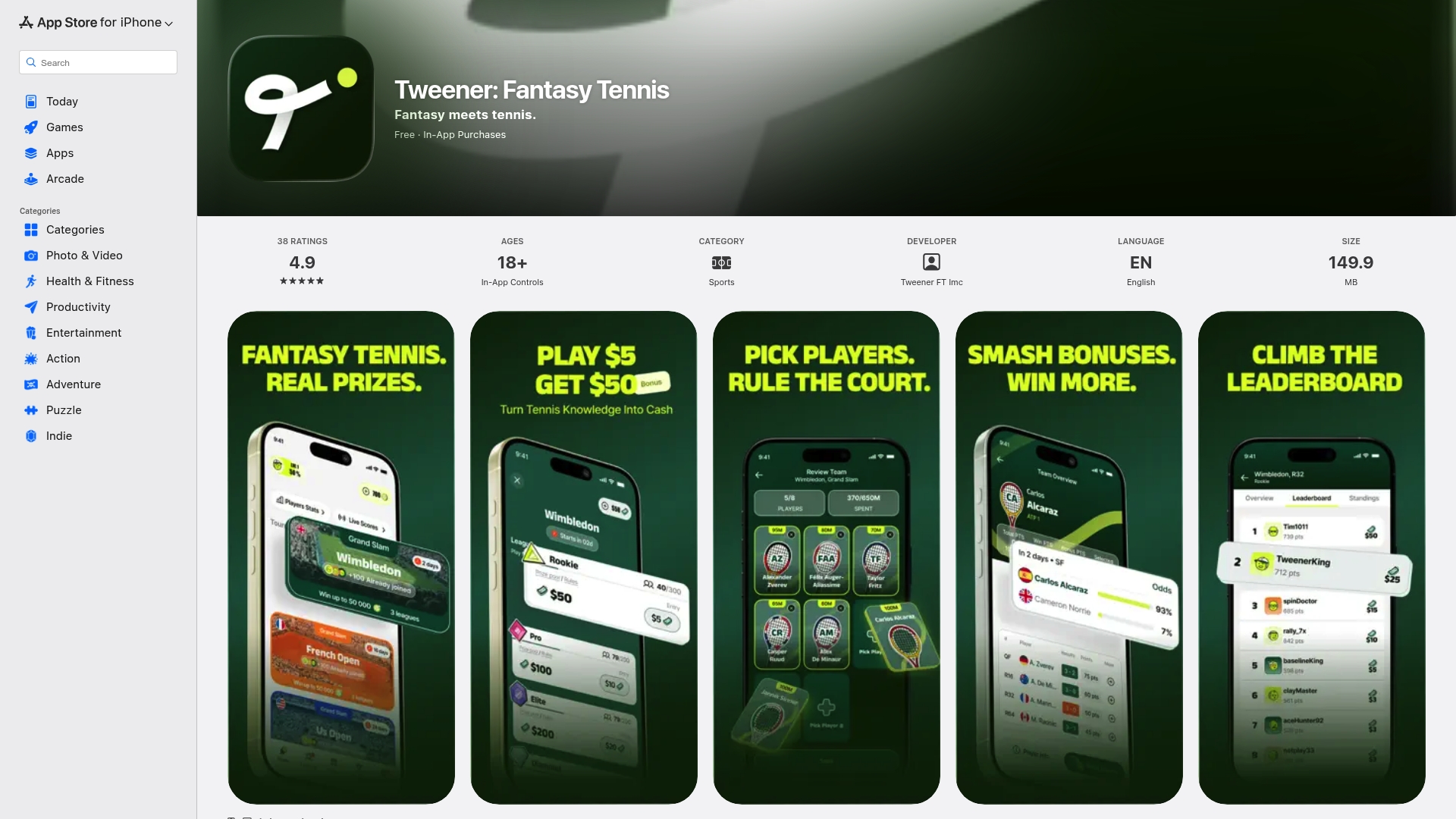
The practical next step: download Tweener and run your first private league in virtual-coins mode during the next major. You get the full draft and pick'em experience, the live scoring, and the leaderboard — with no cash at stake while you learn the formats. Once you know which analytics cards and captain strategies work for you, the cash-contest mode is there when you're ready. Cash contests are available where legally permitted in the U.S.; check your state's rules and use Tweener's responsible-gaming tools to set deposit limits before you play.
Useful sources
- Top Fantasy Sports App Features Users Expect in 2026 — supports AI assistive features, live scoring expectations, and social feature recommendations
- Why Growth Engineering Is Essential for Scaling a Fantasy Sports Platform — source for "momentum between sessions" principle and reward-loop mechanics
- Sports App UX Design: Lessons from Designing for Cricket, Fantasy & Live Score Platforms — UX guidance on step reduction, notification strategy, and live scoring latency thresholds
- Fantasy Sports App Design Case Study | My Fantasy League — source for visual separation of live match data and fantasy scoring
- Impact of AI-Based Matchmaking on Motivation to Re-Engage with Fantasy Sports Applications — academic basis for segmenting competitive users before applying AI matchmaking
- Tweener: Predictive Analytics in Fantasy Sports — Tweener's own guide to AI assistive features and analytics strategy
- How Live Data Elevates Your Fantasy Sports Strategy — Tweener guide on live scoring and real-time decision-making