

TL;DR:
- Understanding your league's scoring format and prize structure is essential for maximizing fantasy rewards, as they influence player value and lineup decisions. Tailoring projections, roster strategies, and threshold threshold management to specific rules helps secure more wins, prizes, and milestones throughout the season. Most players miss out by neglecting league-specific settings, treating fantasy sports as a generic game rather than customizing their approach to their unique reward system.
Fantasy rewards are the points, prizes, and payouts your league assigns based on how real players perform in actual games. Understanding fantasy rewards is the difference between drafting a team that looks good on paper and building one that actually wins money, gift cards, or league championships. The reward structure your league uses determines which stats matter, which players hold value, and which weekly decisions move the needle. This guide breaks down scoring formats, prize mechanics, and lineup strategies across football, baseball, and fantasy tennis so you can align every roster decision with what your league actually pays out.
Understanding fantasy rewards: how scoring formats shape player value
Fantasy reward mechanics begin with one question: what does your league pay for? The answer lives in the scoring format, and getting it wrong before your draft is the single most expensive mistake a fantasy player makes.

The three most common football formats are standard (non-PPR), half-PPR, and full-PPR. Standard scoring awards no points for receptions, which means running backs who catch passes out of the backfield lose significant value. Full-PPR awards one point per reception, which completely reorders receiver rankings. A slot receiver running 90 routes per game becomes a weekly starter. A touchdown-dependent tight end with low target volume drops several rounds. Half-PPR splits the difference, but the principle stays the same: the format is a roster construction tool, not just a scoring rule.
The contrast is even sharper in fantasy baseball. Head-to-head each-category leagues score wins per statistical category rather than total points, which means winning six of ten categories beats dominating two. That format rewards roster depth and midweek flexibility over stacking elite hitters. A total points league, by contrast, rewards raw production. The same player can be a top-five asset in one format and a mid-tier pick in the other.
| Format | What it rewards | Key player type to target |
|---|---|---|
| Full-PPR | Reception volume and target share | Slot receivers, pass-catching backs |
| Standard/non-PPR | Touchdowns and yardage | Goal-line backs, red-zone receivers |
| H2H each-category (baseball) | Category balance and roster depth | Multi-category contributors |
| H2H total points | Raw statistical output | Elite producers at premium positions |
| Fantasy tennis (Tweener) | Match wins, sets, and performance stats | In-form players on favorable surfaces |
Pro Tip: Read your league's full scoring rules before your draft, not after. Pay specific attention to yardage bonuses, TE premium settings, and any superflex designations. These details shift player values by multiple rounds.
What are common fantasy reward systems and how do they incentivize gameplay?
Prize structures in fantasy leagues fall into two broad categories: season-long rewards and in-season milestone rewards. Both shape how you should manage your roster, and most players only think about one of them.
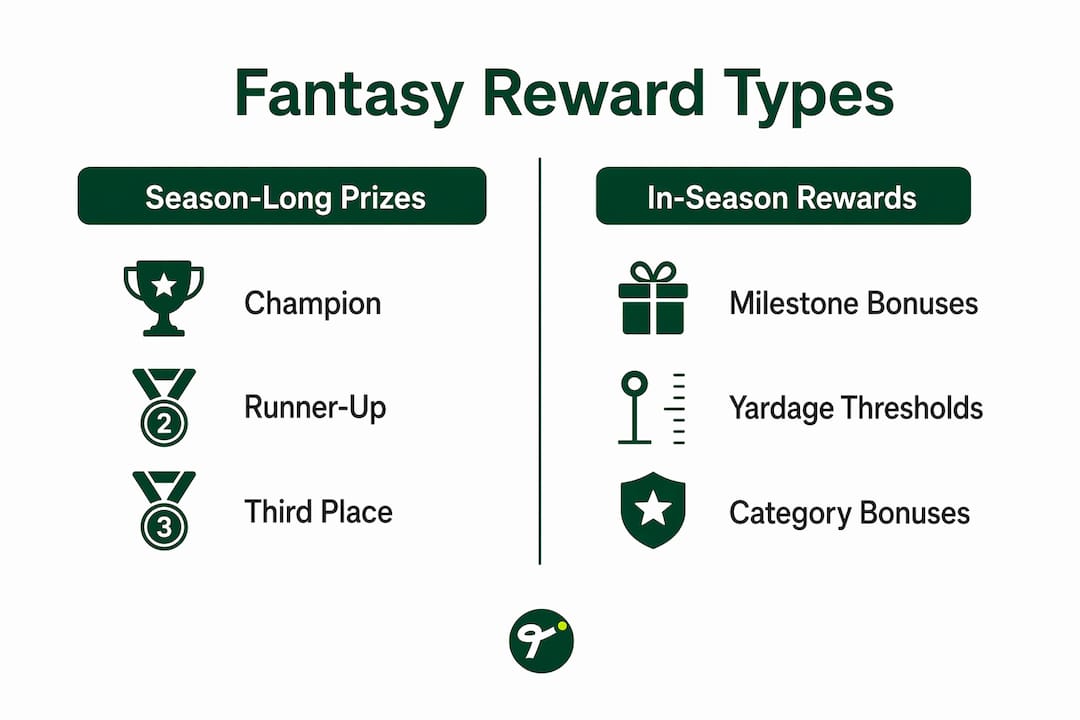
Season-long prizes are the most familiar. A typical 12-team league pays out the champion, runner-up, and sometimes third place. Some leagues add weekly high-score prizes, which creates a second competition running parallel to the standings. That weekly prize changes your lineup calculus. If you are comfortably ahead in your matchup, you might still swap in a high-upside player to chase the weekly bonus. Ignoring that incentive is leaving money on the table.
Milestone bonuses add another layer. Yardage thresholds and category bonuses create nonlinear scoring spikes. A running back who finishes with 98 rushing yards scores the same as one with 75 yards in a standard league. But in a league with a 100-yard bonus, that two-yard gap is worth an extra two points. Chasing those thresholds requires optimizing lineup choices for nonlinear reward rules, not just total expected points. That is a meaningfully different decision framework.
Stage-based leagues add a third dynamic. Fantasy Premier League's Second Chance league resets scoring after Gameweek 21, giving managers a fresh start mid-season with selection advantages. Stage-based prize structures and scoring resets alter optimization priorities and keep more players engaged deep into a season. The strategic implication is real: managers who were eliminated from contention in the first half now have a live prize to chase, which changes how they manage their squads.
Key reward types to track in any league:
- Weekly prizes: High-score bonuses that run independently of head-to-head results
- Monthly awards: Consistency-based prizes for cumulative performance over a calendar period
- Championship payouts: Season-long prizes for top finishers, typically the top two or three spots
- Milestone bonuses: Points awarded for crossing statistical thresholds like 100 rushing yards or 300 passing yards
- Stage resets: Mid-season scoring resets that create a second competition within the same league
How to use projections and league rules to maximize your fantasy rewards
Projections are only useful when they are calibrated to your specific scoring format. A generic projection that ranks players by expected fantasy points in a standard league is actively misleading in a full-PPR or superflex format. Projection reliability and format sensitivity are critical because small differences between projected scores often fall within model error margins. The goal is not to find the player projected for 14.2 points over one projected for 13.8. The goal is to identify clear separations driven by format-specific advantages.
Here is a practical process for aligning projections with your reward system:
- Identify what your league pays for. List every scoring category and bonus threshold before touching a projection tool. In Tweener's fantasy tennis format, this means knowing how match wins, set wins, and individual performance stats translate into points.
- Filter projections by format. Use tools that let you input your exact scoring settings. Fantasy Projection Lab allows format-specific inputs that change output rankings meaningfully.
- Target predictable involvement, not just upside. In PPR formats, consistent target volume matters more than touchdown potential. A receiver running 10 routes per game is a liability regardless of his talent.
- Map roster construction to reward structure. If your league pays a weekly high-score prize, carry one or two high-variance players who can spike. If you only get paid for the championship, prioritize floor and consistency.
- Adjust weekly lineups for threshold bonuses. When two players project similarly, choose the one more likely to cross a yardage or category bonus threshold. That nonlinear upside is real value that flat projections miss.
- Revisit rules mid-season. Stage-based leagues and second-chance formats change the reward landscape partway through the year. Managers who adapt their strategy to the new prize structure gain a real edge over those who do not.
Pro Tip: Reverse-engineer your league's reward system before every waiver wire decision. Ask which available player best fits the stats your league pays for, not which player has the highest name recognition.
What strategic nuances affect earning fantasy rewards in different league types?
The deeper you go into fantasy reward mechanics, the more you realize that format-specific strategy diverges sharply from general fantasy advice. Three areas stand out: head-to-head category management, volatility calibration, and threshold bonus exploitation.
In head-to-head each-category baseball formats, winning more categories per matchup matters more than total statistical output. A team that wins six of ten categories beats a team that dominates two categories by a wide margin. This creates a specific roster-building mandate: avoid players who are elite in one category but dead weight in others. A pure power hitter who hurts your batting average and strikeout rate is a liability in category leagues even if he hits 40 home runs.
Volatility calibration is the most underrated skill in fantasy reward optimization. The right level of risk depends entirely on your position in the standings and the prize structure you are chasing:
- When chasing a weekly prize: Maximize upside. Start the boom-or-bust receiver over the safe floor option.
- When protecting a lead in a head-to-head matchup: Prioritize floor. A player who reliably scores 10 points beats a player who scores 20 or 2.
- In category leagues with a narrow deficit: Target players who can swing one or two specific categories, not overall production.
- In stage-based or second-chance leagues: Treat the reset as a new season. Prior-season strategy no longer applies.
The players who consistently earn fantasy rewards are not the ones with the best players. They are the ones who understand exactly what their league pays for and build every decision around that specific answer.
Threshold bonuses deserve special attention because they create nonlinear value spikes that flat projections miss entirely. A quarterback who averages 295 passing yards per game is worth significantly less in a league with a 300-yard bonus than one who averages 305 yards. That ten-yard gap is worth extra points every week it is crossed. Nonlinear bonuses drive value to players who regularly cross thresholds, which means your draft and waiver decisions should account for how often a player is likely to hit those marks, not just their average output.
Key takeaways
Fantasy rewards are determined by scoring format, prize structure, and threshold bonuses. Aligning your draft, roster moves, and weekly lineup decisions with what your specific league pays for is the most direct path to maximizing your returns.
| Point | Details |
|---|---|
| Format drives player value | PPR, standard, and category formats each reward different stats and player types. |
| Prize structure changes lineup decisions | Weekly prizes, milestone bonuses, and stage resets each require a different optimization approach. |
| Projections must match your format | Generic projections mislead. Use format-specific tools and focus on clear separations, not small differences. |
| Threshold bonuses create nonlinear value | Players who regularly cross yardage or category thresholds are worth more than flat projections suggest. |
| Category leagues reward depth over dominance | In head-to-head each-category formats, multi-category contributors outperform one-dimensional elite players. |
Why most fantasy players leave rewards on the table
I have watched a lot of fantasy players draft excellent rosters and still finish outside the money. The pattern is almost always the same. They understand player talent but they do not understand what their league actually pays for. They draft for a generic version of fantasy sports that does not match the specific rules sitting in their league settings.
The most common mistake I see is treating PPR and standard leagues as interchangeable. A player who drafts Davante Adams in round one of a standard league and then complains about his performance is not wrong about Adams. He is wrong about the format. In a non-PPR league, Adams' value drops because his reception volume is already priced in and touchdowns become the only lever. That is a draft-room mistake that compounds every week.
The second mistake is ignoring mid-season prize resets. When a league introduces a second-chance format or a stage-based scoring reset, most managers who were out of contention mentally check out. The managers who recognize that reset as a live prize to chase and adjust their roster strategy accordingly gain a real competitive edge. I have seen managers win second-chance prizes with rosters they would have otherwise abandoned.
The third mistake is the most subtle. Managers use projections as rankings rather than as decision tools. A projection that says Player A scores 14.3 points and Player B scores 13.9 points is not telling you to start Player A. It is telling you those players are essentially equivalent and you should make the decision based on matchup, threshold proximity, and what your specific league rewards. Projection outputs are most useful when the separation is clear and format-specific, not when you are splitting hairs between nearly identical numbers.
The same logic applies directly to fantasy tennis on Tweener. Knowing that Carlos Alcaraz is the better player does not tell you whether to start him in a specific tournament round. Knowing how Tweener's scoring system weights match wins versus set wins versus individual performance stats, and then checking Alcaraz's surface record and recent form, tells you that.
— Nathan
Take your fantasy tennis rewards further with Tweener
Tweener is built for the kind of analytical player who reads articles like this one. The platform tracks real ATP and WTA match results across live tournaments and converts them into fantasy points through a scoring system you can learn and exploit strategically.
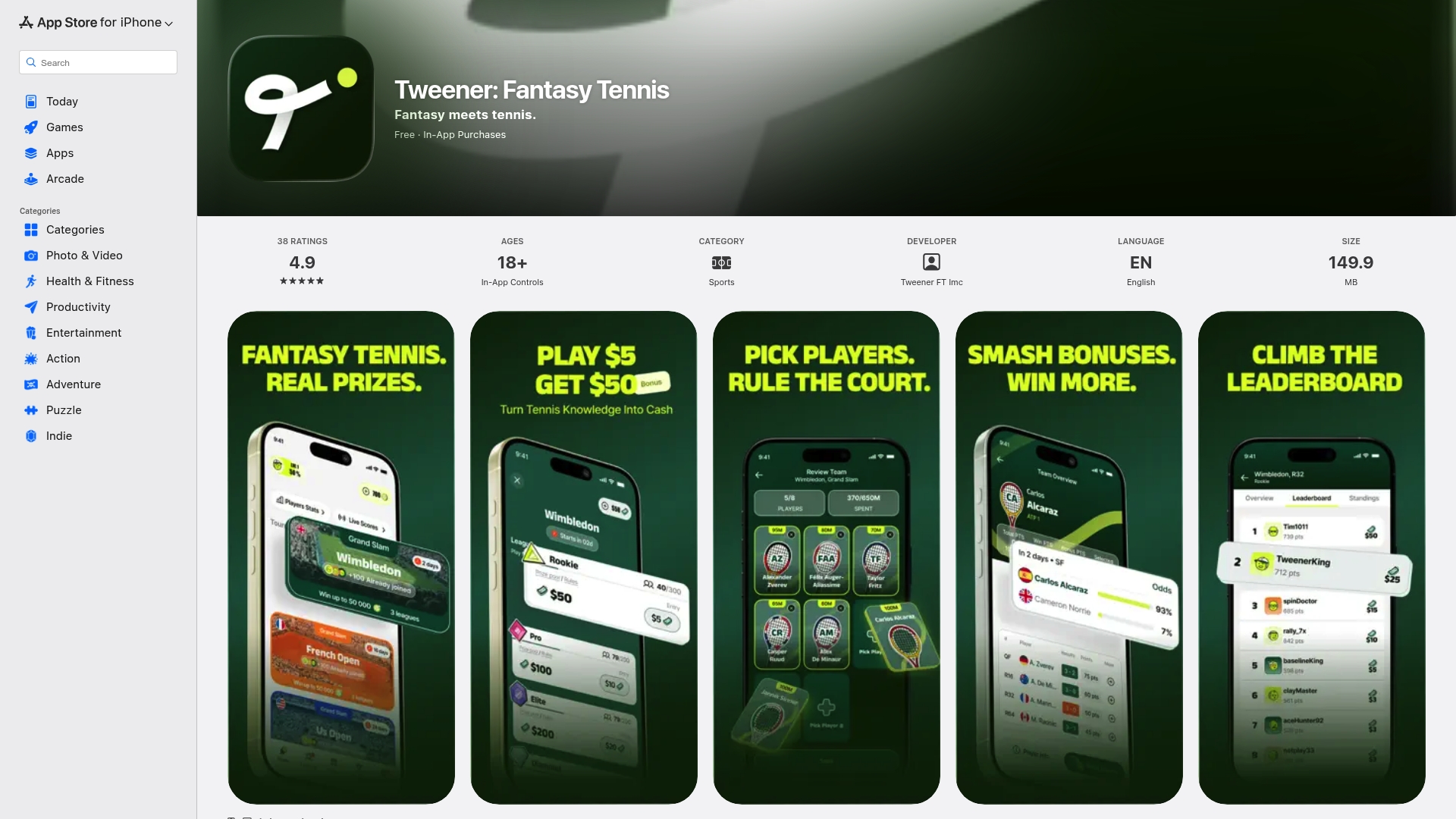
Private leagues let you compete with up to nine friends across Grand Slams and ATP/WTA events, with real rewards on the line in cash mode or virtual coins redeemable for gift cards in free mode. The same principles covered in this guide apply directly: understand how Tweener scores performance, align your player picks with the reward structure, and use surface stats, H2H records, and form data to make decisions that go beyond gut feel. Download the Tweener app and start competing in leagues where strategy, not luck, determines who earns the rewards.
FAQ
What are fantasy rewards in a sports league?
Fantasy rewards are the points, prizes, or payouts a league assigns based on real player performance. They include season-long prizes, weekly bonuses, and milestone payouts tied to specific statistical thresholds.
How does scoring format affect fantasy league prizes?
Scoring format determines which stats earn points and which player types hold value. Full-PPR formats reward reception volume, while standard formats prioritize touchdowns, which shifts player rankings and prize potential significantly.
What is a second-chance league in fantasy sports?
A second-chance league resets scoring mid-season to give managers a fresh start. Fantasy Premier League's version begins after Gameweek 21 and creates a new prize competition within the same platform.
How do threshold bonuses work in fantasy scoring?
Threshold bonuses award extra points when a player crosses a statistical milestone, such as 100 rushing yards or 300 passing yards. These nonlinear bonuses increase the value of players who regularly hit those marks beyond what standard projections capture.
How can I earn more fantasy rewards in tennis leagues?
In fantasy tennis platforms like Tweener, earning more rewards requires understanding how the scoring system weights match wins, set wins, and performance stats, then selecting players based on surface form, H2H records, and live tournament data rather than reputation alone.