

TL;DR:
- Many players mistakenly treat tennis fantasy projections as guarantees rather than probability estimates.
- Projections represent the mean outcome of a range with inherent variability, requiring contextual interpretation for effective lineup decisions.
Most tennis fantasy players look at a projection and treat it like a promise. If a model says a player scores 42 points, they pick that player expecting 42 points. That misunderstanding is exactly what separates casual players from consistent winners. The role of projections in fantasy games is not to predict the future with precision. It is to reduce lineup uncertainty by giving you a probability-weighted starting point for decisions. Understanding this distinction changes how you play, how you pick, and how often you win.
Table of Contents
- What projections really mean in fantasy sports
- Drivers of projection values: role, opportunity, and matchup factors
- Timing and updates: how fresh information influences projections
- Using expected vs actual points to assess player value and role
- Comparing projections and prop lines: uncovering fantasy edges
- Applying projection insights to tennis fantasy lineup strategy
- Rethinking projections: what tennis fantasy players often overlook
- Enhance your fantasy tennis game with Tweener
- Frequently asked questions
Key Takeaways
| Point | Details |
|---|---|
| Projections reduce uncertainty | Fantasy projections provide weighted estimates that help you make informed lineup decisions rather than exact predictions. |
| Role drives fantasy points | A player's expected volume and opportunity are the main factors influencing their fantasy output projections. |
| Update projections often | Refresh your projections with the latest injury and lineup news to keep your decisions accurate and timely. |
| Use multiple data sources | Comparing fantasy projections with player props and expected points reveals valuable insights and unexplored edges. |
| Mind variance and context | Consider floors, ceilings, and matchup context alongside mean projections to build robust tennis fantasy lineups. |
What projections really mean in fantasy sports
Fantasy projections get misread more often than any other tool in the game. Most players scan the number, rank their options by it, and move on. That approach ignores what a projection actually tells you.
Fantasy projections represent the mean of a distribution of possible outcomes, not a guaranteed result. Think of it like a bell curve. The projection sits at the center, but real outcomes spread out on either side. A player projected for 38 points might realistically score anywhere from 18 to 62, depending on how the match unfolds. The projection just tells you where the middle of that range sits.
Every quality projection model blends several inputs:
- Raw historical performance on specific surfaces and against similar opponents
- Matchup adjustments based on the upcoming opponent's style and ranking
- Tournament context including match importance and scheduling
- Probability weighting that accounts for likely outcomes across different scenarios
"A projection is not a forecast of what will happen. It is a forecast of what would happen on average across many similar situations. Your match is one instance."
That last point matters enormously for fantasy tennis tips strategy. When two players are projected at 34 and 36 points respectively, that two-point gap is often within the model's margin of noise. Treating it as a meaningful signal leads you to overthink decisions that should be simple. Save your energy for gaps of 10 points or more. Those actually tell you something.
Drivers of projection values: role, opportunity, and matchup factors
Once you know what a projection is, the next question is what moves it. Three factors dominate: role, opportunity, and matchup.
Volume and opportunity are the primary drivers of expected fantasy output. In tennis fantasy, that means a player's expected match length, their likelihood of advancing deep into a tournament, and their current physical status. A player who tends to win in straight sets generates fewer points than one who fights through three-set battles, even if both are equally talented on paper.
Tennis-specific factors that materially shift projections include:
- Surface (clay specialists project very differently on hard courts)
- Opponent's playing style (big servers suppress rallies and reduce ace opportunities for both players)
- Recent form and winning streaks
- Match round (later rounds mean longer, higher-intensity matches with more scoring opportunities)
When a projection significantly diverges from sportsbook prop lines on the same player, that gap is a signal worth tracking. It often points to role uncertainty, like an injury that has not been officially confirmed yet.
Here is a stepwise process for using projection drivers effectively when building winning tennis lineups:
- Check the player's surface win rate for the current tournament surface
- Review their opponent's ranking and recent head-to-head results
- Compare the projection to any available prop lines for the same match
- Flag any projection that sits more than 20% above or below comparable players in the same price tier
- Apply the tennis match prediction strategies that account for opponent quality adjustments
Pro Tip: Never use projections as your only filter. A high projection on a player facing a tough draw in the next round can evaporate fast. Pair the number with context.
Timing and updates: how fresh information influences projections
Projection models are not static. They refresh constantly, and the value of a projection is directly tied to how recently it was updated.

Daily fantasy projections update frequently to incorporate injury news, lineup changes, and late-breaking information. In tennis, that means pre-match withdrawal announcements, retirement history in specific conditions, and even weather affecting court speed all flow into updated models throughout the day.
The types of updates that shift projections most:
- Injury confirmations or withdrawals that change draw scenarios
- Surface conditions altered by rain or tournament scheduling
- Recent fitness news from press conferences or practice reports
- Opponent substitution in the draw due to a late retirement
Using a projection from the morning when a significant news item breaks at midday is like navigating with an outdated map. The terrain has changed.
Pro Tip: Set a reminder to check projections within two hours of your lineup lock time. That window catches the most impactful late updates and gives you the freshest data possible before daily fantasy sports strategies come into play.
Combining fresh projections with the winning lineup tips that account for draw progression and round-by-round changes gives you a real edge over players who set and forget their rosters.
Using expected vs actual points to assess player value and role
Expected fantasy points (xFP) take projection analysis one layer deeper. Where a standard projection estimates future output, xFP measures what a player should have scored based on their workload in a completed match, regardless of how the actual points fell.
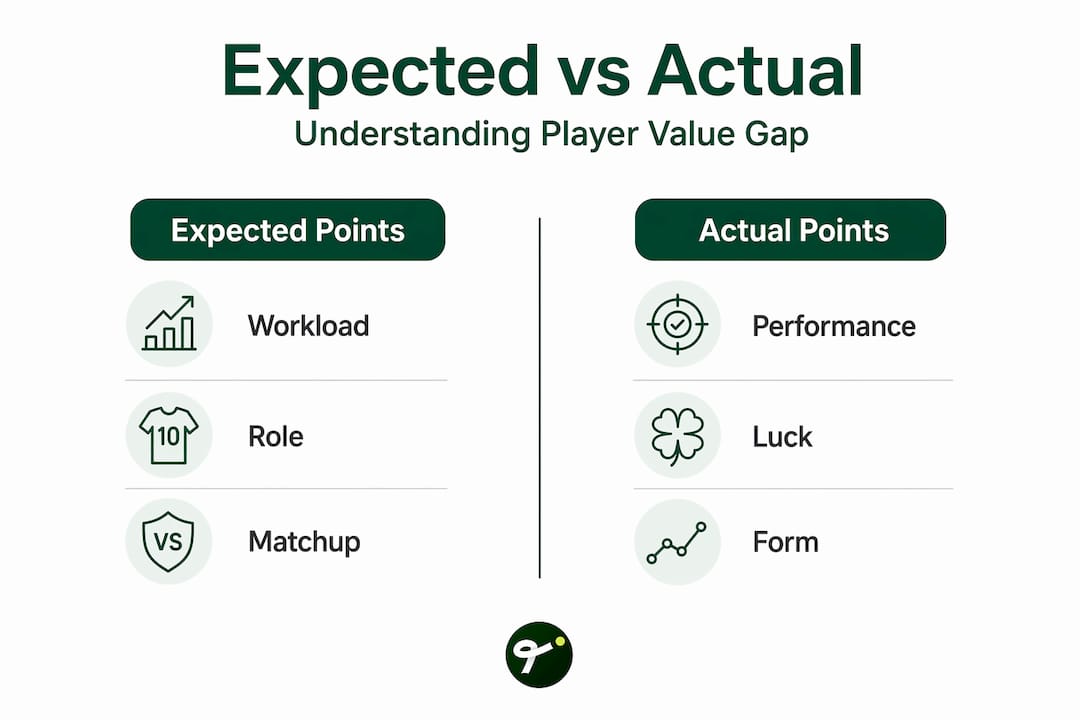
Expected fantasy points quantify production based on player workload, independent of talent or luck. Comparing xFP to actual fantasy points tells you something projections alone cannot: whether a player is consistently outperforming their opportunities or consistently leaving points on the table.
Here is how that comparison looks in a practical tennis fantasy context:
| Player | xFP (based on workload) | Actual FP | Gap | Insight |
|---|---|---|---|---|
| Player A | 41 | 55 | +14 | Overperforming, possibly unsustainable |
| Player B | 38 | 22 | -16 | Underperforming, role or form concern |
| Player C | 35 | 34 | -1 | Performing as expected, reliable pick |
| Player D | 29 | 44 | +15 | Breakout form, worth targeting |
The players most worth targeting are those with a large positive gap that is not yet priced into their salary. The players to fade are those showing consistent negative gaps, because the model expects them to score but they keep falling short. That pattern often signals a form issue that projections have not caught up with yet.
Tracking this data over multiple rounds lets you predict tennis outcomes with more precision than relying on projections alone.
Comparing projections and prop lines: uncovering fantasy edges
When fantasy projections and sportsbook prop lines point in the same direction, that agreement signals low uncertainty. When they diverge significantly, something worth investigating is happening.
Large gaps between props and projections signal role or usage uncertainty and prompt closer examination. Props are built to balance betting action, so they skew conservative. Fantasy projections are built to estimate mean outcomes, so they incorporate player upside more freely. Neither is right or wrong; they are built for different purposes.
Here is how the two data sources compare in practical terms:
| Data source | Goal | Skew | Best used for |
|---|---|---|---|
| Fantasy projection | Estimate mean outcome | Slightly optimistic | Ranking players, salary value |
| Sportsbook prop | Balance bettors | Conservative | Identifying uncertainty |
| Combined analysis | Surface disagreement | Contextual | Finding edge cases worth targeting |
A step-by-step process for using this comparison to choose tennis players:
- Pull the current fantasy projection for each player you are evaluating
- Find the corresponding sportsbook prop (aces, games won, match duration)
- Convert both to a common score scale where possible
- Flag any player where the gap exceeds 15%
- Investigate the reason for that gap before including or excluding them from your lineup
Pro Tip: A player whose projection is 20% higher than their prop line is not automatically a must-start. The gap might reflect a projection model that has not updated for a withdrawal or injury. Always investigate before acting.
These comparisons become even more powerful when you optimize tennis fantasy picks using both data streams together rather than relying on either one alone.
Applying projection insights to tennis fantasy lineup strategy
Theory only matters when it produces lineup decisions. Here is how fantasy game strategy projections translate directly into the players you select on match day.
Successful tennis DFS strategy incorporates surface-split data, opponent quality adjustments, and value thresholds to build optimal lineups. That framework, applied practically, looks like this:
- Surface win rate threshold: Only consider players with a win rate of 55% or higher on the current tournament surface over their last 20 matches
- Value threshold: Target players projecting at 3.5 or more fantasy points per $1,000 of salary
- Match length bias: On slow surfaces like clay, favor players who excel in extended rallies over big servers
- Draw awareness: Check whether your projected player faces an easy or brutal path through the round. A 40-point projection against a top-10 opponent is worth less than a 35-point projection against a struggling qualifier
Continuously updating this analysis as the tournament progresses is not optional. Draws shift, players withdraw, and conditions change. The fantasy tennis lineup tips that win consistently are built on current information, not morning assumptions.
Pro Tip: Build two lineup variations before locking in: one that optimizes for high projection value, and one that hedges with safer, lower-variance picks. Which you use depends on your position in the standings and how many points you need to catch up or protect.
Check top ATP and WTA picks before each tournament round to cross-reference your projection analysis against current expert consensus.
Rethinking projections: what tennis fantasy players often overlook
Here is the uncomfortable truth most fantasy guides will not say directly: projections fail at the worst moments not because the math is bad, but because players treat a mean as a guarantee.
The biggest source of projection error is structural role change, not random noise. A player's mean projection holds steady right up until something fundamentally shifts, like a recurring shoulder injury that was not disclosed, a sudden drop in first-serve percentage, or a coaching change that shifts their tactical approach. When that structural break happens, the projection model keeps cranking out numbers based on old data. You are the one who has to catch it first.
This is why fantasy tennis tips that focus purely on projection rankings miss the point. A 40-point projection based on last season's clay performance means very little if the player has barely practiced on clay this year. Context overrides the number.
The mindset shift that actually moves the needle: stop asking "who has the highest projection?" and start asking "whose projection floor is highest and whose ceiling is worth the risk?" Floor and ceiling, not the mean, are where real lineup edges live. A player with a 38-point mean, a 28-point floor, and a 55-point ceiling is a fundamentally different asset than one with a 38-point mean, a 34-point floor, and a 42-point ceiling. Same headline number, completely different risk profile.
Players who embrace that uncertainty, and build lineups around it rather than against it, win more over a full tournament. That is not a projection. That is a pattern.
Enhance your fantasy tennis game with Tweener
Understanding the impact of projections on fantasy decisions is only half the work. The other half is having a platform built to support how you actually use that knowledge.
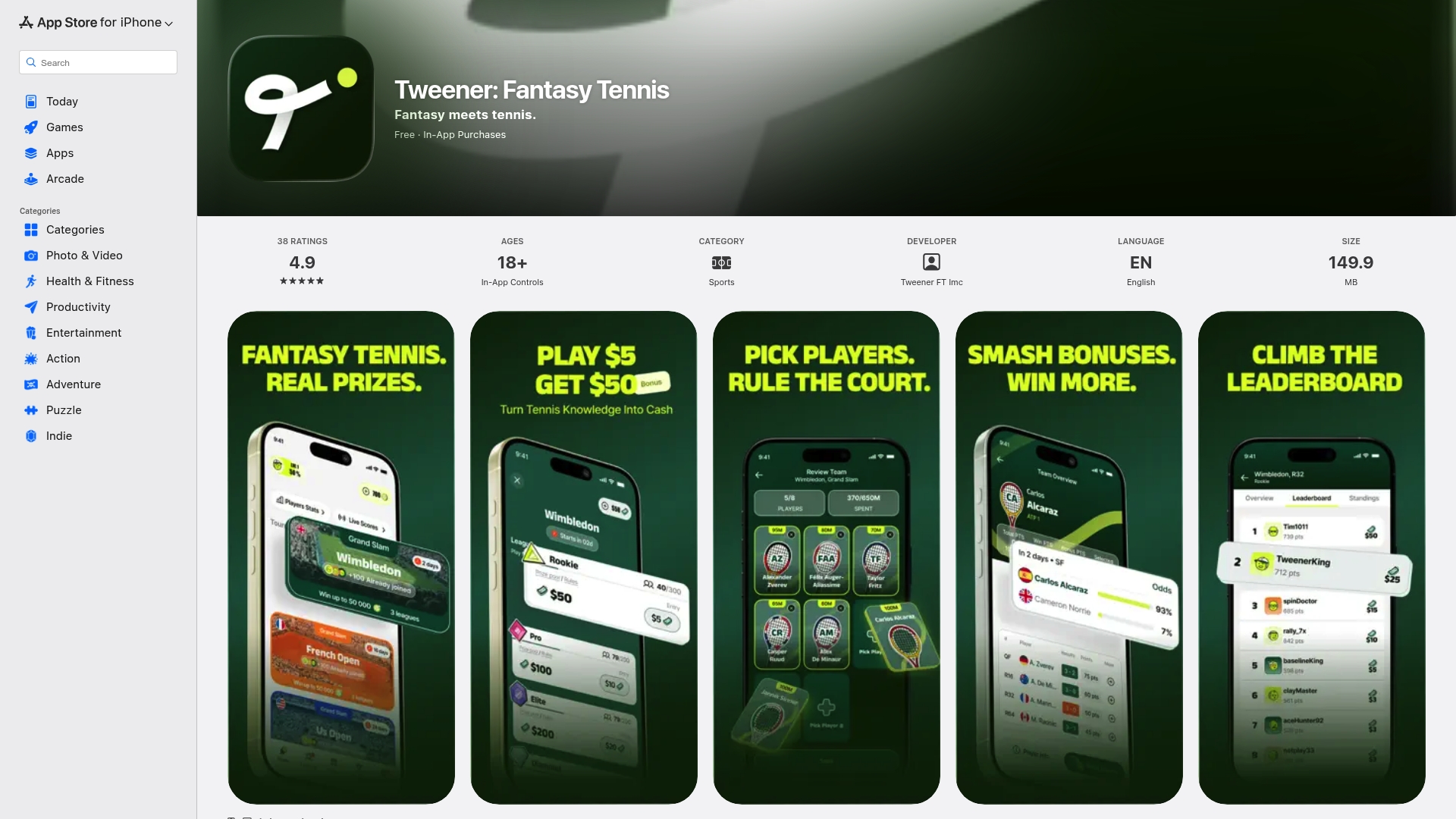
Tweener is the fantasy sports app built specifically for tennis fans who want more than a passive viewing experience. With real ATP and WTA players, live tournament scoring, and both free-to-play and cash contest modes, Tweener gives you the arena to apply every projection insight you have developed. Join public leagues, challenge friends in private leagues, and use your knowledge of player matchups, surface data, and projection analysis to build lineups that compete. Whether you are playing for virtual coins or real prizes, Tweener turns every projection decision into a live, competitive outcome.
Frequently asked questions
What exactly is a fantasy projection in tennis games?
A fantasy projection is a probability-weighted estimate of a player's expected fantasy points, reflecting the mean of a range of possible outcomes rather than a specific guaranteed result.
How do player props differ from fantasy projections in tennis?
Player props aim to balance betting action and tend to be conservative, while fantasy projections incorporate player upside and can skew optimistic. Large gaps between the two signal role or usage uncertainty worth investigating before you finalize your lineup.
Why should I consider expected versus actual fantasy points?
Expected fantasy points measure what a player should have scored based on workload, so comparing them to actual points reveals whether someone is consistently outperforming or underperforming their opportunity, which signals potential role or form shifts ahead.
How important is updating projections with late-breaking news?
Very important. Fresh injury and lineup updates can shift a projection significantly, and daily projections update continuously with new player news, so using stale data at lineup lock time is one of the most avoidable mistakes in fantasy tennis.