

TL;DR:
- Successful tennis DFS lineup construction requires balancing matchup quality, surface fit, and recent form within a salary cap for varying contest types.
- Cash games favor safe, high-floor picks, while GPPs demand ownership leverage and differentiation for large payouts.
Choosing a winning tennis DFS lineup is one of the most satisfying puzzles in fantasy sports. Unlike football or basketball, where volume and pace stats drive projections, tennis rewards an entirely different skill set. Every player faces a single opponent on a specific surface, and one bad day ends their tournament. That volatility makes lineup construction both thrilling and unforgiving. Whether you're grinding cash games for consistent returns or shooting for a big GPP payday, the decisions you make before lineup lock define your ceiling. This guide breaks down exactly what to evaluate, how to approach each contest type, and how to play responsibly and legally in 2026.
Table of Contents
- Key criteria for successful daily fantasy sports lineups
- Top strategies for daily fantasy tennis contests
- Comparing contest types: Cash games vs. GPPs
- Responsible play, legal status, and safe engagement
- What most DFS guides miss about winning in tennis
- Take your tennis DFS game to the next level
- Frequently asked questions
Key Takeaways
| Point | Details |
|---|---|
| Choose the right contest | Knowing the difference between cash games and tournaments is vital for maximizing your odds. |
| Balance risk and reward | Your lineup strategy should match contest type, leveraging safe picks or bold differentiation as needed. |
| Use responsible gaming tools | Safety features like deposit limits help keep your DFS play enjoyable and within limits. |
| Check local legality | Always confirm DFS is permitted in your location before entering paid contests. |
| Apply expert strategies | Advanced tactics and live adaptation set winning DFS players apart in tennis leagues. |
Key criteria for successful daily fantasy sports lineups
Start by understanding the core mechanics that shape every decision in tennis DFS. You are building a roster within a salary cap, selecting players from a specific slate, and submitting your lineup before a lock time. After lock, your score is calculated based on live match results. There is no swapping players mid-round. What you set is what you get.
That structure creates two very different goals depending on the contest you enter. As noted in the DraftKings DFS guide, the slate-based scoring mechanics reward higher floors in cash games while tournaments reward differentiated upside. In other words, cashing in a head-to-head or 50/50 contest requires a safe, reliable score. Winning a large-field GPP requires a lineup that most other players are not using.
Here are the main factors you need to evaluate every time you build a lineup:
- Salary efficiency: How much production does each player deliver per dollar of salary? A top seed priced at $9,000 may be worth less than a $6,500 underdog on a good surface matchup.
- Matchup quality: Who is the player facing? First-round opponents on clay may be very different from second-round opponents at a hardcourt major.
- Surface fit: Some players dramatically outperform their ranking on specific surfaces. Grass specialists, clay grinders, and hardcourt baseline players all have distinct performance curves.
- Recent form: A player coming off a deep run at the previous tournament carries momentum. One returning from injury or a long absence is a question mark.
- Ownership projection: In large tournaments, knowing which players most lineups will include helps you decide where to be different.
- Lineup lock awareness: Late scratches, retirements, and weather delays affect slate composition. Monitor injury news until the last minute before lock.
Pro Tip: Match your selection criteria to the contest type first, then select your players. The mistake most beginners make is picking great players without considering whether those players fit the format they are entering.
Spending time on building winning lineups before entering contests will save you from repeatedly filling rosters on instinct alone.
Top strategies for daily fantasy tennis contests
With the main criteria in mind, the next step is turning that knowledge into a repeatable strategy for each contest type. Cash games and GPPs require genuinely different approaches, and confusing the two is the most common mistake intermediate DFS players make.
Cash game approach (step by step):
- Start with projections. Use available data on match odds, surface stats, and recent form to rank players by expected output relative to salary.
- Load up on chalk. In cash games, playing heavily owned favorites is correct. Your goal is a safe, high-probability score. You do not benefit from being different.
- Minimize risk. Avoid players in risky matches, anyone dealing with physical concerns, and long-shot upsets. One underperformer tanks your entire lineup.
- Check salary utilization. Build toward your cap without leaving money on the table. Unused salary often means missed value.
- Do a final injury scan. Run a quick news check 30 minutes before lock. Withdrawals can open up cheaper, unexpected value in the remaining slate.
GPP approach (step by step):
- Identify the chalk. Know which players most competitors will use. These are the high-owned favorites.
- Decide where to fade. You cannot win a large tournament by mimicking everyone else. Strategically leave out one or two chalk players in favor of differentiated options.
- Find ownership leverage. Look for players who project well but are under-owned due to recent bad press, lower seeding, or quiet form. These are your differentiators.
- Build correlated stacks where the format allows. Pairing a player you believe in deeply with supporting picks that also benefit from his or her success amplifies upside.
- Accept volatility. GPPs mean sometimes you finish near the bottom. That is the cost of swinging for a top prize.
As tennis DFS strategy research confirms, GPP success requires ownership leverage and differentiation while cash games live and die by expected value relative to salary. These are genuinely different skill sets, not just slightly different versions of the same thing.
"The player who wins the most often in cash games and the player who wins the biggest prizes in GPPs are usually doing completely opposite things. Recognizing which game you are playing is the real skill."
Surface fit deserves special attention. Clay courts slow the ball down and favor baseline players with strong topspin. Grass is fast and punishes opponents who struggle with low balls. Hardcourt is neutral but rewards big servers on indoor surfaces. A player like a clay-court specialist who reaches the quarterfinals at Roland Garros every year but exits in the first round at Wimbledon is a dramatically different DFS asset depending on the week.

Pro Tip: Do not just check a player's ranking. Check their surface-specific win rate over the last 12 months. This single filter can expose underpriced value and overpriced liabilities that most casual lineups will miss.
Pairing a strong read on the field with these strategies is how you go from reactive to proactive. The DFS tennis lineup guide offers additional depth, and if you want to get sharper at drafting tennis players, the frameworks for consistent drafting apply directly to DFS slate building. For prediction-based contests, the prediction games strategy breaks down how anticipating match outcomes compounds your edge.
Comparing contest types: Cash games vs. GPPs
Now that the strategies are clear, here is a direct side-by-side comparison to help you decide which format fits your goals and risk tolerance.
| Feature | Cash games | GPPs (large-field tournaments) |
|---|---|---|
| Payout structure | Flat payout to top 40-50% | Top-heavy, prize pool focused at top 1-10% |
| Risk level | Low to medium | Medium to high |
| Lineup type | Safe, high-floor picks | Differentiated, high-upside picks |
| Skill rewarded | Projection accuracy, chalk | Ownership leverage, creativity |
| Winning frequency | More consistent | Less frequent but bigger payouts |
| Best for | Steady bankroll building | Large wins, excitement |
| Main risk | One bad player tanks your score | Finishing outside payout zone often |
The right contest type depends on your goals, bankroll, and experience level. Contest-type selection fundamentally changes what a winning lineup looks like, and treating both formats identically is a guaranteed way to underperform in both. For a deeper breakdown of how to manage your entries across formats, the real money DFS tips guide walks through bankroll allocation by contest type.
Before entering any contest, ask yourself these questions:
- Am I building this lineup for safety or upside?
- Do I know the approximate ownership levels of my key players?
- Is my bankroll appropriate for the entry fee I am considering?
- Have I checked for late injuries or withdrawals?
- Does my lineup match the format I am entering?
Getting these questions answered before you lock a lineup takes less than five minutes. Most losing entries skip this step entirely.
Responsible play, legal status, and safe engagement
Making smart lineup and contest decisions is key, but playing safely and legally is just as important. The DFS industry has matured significantly, and responsible gaming tools are now a standard part of most major platforms.
Major DFS operators offer a robust set of safeguards, including deposit limits, wager limits, activity alerts, cooling-off periods, and full self-exclusion options. These tools are not just checkbox features. Used actively, they help you stay in control of your spending and playing habits.
| Responsible play feature | What it does | Why it matters |
|---|---|---|
| Deposit limits | Caps how much you can load into your account | Prevents impulsive large deposits |
| Wager limits | Caps total entry fees per day/week | Controls how much is at risk at once |
| Activity reminders | Timed alerts during play sessions | Keeps you aware of time spent |
| Cooling-off periods | Temporary lock on your account | Useful during losing streaks |
| Self-exclusion | Full account freeze for a set period | Strongest tool for stopping problematic play |
Practical tips for healthy DFS engagement:
- Set a weekly DFS budget and treat it like an entertainment expense, not an investment.
- Review your win/loss record monthly. Tracking results honestly reveals patterns faster than gut instinct.
- Use the deposit limit feature before your first session, not after a bad run.
- Do not enter contests when you are emotionally reactive after a loss. The reflex to immediately re-enter is one of the most common sources of poor decisions.
- Use the responsible play tech overview to understand how platforms test and verify their safety tools.
On the legal side, DFS legal status varies significantly by jurisdiction. Some states classify DFS as a game of skill and permit paid contests freely. Others restrict certain contest structures, and a few have taken restrictive positions on DFS altogether. Before depositing real money anywhere, confirm that cash contests are permitted in your state or country. The DFS risks for tennis breakdown covers the key legal considerations alongside the financial risks specific to tennis fantasy formats.
What most DFS guides miss about winning in tennis
Here is the honest take that most DFS content skips over entirely. The majority of guides spend 90% of their coverage on projections and chalk selection, as if the math alone decides outcomes. It does not.
Tennis is uniquely chaotic. A top-10 player retires with a forearm issue in the second set. A clay-court specialist unexpectedly destroys a grass specialist on a rain-softened hardcourt. A second-round match gets pushed to day three because of a three-day weather delay, suddenly fatiguing a player who had three matches stacked. None of these events show up in a projection model. They show up in real time.
The players who consistently outperform in tennis DFS are not necessarily better at spreadsheets. They are better at disciplined risk management combined with staying genuinely engaged with the live tournament. Watching matches, tracking fatigue, noticing who is grinding through five-setters and who is cruising in straights, these qualitative reads are the real edge that projections cannot capture alone.
The consistency in picks framework matters more in tennis than almost any other sport because your roster cannot adapt once locked. You have to anticipate. That means building in resilience: not just picking the player most likely to win, but picking players whose worst-case scenario still produces a usable score.
Legal changes also deserve more attention than they typically receive. DFS regulation is not static. Contest availability can shift within a season as state legislatures move, court rulings change the landscape, or platforms update their terms for specific jurisdictions. Treating legal status as a permanent given is a mistake. Check your jurisdiction at least once per season to make sure your preferred platform still operates as expected in your area.
The real winning edge in 2026 is the combination of projection-based process, live tournament awareness, disciplined bankroll management, and legal awareness. Any guide that hands you a formula without mentioning all four is leaving out the most important parts.
Take your tennis DFS game to the next level
If these strategies have you ready to build better lineups and compete more seriously, Tweener is built exactly for this. The platform turns every live ATP and WTA tournament into an active competition, letting you draft real players, join public or private leagues, and earn points as matches unfold in real time.
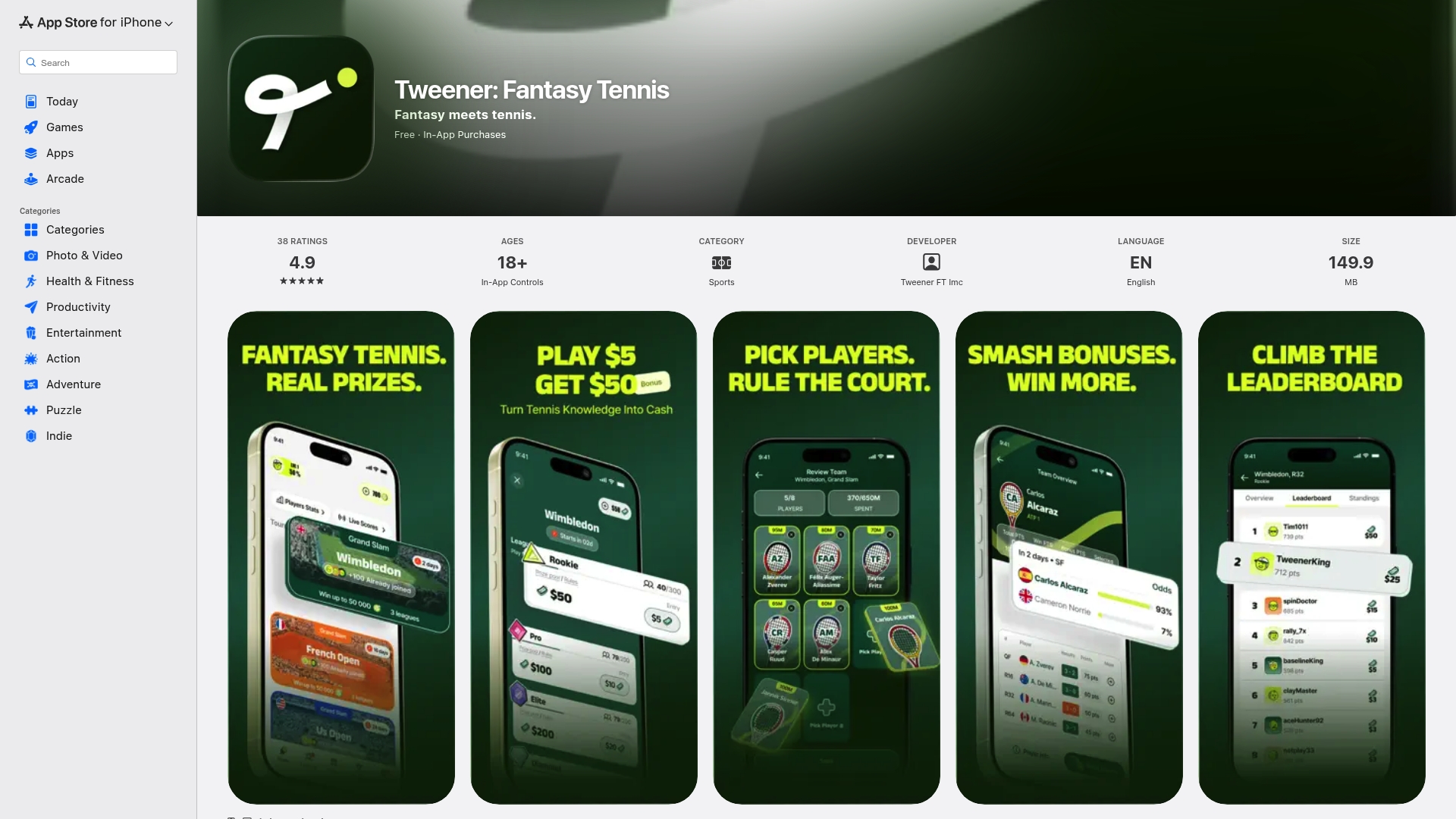
Whether you prefer the free coin-based mode or want to enter real-money contests where legally permitted, Tweener gives you both paths with responsible gaming tools built in. The strategy content does not stop here either. The ATP fantasy tips guide gives you tournament-specific advice for maximizing your picks at the biggest events of the year. Stronger decisions, better lineups, and real competitive action through every round of every tournament. That is what Tweener is for.
Frequently asked questions
What's the main difference between tennis DFS cash games and GPPs?
Cash games pay out a flat prize to roughly the top half of the field, rewarding safe and consistent lineups, while GPPs concentrate payouts at the top and require high-upside, differentiated selections to win.
What tools help me play daily fantasy sports responsibly?
Most major DFS platforms offer deposit and wager limits, session reminders, cooling-off periods, and self-exclusion, all of which you can activate directly from your account settings.
Is daily fantasy sports legal everywhere in the US?
No. DFS legality varies by state, with some permitting paid contests as games of skill and others restricting or prohibiting them. Always verify your local rules before entering paid competitions.
What's the best place to start for beginners in tennis DFS?
Beginners should start with low-stakes cash contests, build lineups around projection-driven chalk, and focus on minimizing downside before experimenting with GPP differentiation strategies.
Recommended
- Tennis Fantasy Prediction Games: Your 2026 Winning Guide
- Fantasy tennis tips: build a winning lineup in 2026
- Tennis match prediction: 7 strategies for fantasy wins
- Top fantasy sports rewards for tennis fans: win big in 2026
- 2^ Quarto Di Finale : Tennis Atp Masters 1000 2026 Monte-Carlo 2^ Quarto Di Finale Auger-Aliassime/ Sinner - Programma TV | tivvi