

TL;DR:
- Cash fantasy tennis is legally considered gambling due to risk of real money and potential addiction.
- Tennis DFS's rapid feedback and mobile access increase the risk of addictive behaviors and emotional stress.
- Lower-tier tennis events pose corruption risks that can compromise fantasy outcomes and sport integrity.
Risks of Fantasy Sports Betting: Tennis Players Must Know
Most tennis fans who play fantasy sports see themselves as strategists, not gamblers. You study ATP rankings, track player form across clay and hard courts, and pick lineups based on real data. That feels like skill, not chance. But once real money enters the picture, the dynamic shifts in ways that are easy to miss until serious harm is already done. Cash-based fantasy tennis carries legal, psychological, and social risks that most players never consider before they deposit their first dollar. This article breaks down exactly what those risks look like and how you can protect yourself while still enjoying the sport you love.
Table of Contents
- How fantasy tennis betting crosses into gambling
- Addictive dynamics: Why tennis DFS poses unique risks
- Mental health and social impacts of cash fantasy leagues
- Integrity and corruption risks in tennis fantasy betting
- A tennis fan's perspective on balancing risk and enjoyment
- Next steps: Safe fantasy tennis platforms
- Frequently asked questions
Key Takeaways
| Point | Details |
|---|---|
| Cash fantasy equals gambling | Betting on fantasy tennis with cash entry fees is legally classified as gambling. |
| Addictive traits in DFS | Daily fantasy tennis leagues can promote compulsive behavior through frequent and fast feedback cycles. |
| Mental health risks rise | Players in cash leagues experience more stress, anxiety, and social disruption than those in free play. |
| Integrity challenges | Micro-betting and spot-fixing undermine fairness in tennis fantasy outcomes. |
| Safer play options exist | Players can minimize risks by choosing free leagues and platforms with responsible gaming support. |
How fantasy tennis betting crosses into gambling
The line between competitive skill and gambling is blurrier than most fantasy players want to admit. When you pay an entry fee, risk losing that money, and compete for a larger prize, you are legally gambling in most jurisdictions, even if your lineup decisions require real knowledge and strategy.
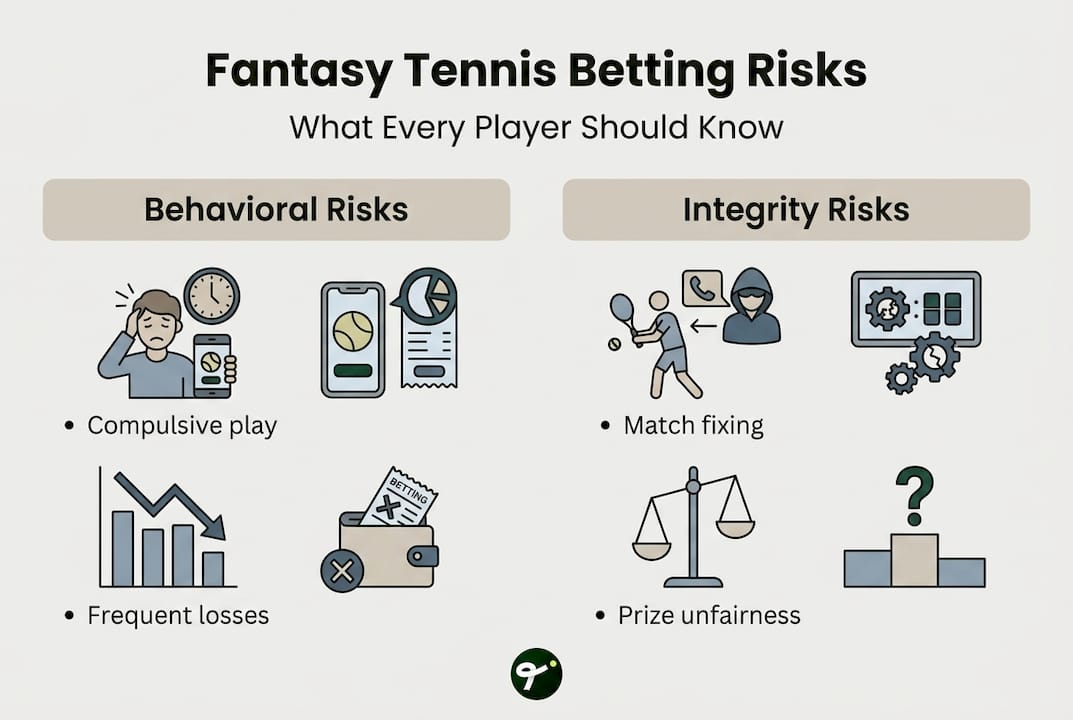
Cash-entry fantasy sports legally qualify as gambling because they involve risking something of value for a chance at a prize, regardless of how much skill is involved. Tennis fantasy leagues fall squarely in this category. The fact that you researched Carlos Alcaraz's clay-court win rate before drafting him does not change the legal or psychological nature of the transaction.
This classification matters for several practical reasons:
- Access to resources: If you develop a problem, the legal framing of cash fantasy as gambling determines whether you qualify for gambling addiction support programs.
- Platform regulation: Apps offering cash contests must comply with gambling laws, which vary wildly by state and country, meaning your access can be cut off without warning.
- Tax implications: Winnings from cash fantasy leagues are taxable income in the United States, something many casual players completely overlook.
- Banking complications: Some banks flag or block transactions to gambling platforms, which can create unexpected account issues.
- Mental framing: Calling it a "game" instead of "gambling" lowers your psychological defenses, making it easier to rationalize escalating losses.
The skill argument is real but incomplete. You can be a highly skilled fantasy tennis player and still lose repeatedly because of variance, injury surprises, or rain delays. Skill reduces risk; it does not eliminate it. And when money is on the line, even temporary losing streaks can trigger impulsive behavior that looks a lot more like problem gambling than competitive strategy.
For a full breakdown of how real money fantasy tennis works from a platform perspective, it helps to understand exactly what you are agreeing to before you enter a paid contest.
Pro Tip: Before entering any cash fantasy league, check your state or country's legal status for daily fantasy sports. Not every platform is licensed everywhere, and playing on an unlicensed site removes consumer protections entirely.
The behavioral patterns that show up in cash fantasy leagues mirror those documented in traditional sports betting. Players chase losses, enter higher-stakes contests after a bad week, and rationalize increasing deposits as "investing" in their skill development. These patterns are not personality flaws. They are predictable responses to how these products are designed.
Addictive dynamics: Why tennis DFS poses unique risks
Daily fantasy sports, or DFS, are a specific format where you draft a new lineup for each contest rather than managing a season-long team. This structure creates a fundamentally different psychological environment than traditional fantasy leagues, and tennis makes it especially intense.
DFS formats are more addictive than season-long leagues because of instant gratification, rapid feedback cycles, and the frictionless nature of mobile apps. Tennis amplifies every one of these factors.
Consider the tennis calendar. ATP and WTA events run nearly every week of the year, across multiple time zones. There is almost always a tournament happening somewhere. That means there is almost always a new DFS contest available, which gives you near-constant opportunities to deposit, draft, and compete. Unlike NFL fantasy, where you wait seven days between results, tennis DFS can deliver wins and losses within a single afternoon.
Here is a comparison of how different fantasy formats stack up on key risk factors:
| Risk Factor | Season-long league | Tennis DFS |
|---|---|---|
| Contest frequency | Weekly or less | Daily or multiple times daily |
| Result feedback | Days to weeks | Hours |
| Entry cost per session | One-time fee | Repeatable deposits |
| Mobile accessibility | Moderate | Very high |
| Loss-chasing opportunity | Low | Very high |
The numbered reasons tennis DFS is particularly risky come down to design, not coincidence:
- Short contest windows make losses feel temporary and wins feel repeatable, encouraging immediate re-entry.
- Mobile-first apps reduce every barrier to participation. You can deposit and enter a contest in under two minutes, often without leaving your couch.
- Individual match focus means a single injury or retirement mid-match can wipe out your entry, creating emotional spikes that drive re-entry behavior.
- Push notifications alert you to contest start times, player updates, and prize opportunities, pulling you back in constantly.
- Small minimum deposits make it easy to start, but also easy to escalate gradually over time without noticing the total spend.
"The faster the feedback loop, the stronger the behavioral reinforcement. Tennis DFS delivers results in hours, not days, which is precisely what makes it more psychologically demanding than traditional fantasy formats."
Young adults between 18 and 25 are especially vulnerable. This group grew up with smartphones and normalized sports betting through advertising, social media influencers, and peer culture. They are more likely to underestimate risk, overestimate their skill level, and continue playing through losses. Building a solid foundation of fantasy tennis strategy can help channel competitive instincts more productively, but it is not a substitute for honest self-assessment about your relationship with cash play.
Mental health and social impacts of cash fantasy leagues
The psychological toll of cash-based fantasy tennis is not just about addiction. It shows up in everyday stress, relationship strain, and a creeping sense that the sport you used to love now feels like an obligation.

Research backs this up clearly. A 2024 study of 635 players found that participants in the most cash-based fantasy leagues reported the highest levels of stress and anxiety. This was not a marginal difference. Players with heavy cash league involvement consistently scored worse on mental health measures than those who played free leagues or did not play at all.
A striking data point: Florida saw a 138% increase in gambling helpline calls between 2023 and 2025, with 41% of those callers between the ages of 18 and 25. Researchers linked this surge directly to the growth of online sports betting and fantasy platforms.
Cash fantasy leagues affect more than just your mood in the moment. Here is what the social and behavioral picture typically looks like:
- Withdrawing from friends or family who do not share the interest
- Hiding the amount you spend from a partner or parent
- Checking lineups obsessively during work hours or social events
- Feeling irritable or depressed after losses in a way that affects your whole day
- Prioritizing contest entry fees over essential expenses
- Rationalizing losses as "near wins" that justify another entry
These behaviors exist on a spectrum. Not every cash fantasy player will experience all of them, but recognizing even two or three in your own patterns is worth paying attention to. The social isolation piece is particularly underreported. Tennis fans often find strong community in leagues and group chats, and that community can reinforce continued play even when an individual is struggling.
Work and academic performance are also at risk. A player who is checking match scores every 20 minutes during the workday, or who loses sleep tracking a match in a different time zone, is paying a real productivity cost that rarely gets counted as a "gambling loss" but absolutely is one.
For players looking for a healthier competitive outlet, fantasy team competitions that center skill and community rather than financial stakes offer a genuinely fun alternative that preserves the things people love about fantasy tennis.
If you recognize these patterns in yourself or someone you know, the National Problem Gambling Helpline at 1-800-522-4700 is a confidential resource available 24/7.
Integrity and corruption risks in tennis fantasy betting
There is a dimension to cash fantasy tennis that most players never think about: the sport itself is uniquely vulnerable to corruption, and that corruption has a direct impact on your fantasy results.
Tennis's match structure creates something called micro-betting, where wagers are placed on individual games, sets, or even service games within a match. This granularity makes it relatively easy for a player to deliberately lose a single game or drop a set without obviously throwing the match. Tennis micro-betting and spot-fixing present heightened corruption risks that indirectly compromise the integrity of fantasy outcomes.
Spot-fixing, which involves manipulating a small portion of a match rather than the final result, is particularly difficult to detect and prosecute. A player who agrees to double-fault on a specific point or lose a particular service game may still win the overall match, making the manipulation invisible to most observers.
Here is what makes tennis especially susceptible:
- Large field of players: Unlike major team sports, tennis involves thousands of professional players, many of whom earn very little income at the Challenger or ITF level.
- Individual sport pressure: Without teammates to notice unusual behavior, a player faces outside pressure alone.
- Global match schedule: Matches in less-monitored regions or lower-tier events attract less scrutiny from governing bodies.
- Accessible to outside influence: A player in a lower-ranked event may be approached by organized gambling networks with offers that are financially significant relative to their prize money.
For fantasy players, this matters because your carefully drafted lineup can lose points due to manipulation that had nothing to do with player fitness, form, or your strategic choices. You made the right call, but the outcome was compromised before the match even started.
Pro Tip: Stick to top-tier ATP and WTA events for your fantasy lineups. Grand Slams, Masters 1000s, and Premier events have stronger integrity monitoring than smaller tournaments, giving your fantasy picks a cleaner foundation.
Understanding how prize structures work in fantasy tennis can also help you evaluate which contests are structured fairly and which ones carry more inherent risk. Transparency in scoring and prize distribution is a signal of platform integrity. If you explore the real money fantasy guide before entering paid contests, you will be far better equipped to spot red flags in contest design.
A tennis fan's perspective on balancing risk and enjoyment
Here is the honest truth that most fantasy platforms will never tell you: cash leagues have a way of quietly turning something you love into something that stresses you out. The tennis fan who once thrilled at watching a tiebreak now watches it through the lens of a lineup decision gone wrong. The joy narrows.
We think the conventional wisdom around responsible gambling, things like "just set a budget" and "know your limits," is not wrong exactly, but it is incomplete. Budgets are easy to set and easy to abandon when you are emotionally invested in a result. What actually helps is changing the frame entirely.
Free play is not a consolation prize. It is a genuinely different competitive experience, one that rewards skill and strategic thinking without the anxiety that money introduces. When you play for virtual coins and community ranking, you are still competing. You are still making smart calls on Jannik Sinner versus a qualifier on a fast court. But you are doing it without the psychological weight that makes a first-round upset feel like a personal financial disaster.
Overconfidence is the quiet enemy here. Ads for DFS platforms are specifically designed to show you the winners, not the distribution of outcomes. The player who feels like their tennis knowledge gives them a real edge is exactly the player most likely to overcommit financially. Guardrails matter. That means using platform-level deposit limits, taking breaks between tournaments, and leaning on community for safe fantasy play rather than financial competition.
Next steps: Safe fantasy tennis platforms
Understanding the risks is the first step. Choosing where and how you play is the second.
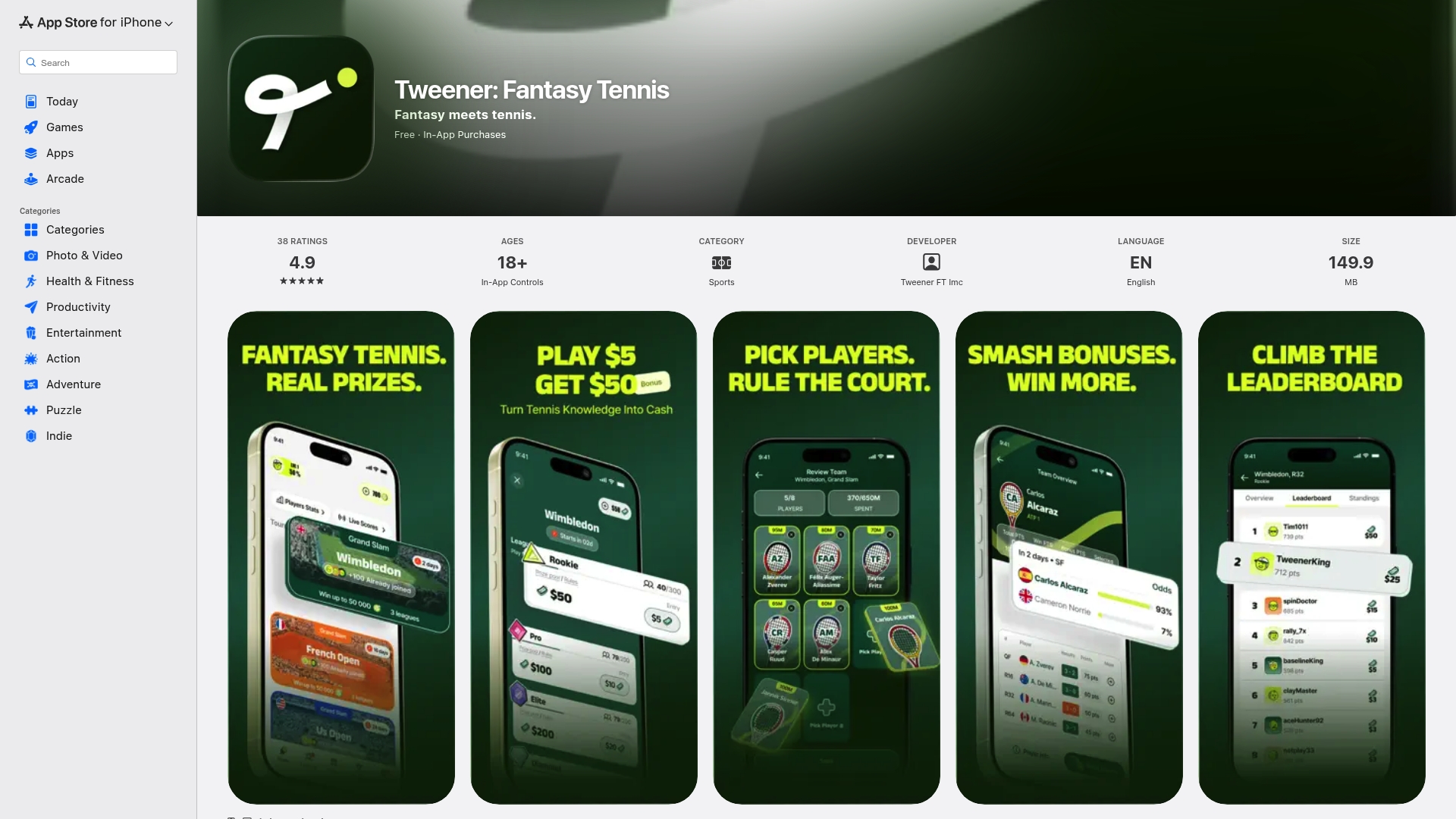
Tweener is built specifically for tennis fans who want the full fantasy experience without reckless risk. The platform puts ATP and WTA match data at the center of a genuinely skill-driven competition. You build lineups, join leagues, follow real tournaments, and compete against others who know the game as well as you do. The free mode lets you earn virtual coins through gameplay and redeem them for real rewards like gift cards, so the competitive stakes are real without the financial danger. For players who choose cash contests, Tweener operates within legal frameworks and promotes responsible gaming features at every step. Download the app and start competing in a way that puts the love of tennis first.
Frequently asked questions
Is fantasy tennis betting considered gambling?
Yes, cash-entry fantasy tennis legally qualifies as gambling because players risk real money for a potential prize, regardless of the skill involved in lineup decisions.
What signs indicate fantasy betting addiction?
Addiction signs include missing work or social events, hiding entry fees, obsessively checking lineups, neglecting responsibilities, feeling irritable after losses, and lying about how much you have spent.
How has sports betting legalization affected fantasy players?
Post-legalization, online gambling spending rose 633% on a per-individual monthly basis, and the share of people gambling beyond responsible limits increased 400%, putting more fantasy players at financial and mental health risk.
Are young adults most at risk for fantasy betting harm?
Yes. 41% of callers to Florida's gambling helpline between 2023 and 2025 were aged 18 to 25, a group particularly vulnerable to normalization and compulsive patterns driven by mobile sports betting and fantasy platforms.