

TL;DR:
- Choosing a fantasy tennis league depends on whether you prioritize cash, real-world rewards, or in-game coins, as prize types influence your engagement and strategy. Understanding the prize structure, entry costs, and payout distribution helps you align your participation with your goals and risk tolerance. Platforms like Tweener offer flexible options across tours, enabling casual, competitive, or experience-focused players to find their ideal match.
Picking a fantasy tennis league feels straightforward until you realize the real decision isn't about which players to draft. It's about what you're actually playing for. Cash payouts, gift cards, signed merchandise, courtside tickets, or virtual coins that convert to rewards — the prize type shapes everything from how aggressively you pick players to how long you stay engaged across a tournament. Before you enter your first league or deposit a single dollar, you need to know exactly what's on the table and whether it matches your goals as a player.
Table of Contents
- How to evaluate fantasy tennis prize options
- Top fantasy tennis leagues and their prize structures
- Prize comparison table: Cash vs. coins vs. experiences
- Situational recommendations: Which fantasy tennis prize is right for you?
- Why focusing on prize structure transforms the fantasy tennis experience
- Ready to chase your perfect fantasy tennis prize?
- Frequently asked questions
Key Takeaways
| Point | Details |
|---|---|
| Prize variety matters | Different leagues offer cash, coins, or event tickets, so match your play to your reward preference. |
| Know your odds | Always check the payout structure to understand your real chance of winning something. |
| Align with motivation | Choose leagues where the prize motivates you—big cash for thrill seekers, ongoing rewards for dedicated fans. |
| Platform choice impacts strategy | Leagues with coin-based rewards encourage steadiness, while cash prizes spark high-stakes competition. |
How to evaluate fantasy tennis prize options
Not all prizes are created equal, and the way a platform structures its rewards has a direct impact on how you should play. Understanding the core categories upfront saves you from the frustration of grinding through a tournament only to discover the prize doesn't excite you.
The three main prize types you'll encounter are cash payouts, real-world rewards like merchandise or event tickets, and in-game coins that can be redeemed for tangible rewards. Cash is the most straightforward — you win money. Real-world rewards add an experiential dimension that pure cash can't replicate. Coins sit somewhere in between, offering flexibility and ongoing engagement, but requiring you to accumulate enough to redeem for something meaningful.
Entry fees and prize pools are directly linked. A free-to-enter league will naturally have smaller or non-monetary prizes, while paid contests can fund larger pools distributed among winners. The key question isn't just "what's the top prize?" It's about the ratio between what you pay in and what you can realistically win based on the contest format. Understanding prize structures in fantasy tennis before you commit to a league changes how you evaluate risk and reward.
There's also the difference between instant gratification and long-term achievement. Cash prizes in short-format contests give you an immediate result. Coin-based systems reward sustained participation, consistent performance, and strategic thinking over weeks or even an entire season. Both are valid approaches — they just attract different types of players.
Here are the must-ask questions before joining any fantasy tennis league:
- What does entry cost? Free, low-stakes ($5 to $20), or high-roller contests each carry different dynamics.
- How are prizes distributed? Top-heavy payouts reward only the very best; flatter structures give more players a shot.
- How many spots get paid out? A contest that pays the top 10% of finishers is very different from one that only pays first place.
- Are the prizes tangible and immediately redeemable? Coins that expire or require a high threshold to redeem have hidden costs.
- Which tours does the platform cover? ATP only, WTA only, or both — this affects how many tournaments you can compete across.
The Tweener app covers both ATP and WTA matches, letting you pick a team before each round within a set budget. You earn points for player advancement, aces, comeback wins, and dominant performances. You can join public leagues or set up private ones with friends, which gives you full control over who you compete against.
Pro Tip: Don't just fixate on the top prize. Review how many finishers a contest actually pays out. A league that rewards the top 20% of entrants with modest payouts might give you far better expected value than a winner-takes-all structure with a flashy top prize.
Top fantasy tennis leagues and their prize structures
Armed with the right criteria, let's break down how the leading platforms actually compare when it comes to prizes and how they're earned.
Here are the major fantasy tennis options available to players in 2026:
-
Tweener. Tweener covers both the ATP and WTA tours, making it one of the most versatile platforms out there. You accumulate coins based on how well your selected players perform across rounds, with bonus points for standout moments like aces, comeback victories, and dominant set wins. Those coins can be redeemed for real-world rewards, and you can also purchase additional coins through in-app transactions. The public and private league structure means you can compete casually with friends or go head-to-head against a global player base. This makes Tweener particularly strong for players who want ongoing engagement rather than single-event gambling. Exploring top fantasy rewards for tennis fans in 2026 shows how coin-based platforms are growing in appeal for casual and semi-competitive players alike.
-
Fantasy ATP Tennis 2026. This independent platform runs a dedicated season-long contest built entirely around the ATP calendar. Players manage a squad of 20 players within a €300M budget, earning points from match wins, games and sets won, aces, and detailed service and return statistics. The prize pool exceeds $5,850, with a top prize of $1,173 and an entry fee of $17.60. The transparent payout chart is one of the platform's strongest features — you know exactly what you're playing for at every tier. This format suits competitive players who want hard cash and are willing to invest in a full-season commitment.
-
Official ATP Fantasy. The ATP's own fantasy game is free to enter and focuses on merchandise and event ticket prizes rather than cash payouts. It caters to the passionate tennis fan who would genuinely value a signed racket or VIP tournament access over a direct deposit. Coverage is naturally ATP-focused, and the format is designed for broad participation rather than elite competition. For fans who follow the tour obsessively and want prizes that connect them to the sport itself, this is a compelling option. If you're curious about the WTA side of fantasy play, the landscape is similar — learning how WTA fantasy leagues work can help you diversify your fantasy involvement across both tours.
Prize comparison table: Cash vs. coins vs. experiences
Seeing the platforms side by side makes the tradeoffs clearer. Here's how the major options stack up:
| Platform | Entry fee | Prize types | Top prize | Winners paid | Reward tangibility |
|---|---|---|---|---|---|
| Tweener | Free (coin mode) | Coins → real rewards | Redeemable rewards | Multiple tiers | Medium (gift cards, rewards) |
| Fantasy ATP Tennis 2026 | $17.60 | Cash | $1,173 | Multiple tiers | High (direct cash) |
| Official ATP Fantasy | Free | Merch, tickets | VIP experiences | Selected winners | High but unique |
The fantasy tennis payout guide breaks down these structures in further detail, but even this table reveals important patterns. Free platforms either monetize through in-app engagement (Tweener) or rely on sponsor-funded merchandise prizes (official ATP). Paid platforms like Fantasy ATP Tennis use the collected entry fees to build and distribute a transparent cash pool across ranked finishers.
The experiential prizes from official league platforms carry a value that's genuinely hard to put a dollar figure on. A ticket to a Grand Slam or a signed item from your favorite player isn't something you can simply buy on demand.
"Many players feel real cash is more motivating because it's universally useful, but for the dedicated tennis fan, official league prizes like tournament tickets or signed merchandise can deliver an emotional payoff that a bank transfer simply can't match."
The right prize format depends entirely on what drives you as a player. Cash is universally appealing for competitive types. Coins reward loyalty and long-term engagement. Merch and tickets speak directly to the superfan who would travel across the world to watch a Slam final.
Situational recommendations: Which fantasy tennis prize is right for you?
After laying out all the options, the final step is matching the prize format to your actual goals. Here's how to think about it based on your situation.
If you want cash prizes and enjoy high-stakes competition, paid-entry leagues with transparent prize pools are your best fit. Fantasy ATP Tennis 2026 offers a clear entry fee, a known prize pool, and ranked payouts. You know your odds going in, and the cash reward is immediate and usable. The real money fantasy tennis guide walks through how to approach these contests strategically, including bankroll management and when to take on more risk.

If you prefer steady, ongoing engagement without financial pressure, coin-based platforms like Tweener suit your style. You earn rewards through consistent good performance rather than single high-stakes moments. The accumulation model means that showing up every tournament week and making smart picks compounds into real rewards over time.
If you're a deep tennis superfan who values the sport's culture, official ATP Fantasy's merchandise and ticket prizes may genuinely be worth more to you than cash equivalents. A courtside seat or a signed racket from Carlos Alcaraz carries meaning that no transfer can replicate.
One important expert insight worth knowing: in the official ATP Fantasy game, top player pricing compression means selecting stars like Alcaraz (40 credits) and Sinner (36 credits) often becomes mandatory rather than strategic. Features like the Bonus Ball, which doubles one selected player's points for a given week, add a meaningful tactical layer that can swing your standings significantly. Understanding mechanics like this is part of smart team selection for fantasy tennis regardless of which platform you play on.
Here's a quick breakdown by player type:
- Competitive cash seeker: Paid leagues, transparent prize pools, strong knowledge of the ATP tour results.
- Casual regular: Free coin-based platforms with redemption rewards and low-pressure formats.
- Experience-driven superfan: Official tour fantasy games with merchandise and ticket prizes.
- Social player: Private leagues on platforms like Tweener where you compete directly against friends.
Pro Tip: Consider the odds carefully. A contest that pays out 30 winners from 100 entrants gives you three times the winning probability compared to a top-10 payout structure, even if the top prize is smaller. More winners means your skill level has more room to pay off.
Why focusing on prize structure transforms the fantasy tennis experience
Here's an opinion you won't read in most fantasy tennis guides: the prize structure doesn't just determine what you win. It fundamentally changes how you play, which players you pick, and how invested you feel in every match.
This matters more than people realize. When cash is on the line, players make aggressive, differentiating picks. They take a risk on the unseeded player from Madrid because the upside is worth it. In a coin-based system, the calculus shifts entirely. Steady points accumulation becomes more valuable than high-variance swings. You start picking safer, more consistent players because long-term coin growth is the goal.
The mistake we see constantly is players jumping into a league format that contradicts their actual motivation. A casual fan who loves tennis but doesn't want the pressure of money joins a paid cash league because the prize pool sounds exciting. Three tournaments in, they're stressed rather than entertained. The effect of prize structure on teams is real and measurable — it changes draft strategy, risk tolerance, and even how often players check scores during live matches.
Conventional wisdom says "play for fun, not money." That's an oversimplification. The real advice is: play in leagues where the prize type aligns with your internal motivation. Fun and money aren't opposites. But misalignment between what you're chasing and what the platform actually offers is a guaranteed path to disengagement.
Pro Tip: If your dream prize is a Grand Slam ticket or courtside experience, make sure the platform you're targeting actually awards these prizes to players at your skill level — not just to the top 1% of a massive entry pool where your odds are essentially zero.
Ready to chase your perfect fantasy tennis prize?
If you're ready to put this framework into action, Tweener offers one of the most flexible starting points in 2026 for tennis fantasy players at any level.
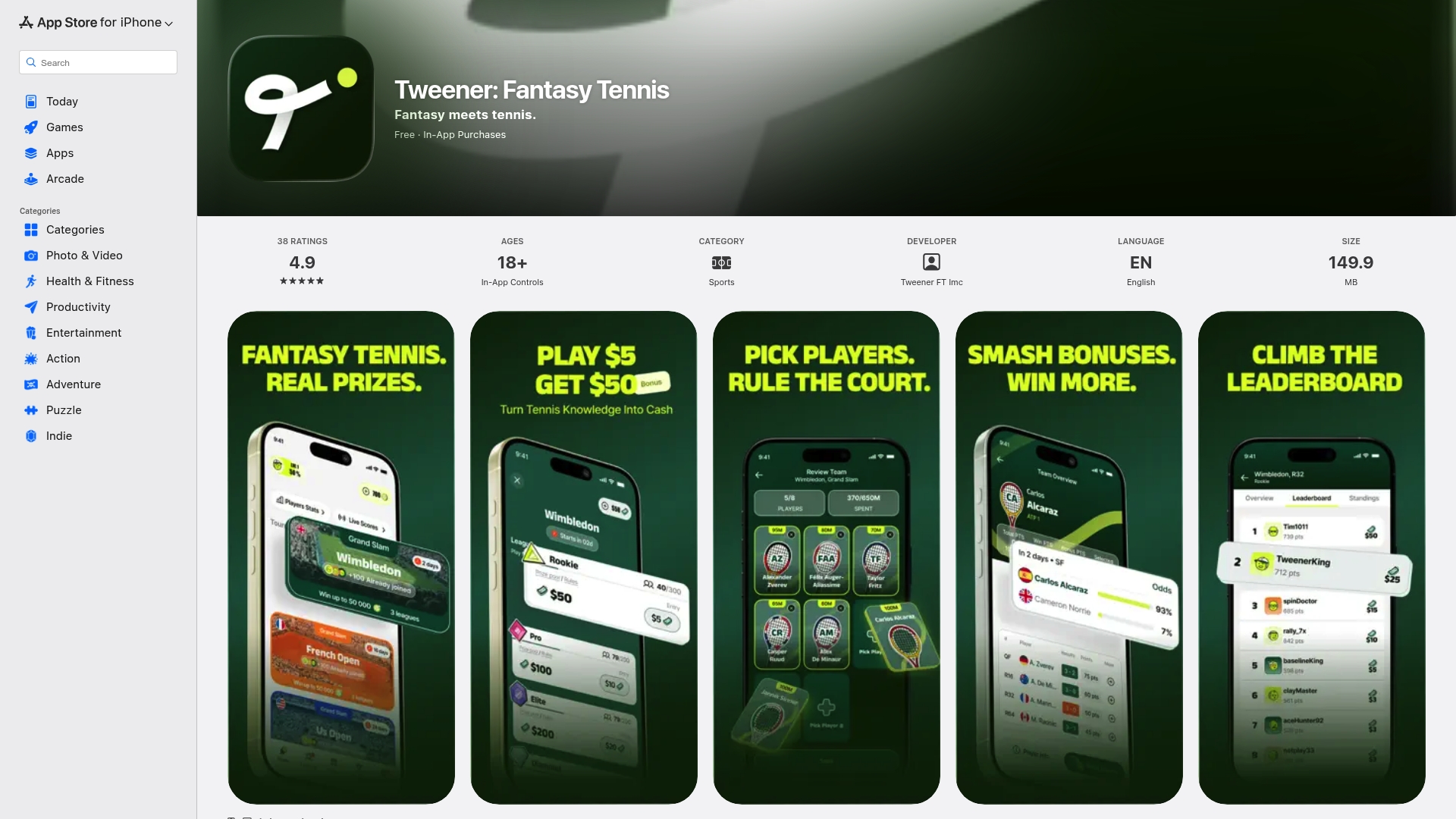
The Tweener platform covers both ATP and WTA matches, so you're never limited to just one tour. You can compete in public leagues against players from around the world or set up private leagues for a more personal competition with your tennis-obsessed friends. Earn coins through your performance, redeem them for real rewards, and choose between free coin mode or cash contests depending on where you're comfortable. Download the Tweener app and see how your tennis knowledge translates into actual prizes across the tournaments you're already watching.
Frequently asked questions
How do fantasy tennis coins work on Tweener?
You earn coins through performance in your fantasy leagues, then redeem them for real-world rewards like gift cards; you can also purchase additional coins through in-app transactions if you want to accelerate your balance.
Are cash fantasy tennis prizes legal in my country?
Legality varies significantly by country and state, so always check your local regulations before entering any paid cash contest on any fantasy platform.
Which platform offers the biggest cash prize for tennis fantasy in 2026?
Fantasy ATP Tennis 2026 features a prize pool over $5,850 with the top individual prize reaching $1,173 for a $17.60 entry fee.
Is it better to play for cash, coins, or merch and tickets?
It depends entirely on your motivation — cash rewards suit competitive high-stakes players, coins work well for regular casual engagement, and merch or ticket prizes are ideal for superfans who want experiences directly connected to the sport.
How do entry fees and prize pool structure affect my chance of winning?
A higher entry fee typically funds a larger prize pool but also attracts more serious competition; platforms that pay out more finishers give you statistically better odds of walking away with something, even if the top prize is more modest.