

Cash fantasy tennis contests are legal in most of the United States. Five states, Hawaii, Idaho, Montana, Nevada, and Washington, effectively ban daily fantasy sports outright, and a handful of others impose licensing rules or extra scrutiny on specific contest formats. That covers the vast majority of tennis fans reading this, but not all of them, and the details matter more than the headline number.
Fantasy sports law by state isn't a single rulebook. It's fifty separate legislative decisions, and a few of them contradict each other in ways that trip up new players. Pick'em style contests, in particular, get treated differently from classic salary-cap formats in several states. So does the platform you use.
Here's what actually determines whether you can enter a cash fantasy tennis contest:
- Your state's classification of daily fantasy sports (legal, restricted, or banned)
- The contest format (salary-cap team vs. pick'em predictions)
- The operator's own restricted-state list, which can be stricter than state law requires
Roughly 38 to 41 states plus Washington, D.C. allow regulated DFS, according to trackers that monitor state gaming statutes. Before you deposit a dollar, check the app's own restricted-state list. It's the fastest, most current answer you'll find.
Key Takeaways
Cash fantasy tennis contests are legal in most U.S. states, but format (salary-cap vs. pick'em) and operator geofencing determine your actual access more than your state's headline status alone.
| Point | Details |
|---|---|
| Five states ban DFS | Hawaii, Idaho, Montana, Nevada, and Washington are commonly listed as prohibiting cash fantasy contests. |
| Format changes the legal answer | Pick'em contests face separate scrutiny in several states even where salary-cap DFS is fine. |
| Check the operator, not just the state | Restricted-state lists inside the app are more current and specific than any third-party tracker. |
| Age and geolocation gate cash entry | Most operators require 18 and verify your physical location before letting a deposit through. |
| Tweener runs both modes | Free virtual-coin play is available broadly; cash contests unlock where state law and app registration permit. |
Authoritative Regulators And Trackers To Verify State Rules
Check these before you deposit anywhere:
- AllowedHere's 50-state DFS table for a full-state legal reference
- OddsReference's DFS legal states guide for state-by-state breakdowns and format distinctions
- Arizona's official fantasy sports guidance as an example of primary regulator documentation
- Your chosen operator's own restricted-state list, updated in real time and the fastest way to confirm current playability
Table of Contents
- Is Fantasy Tennis Legal In Your State?
- Salary-Cap Vs. Pick'em: Why The Format You Choose Changes The Legal Answer
- How Do You Verify You Can Enter A Cash Contest?
- What Can You Do If Cash Contests Are Blocked In Your State?
- How Tweener Handles Free And Cash Modes For U.S. Players
- Are States Changing Their Fantasy Sports Laws?
- Does Fantasy Tennis Get Treated Differently Than Other Fantasy Sports?
- What Federal Rules Apply To Fantasy Sports?
- What Happens If You Play In A Non-Legal State?
- What Protections Do You Have In A Legal State?
- Why Legal Status Should Shape How You Play, Not Just Whether You Can
- Ready To Play? Start With Tweener's Free Mode
- Frequently Asked Questions
- Sources
Is Fantasy Tennis Legal In Your State?
"Legal," "restricted," and "banned" mean three different things, and mixing them up is how people end up locked out after they've already added a card to their account.
Legal and regulated means your state has passed a law or issued formal guidance that permits daily fantasy sports, sometimes with licensing or registration requirements for the operator. Restricted means the state allows some forms of DFS but not others, or requires specific consumer protections before an operator can accept cash entries. Banned means the state treats real-money fantasy contests as a form of gambling that falls outside any legal carve-out, full stop.
The states most commonly named as banning DFS are Hawaii, Idaho, Montana, Nevada, and Washington. Each got there differently. Nevada's gaming laws are so tightly regulated that DFS operators typically need a gaming license to operate there at all, which most haven't pursued. Washington's law defines gambling broadly enough that DFS contests fall inside it. Idaho and Montana never passed the fantasy-sports carve-outs that most other states adopted after 2015. Hawaii bans nearly all forms of gambling and has made no exception for fantasy sports.
A few other states sit in gray territory. Some require operators to register or obtain a license before offering cash contests to residents, which means an app might be legal in the state but unavailable simply because that particular operator hasn't completed the paperwork. This is a real distinction: state law permitting DFS doesn't guarantee every app will offer it to you.
Restriction status isn't static, either:
- It can change with a new legislative session or an attorney general opinion.
- It can differ by contest format, meaning salary-cap contests and pick'em contests get evaluated separately.
- It can differ by operator, since not every platform pursues licensing in every eligible state.
Trackers like AllowedHere's 50-state table are a solid starting point for a bird's eye view. But state regulator pages, like Arizona's fantasy sports guidance, carry more weight than any third-party map, because they're the primary source the map is built from. When the two disagree, trust the regulator.
Salary-Cap Vs. Pick'em: Why The Format You Choose Changes The Legal Answer
Not all fantasy tennis contests get judged the same way under state law, and this is the part most guides skip past. The format itself, not just the sport, determines the legal analysis.
A cash contest involves a real-money entry fee and a real-money payout. A free-to-play or virtual-coin contest involves neither. That distinction matters enormously in states where cash gambling is restricted but skill-based free contests aren't regulated at all, which is why most operators keep a free mode running everywhere, even in the five banned states.
Format matters just as much as the cash question. Salary-cap DFS has players draft a full roster of ATP or WTA players against a fictional budget, and points accumulate across an entire tournament. Pick'em contests strip that down to simpler predictions, like picking which player wins a given match, often against a fixed multiplier or spread rather than a rival roster.
Regulators have not treated these the same way. Pick'em formats have drawn separate legal scrutiny in multiple states, with several attorneys general questioning whether pick'em resembles sports betting more than it resembles a skill-based fantasy contest. Multi-match, salary-cap team formats have generally avoided that scrutiny because the strategic layer, drafting a full lineup, managing a budget, tracking performance across a full draw, is harder to mistake for a single wager.
Picture two tennis contests side by side. One asks you to draft six players across the Australian Open field and manage your roster as the tournament unfolds. The other asks you to pick who wins the Djokovic-Alcaraz semifinal, straight up. The second one looks a lot more like a bet on a single outcome, and regulators in several states have said as much.
- Salary-cap contests: generally treated as skill-based fantasy, wider legal acceptance
- Pick'em contests: face added scrutiny in several states, sometimes restricted even where salary-cap DFS is fine
- Free-to-play/virtual-coin contests: typically unaffected by either restriction, since no cash changes hands
Pro Tip: Before you enter any cash contest, check the format name inside the app itself, pick'em, pick-six, salary-cap, or draft. That single word often tells you more about your legal exposure than the state you live in.
How Do You Verify You Can Enter A Cash Contest?
Age and location are the two gates every cash fantasy contest checks before letting your money in, and both are easier to confirm than most players assume.
The standard minimum age across the industry is 18. A number of states, and some individual operators, set the bar at 19 or at the state's legal age of majority, which can differ from 18 depending on where you live. Official tournament-run fantasy games, like the WTA's own fantasy contest rules, spell out both age and residency requirements plainly, and that's a useful model for what to expect from any legitimate operator.
Location works differently. Downloading an app and creating an account almost never means you're cleared for cash contests. Operators use geolocation and geofencing, checking your device's location and often your payment method, to confirm you're physically inside a state where cash play is permitted before letting a deposit go through. You can sign up from a banned state and still get blocked the moment you try to fund an account.
Here's the verification sequence that actually works:
- Open the app's restricted-state list before you do anything else. This is the single fastest way to confirm status, faster than any third-party tracker.
- Read the game's terms of service or rules page for age and residency requirements specific to that operator.
- Attempt a small deposit only after confirming eligibility. If the app blocks the transaction, that's your answer, not a bug to work around.
- Recheck periodically. Legal status shifts with legislative sessions, and operators update their restricted lists in real time as rulings change.
Geofencing has become close to universal among licensed DFS operators, largely because state regulators require it as a condition of doing business at all. It's not optional infrastructure. It's the compliance layer that lets an app operate in 40 states while legally shutting the door in five.
What Can You Do If Cash Contests Are Blocked In Your State?
Living in Idaho or Nevada doesn't mean fantasy tennis is off the table. It means the cash layer is off the table, and there's a real difference.

Free-to-play modes, the kind that run on virtual coins instead of real money, are typically available regardless of state restrictions on cash gambling, because no cash entry fee or cash prize is involved. Some platforms let you redeem coins for gift cards or merchandise, so check the specific rules for prize eligibility in your state rather than assuming every reward works everywhere.
Private leagues with friends are another solid workaround, especially for Grand Slam tournaments where the format naturally rewards a season-long strategic approach. A private league built around free entry or token stakes, rather than real-money buy-ins, sidesteps the cash-gambling question entirely while keeping the competitive stakes with people you actually know.
Official tournament fantasy games are worth a look too. Contests run directly by the ATP or WTA typically spell out eligible jurisdictions upfront, so there's no ambiguity about whether you qualify.
- Play in free/virtual-coin modes, which sidestep cash-gambling restrictions entirely
- Start or join private leagues with friends for the social and competitive layer
- Enter official ATP or WTA fantasy contests that list eligibility clearly
- Skip VPNs and skip lying about your residency on signup forms
Pro Tip: A VPN doesn't fix the legal problem, it just hides it temporarily. Operators cross-check device location against payment and billing data, and getting caught misrepresenting your location typically means a permanent account ban and forfeited funds, not a warning.
For more on how the risk side of this actually plays out, see this breakdown of fantasy sports betting risks tennis players should know.
How Tweener Handles Free And Cash Modes For U.S. Players
Tweener runs on the same two-tier structure that responsible operators use industry-wide: a free mode open broadly to U.S. tennis fans, and a cash mode that's geofenced to states where real-money fantasy contests are legally permitted.
In free mode, you build fantasy teams from real ATP and WTA rosters, compete in public or private leagues, and earn virtual coins through gameplay that can later go toward gift cards and other rewards. Nothing about that mode touches state gambling law, since no cash changes hands on either side.
Cash mode is where the state-by-state framework actually applies. Tweener checks device location and account details before letting a deposit through, the same geofencing approach documented in the app's game rules. If you're in one of the five commonly banned states, or a state where Tweener hasn't completed operator registration, you'll see free mode available and cash mode locked out, exactly as it should work.
- Free mode: virtual coins, broad U.S. availability, redeemable rewards
- Cash mode: real-money entry, geofenced by state, checked before deposit
- Game rules page: the definitive source for current state-by-state availability
- Private leagues: up to nine friends per Grand Slam tournament, regardless of cash-mode status
Players who want to sharpen their approach before risking real money should look at strategy content built specifically for the draft and scoring mechanics tennis rewards, like this guide to winning fantasy tennis strategies. Understanding surface splits and head-to-head history matters just as much in free mode as it does once real payouts are on the line.
Are States Changing Their Fantasy Sports Laws?
State fantasy sports law isn't frozen. Legislatures revisit gambling classifications almost every session, and pick'em contests specifically have become a recurring flashpoint. Several states have seen attorneys general issue opinions questioning whether pick'em formats count as fantasy sports or as a disguised sportsbook, and that scrutiny has continued into 2026 as more operators lean on the pick'em format for its simplicity.
That pressure cuts both ways. Some states have tightened rules around pick'em specifically while leaving salary-cap DFS untouched. Others have moved toward clearer licensing frameworks that give operators a defined path to legal cash contests rather than leaving the question to informal guidance. Neither direction is universal, and a state that looks settled this year can see new legislation introduced the next.
None of the five commonly banned states, Hawaii, Idaho, Montana, Nevada, and Washington, have signaled imminent reversal, though DFS advocates have pushed legislation in a few of them over the past several sessions without success. Montana has seen periodic bills aimed at creating a fantasy-sports carve-out, similar to what most other states adopted years ago, but none has passed as of this writing.
The practical takeaway isn't to memorize a snapshot. It's to treat your state's status as something worth rechecking each season, especially if you play pick'em formats, since that's where the legal ground has shifted most in recent years.
Does Fantasy Tennis Get Treated Differently Than Other Fantasy Sports?
State law doesn't write separate statutes for each sport, so fantasy tennis generally falls under the same daily fantasy sports framework as fantasy football or fantasy basketball. Where it differs is in format exposure, not sport-specific rules.
Tennis lends itself unusually well to pick'em contests, since a single match has a binary outcome and tournaments produce dozens of matches in rapid succession. That makes tennis pick'em products common, and it means tennis fans run into the pick'em scrutiny problem more often than, say, fantasy baseball players drafting season-long rosters. Regulators evaluating pick'em legality have specifically flagged single-outcome predictions, like picking a match winner, as closer to traditional sports betting than multi-week roster management.
Salary-cap fantasy tennis, by contrast, spans a full tournament draw, sometimes two weeks at a Grand Slam, and requires drafting a roster across dozens of players rather than betting on one outcome. That structure puts it on far steadier legal footing, closer to how fantasy football's season-long formats have been treated for years.
The upshot: if you're comparing fantasy tennis to fantasy football or fantasy basketball, the state-by-state legal map is the same. The format you choose within tennis, salary-cap versus pick'em, is what actually shifts your legal footing, more so than the sport itself.
What Federal Rules Apply To Fantasy Sports?
Federal law sets a floor, not a ceiling, for fantasy sports regulation, and that's exactly why the state-by-state patchwork exists in the first place.
The Unlawful Internet Gambling Enforcement Act, passed in 2006, includes a specific carve-out for fantasy sports contests that meet certain criteria: outcomes must reflect the relative knowledge and skill of participants, and no single real-world sporting event or performance by an individual athlete can determine the entire outcome. That carve-out is why fantasy sports operators can legally accept entry fees across most states without a federal gambling license.
What UIGEA doesn't do is force any state to allow DFS. It exempts fantasy sports from one specific federal gambling statute and leaves the actual legality decision to each state's own gambling laws. That's the root cause of the fragmentation covered throughout this article: federal law cleared a path, but each state still had to decide whether to walk down it, and five chose not to.
No comprehensive federal fantasy-sports licensing regime exists beyond that carve-out. There's no federal regulator issuing operator licenses the way individual states do. That leaves state attorneys general, state gaming commissions, and state legislatures as the actual decision-makers, which is why checking your specific state's status matters far more than checking any federal statute.
What Happens If You Play In A Non-Legal State?
Entering a cash fantasy tennis contest from a banned state carries real consequences, and they land on you, not the operator.
Most licensed operators geofence aggressively enough that the risk of successfully entering from a truly banned state is low to begin with. The bigger risk shows up when someone tries to work around that geofencing, using a VPN, a friend's address, or a false residency claim during signup. Operators reserve the right to freeze accounts and withhold funds when they detect that kind of misrepresentation, and most terms-of-service agreements spell that out explicitly.
Beyond account penalties, you're also stepping outside whatever consumer protections your state would otherwise extend to a legal fantasy sports participant. If a dispute arises over a payout, or an operator fails to deliver on its own terms, a player in a banned state has far less legal standing to seek a resolution than a player operating within a state's regulated framework.
There's also a simple financial risk that gets overlooked: an operator that detects a state-restriction violation isn't obligated to refund your entry fee. You could lose the deposit, lose access to the account, and have no regulatory body to appeal to, since you were operating outside the system that would have offered you recourse in the first place.
None of this applies to free-to-play or virtual-coin contests, which is exactly why that mode exists as the safe fallback everywhere.
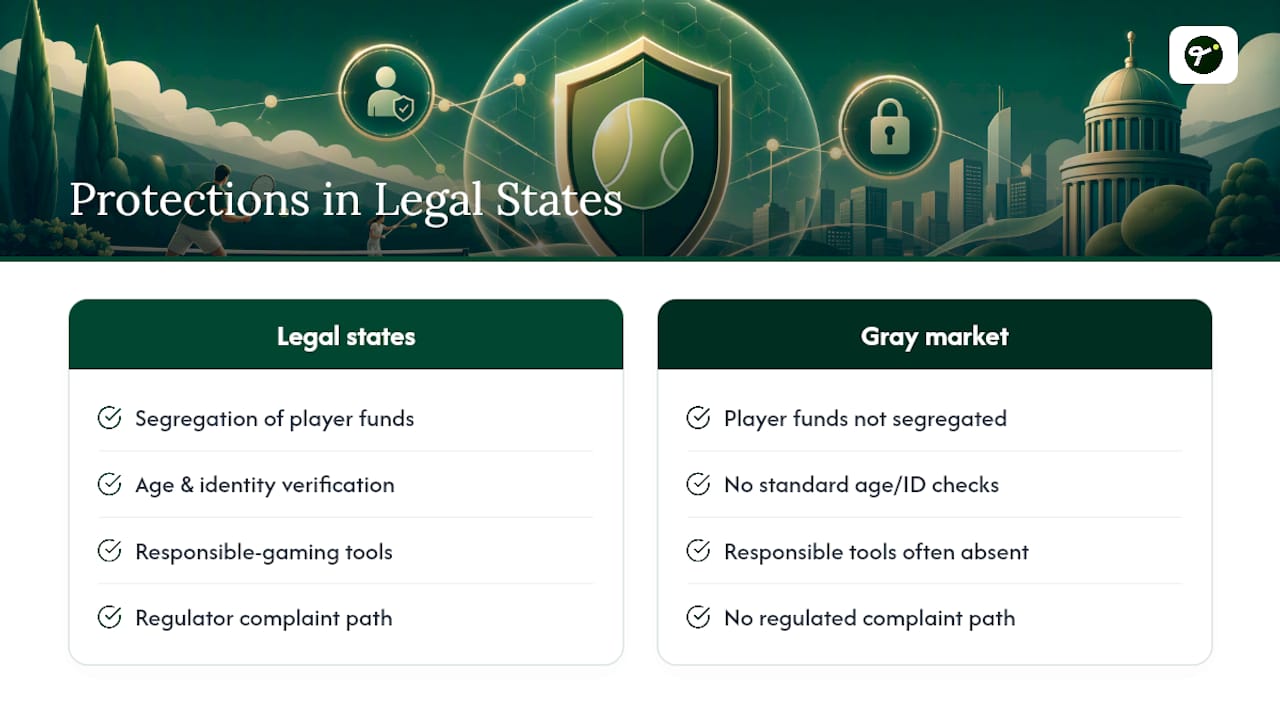
What Protections Do You Have In A Legal State?
Playing fantasy tennis for cash in a regulated state comes with real protections you don't get in gray-market play, and most players never think to ask about them until something goes wrong.
States that license or register DFS operators typically require baseline consumer protections: segregation of player funds from operating capital, age and identity verification standards, and, in some states, mandated responsible-gaming tools like deposit limits or self-exclusion options. These aren't universal across every legal state, but they show up consistently enough in state gaming statutes to be worth checking for on your state's regulator page.
Licensed status also gives you a path for recourse. If an operator misrepresents odds, mishandles a payout, or violates its own posted rules, a player in a regulated state generally has standing to file a complaint with the state gaming commission or attorney general's office, something that simply doesn't exist for a player operating outside legal boundaries.
Operator transparency requirements matter here too. Licensed platforms are typically required to post clear rules, disclose the mathematical structure of contests, and maintain accessible customer support for disputes. Reading an operator's published game rules, Tweener's included, tells you upfront what protections you're entitled to before you ever deposit a dollar.
That's the practical value of playing within a legal state: not just permission to compete for cash, but an actual framework you can lean on if the operator doesn't hold up its end.
Why Legal Status Should Shape How You Play, Not Just Whether You Can
The state you live in shouldn't just determine whether you're allowed to enter a cash contest. It should shape how seriously you build your skills before you do.
Free modes aren't a consolation prize. They're where you should be testing surface splits, head-to-head trends, and draft strategy long before real money is on the line, whether or not your state permits cash play. If Tweener's cash mode isn't available where you live yet, running a private Grand Slam league with friends still gets you the strategic depth that makes fantasy tennis worth playing in the first place.
Legal clarity is also what makes long-term trust possible. A platform that geofences honestly and pays out reliably in the states where it operates is building something worth sticking with over the states that skip the paperwork entirely. That's the difference that actually matters over a full season, not just for one tournament.
Ready To Play? Start With Tweener's Free Mode
Tweener gives you a way to test real fantasy tennis strategy, drafting ATP and WTA rosters, tracking head-to-head history, managing a salary cap across a full tournament draw, without waiting on your state's cash-mode status to catch up.
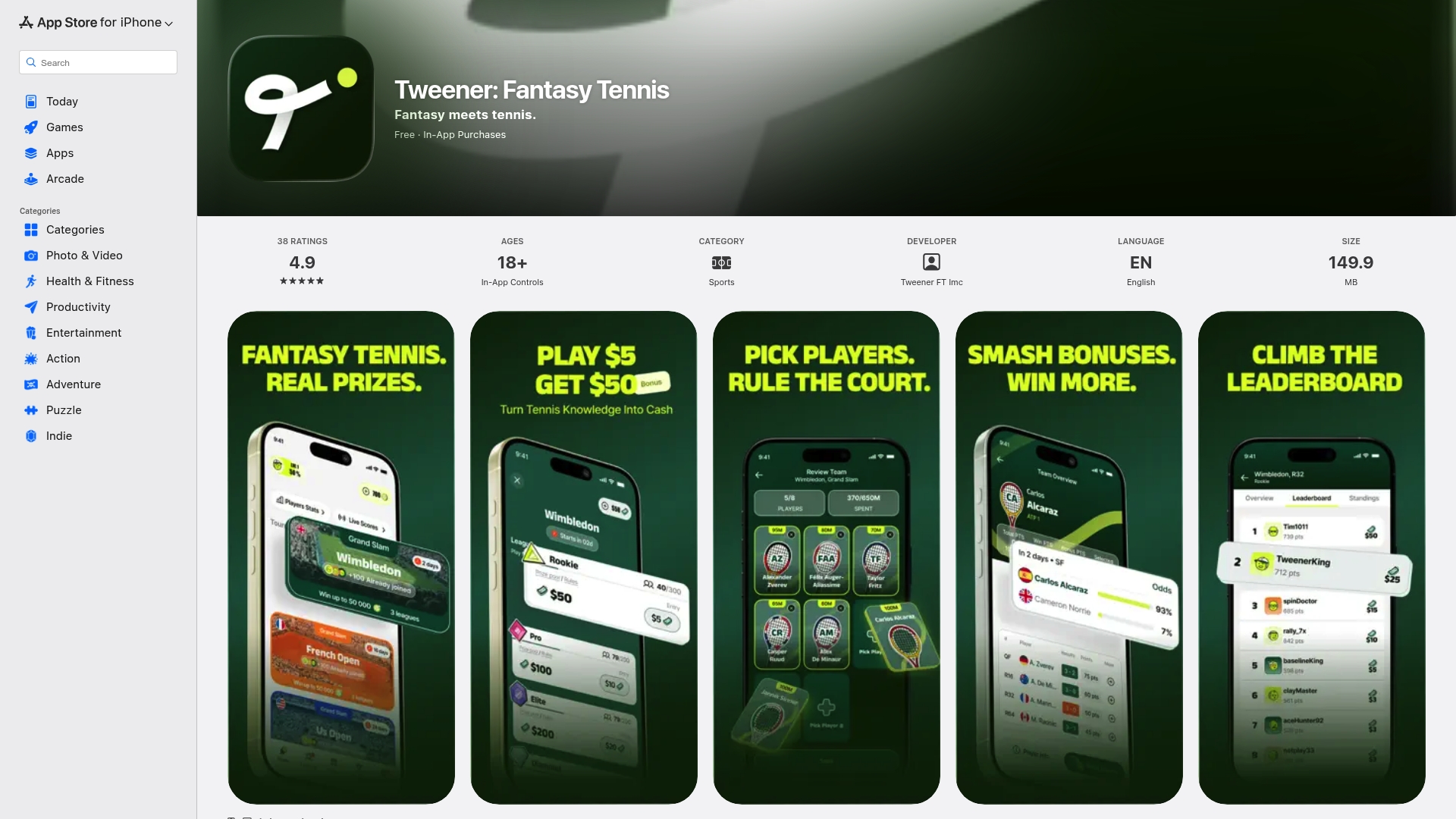
The free mode runs on virtual coins, redeemable for rewards, and it's built for the same analytical decisions cash mode rewards: reading form, weighing surface performance, and picking your six against a real ATP or WTA field. If your state allows cash contests, Tweener's geofencing confirms it automatically once you attempt a deposit. If it doesn't yet, you're not locked out of the game, just the cash layer, and free mode plus private leagues with up to nine friends still gets you the full Grand Slam experience. Check your eligibility and the current state-by-state breakdown on Tweener's game rules page, then download the app and build your first roster before the next Slam starts.
Frequently Asked Questions
Is fantasy tennis legal in all 50 states? No. Cash fantasy tennis contests are legal in most states, but Hawaii, Idaho, Montana, Nevada, and Washington effectively ban them. Free-to-play, virtual-coin modes are typically available regardless of state.
What's the difference between fantasy tennis betting laws and sports betting laws? Fantasy sports contests, including tennis, generally fall under a skill-based carve-out that separates them from traditional sports betting, both federally under UIGEA and in most state statutes. Pick'em formats blur that line more than salary-cap contests, which is why they face separate scrutiny.
Can I use a VPN to enter a cash contest from a banned state? Don't. Operators cross-check device location against payment and account data, and getting flagged typically results in a permanent ban and forfeited funds rather than a warning.
How do I know if fantasy tennis is allowed where I live? Check the operator's restricted-state list first, since it reflects both state law and the operator's own registration status. Then cross-reference your state's gaming regulator page for the underlying legal basis.
Are legal fantasy sports platforms required to protect player funds? In most regulated states, yes. Licensed operators are typically required to segregate player funds and follow disclosed rules, giving players standing to file complaints with a state gaming commission if something goes wrong.
Does playing fantasy tennis for free coins require the same legal checks as cash play? No. Free-to-play and virtual-coin modes don't involve real-money entry or cash prizes, so they generally sidestep the state gambling restrictions that apply to cash contests.
This article is general information, not a substitute for advice from a qualified lawyer. Consult a qualified legal professional about your own circumstances before acting on anything here.
Sources
- Daily Fantasy Sports Laws by State: Legal Status in All 50 States (2026)
- Fantasy Official Rules | WTA Official
- Pick'em DFS legality analysis