

In fantasy tennis, "tiebreak points" means two different things. One is the points played inside a tennis tiebreak, which can change how many fantasy points a player earns. The other is the tiebreaker that decides a winner when two fantasy lineups finish with the same score. This guide covers both, so you can draft with tiebreaks in mind and know what happens when a contest ends level.
TL;DR
- A set tiebreak starts at 6-6 and goes to seven points, win by two. A deciding-set match tiebreak at the majors goes to 10, win by two.
- Fantasy platforms usually score sets, games and match results rather than every individual tiebreak point. Always read the scoring rules for your contest.
- A tight 7-6 set is typically worth fewer fantasy points than a clean 6-1 set, so players who win quickly are often the better fantasy assets.
- When two lineups tie, contests use a tiebreaker rule that is stated in advance. Check it before you enter.
- Private leagues on Tweener let you play Grand Slams with up to 9 friends, so a clear tiebreak rule keeps the group happy.
Table of Contents
- What counts as a tiebreak point in real tennis
- Do fantasy tennis platforms score individual tiebreak points?
- How to draft with tiebreaks in mind
- When two lineups tie: how fantasy tiebreakers work
- Perspective
- Play tiebreak-smart fantasy tennis on Tweener
- A quick pre-contest checklist
- FAQ
- Sources
What counts as a tiebreak point in real tennis
Start with the sport, because every fantasy rule sits on top of it. According to the USTA scoring rules, a tiebreak game is played when a set reaches 6-6. The first player to win seven points, by a margin of two, wins the tiebreak and the set, which is recorded as 7-6.
Tiebreak points are counted as zero, one, two, three and so on, not 15, 30, 40. That small detail matters for fantasy: a tiebreak is a single game on the scoreboard, even though 12 or more points can be played inside it.
The serving pattern
The serving order is what makes tiebreaks swingy. The USTA explains that the player next due to serve starts the tiebreak, serving one point to the deuce side. The opponent then serves two points starting from the ad side, and the pattern continues with two serves each. Players switch ends every six points.

The WTA adds a useful note: because of how serving alternates, a player has to win at least one point on return to win the tiebreak. The first returner is not put at a disadvantage.
If the tiebreak reaches 6-6, play continues until one player leads by two points. That is why you sometimes see scores like 9-7 or 12-10 in the tiebreak.
Set tiebreak vs. match tiebreak
There are two formats, and they are not interchangeable:
| Format | Played to | Margin | Where it appears |
|---|---|---|---|
| Set tiebreak | 7 points | Win by 2 | Set reaches 6-6 |
| Match tiebreak | 10 points | Win by 2 | Replaces a deciding set in some formats, including doubles |
The Australian Open confirms the 10-point version replaces the deciding set at that event, which is the fifth set in men's singles or the third set in women's. USTA Colorado's tiebreak guide states the same 10-point, win-by-two rule for a match tiebreak. Rules for the deciding set differ by tournament, so a player's fantasy output at one Slam does not always carry over to the next.
For how serve order plays out in the 10-point version, our breakdown of match tiebreaks in doubles walks through it.
Do fantasy tennis platforms score individual tiebreak points?
In most formats, no. Fantasy tennis scoring generally builds on larger units: match wins, sets won, games won, aces, breaks of serve and sometimes straight-sets bonuses. A tiebreak usually enters the score in one of two ways:
- Through the set. The player who wins 7-6 gets the set credit, and the games count reflects the 7 to 6 score.
- Through a bonus. Some scoring systems add a flat bonus for winning a tiebreak.
A MatchPointPost guide reports that tiebreak bonuses of roughly 4 to 5 points exist on some platforms. Treat that as a general picture, not a rulebook: every contest publishes its own scoring, and that page is the only one that counts for your lineup.
So the practical answer is this. Before you draft, open the scoring rules for the specific contest and look for three things: whether a tiebreak win carries a bonus, whether games inside a tiebreak count as a single game, and whether a match tiebreak in place of a final set is handled differently.
Why a 7-6 set is a weak fantasy outcome
Even with a bonus, tiebreaks tend to be a poor way to earn fantasy points. Tennis Majors notes that a clinical 6-1 set produces roughly 1.5 times the fantasy points of a 7-6 tiebreak set. Margin of victory matters.
Think about what that means with a simple example. A big server who wins two sets 7-6 and 7-6 has used up a lot of court time and earned fewer game points than a baseliner who wins 6-2, 6-3. The server may still collect aces, but the lopsided winner usually finishes ahead in total points, and gets off court sooner.
The flip side matters too. A player who loses a match in tiebreaks may still pile up games and aces, so a close loss can be less damaging than a one-sided one in a games-based scoring system.

How to draft with tiebreaks in mind
Tiebreak awareness is a small edge, but fantasy is a game of small edges. Here is how to use it.
Look for matchups that avoid tiebreaks
Tiebreaks cluster when two strong servers meet, particularly on fast surfaces like grass or quick indoor hard courts. Two big servers will trade holds for long stretches, and 6-6 becomes likely. If your scoring rewards game margin, a heavy favorite against a weaker returner is the safer pick: break chances arrive early, and sets finish 6-3 or better.
On clay, longer rallies and more breaks mean tiebreaks are less common. A top clay player facing a mid-ranked opponent at Roland Garros is a classic route to a high-margin straight-sets win.
Check head-to-head and surface
Head-to-head records tell you more than rankings when two similar servers meet. If the last three meetings went to tiebreaks, expect it again. Our guide to matchup analysis in fantasy tennis shows how to combine head-to-head, surface and recent form into a quick read.
Remember the format
Best-of-five men's matches at the Slams give more sets, and so more chances for tiebreaks, but they also give a dominant player more time to build a big games total. Best-of-three women's matches end faster. If your contest scores by games or sets, the format changes how much you want a heavy favorite versus a slugger.
For wider lineup thinking, see our fantasy tennis tips for building a winning lineup and the guide to building winning tennis lineups.
When two lineups tie: how fantasy tiebreakers work
The second meaning of "tiebreak points" is the rule that settles a contest when two lineups finish level. This is common in short tennis contests, where scores can land on the same number because only a handful of matches are played.
A good tiebreaker rule has three traits: it is written before the contest starts, it uses a statistic players can verify, and it leaves no room for debate. Common approaches in fantasy sports include:
- Split the prize. Tied entrants share the payout for the places they occupy. Simple and fair.
- Best single player. The lineup with the highest-scoring individual player wins.
- Bench or depth points. Points from players outside the starting lineup are compared. This rewards roster depth.
- Head-to-head record. In league play, the result between the two tied teams decides it.
- Total points for. In a league, the team with more cumulative points across the season ranks higher.
- Final match. The player in the last match of the event, usually the final, is the deciding factor.
For league play, our write-up on how tie-breakers work in fantasy leagues goes deeper, and tiebreak scoring in fantasy tennis covers the scoring side.
Which rules can vary
Expect these to differ from one contest or league to the next:
| Setting | What can differ |
|---|---|
| Tiebreak bonus | Flat bonus, none, or counted only as a game |
| Match tiebreak scoring | Counted as a set, a single game or a separate bonus |
| Tied lineups | Split prize, countback or head-to-head |
| Walkovers and retirements | Counted, partially counted, or voided |
| Private league rules | Set by the commissioner before the event |
If you run a private league with friends, decide the tiebreaker before the first ball is struck. Arguments over a tied Grand Slam final are no fun.
Perspective
We built Tweener because tennis fans had no home for serious fantasy play. Tennis is a sport of tiny margins: a tiebreak can turn on a single return, and the stats behind those moments are rich. Fans who dig into head-to-head, surface splits and form should be rewarded for it.
That is why we focus only on ATP and WTA tennis. A general platform treats tennis as an afterthought. We treat a 7-6 set and a 6-1 set as different stories, because they are.
Our view is that skill beats luck over a tournament. Choose players for the right reasons, read the matchup, and the scoring takes care of itself. Our Draft Mode and Pick'em Mode are designed around that idea, and private leagues let you test your read against up to 9 friends at a Grand Slam.
Nathan
Play tiebreak-smart fantasy tennis on Tweener
Tweener is a mobile fantasy app built only for professional tennis. You build teams from real ATP and WTA players and score points from live match results. You can play in Draft Mode or Pick'em Mode, join public leagues or set up a private league with friends.
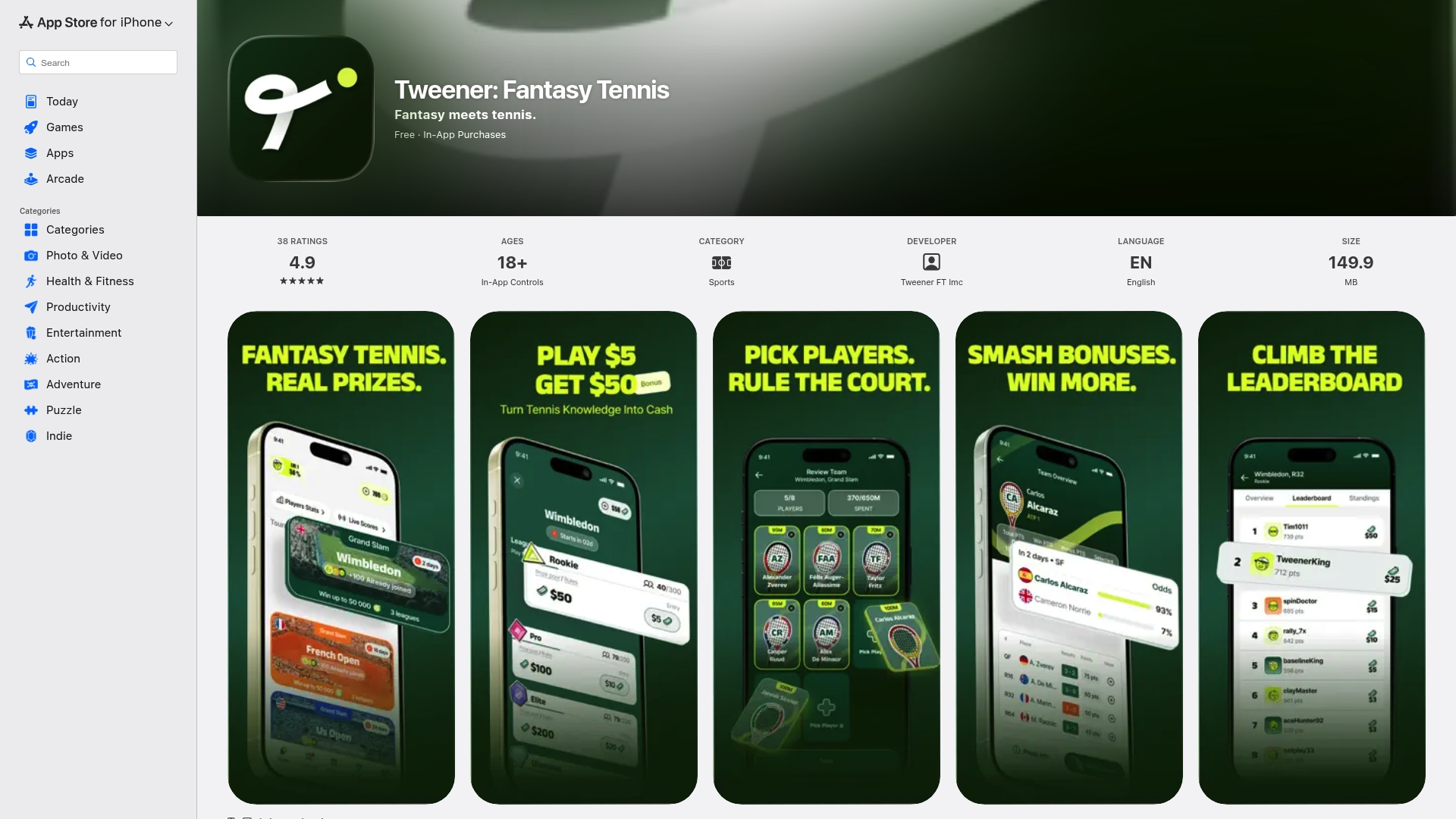
There are two ways to play. The free mode uses virtual coins that you earn through gameplay and in-app activity, and the coins can be redeemed for rewards such as gift cards. A cash mode lets you deposit money to enter paid contests for real-money payouts, where legally permitted. Cash play is available in select US states, so check availability where you live before you deposit.
A quick pre-contest checklist
Before you lock a lineup, run through this list:
- Read the contest's scoring rules, and note how a set tiebreak and a match tiebreak count.
- Identify the two or three matches most likely to go to tiebreaks, and decide if your scoring makes those players riskier.
- Lean toward favorites who break serve often, since they win in straight sets with a bigger games margin.
- Check the surface and the format, best-of-three or best-of-five.
- Find the contest's tiebreaker rule so a tie never surprises you.
- In a private league, agree the tiebreaker with everyone in advance.
For more on strategy, our fantasy tennis strategy guide, the piece on drafting tennis players and the article on tennis match prediction strategies are good next reads. You can also see how to optimize your picks for consistent wins.
FAQ
Do fantasy tennis games score every tiebreak point?
Usually not. Most scoring systems count sets, games, match wins and bonuses rather than each point. A tiebreak typically shows up as a single game inside a 7-6 set, sometimes with a bonus. Check your contest's scoring page to see how it is handled.
How many points does a tennis tiebreak go to?
A standard set tiebreak goes to seven points, and you must win by two, according to the USTA. A match tiebreak, used in place of a deciding set in some formats, goes to 10 points, also win by two. If the score reaches 6-6 in a seven-point tiebreak, play continues until someone leads by two.
What happens if two fantasy lineups tie?
It depends on the contest or league rules. Common outcomes are a split of the prize, a comparison of the best individual player, or a comparison of bench points. The rule should be stated before the event, so read it before you enter.
Are tiebreaks good or bad for my fantasy players?
They tend to be less valuable than clean wins. A 6-1 set can produce roughly 1.5 times the fantasy points of a 7-6 set, per Tennis Majors. Favorites who break serve and win in straight sets usually give you the best return.
Sources
- Tennis Scoring: Points, Sets & Games, USTA
- Tennis explained: Learn the game, WTA
- A guide to scoring in tennis, Australian Open
- Standard Tiebreak for Tennis, USTA Colorado
- How to Build a Winning Tennis DFS Strategy, Tennis Majors
- How Does Fantasy Score Work in Tennis?, MatchPointPost