
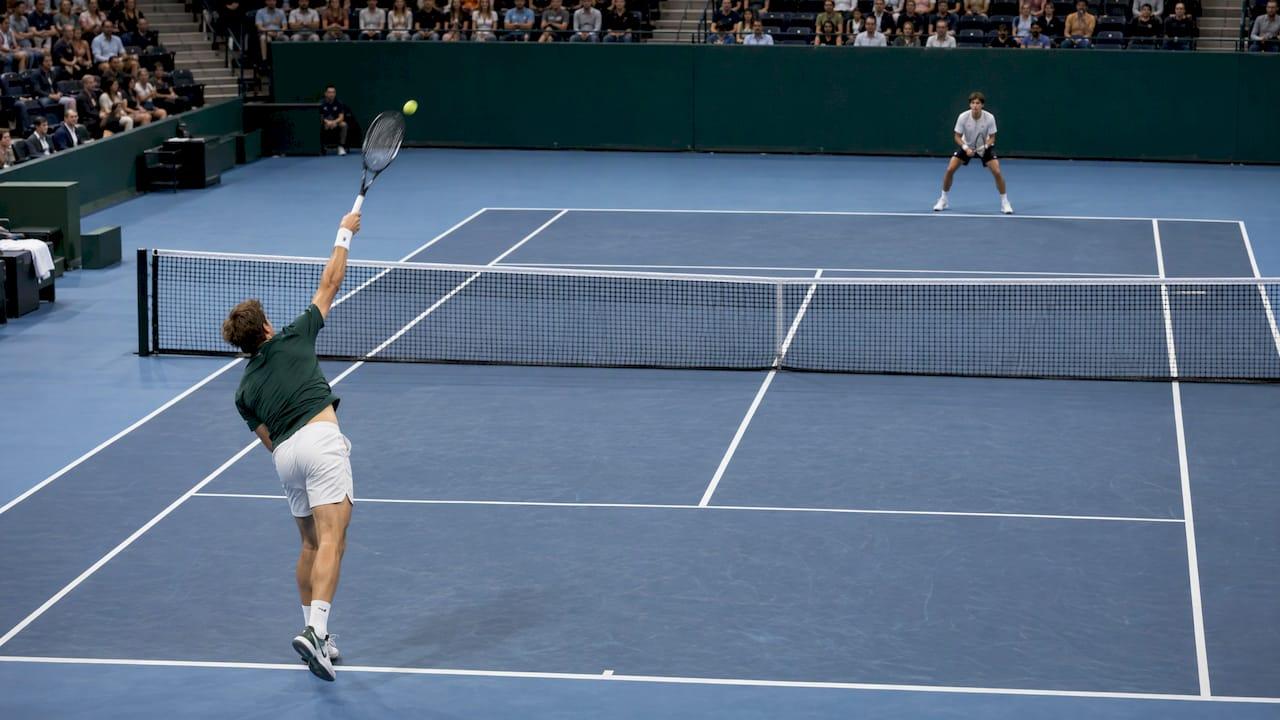
A tennis tiebreak is won by the first player to reach seven points with a two-point lead, and the set is recorded as 7-6. In fantasy tennis, that single detail can decide a close matchup, because a tiebreak set tells you a match was tight and that neither player could break serve. Separately, "tiebreak" also means the rule your league uses when two fantasy teams finish level. This guide covers both: the real tiebreak rules you need to read matches well, and the way fantasy games and leagues settle ties.
TL;DR
- A standard tiebreak goes to seven points, win by two. A deciding-set match tiebreak, where used, goes to 10, also win by two.
- Serve rotates after the first point, then every two points, and players switch ends every six points.
- How a tiebreak affects your fantasy score depends on the scoring sheet of your game, so read it before you draft.
- Tiebreak-heavy matchups come from big servers on fast surfaces. That is a stats question you can research before lock.
- Tied fantasy standings are settled by a league rule (commonly total points or head-to-head), set before the event starts.
Table of Contents
- How a tennis tiebreak works
- Serve order and changing ends
- Match tiebreaks: the 10-point version
- How tiebreaks show up in fantasy tennis scoring
- Finding tiebreak-prone matchups before lock
- The other tiebreak: when fantasy teams finish level
- Perspective
- Put it to work on Tweener
- A short checklist before you lock a lineup
- FAQ
- Sources
How a tennis tiebreak works
When a set reaches 6-6 in games, most tournaments play a tiebreak game instead of continuing the set. According to the USTA scoring rules, the first player or team to win seven points, by a margin of two, wins the tiebreak, and the set is recorded as 7-6. If the tiebreak reaches 6-6, play continues until someone leads by two.
The ITF Rules of Tennis (2026 edition) say the same thing in formal language: seven points, a two-point margin, and the game continues if necessary until that margin is reached. So a tiebreak can finish 7-0 or 7-5, but it can also stretch to 12-10 or beyond.
The scoring inside a tiebreak is also different from a normal game. Per the USTA's Friend at Court 2026, points are counted "Zero," "1," "2," "3" and so on, not the 15-30-40 sequence. That matters for reading box scores: a tiebreak score of 7-4 is simply seven points to four.
Why it counts as one game in the set score
The winner of the tiebreak is credited with the seventh game of the set, so the set finishes 7-6. The loser's tally stays at six games. If you track games won as a stat, a tiebreak set gives the winner seven and the loser six, even though the tiebreak itself may have lasted a dozen points or more.
Serve order and changing ends
Tiebreak serving is the part casual viewers get wrong. Under Friend at Court 2026, the player whose turn it is to serve takes the first point of the tiebreak. The opponent then serves the next two points, and from there each player serves two consecutive points in turn until the tiebreak ends.

The WTA's Tennis explained guide puts it in plain terms: one serve to start, then two each. It adds that a player must win at least one point on return to win a tiebreak. That is simple arithmetic with big consequences: a monster server who holds every service point still needs a return point to close it out.
Players also switch sides. The Australian Open scoring guide explains that players change ends after every six points during tiebreaks, to cancel out any advantage from wind or sun at one end of the court.
A quick worked example
Say Player A is due to serve first at 6-6.
- Player A serves point 1.
- Player B serves points 2 and 3.
- Player A serves points 4 and 5.
- Player B serves points 6 and 7, and the players change ends after point 6.
- This pattern continues until one player has at least seven points and a two-point lead.
In that sequence, each player serves roughly half the points, but the first server serves one fewer point in the opening stretch. The early minibreak, winning a point on the opponent's serve, is usually the thing that matters most.
Match tiebreaks: the 10-point version
Not every deciding set ends the same way. The Australian Open scoring guide notes that at 6-6 in a deciding set, such as the fifth set of men's singles or the third set of women's singles, a 10-point match tiebreak with at least a two-point advantage is used. Check each event's rulebook before assuming, because Grand Slams have changed their deciding-set rules over the years, and the event's official page is the place for the current format.
Below the top level, the format is common. The LTA rules page describes a match tie-break as following the same format as a standard tiebreak but played up to 10 points. And Tennis Australia's match formats document lays out a "2 TB Sets + 10MTB" format: at one set all, one tiebreak game decides the whole match, and the first to 10 points with a two-point margin wins.

Doubles and mixed formats
Doubles often uses the shorter format. The Australian Open guide says mixed doubles, junior doubles, and quad and wheelchair doubles play a 10-point tiebreak in place of a third set. If the teams split the first two sets, the entire match comes down to it. For fantasy players, that means a doubles result can swing on a handful of points, which is one reason doubles-heavy contests reward extra care. We go deeper on that in our piece on match tiebreaks in doubles and serve order.
How tiebreaks show up in fantasy tennis scoring
Here is the honest answer to the question behind this keyword: there is no universal rule. Every fantasy tennis game builds its own scoring sheet. Some formats reward match wins and set wins. Some reward games won, aces, or breaks of serve. Some add bonuses for straight-set wins. Whether a tiebreak earns its own value, or simply shows up as a 7-6 set, is a decision of the game you are playing.
That is why the first step before any draft is reading the sheet. Our guide to how fantasy tennis points are calculated walks through the typical building blocks, and Fantasy Tennis Scoring on Tweener covers how to read a sheet and pick players against it.
Even when tiebreaks have no special line, they change your outcome in indirect ways:
- Set and match results. A 7-6 set win is still a set win. A player who wins two tiebreak sets takes the match just like one who wins 6-0, 6-0, but usually with less margin for error.
- Games won. If your scoring counts games, a 7-6 set gives the winner seven and the loser six. Close sets compress the gap between winners and losers.
- Match length. Tiebreak sets tend to push matches toward three or five sets, which creates more service games and more chances for serve-based stats to pile up, if your sheet rewards them.
- Straight-set bonuses. If your game pays extra for winning without dropping a set, a tiebreak in the first set does not cost you the bonus, but losing one can.
The point is to map each of these to your game's rules, not to assume. For the bigger picture of how results flow into points, see how real match results drive fantasy tennis success.
Finding tiebreak-prone matchups before lock
Tiebreaks are not random. They cluster around specific players, surfaces and matchups, and you can research them like any other stat.
Start with serve strength
A set only reaches a tiebreak when both players hold serve through twelve games. The usual suspects are tall, heavy servers who win a very high share of their service games, facing opponents who do not break often. Look at:
- Percentage of service games held
- First-serve points won
- Break points converted against the opponent
- Return points won, which is the stat that tells you whether a tiebreak can be broken open
When two big servers meet, expect long sets with few break chances. That profile produces tiebreaks, and it also produces tight, coin-flip-feeling matches that can go either way.
Then add the surface
Fast courts and high bounces help servers. Grass and fast indoor hard courts tend to produce more holds than slow clay, where returners get more time. If you are drafting a Wimbledon-style event, tiebreak frequency is a bigger factor than at a clay tournament such as Roland-Garros. Surface splits are one of the most useful filters you can apply, and we cover the approach in Tennis Fantasy Prediction Games: Your 2026 Winning Guide.
Check head-to-head and recent form
Head-to-head records tell you whether a matchup tends to be close. If two players have split several meetings with multiple tiebreak sets, that is a signal. Pair it with recent form: a player who has been winning tiebreaks lately is usually serving with confidence. A player who keeps losing them may be one point away from turning results around, and may be priced or picked as if the results were worse than the underlying play.
Respect the small sample
Tiebreak win rates are noisy because each tiebreak is a short race. A player who has won 70 percent of tiebreaks over ten matches may not hold that rate over the next ten. Use tiebreak history as one input, with serve and return stats as the foundation. Where the data comes from matters too, which is why we wrote about how sports statistics are collected for fantasy tennis.
The other tiebreak: when fantasy teams finish level
If you searched this phrase for fantasy football-style standings, here is how it works in general. When two teams share the same record or the same score, the league needs a rule to separate them. Commonly used methods include total points scored, head-to-head record, and, in some formats, bench points or points against. Which one applies is up to the platform or commissioner.
Two habits keep disputes away:
- Read the tiebreaker before you join. The rule is usually listed in the league settings or contest rules.
- Prefer rules based on performance. Total points rewards the team that drafted and managed better, and it is easy to verify from the standings.
In a tennis tournament, a tie is less likely when scoring involves many small point increments, but it can still happen in pick'em formats where the scoring is a count of correct picks. That is where a clear secondary rule matters most. Our breakdown of how tie-breakers work in fantasy leagues covers the common options for tennis leagues, and our fantasy tennis terms guide explains the vocabulary used in contest rules.
Perspective
We built Tweener because tennis has never had its own version of the big daily fantasy platforms, and the sport rewards exactly the kind of fan who reads the numbers. A tiebreak is a perfect example. To a casual viewer it is a nervous stretch of points. To an analytical fan, it is the result of serve holds, surface speed, return quality and matchup history that you could have looked at before the match began.
That is why we think fantasy tennis is a skill game. Choosing between two servers on a fast court, or deciding whether a returner can break a tiebreak open, is strategy, not a guess. In Draft Mode and Pick'em Mode you make those calls against real ATP and WTA results, and you can play them in free leagues with virtual coins or, where legally permitted, in cash contests.
Our advice: read the scoring sheet first, build your player pool around serve and return numbers, and treat tiebreak history as a tiebreaker of your own, not the whole case. Private leagues for Grand Slams, with up to nine friends, are the best place to test the theory, because everyone is arguing over the same matches.
Nathan
Put it to work on Tweener
Tweener is a mobile fantasy app built only for tennis. You draft real ATP and WTA players or make pick'em calls, then score points from actual match results. You can start in free play with virtual coins that can be redeemed for rewards such as gift cards, or join private leagues with friends. Cash contests with real-money payouts are available only where legally permitted, which currently means select US states.
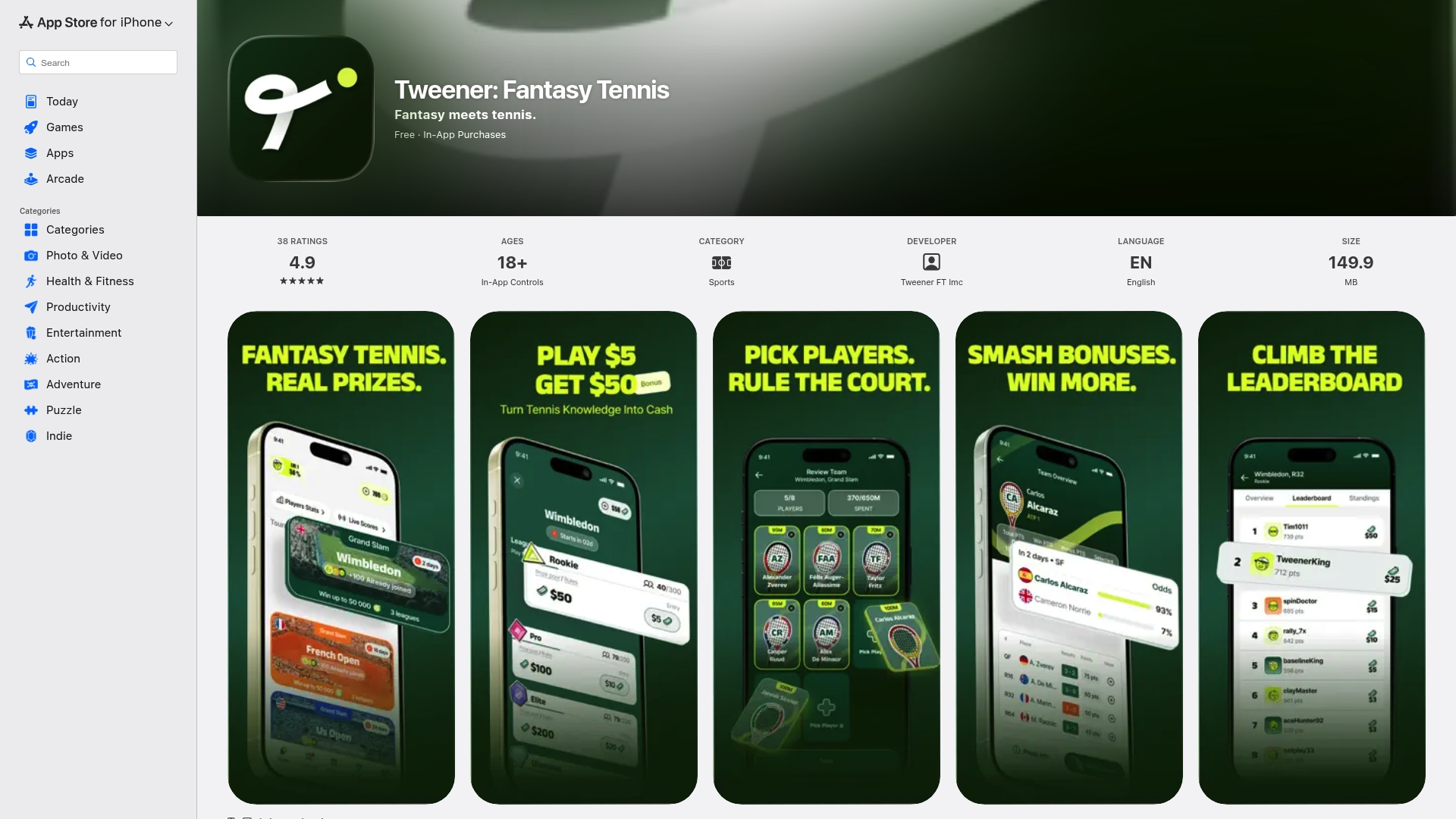
If you want to try the ideas in this guide on a live tournament, download the Tweener app or look at Draft Mode and Pick'em Mode to see which format fits your style. Before your first contest, give the in-app scoring a read, and use our how tennis scoring works guide as a refresher on sets, games and tiebreaks.
A short checklist before you lock a lineup
- Confirm the scoring rules for your contest, especially for games won and set results.
- Check the tournament's deciding-set rule on its official site, since formats differ between events.
- Compare each player's hold percentage and return points won on the surface in play.
- Look at the head-to-head and the last few matches for tight sets.
- Note doubles formats, where a 10-point tiebreak can replace the third set.
- Confirm the league's tiebreaker for tied standings before the first match.
FAQ
How many points do you need to win a tennis tiebreak?
You need seven points with a lead of at least two. If the score reaches 6-6, the tiebreak continues until one player is two points ahead. The winner is credited with the set, usually recorded as 7-6, according to the USTA and the ITF rules.
Who serves first in a tiebreak, and how does serve change?
The player whose turn it is to serve begins with one point. Their opponent then serves two points, and the players alternate every two points after that. Players change ends after every six points, per the USTA's Friend at Court and the Australian Open scoring guide.
Does a tiebreak give extra points in fantasy tennis?
That depends on your game's scoring sheet. In many formats, a tiebreak simply appears as a 7-6 set, which affects set wins, games won and match results. Read your contest rules before drafting, and see our scoring guide to understand typical categories.
What is a match tiebreak?
A match tiebreak is a 10-point tiebreak played in place of a deciding set in some formats. The winner needs at least 10 points and a two-point lead. It is used in situations such as doubles, and some events use it at one set all. Always check the specific event's rules.
How are ties in fantasy standings settled?
The league or platform sets the rule, and common choices include total points and head-to-head record. The rule should be visible before the contest starts. In Tweener's private leagues, check the league details so everyone knows how a tie would be handled.
Sources
- Tennis Scoring: Points, Sets & Games, USTA
- ITF Rules of Tennis 2026
- Friend at Court 2026, USTA
- Tennis explained: Learn the game, WTA
- A guide to scoring in tennis, Australian Open
- Tennis rules & scoring system, LTA
- Match and Draw Formats, Tennis Australia