

Professional tennis statistics reach your fantasy app through a hybrid pipeline: live human event coding at the venue, automated tracking systems, vendor validation, and a post-match audit that produces the canonical numbers you should actually trust. The ATP, WTA, and USTA generate official match records; commercial vendors like Stats Perform and Sportradar package and distribute those feeds; and apps like Tweener consume them to power contest scoring.
Two numbers matter most to fantasy players: live graphics update very quickly, while canonical audited figures typically arrive a day or two after a match ends. That gap is where scoring corrections happen, and it directly affects your leaderboard.
Table of Contents
- How sports statistics are collected at a live tennis match
- What player tracking and computer vision add to raw event data
- How raw inputs become clean, time-stamped datasets
- Who packages and distributes tennis data, and how fantasy apps get it
- Why accuracy, latency, and versioning change your fantasy outcomes
- A step-by-step checklist for fans who want to use tennis stats for fantasy
- How to tell whether a dataset is actually reliable
- Key Takeaways
- The part most fantasy tennis players get wrong about data
- Put validated tennis stats to work on Tweener
- Useful sources
How sports statistics are collected at a live tennis match
Every ace, double fault, and break point you see in a box score starts with a human being sitting courtside with a laptop. Professional tennis matches use a scoring crew, typically a primary spotter who watches the ball, an inputer who keys the event code in real time, a secondary editor who cross-checks entries as play continues, and a QA role connected to the league or vendor's central hub. The NBA's four-person scorekeeping crew follows the same logic, and tennis data operations mirror it closely.
A single point generates a short event log including server info, serve details, rally events, outcome, score state, and timestamp.
Ambiguous events create the most downstream problems. Let-serves, net-cord winners, and interference calls are the three categories scorers flag most often. A let-serve that goes uncalled gets coded as a fault; a net-cord winner might be logged as a forced error depending on the scorer's angle. Those edge cases are exactly where fantasy points can shift.
Pro Tip: When a player's ace count looks suspiciously low or high after a match, check whether the official log was audited. A serve that clipped the line and was initially coded as a fault sometimes gets corrected to an ace in the post-game review, adding a point to your fantasy total retroactively.
What player tracking and computer vision add to raw event data
Event data tells you what happened. Tracking data tells you where everyone was when it happened, providing richer context for fantasy modeling.

Camera-based systems like StatsBomb 360 and Second Spectrum convert multi-camera feeds into x,y coordinates at roughly 25 frames per second. At that resolution, you get continuous position data for every player on court, not just the ball. Sensor-based systems used in training environments add biomechanical layers like racket speed and footwork patterns, though those rarely appear in broadcast-grade match feeds.
What tracking unlocks for fantasy models:
- Return positioning: where a player stands when receiving a first serve, which predicts break-point conversion rates
- Court coverage: total distance run per set, a proxy for fatigue in long matches
- Serve pressure index: how much the returner has to move to reach the ball, useful for projecting hold percentages on fast surfaces
"The shift to AI and computer vision is intended to provide richer context to human-coded event data, not to replace human judgment, as explored in NextGen Coxing's AI-Powered Coxswain Training & CoxIQ. Trained collection experts remain central to the capture process." Stats Perform describes its Opta engine this way, blending analysts with computer vision to collect millions of data points and tracking coordinates per match.
How raw inputs become clean, time-stamped datasets
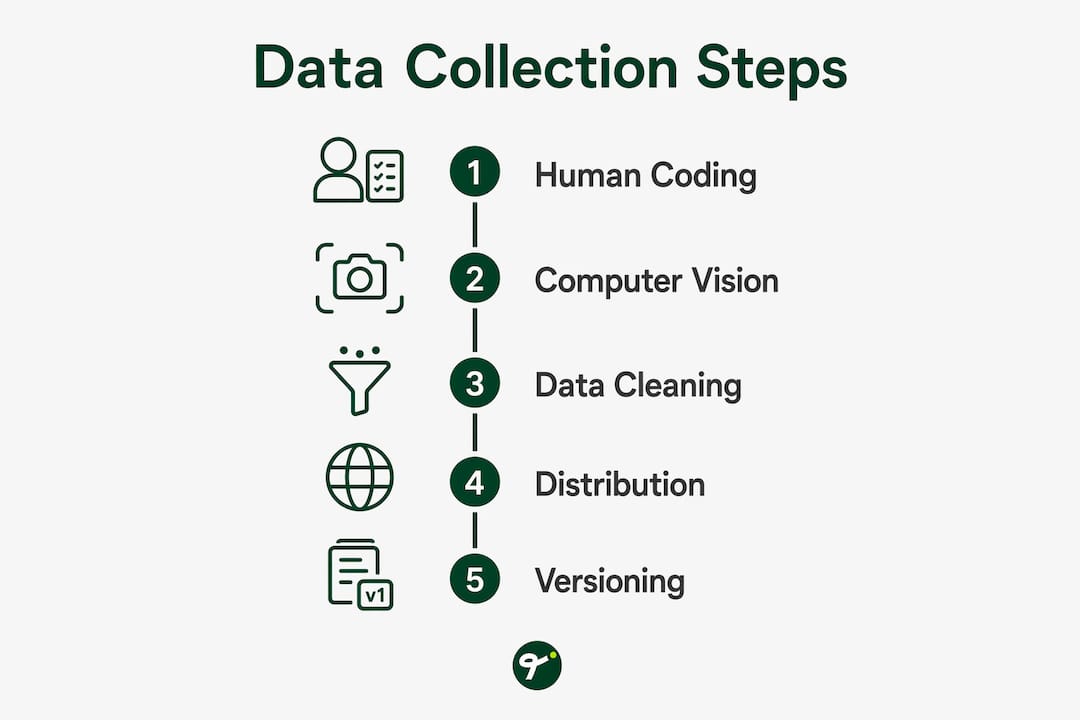
The journey from courtside keystroke to the number in your fantasy app has several checkpoints, and skipping any one of them is where errors survive into production.
- In-venue input: The scoring crew logs each event in real time. The secondary editor flags discrepancies immediately.
- Real-time validation: Automated sanity checks run on the live stream. Impossible values (a third serve, a negative point count) trigger an alert.
- Vendor aggregation: Stats Perform, Sportradar, or the league's own hub receives the stream, applies its own format rules, and pushes to downstream endpoints.
- Post-game video audit: Officials review the play-by-play log against broadcast footage. This is where an ace misclassified as a winner gets corrected.
- Canonical archive: The corrected, versioned file is timestamped and stored. This is the number modelers should use.
A concrete example: a serve that clips the service-box line is initially coded as a fault by the inputer. The post-game audit catches it on video review and reclassifies it as an ace. If your fantasy app processes scoring updates, that correction adds a point to the serving player's total. How Tweener handles that scenario is covered in the perspective section below.
For tracking fantasy league performance, always log which feed version your data came from and when you pulled it.
Who packages and distributes tennis data, and how fantasy apps get it
| Source | Latency | Reliability | Licensing |
|---|---|---|---|
| Official ATP/WTA/USTA feeds | Seconds to minutes | Highest (primary source) | Licensed; not public |
| Commercial vendors (Stats Perform, Sportradar) | Under 30 seconds for live endpoints | High; validated pipelines | Paid API access |
| Broadcaster integrations | Seconds (graphics layer) | Medium; display-only | Restricted redistribution |
| Public datasets / scraped pages | Minutes to hours | Variable; no audit trail | TOS-restricted; legal risk |
Sportradar's API delivers real-time and historical feeds via JSON/XML endpoints across dozens of sports. Stats Perform's Opta platform combines proprietary capture with a deep archive, and access to the richest datasets requires a paid license.
Scraping is tempting because it costs nothing upfront. The problem is that scraping public stats pages almost always violates the site's Terms of Service, and redistribution for commercial use is explicitly prohibited on most league and broadcaster properties. For personal research, read the TOS carefully. For anything powering a contest or a published model, use a licensed feed.
Why accuracy, latency, and versioning change your fantasy outcomes
Three failure modes hit fantasy players hardest.
Scoring errors from misattributed events are the most common. An ace coded as a winner, or a double fault logged as a second-serve fault, changes the point totals for both players in a head-to-head contest. Over a five-set match, a handful of miscoded events can flip a close leaderboard.
Latency-driven timing losses matter when your app locks lineups close to match start. If the live feed lags by more than a few minutes, a retirement or a walkover you saw on broadcast might not yet be reflected in the app's player status. That's a lineup decision made on stale data.
Inconsistent historical records degrade model training. If you pull data from two different sources and one uses the live feed while the other uses the canonical archive, your training set has two versions of the same match. Predictive models built on inconsistent inputs produce unreliable forecasts.
Pro Tip: Always log the feed version and pull timestamp alongside your data. When you retrain a model, use only canonical-archive pulls. A simple rule: if the match ended less than 48 hours ago, treat the numbers as provisional.
A step-by-step checklist for fans who want to use tennis stats for fantasy
- Pick a data source. Start with official ATP or WTA match stats pages for free historical data. For live feeds, evaluate vendor APIs like Sportradar. Understand the licensing terms before you build anything on top of it.
- Choose your tools. A spreadsheet works for basic mapping. Python with pandas handles larger datasets and automated pulls cleanly. Tweener's internal scoring engine already maps ATP/WTA events to fantasy points, so you can test lineup logic without building a pipeline from scratch.
- Map events to fantasy scoring. Build an explicit translation table.
| Tennis event | Example fantasy points | Dataset field |
|---|---|---|
| Ace | +1 | serve_outcome = ACE |
| Double fault | — | serve_outcome = DOUBLE_FAULT |
| Break point won | +2 | point_type = BREAK_POINT, winner = returner |
| Break of serve | +3 | game_outcome = BREAK |
- Validate with a sample match. Pull one completed match, run your mapping, and compare the output to the official box score. Discrepancies reveal coding differences between your source and the official record.
- Automate updates carefully. Schedule pulls after the canonical window (24–48 hours post-match) for training data. For live contest decisions, use a vendor feed with a documented SLA.
For a deeper look at building a tracking workflow around these steps, the Tweener blog covers the full process.
Safety note: Check licensing before scraping or republishing any feed. Even public-facing stats pages carry redistribution restrictions in their Terms of Service.
How to tell whether a dataset is actually reliable
Trust signals worth checking before you base a lineup on a dataset:
- Multi-layer validation: Does the provider document a live-input plus secondary-editor plus post-game audit process?
- Versioned, time-stamped feeds: Can you tell whether a number came from the live stream or the corrected archive?
- Vendor SLA or latency guarantee: Does the provider publish uptime and delivery-time commitments?
- Clear licensing and TOS: Is the permitted use scope explicit? Ambiguity is a red flag.
Common error modes to watch for:
- Occlusion in tracking data: Camera-based systems lose players behind the net post or during rapid direction changes. Derived metrics like court coverage can have gaps.
- Misattributed events in fast rallies: A forced error and an unforced error look similar from one camera angle. Rapid exchanges generate the most miscodes.
- Missing timestamps: A feed without timestamps cannot be versioned. Avoid it for modeling.
- Cross-vendor inconsistency: The same match coded by two vendors can produce different ace counts if their event definitions differ slightly.
Canonical, post-match audited figures are more reliable than raw live feeds; reviewed versions typically become available 24–48 hours after a match, while live graphics update in 1–15 seconds depending on the endpoint.
Key Takeaways
Tennis stats for fantasy rely on a hybrid pipeline of human coding, automated tracking, and vendor validation, where canonical audited numbers are always more reliable than raw live feeds.
| Point | Details |
|---|---|
| Hybrid pipeline | Human scorers plus computer vision produce the event logs that power ATP/WTA feeds and fantasy scoring. |
| Latency window | Live graphics update in 1–15 seconds; canonical audited numbers arrive 24–48 hours post-match. |
| Source hierarchy | Official feeds and commercial vendors (Stats Perform, Sportradar) outrank scraped public pages on reliability and legal safety. |
| Modeling discipline | Log feed version and timestamp with every pull; train models only on canonical-archive data. |
| Tweener | Uses validated, versioned ATP/WTA feeds so contest scoring reflects audited match data, not provisional live numbers. |
The part most fantasy tennis players get wrong about data
Most fantasy tennis players treat the box score as a fact. It isn't, at least not immediately. It's a best estimate that gets refined over the next 24–48 hours. The ace count you see at 11 PM on match night is the live-feed number. The one that actually settles your contest should be the audited version.
What surprises me about how sports analytics changed competition is not the technology. It's how few fantasy players think about the data layer underneath their app. They'll spend an hour debating whether to start Carlos Alcaraz or Jannik Sinner on clay, then trust a number that hasn't been through a post-game audit yet. That's backwards. The lineup decision and the data quality are equally important.
The other underrated issue is cross-vendor inconsistency. Two platforms can show different ace counts for the same match because their event definitions diverge at the margin. A serve that catches the line and forces a weak return might be an ace on one system and a winner on another, depending on how the scorer interpreted the receiver's contact. Neither is wrong by their own rulebook. But if you're training a model on data from one vendor and validating it against another, you're introducing noise that looks like signal.
The practical fix is simple: pick one canonical source, document it, and stick to it. For predictive analytics in fantasy sports, consistency in your data source matters more than chasing the richest available dataset.
Put validated tennis stats to work on Tweener
Fantasy tennis without reliable data is just guessing. Tweener is built specifically for analytical tennis fans who want to compete on skill, using validated ATP and WTA match stats as the scoring foundation for every contest.
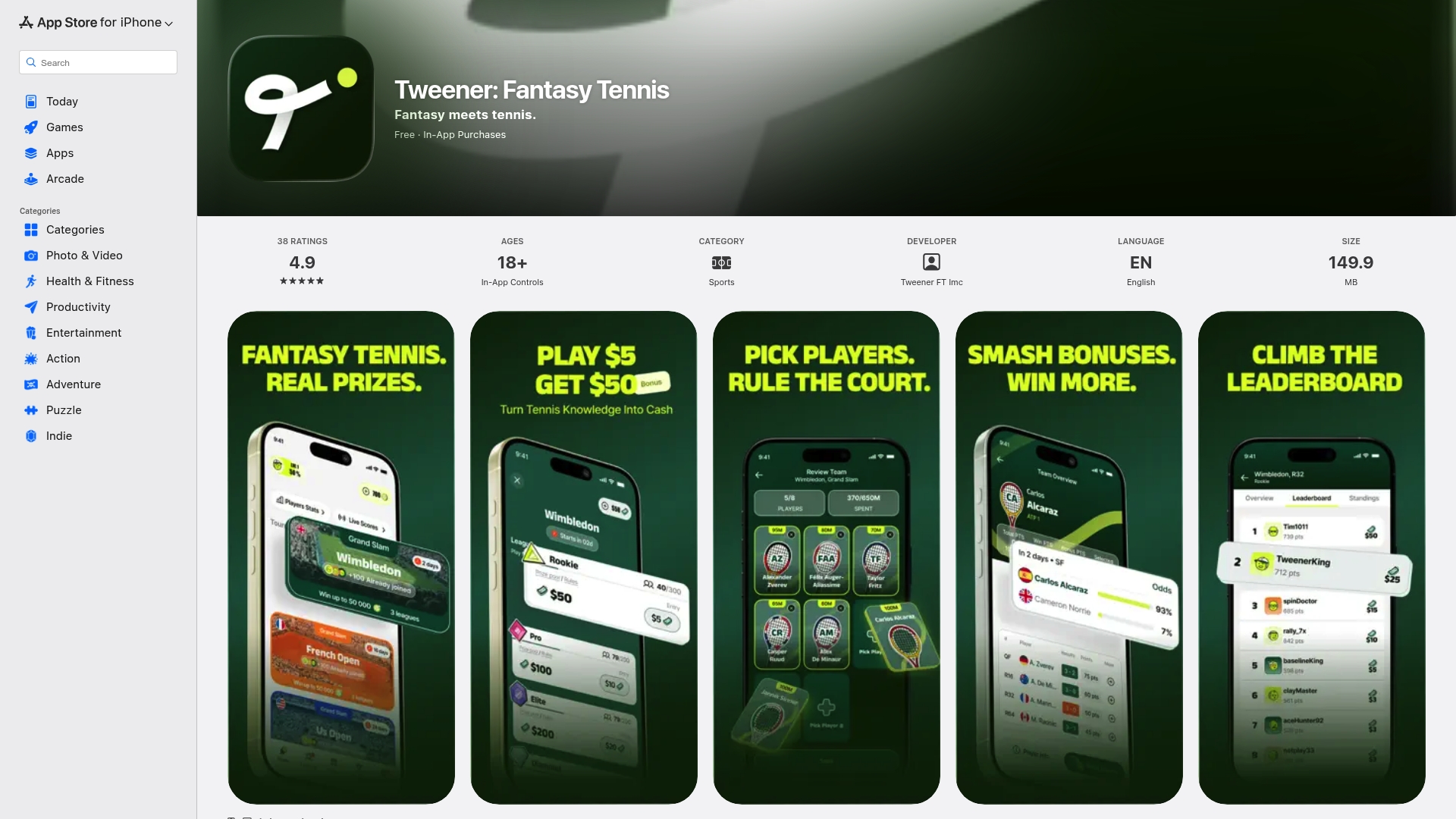
Tweener sources match data from vetted feeds and applies versioning so that post-match corrections update contest standings fairly, not arbitrarily. You can test your lineup logic in free-to-play leagues using virtual coins before entering paid contests. Private leagues let you compete with up to nine friends across a full Grand Slam draw, which is the closest thing tennis has to a dedicated DFS platform.
Start competing on Tweener and put everything in this article to use against real opponents.
Useful sources
- Stats Perform / Opta Data: The vendor's own description of its hybrid capture engine, combining trained analysts with computer vision. Useful for developers evaluating API access and understanding what "multi-layer validation" means in practice.
- Sportradar Sports Data API: Sportradar's product page for real-time and historical feeds. Start here if you're evaluating a paid vendor for live tennis data.
- KiqIQ: How Are Football Match Stats Collected?: A clear walkthrough of the end-to-end pipeline from stadium to screen, including latency benchmarks and the case for canonical numbers over live feeds.
- The Athletic / New York Times: NBA Scorekeeping Explained: A former NBA scorekeeper explains the four-person crew model and post-game audit process, directly applicable to how tennis data operations work.
- Sport Performance Analysis: Web Scraping: A practical overview of scraping as a data-collection method, including the TOS and licensing constraints fans need to understand before building a pipeline.
- University of Missouri Statistics Department: Academic framing of why standardized, quality data capture is the prerequisite for any reliable predictive model in sports.
- Tweener Blog: Predictive Analytics in Fantasy Sports: Practical advice on applying validated data to fantasy tennis lineup decisions and model-building.
- Tweener Blog: Tennis Performance Tracking Workflow: Step-by-step guide to combining event data with tracking metrics for fantasy tennis analysis.