

TL;DR:
- Effective fantasy tennis relies on up-to-date, granular performance data segmented by surface and tournament level.
- Focus on serve, return, and pressure metrics for better prediction than raw win/loss records.
- Regularly verify data coverage, scope, and benchmarks to prevent misleading insights and improve decision-making.
Missed the fantasy tennis playoffs because you picked the wrong player on clay, or worse, relied on season-long win/loss records that told you nothing about how a player actually performs when a match is tight? That frustration is more common than you think. Outdated stats, incomplete datasets, and no clear process for updating picks are the silent killers of fantasy tennis results. This guide walks you through every step of building a performance tracking workflow that turns raw ATP and WTA data into sharp, confident player selections throughout the season.
Table of Contents
- Understand data types and prerequisites
- Step-by-step: Build your tennis performance tracking workflow
- Focus on serve, return, and pressure metrics
- Troubleshooting: Common data pitfalls and validation methods
- Validate and analyze: Turning data into decisions
- What most fans and fantasy players get wrong about tennis tracking
- Take your tennis tracking further with Tweener tools
- Frequently asked questions
Key Takeaways
| Point | Details |
|---|---|
| Choose the right data | Verify tournament and data coverage before starting your workflow to avoid pitfalls later. |
| Use actionable metrics | Prioritize serve, return, and pressure stats for picking winning lineups over basic win/loss records. |
| Automate updates | Refresh your dataset regularly, especially around tournaments, to capture timely performance changes. |
| Validate context | Always check if scope changes or qualifiers included shift benchmarks in your analysis. |
| Simplify, then optimize | A focused, quality-driven workflow beats complexity for both fans and fantasy competitors. |
Understand data types and prerequisites
After understanding the stakes, it's essential to start with the right prerequisites and data sources for your tracking system. Not all tennis data is equal, and the difference between core match stats and granular serve or point-by-point data can completely change what your models tell you.
Tracking player performance effectively starts before you write a single formula. You need to understand what kind of data you are working with and whether it actually covers the tournaments that matter to your fantasy leagues. An effective tracking workflow starts by choosing the right data granularity and verifying coverage by tournament level before building any models.
The most common mistake beginners make is grabbing whatever data is available without checking if it aligns with the specific draw type (main draw vs. qualifiers), tour level (ATP 250 vs. Grand Slam), or stat type they actually need. This mismatch creates false benchmarks and misleading insights.
Here is a breakdown of the three main data tiers and what they cover:
| Data tier | What it includes | Best used for |
|---|---|---|
| Core match stats | Aces, double faults, first serve %, winners, errors | Basic player comparisons, historical win rates |
| Enhanced serve stats | Serve speed zones, placement maps, hold/break rates | Matchup modeling, serve effectiveness scoring |
| Play-by-play data | Point outcomes, pressure point tracking, rally length | Pressure metrics, momentum analysis, live fantasy |
Before building anything, make sure your chosen source has explicit coverage flags for the tours and tournament categories you care about. Check for flags like enhanced_stats, detailed_serve_outcomes, and play_by_play availability per event. The tennis player stats guide covers how to read these flags across common platforms.
Must-have tools for ATP/WTA performance tracking:
- A data source with confirmed ATP and WTA tournament-level coverage (official APIs or licensed aggregators)
- Spreadsheet or database software for segmenting by surface and time window
- A scripting tool (Python or similar) if you plan to automate data pulls
- A comparison layer to track how your metrics move across weeks or months
Pro Tip: Always verify coverage before building or updating your models. A gap in coverage at a key tournament can silently corrupt your benchmarks without any obvious error message.
Step-by-step: Build your tennis performance tracking workflow
With the basics covered, you are ready to create your custom tennis performance tracking workflow. This is where most guides fall short, because they describe what to track but skip the "how to actually structure it" part.
The core workflow for ATP/WTA player tracking follows four essential phases: define the objective, collect and segment data, compute matchup metrics, and update continuously. Each step feeds the next, so skipping one creates gaps that compound over time.
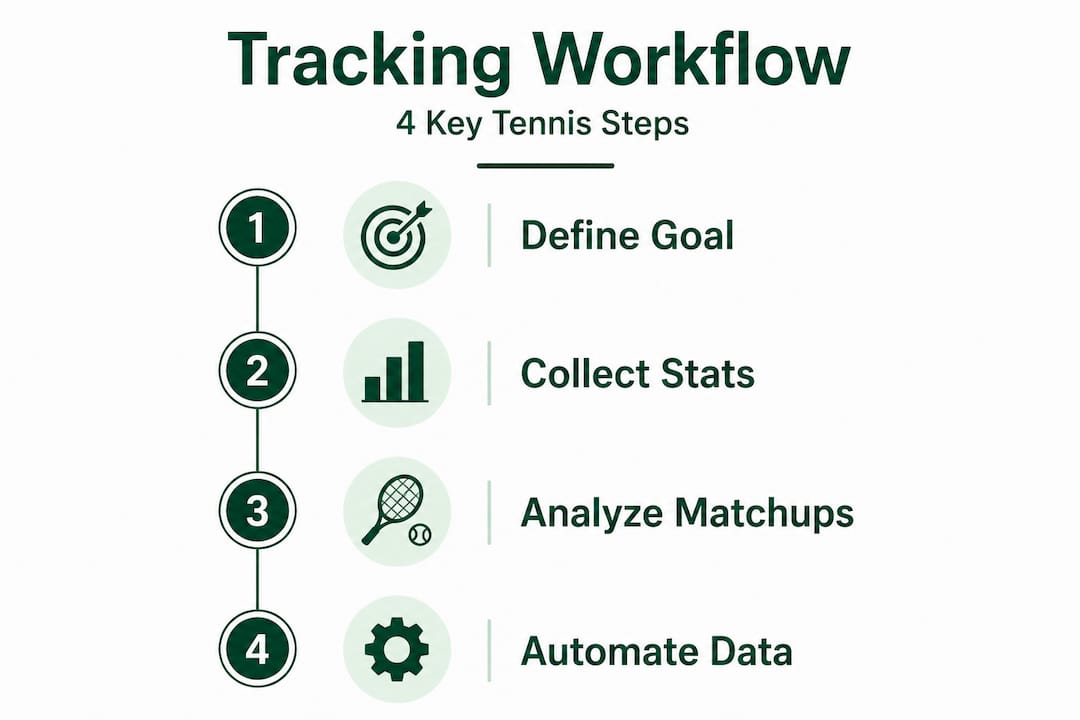
Step 1: Define your objective clearly. Are you building this for deeper match analysis, or to optimize fantasy picks week to week? A training-focused workflow prioritizes long-run stat trends. A fantasy-focused one needs faster data refresh cycles and matchup-specific outputs. Mixing these without separating the logic leads to bloated, confusing models.
Step 2: Collect and segment stats by surface and time window. Clay, hard, and grass surfaces produce dramatically different outcomes for the same player. A player with a 70% first-serve win rate on hard courts may drop to 58% on clay against heavy topspin returners. Use rolling windows of 6 to 12 months as your base and then add surface filters on top. This prevents ancient results from distorting current form.
Step 3: Calculate player-versus-matchup metrics. Raw stats tell you what a player does in isolation. Matchup metrics tell you what they do against a specific opponent type or playing style. For example, compute a player's return win rate specifically against heavy servers, or their break point conversion rate in three-set matches. This is where your fantasy edge actually comes from.
Step 4: Automate and refresh your data feeds. Manual updates before every tournament are a recipe for missed picks. Set up automated pulls that trigger at least 24 hours before draw releases. Building winning tennis lineups requires current data, not data from two weeks ago.
Here is a workflow summary with the recommended tools at each phase:
| Step | Action | Recommended tools |
|---|---|---|
| 1. Define objective | Set scope, time window, format | Spreadsheet, notes doc |
| 2. Collect and segment | Pull by surface, level, date range | API client, Python/R, SQL |
| 3. Compute metrics | Build serve, return, pressure outputs | Pandas, Excel formulas |
| 4. Update and refresh | Automate pre-tournament data pulls | Scheduled scripts, cron jobs |
When optimizing fantasy picks, a clean, refreshed dataset matters more than a complex model built on stale numbers.
Pro Tip: Schedule your data refresh to run automatically every morning during active tournaments. Waiting to pull data the night before a selection deadline is one of the most common reasons fantasy players end up with outdated reads on player form.
Focus on serve, return, and pressure metrics
You have got the workflow in place. Now zoom in on which performance metrics actually drive results in analysis and fantasy outcomes. Not all stats are created equal, and the ones most often highlighted in casual coverage are frequently the least predictive.

Market-relevant metrics for fantasy tennis focus on serve effectiveness, return effectiveness, and performance under pressure rather than raw win/loss alone. This shifts the mindset from "who won" to "how they won and whether they can replicate it."
Key stats to track for every player:
- Service hold rate (percentage of service games won) by surface
- Break rate (how often a player breaks opponent serve) weighted for opponent serve strength
- First-serve points won vs. second-serve points won ratio
- Return games won percentage broken down by surface and draw stage
- High-pressure point win rate (tiebreaks, 30-40, break points converted or saved)
- Surface-adjusted rating that blends the above stats into a single score for comparison
"Pressure is where fantasy tennis is really won and lost. A player who wins 73% of first-serve points looks great on paper, but if they save only 40% of break points against them, they are a liability in tight matches. That gap between raw efficiency and clutch performance is where smart fantasy picks are made."
The live data in fantasy strategy guide goes deeper on how real-time pressure stats shift during tournaments, which is especially useful when you have transfer windows mid-event.
Surface and opponent context add another layer. A player ranked 20th on the ATP tour might outperform a top-10 opponent on clay simply because they match up well stylistically. Tracking surface-specific metrics and blending opponent quality into your calculations gives you an edge that pure ranking-based selection misses every time.
Troubleshooting: Common data pitfalls and validation methods
Now that your workflow is live, it is critical to safeguard it against some common and often-overlooked pitfalls. Even well-built tracking systems can produce misleading results if you are not careful about scope, state handling, and benchmark drift.
One of the most damaging errors is tournament scope mismatch: building a dataset using only "main tour" matches or only a rolling window means your resulting percentiles and benchmarks may shift significantly when qualifiers or Challenger matches are included. This throws off every comparison you make between players who have different volumes of non-main-draw experience.
"Benchmarks are not static. When your dataset scope changes, whether by adding qualifiers or extending the time window, every percentile rank shifts with it. A player who was in your top 20% for break rate last month might drop to 35% simply because you added more data. Always document your dataset scope and recalculate benchmarks whenever scope changes."
If you include live or in-play tracking, your system needs to be robust to incomplete data streams. The key is to explicitly distinguish scheduled vs. finished vs. live states rather than relying on continuous streaming, which introduces stale features when connectivity drops mid-match.
Troubleshooting steps for common coverage issues:
- Cross-check every tournament against your source's official coverage list before importing data
- Flag any matches with missing enhanced stats fields rather than treating them as zero values
- Separate live, scheduled, and completed data into distinct processing pipelines
- Run benchmark recalculations whenever you change your tournament or date scope
- Log all data pull timestamps so you can trace back errors to their source
The live prediction accuracy guide covers how to handle edge cases in live tracking, including the common problem of partial point-by-point records that arrive out of sequence during streaming matches.
When you add new data from tennis analytics sources, always validate the first batch manually against known match results before connecting it to your main pipeline.
Pro Tip: Set a validation trigger that checks benchmark distributions whenever your data scope changes. A sudden shift in average hold rates or break rates is a strong signal that your scope or source quality has changed, not that every player suddenly got better or worse.
Validate and analyze: Turning data into decisions
With your system running, putting the data to work for fantasy lineups and game analysis is the final step. Tracking stats is only half the value. The other half comes from systematically applying those stats to actual decisions.
Pressure-aware tracking becomes most powerful when you model return and serve tradeoffs, comparing things like returns in play vs. in-play point win rate, and then validate those findings against charted match analyses from analytic blogs or databases.
Here is a step-by-step validation and analysis process to follow:
- Spot-check new data against known results. Pick three recent matches and confirm your tracked stats match public records from official ATP/WTA sites or reliable third-party sources.
- Run correlation checks. Verify that your custom metrics (pressure win rate, surface-adjusted score) actually correlate with match outcomes across your historical dataset.
- Build a short-list ranking. Using your metrics, rank available players for the upcoming draw and compare against public rankings to identify gaps where you have a data edge.
- Apply matchup filters. For each tournament round, overlay serve vs. return matchup profiles to flag favorable draw paths for specific players.
- Back-test before committing. Before using a new metric for real fantasy decisions, run it against the last 4 to 6 weeks of results and measure how often it would have improved your picks.
- Document your edge cases. Log every time your model disagreed with the outcome, and review those logs monthly to find systematic blind spots.
The tournament prediction strategies guide offers a deeper look at how to layer these validation steps with actual draw analysis for each tournament cycle.
Pro Tip: Cross-check new insights with historic match-chart data or established analytic blogs before locking in picks. A metric that looks great in isolation often reveals weaknesses when you hold it up against actual charted match data from independent sources.
What most fans and fantasy players get wrong about tennis tracking
Here is the uncomfortable reality: more data does not equal better decisions. The most common mistake in fantasy tennis is building elaborate models stuffed with 30 or 40 variables when three well-chosen metrics would do a better job.
The bias toward complexity is understandable. It feels more rigorous to track everything. But in practice, tracking player performance with too many variables creates noise that buries the signal. Models overfit to historical quirks. Fantasy players end up second-guessing themselves because the data points contradict each other.
What actually matters is context. Surface, opponent quality, and pressure moments explain far more variance in tennis outcomes than any clever composite stat. A player's grand slam clay court break rate against top-20 opponents at the quarterfinal stage tells you far more than their overall season win percentage. The problem is that simpler, contextual metrics require more deliberate data design, while complex models can be assembled quickly from any available dataset.
Most guides focus on the flashy analytics and skip the boring but essential parts: verifying source coverage, setting scope rules, and updating benchmarks regularly. These unglamorous steps are what separate a workflow that actually produces wins from one that just looks impressive in a spreadsheet.
Focus on three core metrics: hold rate by surface, pressure point win rate, and opponent-adjusted return effectiveness. Build those correctly, keep them updated, and you will outperform the majority of fantasy players who are running bloated, stale, or mismatched datasets.
Take your tennis tracking further with Tweener tools
If you have worked through this guide, you now have a solid foundation for building and running a real tennis performance tracking workflow. The next step is putting it to work inside a platform that rewards that kind of preparation.
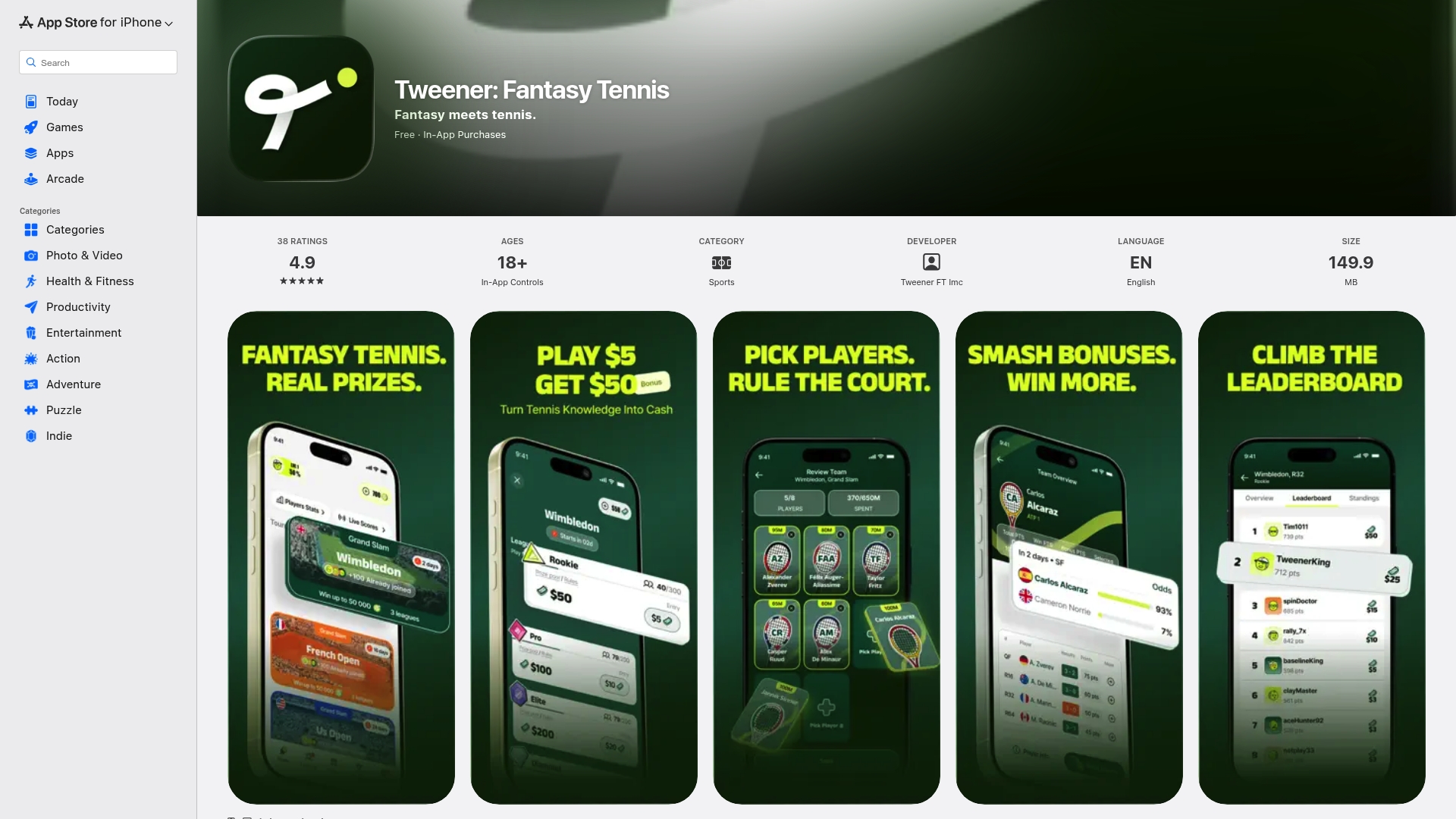
Tweener is built specifically for tennis fans who want more than just watching. With Tweener, you can put your tracking workflow directly to work by competing in fantasy leagues built around real ATP and WTA tournaments. Your carefully selected player picks earn points based on live match performance, which means the metrics you have been building translate directly into competitive results. Whether you prefer free leagues using virtual coins redeemable for gift cards or want to enter cash contests for real-money payouts where permitted, Tweener has a format for your level. Check out the Tweener game rules to understand exactly how points are earned, then download the Tweener app and put your new workflow to the test.
Frequently asked questions
What is the best data source for tracking ATP and WTA player stats?
Choose sources with verified tournament-level coverage flags for official ATP and WTA matches, and always check data granularity before starting your analysis to confirm you have the right stat depth for your needs.
Which metrics are most important for fantasy tennis player selection?
Focus on serve effectiveness, return effectiveness, and performance under pressure rather than just win/loss stats, since these directly reflect how players perform in decisive moments.
How often should I refresh my player dataset for best results?
Update your dataset daily during tournaments and before new selection periods to capture late-breaking trends, since continuous updates around upcoming matches keep your benchmarks accurate and your picks current.
How do I handle live or in-play data gaps during matches?
Design your tracking system to handle scheduled, live, and finished states separately, since distinguishing these data states explicitly prevents stale or incomplete data from corrupting your live analysis.
Why do benchmark stats change when I include qualifiers or Challengers?
Including qualifiers or Challenger data can shift percentiles and performance benchmarks significantly, so always filter your dataset scope consistently and document any scope changes before comparing player rankings.