

Fantasy tennis scoring converts real-match events, match wins, set wins, game wins, aces, breaks, tiebreaks, into platform points, and the exact values shift from app to app. Some systems load the deck toward aces and tiebreak drama; others reward steady match progression more than flash. The single most important thing you can do before drafting is open the platform's scoring sheet and see exactly which stats get paid.
TL;DR:
- Scoring values for match wins, set wins, and game wins vary across platforms, typically ranging from 6 to 30 points for matches and 0.5 to 2 points per game.
- Stat bonuses like aces and break points significantly influence scores, but their value depends on the platform's specific per-stat payout.
- Different fantasy formats reward players differently, with some favoring consistency and others valuing high ceiling stat performances or tournament progression.
- Checking platform-specific rules for bonuses, penalties, and how retired or incomplete matches are scored is crucial for effective lineup building.
- Prioritizing surface-specific recent form and head-to-head matchup history can make a significant difference in draft strategy, especially in stat-heavy or progression-based formats.
Table of Contents
- What Is Fantasy Tennis Scoring?
- Which Scoring Model Are You Actually Playing?
- How to Turn a Scoring Sheet Into a Lineup Plan
- How Tweener's Scoring Rewards the Analytical Fan
- Fantasy Points vs. Real Tennis Points: What Actually Changes
- Head-to-Head, Total Points, and League Formats Explained
- Why Serve Percentage, Winners, and Unforced Errors Matter More Than You Think
- Scoring Scenarios: How the Points Actually Stack Up
- Drafting Smarter: Matching Player Picks to the Scoring Rules
- Where to Check the Official Rules
- The Scoring Sheet Is the Real Draft Board
- Put This Scoring Knowledge to Work on Tweener
- Sources
What Is Fantasy Tennis Scoring?
Fantasy tennis scoring is the point system that translates on court results into fantasy points for your roster. It works off the same structural skeleton as real tennis: a point builds into a game, a game into a set, and a set into a match. Fantasy platforms hang their point values on that skeleton, but the weighting is where things get interesting.
Most systems pay a chunk of points just for winning the match, a smaller chunk for each set won, and a sliver for every game won. Representative ranges you'll see across platforms: a match win might land anywhere from 6 to 30 points, a set win typically runs 3 to 6 points, and individual game wins often sit between 0.5 and 2 points, according to a breakdown of common fantasy tennis scoring formulas.
Then come the stat-based add-ons, the part that separates a boring roster from a strategic one:
- Ace bonuses, often worth a quarter point to two points per ace
- Double-fault penalties, usually small but they add up over a five-setter
- Break-point conversion bonuses for players who capitalize when it counts
- Saved break-point bonuses that reward defensive resilience
- Straight-set win bonuses, since finishing clean and fast has value beyond the base match points
Pro Tip: Don't treat these bonuses as flat extras. A player who racks up 15 aces a match in a system that pays 0.25 points per ace is only banking 3.75 bonus points, less than a single set win. Read the per-stat value before you assume a big server is automatically a fantasy stud.
Tiebreaks and edge cases matter too. A match tiebreak (used instead of a full third or fifth set in some formats) usually scores as its own mini-event, sometimes worth a flat bonus regardless of the score inside it. Retirements and walkovers are the messiest part of any rulebook: some platforms award partial credit for games or sets completed before a retirement, others zero out the match entirely. That distinction alone can swing your lineup's outcome, so check it specifically rather than assuming.
Which Scoring Model Are You Actually Playing?
Not all fantasy tennis runs on the same engine. Four archetypes cover almost everything you'll encounter, and each one rewards a different kind of player.
- Per-match aggregate contests. You draft players for a single match or a short slate, and points come almost entirely from the match/set/game structure with light stat bonuses layered on top.
- DFS salary-cap formats. You build a roster under a fixed salary cap, and per-stat scoring (aces, double faults, break points) carries more weight relative to base match points, which raises volatility.
- Pick'em or prop-line formats. You're grading against a line rather than accumulating raw points, so consistency in hitting a projected number matters more than ceiling.
- Season or tournament fantasy. Points scale with tournament progress and event category, so a run to the semifinal of a Masters 1000 pays more than the same run at a smaller 250-level event, a structure the ATP's own fantasy format uses to reward deep tournament runs.
The strategic fallout is real. In a DFS-heavy stat contest, an ace machine who serves big but loses in three sets can outscore a grinder who wins in straight sets with modest stats, because the per-stat bonuses stack fast. Flip to a season-long tournament format, and that same big server becomes a liability if he's prone to early exits, since progression points dwarf single-match stat bonuses there.
That changes what you should be scouting on the draw sheet:
- For per-match and DFS formats, prioritize surface-specific serve and ace rates over the last five matches
- For pick'em formats, prioritize consistency and low variance over ceiling
- For season-long formats, prioritize draw path, seeding, and event category over any single stat
Know which archetype you're in before you touch a single player card. The same roster can be a great build in one format and a bad one in another.
How to Turn a Scoring Sheet Into a Lineup Plan
Reading a scoring sheet is a skill, and it pays off fast once you've done it a few times. Here's the actual workflow.
- Identify the base points first. Note the exact values for match win, set win, and game win, then calculate what percentage of a typical scoreline's total points comes from base structure alone. If match wins pay 25 points and a straight-set win adds two sets at 5 points each, base scoring already accounts for the bulk of a strong outcome.
- List every stat bonus and penalty, then estimate how often each one realistically fires. An ace bonus that pays well but only triggers for three players in the draw isn't worth building around.
- Map stats to players using context, not name recognition. Check surface, recent form over a five-match window, and head-to-head history where it exists. A tie-breaker's scoring treatment matters here too, since some players are disproportionately strong in breakers.
- Build around a floor-and-ceiling mix. Anchor your roster with one or two high-floor match-winners, then fill remaining slots with stat specialists who carry upside if the bonuses in your format are generous.
Before you lock anything, run this checklist: confirm the retirement/walkover rule, confirm whether tiebreaks score separately, confirm the exact ace and double-fault values, and confirm whether the format rewards tournament progression or single-match results.
Pro Tip: *Cross-reference a player's ace count with their service-games-held percentage rather than looking at raw aces alone. A guide to how fantasy tennis points get calculated notes that expected stat contribution comes from multiplying a player's per-match occurrence rate by the platform's point value for that stat, then weighing it against the match-win base.
How Tweener's Scoring Rewards the Analytical Fan
Tweener builds its scoring around three pillars: match progression, per-stat bonuses, and surface-based adjustments. That combination exists on purpose. Point-for-progression alone rewards steady favorites and gets boring fast; stat bonuses alone turn every contest into an ace-counting exercise. Blending both means a clean straight-set win and a gutsy five-set stat-heavy grind can both produce a winning roster, depending on how you built it.
What that means in practice:
- Match wins and set wins form the scoring floor, so picking the right winner still matters most
- Ace, break-point, and tiebreak bonuses add a stat layer that rewards fans who track surface-specific serve and return numbers, not just rankings
- Surface adjustments shift stat weighting between hard, clay, and grass, since ace rates and break frequency swing hard by surface
That's the whole point of building fantasy tennis around real analytics instead of gut picks: surface and recent-form data change which stats predict fantasy output, and a scoring system that ignores that is just a coin flip with extra steps. For the current, exact point values, the full Tweener game rules page is the source to check before every slate.
Fantasy Points vs. Real Tennis Points: What Actually Changes
Real tennis scoring is a hierarchy with no shortcuts: you win points, points build games, games build sets, and the first player to the required number of sets wins the match. There's no partial credit and no bonus structure. A player who hits 20 aces but loses in straight sets gets nothing for the effort in the official scoreline.
Fantasy scoring breaks that hierarchy apart and pays for pieces of it individually. That's the core difference, and it's the reason fantasy strategy exists at all. In real tennis, an ace is just a point. In fantasy, an ace is a point toward the game and a separate stat bonus on top. A double fault costs a player a point on the court, and it can cost your fantasy roster points twice over if the platform penalizes it directly.
This split creates situations real tennis scoring never allows for. A player can lose a match 6-7, 7-6, 4-6 in a grueling three-setter, contribute zero to your fantasy score for the match-win line, and still hand you a strong stat line from games won, aces, and break points saved along the way. Real tennis calls that a loss. Fantasy can call it a solid fantasy day depending on how the bonuses stack.
Match format differences carry over too. Best-of-five matches at Grand Slams naturally generate more games, sets, and stat opportunities than best-of-three tour events, which is why platforms often scale point values for major tournaments differently than they do for regular-season events.
Head-to-Head, Total Points, and League Formats Explained
The scoring numbers on a sheet only mean something once you know the format wrapped around them, since the same point total can win one contest type and lose another.
Head-to-head formats pit your roster directly against one opponent's roster for a set slate. Total points don't matter against the field, only against that one rival, which makes consistency and avoiding a single disastrous player pick more valuable than chasing a huge ceiling.
Total points (or "classic") formats rank every entrant against the entire field based on cumulative score. Here, ceiling matters more than in head-to-head play, since you need to separate from potentially thousands of other lineups, not just beat one opponent.
League formats, including private leagues where you compete against a fixed group across a tournament, blend elements of both. Tweener's private leagues let you go head-to-head against up to nine friends for the length of a Grand Slam, which changes the calculus again: you're not chasing a massive field, you're trying to consistently out-draft a small group you probably know well. That rewards genuine scoring-sheet literacy over lucky variance, since a small league punishes bad process less randomly than a massive one does.
Scoring itself doesn't change much between these formats, the underlying point values for match wins, aces, and bonuses stay the same. What changes is the strategy the format demands: chase upside in a large-field total-points slate, protect against one bad pick in head-to-head, and play for sustained consistency across a tournament-long private league.
Why Serve Percentage, Winners, and Unforced Errors Matter More Than You Think
Raw box-score stats drive a bigger share of your fantasy score than most casual players realize, and the three that matter most are first-serve percentage, winners, and unforced errors.
First-serve percentage doesn't usually score points directly, but it's the leading indicator behind the stats that do. A player landing 65%+ first serves is going to generate more free points, more holds, and more opportunities to tee off on return, all of which feed into break points saved and aces in serve-heavy scoring systems. Watch this number in the last few matches before a slate, not the season average, since form shifts fast.
Winners feed directly into most stat-bonus structures, especially on faster surfaces like hard courts and grass where clean pace-driven winners are more common than on clay. A player converting a high winner-to-unforced-error ratio is usually the one racking up bonus points cleanly, without the volatility of a boom-or-bust hitter.
Unforced errors are the silent score-killer. They don't just cost the player the point on court, they eat into your fantasy floor by shortening matches (fewer games won) and increasing the odds of an early exit in progression-based formats. A player prone to streaky error clusters is a legitimate fantasy risk even if their raw talent outranks the field, because scoring sheets pay for what actually happens, not for potential.
Scoring Scenarios: How the Points Actually Stack Up
Numbers get clearer with a worked example. Picture a straightforward per-match contest where a match win pays 25 points, a set win pays 5 points, an ace pays 1 point, and a double fault costs 1 point.
Player A wins in straight sets, 6-4, 7-5, hits 10 aces, and commits 3 double faults. The math: 25 (match win) plus 10 (two set wins) plus 10 (aces) minus 3 (double faults), for a total of 42 points. Clean, efficient, and close to that player's realistic ceiling in this scoring structure.
Now picture Player B, who loses a marathon three-setter 7-6, 4-6, 6-7 but hits 22 aces and only 2 double faults. Player B earns zero for the match win and zero for set wins (since he lost all three), but banks 22 points for aces and loses 2 for double faults, netting 20 points. He lost the match and still outscored a mid-tier straight-set winner in a stat-light bonus structure.
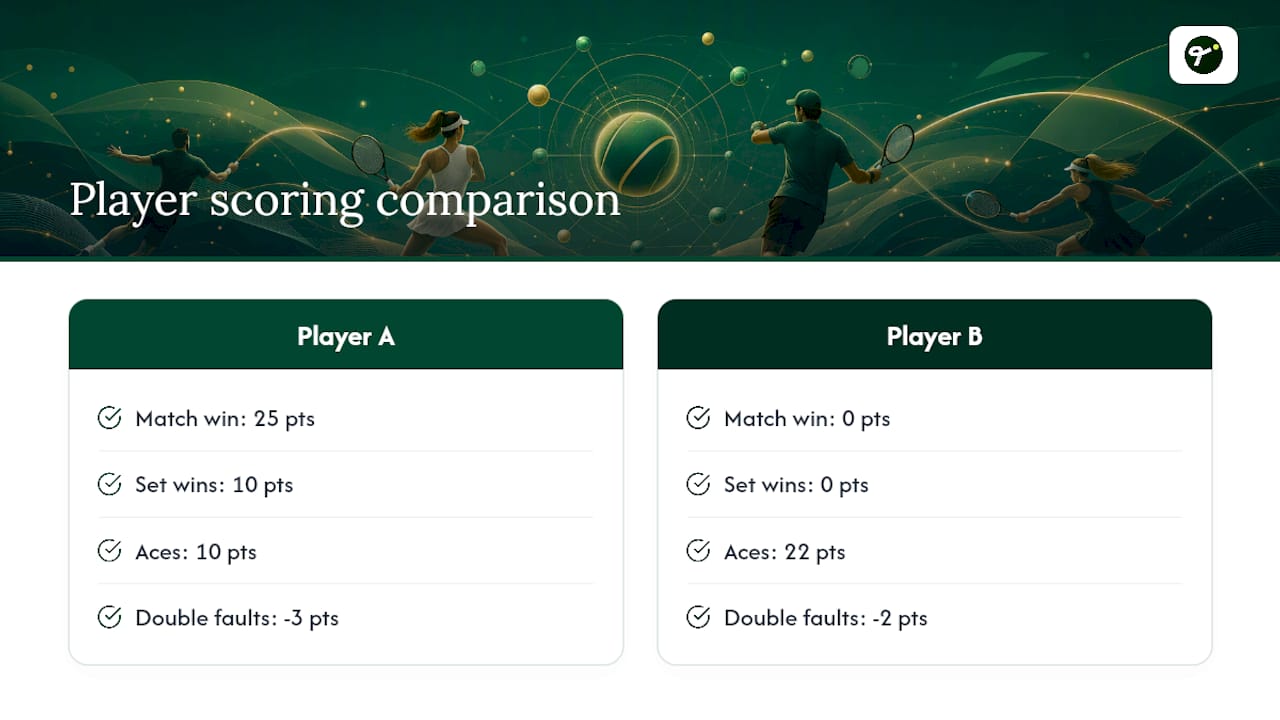
Now flip the scoring: bump the ace value down to 0.25 points and the match win up to 30 points, a structure closer to progression-heavy platforms. Player A's total jumps to roughly 32.5 points, while Player B's stat-heavy performance shrinks to about 5.5 points despite the same on-court effort. Same two matches, same stats, wildly different fantasy outcomes, purely because the point values shifted. That's the entire argument for reading the scoring sheet before you draft, not after.
Drafting Smarter: Matching Player Picks to the Scoring Rules
The best fantasy tennis draft strategy starts with the scoring sheet, not the ATP or WTA rankings. Ranking is a proxy for quality; the scoring sheet tells you exactly what gets paid.
Start by identifying whether your slate's format leans stat-heavy or progression-heavy, then draft accordingly. In a stat-heavy DFS-style contest, target servers with strong recent ace rates on fast surfaces, since that's where the bonus points concentrate. In a progression-heavy tournament format, target players with favorable draws and a track record of deep runs at that specific event category, since a semifinal run at a Masters 1000 outweighs a first-round ace outburst.

Cross-check every pick against surface and recent form, not season-long averages. A clay specialist's ace numbers mean little once the tour shifts to hard courts, and a player who struggled in January can be a completely different competitor by a summer hard-court swing. Head-to-head history is worth a glance too, particularly for players who've faced each other multiple times on tour, since some matchups are stylistically lopsided regardless of ranking.
Build your roster with a mix, not a pile of the same archetype. One or two high-floor match-favorites to anchor your score, paired with one or two higher-variance stat specialists who can spike your total if the bonuses in your specific format reward them. Balance the roster the way the scoring sheet is balanced, and your lineup construction stops being a guess and starts being a repeatable process.
Where to Check the Official Rules
For the underlying tennis definitions behind any scoring sheet, the ITF's tennis glossary covers official terms like ace, deuce, and tiebreak. For fantasy-specific mechanics and worked scoring examples, Tweener's blog post on how fantasy points are calculated breaks down the math platform by platform.
The Scoring Sheet Is the Real Draft Board
Most fantasy tennis advice focuses on picking winners. That's backwards. The scoring sheet decides who's actually worth drafting, and most casual players never read it closely enough to notice how much a single point value can flip a roster's value.
The conventional wisdom, draft the best-ranked players and hope, ignores that fantasy scoring rewards specific behaviors, not general talent. A player ranked 40 spots below a favorite can be the sharper fantasy pick if the format pays heavily for stats that player produces reliably. Ignore that, and you're playing a different game than the one that's actually scoring.
If there's one habit worth building, it's checking base match points against stat bonuses before every single slate, not once at the start of the season. Scoring emphasis shifts by event category and surface, and the players who benefit shift right along with it. Treat the rulebook as your primary scouting tool, and the rankings become a secondary check, not the other way around.
— Nathan
Put This Scoring Knowledge to Work on Tweener
Reading a scoring sheet is only useful if the game behind it rewards actual tennis knowledge instead of luck. Tweener is built specifically for that: match progression, per-stat bonuses, and surface adjustments all factor into scoring, so the analytical work you just did with H2H data, surface splits, and recent form translates directly into a competitive edge, not just trivia.
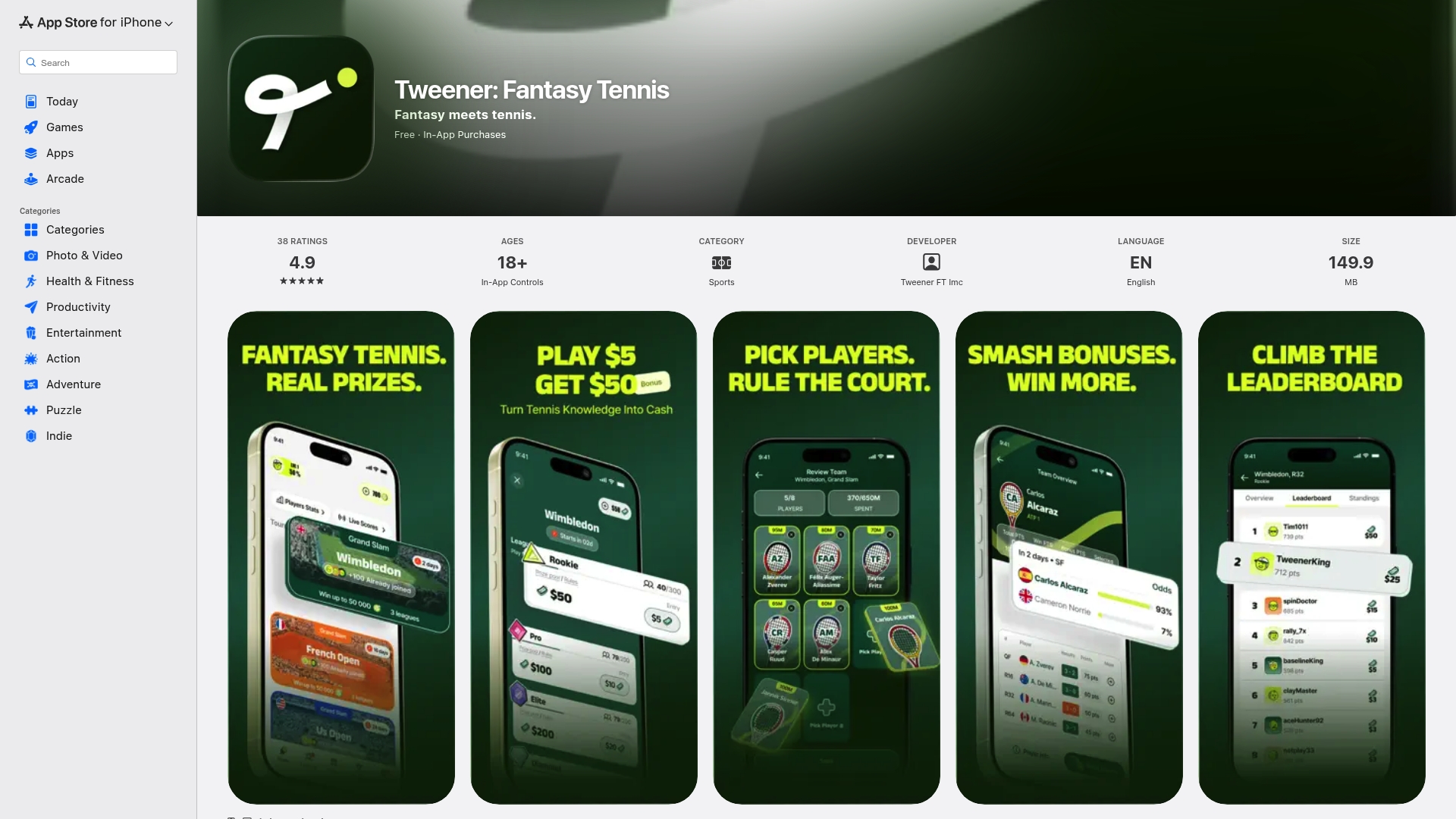
You can play free using virtual coins earned through gameplay, redeemable for rewards like gift cards, or step into cash contests where entry fees turn into real payouts, where legally permitted. Grand Slam season is where Tweener gets its sharpest edge: private leagues let you go head-to-head against up to nine friends for the length of a tournament, turning every match into something worth watching closely instead of background noise. Check the full Tweener game rules for exact current point values before your next slate, then build a roster around what the sheet actually pays for.
Sources
- Tennis Glossary: Terms and Definitions | ITF
- How Does Fantasy Score Work in Tennis? Complete Guide | MatchPointPost
- ATP Fantasy: How to play, choose your team, win points & climb leaderboards | ATP Tour