

In fantasy football, return points are whatever your league awards for kick and punt returns. Most leagues pay only for return touchdowns, usually 6 points, and many pay nothing for return yards. In fantasy tennis, "return points" means something else: the points a player wins when the opponent serves. That is one of the best predictors you can use when you build a roster. This guide covers both meanings, with the math.
TL;DR
- Standard fantasy football leagues generally pay 6 points for a return touchdown and nothing for return yards. Yardage scoring is a custom setting.
- When leagues do score yards, the common rates are 0.01 to 0.1 points per yard, and the rate decides whether a returner is a fantasy asset or a footnote.
- The NFL's dynamic kickoff rules, introduced in 2024, made return yards more relevant, which pushed more commissioners to revisit the setting.
- In tennis, return points won is a core stat for judging who can break serve, and it matters most on slower surfaces.
- Tweener, our tennis fantasy app, is built for fans who like to use that kind of data when picking ATP and WTA players.
Table of Contents
- What return points mean in fantasy football
- How return yards change a player's value
- What the new kickoff rules changed
- How to set return points in your league
- Return points in fantasy tennis
- Play fantasy tennis where return stats matter
- Tracking and fine-tuning your results
- FAQ
- Sources
What return points mean in fantasy football
The phrase covers three separate scoring events: kick return yards, punt return yards and return touchdowns. Platforms handle each differently, and that is why forum threads about the topic keep resurfacing every August.
The touchdown is the simple part. Fantasy writers describing a sensible scoring system treat a return touchdown as worth 6 points, the same as any other touchdown. The confusing part is who gets them. In many default setups the points go to the team defense and special teams unit. Some platforms also credit the individual player if he is in your starting lineup, which can produce a double-dip on one play.
Yardage is where leagues diverge. Return yards are not part of most default scoring. According to Pro Football Network, in the majority of leagues special teams points for players come only from touchdowns or fumbles, and leagues that do pay for yards usually use a rate closer to 0.01 points per yard than the 0.1 points per yard given for rushing and receiving.
Who gets the points: player or D/ST
This is the first thing to check in your league settings. The practical differences:
- D/ST only: The return touchdown helps your defense slot. A returner on your bench or in your flex spot earns nothing from it.
- Player only: The individual who scored gets the credit, so a returner who is also a receiver or running back has real weight.
- Both: One play creates a swing for two roster spots. Some contests credit individual players for return touchdowns and others do not, so the setting has to be read, not assumed. PlayerProfiler notes that FFPC and NFFC contests credit the player, while Underdog does not.
SI's Michael Fabiano makes the argument for crediting the player in his scoring system piece: if you started a player, you should get his return points. He suggests 1 point per 25 return yards plus 6 for touchdowns.
How return yards change a player's value
The scoring rate is everything. Here is how the same yardage looks under different settings.
| Scoring rate | Points for 63 return yards (one team's projected game) | Points for 600 return yards (a full season) |
|---|---|---|
| 0 (default in most leagues) | 0 | 0 |
| 1 point per 25 yards (0.04) | 2.5 | 24 |
| 0.1 per yard (1 per 10) | 6.3 | 60 |
| 1 point per 5 yards (0.2) | 12.6 | 120 |
The 63-yard figure comes from 4for4, which took the NFL's projected 55% kickoff return rate and a 23-yard average return. At the Scott Fish Bowl's rate of one point per five return yards, 4for4 says that is worth almost 13 points per game. The table's other rows are our arithmetic on the same number.
Some real examples show the stakes. Fabiano points out that Marvin Mims Jr. had 602 return yards and Austin Ekeler 594 in 2024. Under a 1-in-25 rate, that is roughly 24 points each over a season: noticeable, not league-winning. At 0.1 per yard it would be around 60, a lot more. Alex Chick III of Vendetta Sports Media makes that case for 0.1 per yard, saying it turns late-round picks into meaningful choices rather than darts.

At the low end of the scale, Pro Football Network shows that at 0.01 per yard, 1,550 return yards would be only 15.5 points, though in its example that would still lift DJ Moore from WR6 to WR4.
What the new kickoff rules changed
The NFL rewrote the kickoff for 2024. The practical effect for fantasy is more live returns and a longer runway for a returner who is dangerous with the ball. Before the change, returns were becoming rare. Pro Football Network counted only four kickoff returns for touchdowns in the NFL in 2023, and it noted that in the XFL's 2023 season, which used a similar format, six players topped 500 return yards compared with two in the NFL, despite far fewer games.
The league later adjusted the touchback spot. One Substack analysis notes that in 2025 the touchback moved from the 30-yard line to the 35, which was widely expected to increase returns because kickers would try to land the ball in the landing zone more often. That is commentary rather than a measured result, so treat it as direction, not a forecast.
The takeaway for commissioners: a league that ignores return yards is unaffected. A league that scores yards has to decide whether the old rate still fits the new game. Forum threads from the past two seasons are full of people finding that a rate set in the old era now rewards kick returners far more than intended.

How to set return points in your league
If you run a league, decide these in order.
- Decide whether yards count at all. If your league is casual, the default of touchdowns only keeps things simple and costs nothing.
- Pick the beneficiary. Choose player-only, D/ST-only or both. Avoid "both" unless your members understand a single play can swing 12 points.
- Choose a modest yardage rate. One point per 25 yards is the gentle setting. Move to 1 per 10 only if you want returners to be a draft strategy.
- Write it down before the draft. Changing scoring mid-season is how leagues break. Our guide to common fantasy league rules covers what a commissioner should lock in early.
Once the rules are set, give your roster an identity with a fantasy team name generator so every manager starts on equal footing at the draft.
As a player, the rule is the opposite: read the settings first. A returner with a 0.1 rate is a mid-round pick. The same player in a default league is a waiver-wire name.
Return points in fantasy tennis
Now the other meaning, which is where Tweener lives. In tennis, the return is the shot that answers a serve. The stat that tracks it, return points won, is defined simply: the percentage of all points won while returning, according to Tennis-DB's performance table. The LTA's stats glossary also explains break points, the moments when the returner is one point from winning the game on serve: at 0-40, 15-40, 30-40 or advantage receiver.
This matters for fantasy because a player's results are the sum of two very different jobs. Holding serve is one. Breaking serve is the other. A player with a huge serve and a weak return will win tiebreaks and lose to anyone who can neutralize the first ball. A player with an elite return turns every opponent's service game into a coin flip.
Why returners win more than the headlines suggest
The typical tour player wins roughly 60 to 70 percent of points on serve, so every return point won is worth more than it looks. Even a small edge on return, a few percentage points, is the difference between a player who gets broken once a set and one who breaks once a set. That swing is invisible in the ranking but obvious in the box score.
The stat table at Tennis-DB shows how thin the margins are at the top: its 2026 ATP sample has Jannik Sinner leading total points won at 56.8%. A lead of a point or two in the percentages separates the elite from the rest.
Surface changes everything
Return numbers are not fixed. A player who wins 40 percent of return points on clay can be a different animal on a fast hard court or grass, where first serves are harder to read. When you draft or pick, always filter by surface:
- Clay (Roland Garros): Slow bounce, longer rallies. Elite returners and counterpunchers gain the most.
- Grass (Wimbledon): Quick, low bounce. Big servers hold more easily, so return stats are harder to earn.
- Hard (US Open, Australian Open): Somewhere in between, with large variance by court speed.
Combine surface-specific return points won with head-to-head history. If a big server has lost three straight to the same counterpuncher, the return matchup likely explains why.
How to use return stats when you pick
A short working method for a fantasy tennis lineup:
- Pull each candidate's return points won on the tournament's surface over the last 12 months.
- Compare it with the opponent's service points won. A high gap in the returner's favor signals a likely break-heavy match.
- Check break points converted. A good returner who does not convert is leaving points on the table, and that is a regression flag.
- Check form and fatigue. A deep run in the previous tournament can blunt the sharpest return game. Our piece on how new tennis rules could shift picks covers heat and reviews.
- Cross-check against a projection. Our guide to projections in fantasy games shows how to weigh a model's number against your own read.
For wider habits, predictive analytics in fantasy sports explains how to turn stats into repeatable decisions.
Our perspective
Football fans argue about return points because the sport has never decided who deserves them: the player or the unit. Tennis has no such confusion. Every point belongs to a named person, and every return is on the record. That is why we built Tweener around tennis alone.
We think the best fantasy sports reward the fan who does the homework. In tennis that homework is concrete: return points won, break points converted, surface splits, head-to-head history. A fan who knows that a particular player turns slow clay into a breaking machine has a real edge, and we want the game to pay attention to that edge.
Tennis never had its own equivalent of the big football and basketball daily fantasy products. We are aiming to be that for ATP and WTA fans: draft or pick'em, free play with virtual coins, or cash contests where legally permitted. It is a skill game. Strategy over luck.
Nathan
Play fantasy tennis where return stats matter
Tweener is a mobile fantasy app for professional tennis. You build teams of real ATP and WTA players, join public leagues or set up private ones with friends, and earn points based on how those players perform in actual matches. Choose Draft Mode to build a roster or Pick'em Mode to make match-by-match calls.
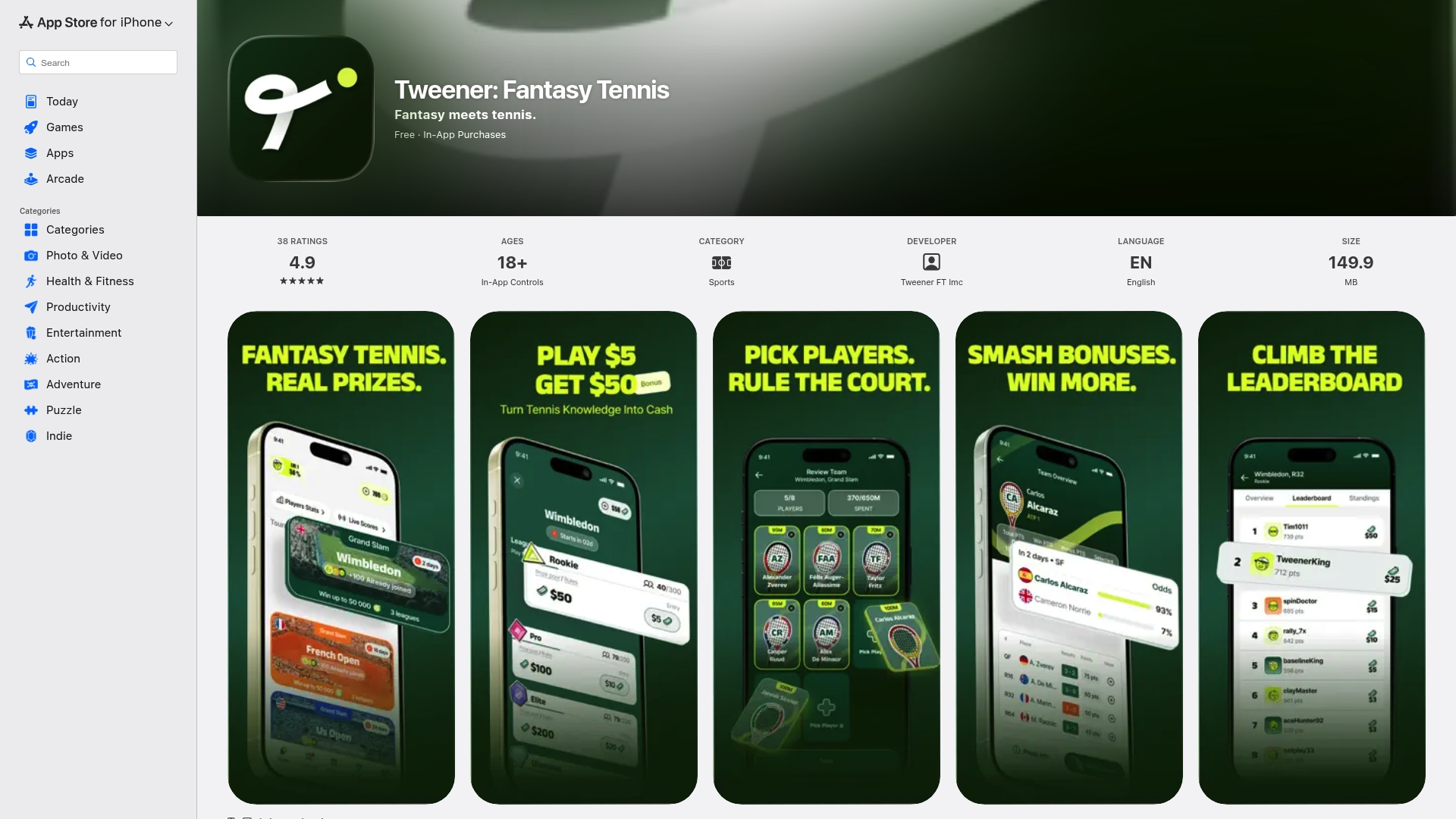
The free mode uses virtual coins that you earn through play and can redeem for rewards such as gift cards. A cash mode with real-money payouts is available in select US states where it is legally permitted. You can start on the Tweener site or go straight to the app download page. If you want to bring friends along for a major, read how to set up a Grand Slam private league.
Tracking and fine-tuning your results
Whatever sport you play, the habit that separates good managers is review. Log the picks you made, the stat that drove each one and what happened. After a few events you will see whether your return-stat reads were right or whether you leaned too hard on one surface. Our guide to tracking fantasy league performance gives a simple system.
Tennis also has quirks football does not, such as weather. If you play outdoors majors, learn how scoring is handled when play stops: our post on rain delay scoring rules walks through the common cases. And if you are weighing which rewards to chase, understanding fantasy rewards helps you plan.
FAQ
Do fantasy football leagues give points for kick return yards?
Most standard leagues do not. Return yards are usually a custom setting, and when commissioners add them the rate is typically between 0.01 and 0.1 points per yard. Check your league's scoring page before the draft, because the default varies by platform.
Do return touchdowns score for the player or the defense?
It depends on the platform and league. Many default setups give 6 points to the D/ST, and some also credit the individual player if he is in your starting lineup. A few contests credit only the player. Look at the commissioner settings to confirm.
What is a good return yardage setting for my league?
One point per 25 yards is a gentle option recommended by SI's Michael Fabiano, alongside 6 points for touchdowns. A rate of 0.1 per yard makes returners a real draft strategy. Pick one before the draft and do not change it mid-season.
What are return points in fantasy tennis?
It is the stat of points a player wins while the opponent serves, usually shown as a percentage. It helps you judge who can break serve and who will struggle against a strong returner, and it changes by surface. It sits alongside break points converted and head-to-head results in a sharp tennis lineup.
Can I play fantasy tennis for free?
Yes. Tweener has a free mode where you compete with virtual coins that can be redeemed for rewards such as gift cards. Cash contests are a separate mode and are offered only in select US states where legally permitted.
Sources
- What's the Best Fantasy Football Scoring System? (SI)
- Will the New NFL Kickoff Rule Impact Fantasy Football? (Pro Football Network)
- New NFL Kickoff Primer With Returners to Target (4for4)
- NFL Kick Returners: How to Find Hidden Value (PlayerProfiler)
- Your NFL Fantasy Leagues Need To Add Points For Returners (Vendetta Sports Media)
- Touchdowns mattered more to fantasy in 2024, and will again
- ATP 2026 Performance Stats, Serve & Return Leaders (Tennis-DB)
- Tennis terms and terminology explained (LTA)