
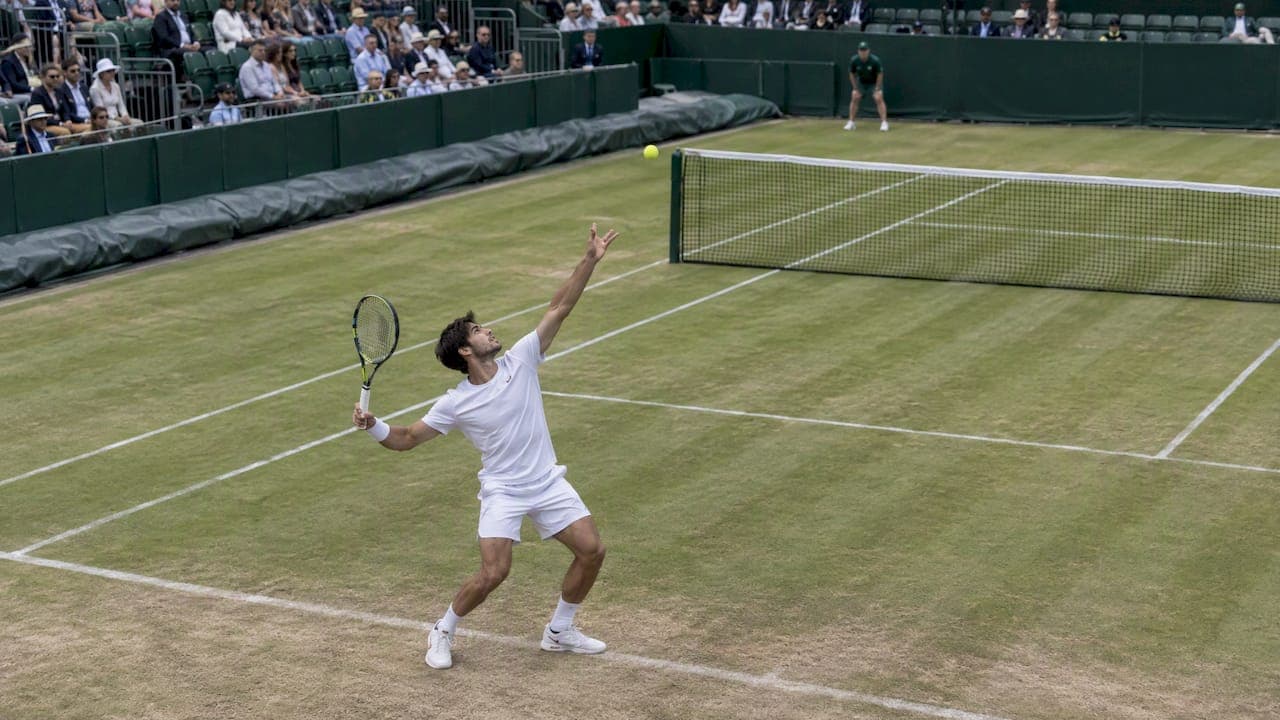
There is no official "Queen's Club fantasy" game, and the club itself does not run one. What you can do is play the tournament it hosts, the HSBC Championships, as fantasy tennis: pick real ATP players, score points from their actual grass-court results, and compete against friends or the public. This guide covers how that works, what makes Queen's different from other events, and how to build a smarter lineup for next June.
TL;DR
- Queen's Club is a private London venue. The event fans mean when they search "Queen's fantasy" is the HSBC Championships, a grass-court ATP 500 and WTA 500 played in June.
- Grass rewards big serves, short points and quick adaptation, so ranking alone is a poor guide to who scores.
- The 2026 men's final went to a third-set decider and a seeded underdog story, a reminder that favorites are thin on grass.
- On Tweener you can play tennis fantasy in free mode with virtual coins, or in cash mode in select US states where it is legally permitted.
- Build the lineup around serve data, recent grass results and draw position, not name value.
Table of Contents
- What people mean by "Queen's Club fantasy"
- The tournament in brief
- What the 2026 final teaches fantasy players
- Why grass changes how you pick
- A worked lineup approach
- Fantasy tennis versus betting on Queen's
- Our perspective on playing Queen's
- Playing it on Tweener
- Other things people ask about Queen's
- A short checklist before you lock
- FAQ
- Sources
What people mean by "Queen's Club fantasy"
The query is small, around 80 searches a month, and it mixes several intents. Some readers want a fantasy game for the tournament. Others are looking for a vlog, prize money, tickets or a hospitality price. The word "fantasy" gets attached because Queen's sits in the most predictable and least predictable part of the tennis calendar at once: a famous venue, a stacked field, and a surface where upsets happen.
It helps to separate two things. The Queen's Club has been a member-owned private institution since 2007, when members acquired a long lease from the LTA. The LTA, however, still owns and operates the HSBC Championships held there. So there is no club-run game to join, and nobody at the club is going to hand you insider picks. What exists is a public tournament with a public draw, public results and public stats. That is all a fantasy player needs.
The tournament in brief
The 2026 edition ran in two parts. The women's WTA 500 was played 8 to 14 June and the men's ATP 500 from 15 to 21 June, and the event dates back to 1889. The official club page lists the title sponsor as HSBC, which partnered with the LTA in 2025.
Where it sits matters for fantasy. Queen's is held every June, starting a week after the French Open and ending a week before Wimbledon, with Wimbledon only about four miles away. Players arrive straight off clay, with a few days to relearn how to move on grass. That transition is the single biggest source of fantasy value, and it is worth planning around.
One note on the women's side: the same reference points out that Eastbourne, the traditional WTA grass event the week after, was downgraded to a WTA 250 in 2025. If you play women's grass fantasy, the Queen's week is now one of the highest-level warm-up events before Wimbledon.
I have not seen the 2027 dates confirmed in any source I could verify, so check the club's tournament page when they are announced rather than trusting a calendar you saw in a forum post.

What the 2026 final teaches fantasy players
In 2026, Francisco Cerundolo beat Tommy Paul 6-7, 6-4, 6-3 to win his first ATP 500 title. The match, by the tour's account, was the longest final in Queen's history at more than three hours. Cerundolo was the seventh seed and Paul the eighth, so the title was decided between two players outside the top tier of seeds.
Three lessons for lineup building:
- Seeds beyond the top four win here. A fantasy lineup that only chases the highest-ranked names is paying a premium for a scarce outcome.
- Long matches mean more fantasy points. Scoring systems that reward sets or games won favor players who push matches deep. A three-set final that runs three hours is a much better scoring event than a 6-4 6-4 win.
- Tiebreaks decide grass matches. Paul took the first set 7-6 and still lost. A single set on grass can turn on two points, so you want players who hold serve under pressure, not just players who hold it often.
Why grass changes how you pick
Grass is the least common surface at tour level, which means fewer data points per player, and the sample size problem is real. A player with 40 career grass matches has a far noisier record than one with 200 clay matches. Here is how to handle it.
Start with serve, then check return
On grass the ball stays low and skids, so first-serve points are cheaper to win. For fantasy purposes, look for players with a high percentage of service games held and a high first-serve points-won rate on grass specifically. Do not average across surfaces. A big server who wins 78% of first-serve points on hard courts may not carry that to a slower, bumpier lawn.
Then look at return. Players who break serve against anyone on grass are rare and valuable. Check how a player has fared in return games against comparable servers, not against the field.
Read the last three weeks, not the season
The clay-to-grass swing is short. Someone who went deep at Roland Garros may arrive tired. Someone who lost early in Paris may be fresh and keen. Look at:
- How many matches a player has played in the previous 21 days.
- Whether they entered a grass event the week before (such as Stuttgart or 's-Hertogenbosch) and how they did.
- Any withdrawals or retirements from the last two tournaments.
Weight head-to-head carefully
Head-to-head records are useful when they are recent and on the same surface. A 4-1 lead built on clay in 2021 tells you almost nothing about a grass match in 2027. Our guide on tennis match prediction strategies for fantasy leagues goes through how to weigh H2H against form and surface.
Draw position is a stat
A 32-player singles draw means a top seed gets a bye. That guarantees a first-round points floor, since the player has not yet had to risk a loss. Check which players are in quarters with other big servers. A lineup of four players who all sit in the same half can cancel itself out when they meet.
A worked lineup approach
Here is a simple framework I would use for a Queen's-style event, written as a process rather than a set of names, since the field changes every year.
- List the 12 to 16 players you would consider. Use the draw once it is released, not the entry list, which can change.
- Rate each on four things: grass serve numbers, previous-week result, fitness signals and draw difficulty in rounds one and two.
- Pick one or two anchors, the players most likely to reach the semifinals. These are your floor.
- Add one or two value picks. Look for players in the seed 5 to 8 range or strong qualifiers with big serves and a soft first-round opponent.
- Avoid two players who can meet before the quarterfinals. One of them is guaranteed to go home.
- Check the lock time. Many contests lock at the first match of the day, so late withdrawals matter. Confirm the player is on the order of play before you lock.
For more on the selection step, see our guide to how to choose tennis players for fantasy leagues and our piece on optimizing tennis fantasy picks for consistent wins.
Fantasy tennis versus betting on Queen's
A lot of the people searching this are also sports bettors who like the grass swing. The overlap is real: both involve reading form, prices and matchups. The difference is in the structure. A bet asks you to be right on one match. A fantasy lineup asks you to be right about a set of players over a tournament, and it rewards depth of research. You are not trying to beat a bookmaker's margin on a single outcome. You are trying to build a better roster than the other entrants.
That is why we describe it as skill-based. You can still lose, because tennis has variance and a tiebreak can go either way. But the inputs you control are the ones you can study: surface splits, workload, draw. Our tennis fantasy prediction games guide explains the formats in more detail.
Our perspective on playing Queen's
We built Tweener around one idea: tennis fans have never had a proper fantasy game of their own. Football, basketball and baseball have a daily fantasy culture. Tennis, with a tournament structure that is made for it, had very little. A tournament such as the HSBC Championships is nearly ideal: a compact draw, a distinctive surface, a clear start and end, and enough variance to keep things honest.
Our view on Queen's is simple. Treat it as a data problem with a human twist. The data tells you who serves well on grass. The human part is knowing that the week after Roland Garros produces odd results: tired finalists, players who lose early and fly home, others who quietly find their feet by Wednesday. Most of the edge is in being honest about how little signal a small grass sample holds, and not overpaying for names.
We also think the social side matters. Grand Slams and big warm-ups are more fun with friends, and private leagues let you play with up to 9 others for a tournament. A friendly league makes you watch matches you would otherwise skip, and that is where you begin to notice the things the numbers do not show.
— Nathan
Playing it on Tweener
Tweener is a mobile fantasy app for professional tennis. You build a team of real ATP and WTA players, join public leagues or create a private one with friends, and earn points from how your players do in real matches. There are two modes: a free mode that uses virtual coins, which can be redeemed for rewards such as gift cards, and a cash mode with paid contests and real-money payouts, available only where legally permitted. Cash play is currently offered in select US states.
The app has Draft Mode and Pick'em Mode, so you can either build a roster or call match outcomes. Contest availability depends on the tournament calendar, so check the app for what is open for a given week rather than assuming a specific event is listed. You can get the app here or read about both modes on our homepage.
If you want to practice on grass before putting any money down, the free mode is the place to do it. Our Eastbourne fantasy tennis walkthrough shows how a grass-swing contest plays out, and our winning tips for picking ATP fantasy teams covers the men's side in more depth.

Other things people ask about Queen's
Since the keyword pulls in other intents, a few quick pointers.
- Membership. City AM reported in 2025 that joining the club costs £15,000. The tournament is separate from membership, so membership is not needed to watch it.
- Hospitality. Packages vary a lot. Keith Prowse, an official hospitality provider, lists experiences such as the Roof Garden, and the research we reviewed put top experiences between £400 and more than £2,000 a head depending on the day. Check current pricing and the specific package on the provider's page, because it changes by year.
- Tickets and planning. The club publishes a plan your visit page for the HSBC Championships, which is the right place for entry, transport and bag rules.
If you plan to watch in person and play fantasy, remember that the order of play can change on the day. Checking your app between matches is a better habit than relying on the printed schedule.
A short checklist before you lock
- Is each player confirmed in the draw and on the order of play?
- Have you looked at grass-only serve and return numbers, not career averages?
- Does anyone in your lineup meet another of your players before the semifinals?
- Did any of your picks play a long three-setter the day before?
- Are you comfortable with the entry fee? Only enter cash contests where it is legal in your state, and only with money you can afford to lose.
For the bigger picture across the year, our WTA calendar guide for fantasy players and tennis power rankings guide help you plan which events to prioritize. Our fantasy tennis tips and top ATP and WTA picks article are good starting points if you are new.
FAQ
Is there an official Queen's Club fantasy game?
No. The Queen's Club is a private members' venue and does not run a fantasy game. The tournament played there, the HSBC Championships, can be played as fantasy tennis on third-party apps, based on real match results.
Who owns Queen's Club and the tournament?
The club has been member-owned since 2007, according to the club's own membership page. The LTA still owns and operates the HSBC Championships held there.
Who won Queen's in 2026?
Francisco Cerundolo won the men's title in June 2026, beating Tommy Paul in three sets in the final. It was his first ATP 500 title.
Can I play fantasy tennis for real money in the US?
It depends on your state. Tweener offers cash contests in select US states where it is legally permitted, and a free mode with virtual coins everywhere the app is available. Check the app for your state before depositing.
Is grass-court fantasy harder than clay or hard court?
It is noisier, because there are fewer matches and fewer data points per player. That makes serve stats, recent form and draw position more important, and it makes big names less reliable.
Sources
- HSBC Championships 2026: Draws, Dates, History | ATP Tour
- What were the Queen's Club tennis results? | ATP Tour
- Queen's Club Championships | Wikipedia
- Membership | The Queen's Club
- HSBC Championships | The Queen's Club
- HSBC Championships 2026 plan your visit | The Queen's Club
- Inside Queen's: Life as a member | City AM
- Keith Prowse hospitality