
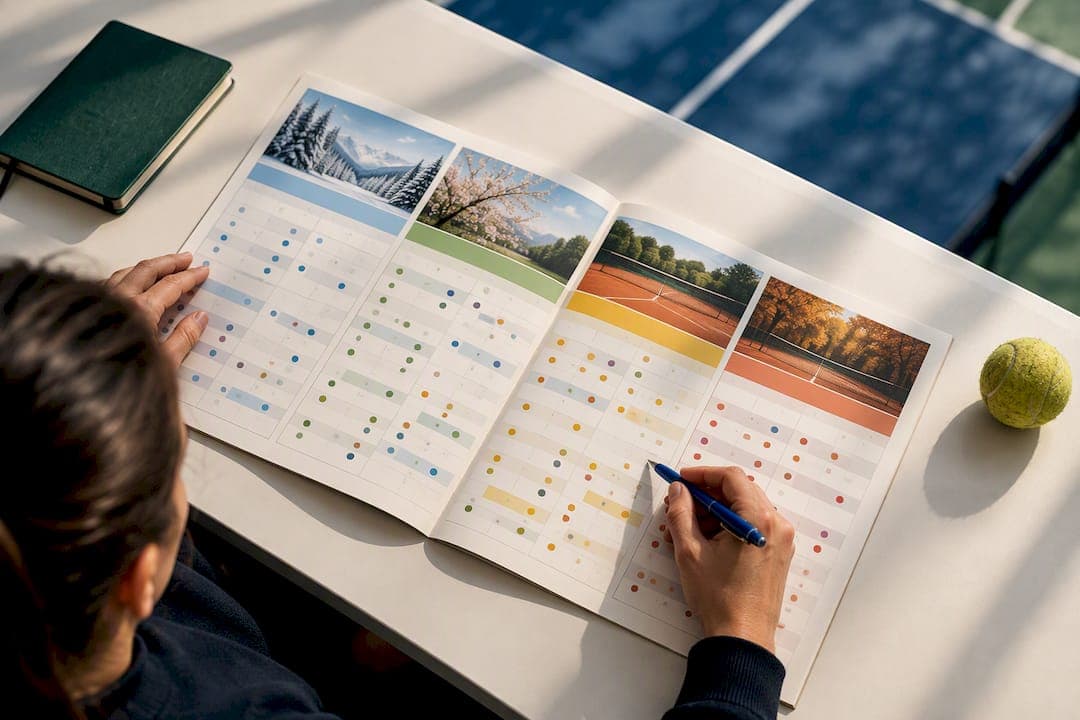
The official 2026 WTA Tour calendar runs from January 2 through November 22 and lists 57 tournaments, including 10 WTA 1000s, 17 WTA 500s, and 22 WTA 250s. The season opens with the United Cup and closes with the WTA Finals, spanning four Grand Slams and every continent tennis touches. Below is the month-by-month roadmap, what each tournament tier means, and how to turn that schedule into a fantasy edge.
TL;DR:
- The 2026 WTA Tour features 57 tournaments across three tiers, with seven of the ten WTA 1000s adopting an extended 12-day format to reduce player fatigue and deepen competition.
- The calendar spans 11 months and covers 26 countries, strategically placing marquee events in key markets while building toward the four Grand Slams and season-ending WTA Finals.
- Major tournaments like Grand Slams operate outside the official WTA tiers and offer the highest points, while WTA 1000 events are near-mandatory for top-ranked players and feature larger draws.
- WTA rankings are based on a rolling 52-week system, with points from tournaments expiring exactly one year after their completion; players defending big points can see significant ranking shifts.
- Fans and fantasy players should plan around the extended WTA 1000s and Grand Slams for optimal roster building, paying close attention to surface types, draw strength, and players’ recent form.
Table of Contents
- Calendar at a glance: season overview and flagship dates
- Month-by-month schedule highlights
- What tournament categories mean: Grand Slams, WTA 1000, WTA 500, WTA 250
- How WTA rankings and points interact with the calendar
- How to follow the 2026 calendar without missing a match
- How fans and fantasy players should use the official calendar
- Why this calendar matters for tennis fans in 2026
- Tweener: the fantasy tennis app to use across the 2026 calendar
- Sources
- FAQ
Calendar at a glance: season overview and flagship dates
The 2026 season stretches across 11 months and touches 26 countries and territories, giving fans a genuinely global slate rather than a Europe-and-America loop. That geographic spread is deliberate. WTA CEO Portia Archer described the calendar as built to place marquee events in key global markets while expanding several WTA 1000 events into a longer format.
The four majors anchor the year as they always have: the Australian Open in January, Roland-Garros in late May and June, Wimbledon in June and July, and the US Open in late August and September. Around those fixed points, the WTA 1000 and 500 events fill in the strategic gaps, from hard courts in the Middle East to clay in Europe to the hard-court swing through North America and Asia.
57 tournaments across three tiers make up the 2026 WTA calendar, according to the official WTA announcement, split into 10 WTA 1000s, 17 WTA 500s, and 22 WTA 250s. That is the framework every fan and fantasy player needs before diving into individual weeks.
A few structural notes worth keeping in mind before the month-by-month breakdown:
- Seven of the 10 WTA 1000 events now run on an extended 12-day format, giving top players more rest between rounds.
- The season opens with the United Cup, a mixed-team event that kicks off the year before the first individual tournaments.
- The WTA Finals in Riyadh closes the season and features only the top-ranked players who qualified across the full year.
- Grand Slams remain outside the WTA 1000/500/250 tier system entirely, governed by their own entry and prize structures.
That enhanced 12-day format at seven WTA 1000 events is one of the more meaningful changes for 2026. It spreads matches out, reduces the physical grind on top seeds, and tends to produce deeper, more competitive draws by the second week, which matters both for viewing and for anyone building fantasy rosters around a tournament's later rounds.
Month-by-month schedule highlights
Rather than scrolling through a static grid, it helps to think of the season in swings, geographic stretches where the tour clusters events on similar surfaces. Here is the chronological map.
- January, Australian swing. The season opens with the United Cup, a mixed-team hard-court event, followed by tune-up tournaments in Adelaide and Auckland before the Australian Open in Melbourne closes the month on hard courts.
- February, indoor and Middle East hard courts. A cluster of WTA 500 and 250 events runs on indoor hard courts in Europe alongside the start of the Middle East swing, setting up the shift toward outdoor hard courts.
- March, Sunshine Double. Indian Wells and Miami, both WTA 1000 events, dominate the month on outdoor hard courts and typically draw the strongest fields of the early season outside the majors.
- April, clay-court launch. The European clay swing begins with WTA 500 and 1000 stops that let players start adjusting footwork and shot selection ahead of the sport's biggest clay test.
- May, Rome and Roland-Garros buildup. A WTA 1000 event in Rome serves as the last major tune-up before Roland-Garros begins in Paris on red clay.
- Late May into June, Roland-Garros. The second Grand Slam of the year plays out over two weeks in Paris, the longest sustained clay-court stretch of the season.
- June, grass-court transition. A short but intense grass swing follows immediately, with WTA 500 and 250 events in the United Kingdom and Germany giving players barely two weeks to adjust surfaces.
- July, Wimbledon. The third major of the year is played on grass at the All England Club, the shortest surface window on tour and the one with the least room for adaptation.
- Late July into August, North American hard-court swing. WTA 1000 events in Canada and Cincinnati mark the return to hard courts and the buildup toward the US Open, both now part of the extended 12-day format group.
- Late August into September, US Open. The final Grand Slam of the year plays out in New York on hard courts, wrapping the North American swing.
- September into October, Asian swing. WTA 1000 events in China headline a stretch that also includes WTA 500 and 250 tournaments across Asia, historically a proving ground for players chasing ranking points late in the year.
- November, season finale. The WTA Finals in Riyadh closes the year, bringing together the top performers from the previous 52 weeks in a season-ending showcase.
Each swing has its own personality for fans tracking form. The clay season rewards patience and heavy topspin, the grass window punishes anyone who struggles with low bounces and quick points, and the North American hard-court stretch tends to favor players with big serves and flat, aggressive ground strokes. Recognizing which swing you're in tells you almost as much about likely outcomes as the ranking list does.
What tournament categories mean: Grand Slams, WTA 1000, WTA 500, WTA 250

Not every tournament on the calendar carries the same weight, and understanding the tiers explains why some fields are stacked with top-10 players while others feature a mix of contenders and rising talent.
Grand Slams sit outside the WTA's own tier system, run by the four major governing bodies, and offer the largest draws (128 players in singles) and the richest prize pools on tour. WTA 1000 events are the next tier down, typically featuring 96-player draws (56 or 60 at combined events) and mandatory or near-mandatory participation for top-ranked players. WTA 500 events usually run 32- or 48-player draws and attract a strong but less complete top-10 presence. WTA 250 events are the entry tier, often 32-player draws that give lower-ranked players and rising juniors a path to points and prize money.
- Grand Slams: 128-player singles draws, no WTA points-tier classification, the highest ranking points on offer.
- WTA 1000: 96-player draws at most stops, near-mandatory for top players, seven of 10 run the extended 12-day format.
- WTA 500: mid-sized draws with a strong but incomplete top-10 field.
- WTA 250: the developmental tier, smaller draws and lower points, but a launching pad for breakout runs.
Ten WTA 1000 tournaments make up the tier just below the majors, per the WTA's 2026 calendar announcement, and seven of them now stretch across 12 days instead of the traditional one-week format. That extra time changes scheduling for broadcasters and players alike, spacing out matches so stars are less likely to withdraw from fatigue and giving depth players more recovery time between rounds.
For fantasy purposes, category matters enormously. A WTA 1000 draw guarantees a deeper pool of ranked players to choose from, while a WTA 250 field can produce value picks who outperform their ranking against thinner competition. Tournament tier is often the single biggest signal for projecting how competitive a draw will be.
How WTA rankings and points interact with the calendar
The PIF WTA Rankings run on a rolling 52-week model, not a calendar-year reset. Every player's singles ranking counts their best 18 tournament results from the previous 52 weeks, while doubles rankings count the best 12. That distinction matters more than most fans realize when trying to read a ranking list mid-season.
- Points earned at a tournament drop off exactly 52 weeks after that event concludes, not at year's end.
- Singles rankings count a player's best 18 results; doubles count the best 12.
- Minimum tournament and points thresholds apply for a player to appear on the official rankings list.
- A player defending a large point total from the prior year can lose ranking spots even with a solid current result, simply because the older points expire.
That dropoff mechanic is why two players with similar current form can carry wildly different ranking trajectories. One might be defending a Grand Slam semifinal from the year before, while another is picking up nearly free points because they missed the previous edition entirely.
Pro Tip: Before drafting for any tournament, check which players are defending big point totals from the same event last year. If a player has few points to lose, a strong run boosts them significantly; if they're protecting a title, even a solid result can look like a step back.
For anyone building fantasy rosters, the practical lesson is to weigh surface consistency and recent 52-week form over a single headline result. A player who has quietly stacked semifinal finishes across clay events all year is a safer long-term pick than one riding a single viral upset.
How to follow the 2026 calendar without missing a match
Staying current with 57 tournaments across 11 months takes more than a bookmark. A few habits keep fans and fantasy players ahead of schedule changes and last-minute withdrawals.
- Check official WTA tournament pages directly for draws, order of play, and schedule updates, since those pages update faster than most secondary sources.
- Confirm broadcaster and streaming rights for your region before a tournament starts, since coverage varies by country and sometimes by round.
- Set notifications through official tour apps or live-score services for match start times, particularly for late-night sessions in different time zones.
- Buy tickets only through official tournament sites, and double-check local start times against your own time zone before booking travel.
Time zone confusion is the most common way fans miss the matches they actually planned to watch, especially during the Asian swing when start times can land in the middle of the night for European and American audiences.
How fans and fantasy players should use the official calendar
The calendar is only useful if you map it to decisions. Time your draft entries around the biggest fields, the four Grand Slams and the seven extended WTA 1000 events, since those draws carry the most ranked players and the clearest form signals. Smaller WTA 250 fields are better suited to shorter, higher-variance contests where a value pick can pay off against thinner competition.
- Draft before Grand Slams and 12-day WTA 1000 events, when full fields and deep draws create the clearest projections.
- Weight surface history and 52-week form over a single recent result when picking players.
- Watch draw strength: a thinner WTA 250 field rewards a rising player differently than a stacked WTA 1000 draw.
Our guide to fantasy picks for major tournaments walks through player selection in more depth, and the WTA stats every fantasy gamer should know breaks down which surface and head-to-head numbers actually move the needle.
Pro Tip: Set your private league entries a week before each Grand Slam begins, so your group has time to review the draw before locking rosters.
Why this calendar matters for tennis fans in 2026

The seven extended WTA 1000s are the most interesting structural change on this calendar. More rest between rounds tends to mean fresher stars in the second week, which is exactly when fan interest and fantasy stakes peak. A calendar that spans 26 countries also gives fans a genuine reason to follow the sport year-round instead of tuning in only for the majors.
What I find most useful about a published, stable calendar is planning. Knowing the Rome-to-Roland-Garros stretch or the North American hard-court swing months in advance lets you build a fantasy season around it instead of reacting to it. That's the real value of pairing the official schedule with a tool built for tracking form across it.
— Nathan
Tweener: the fantasy tennis app to use across the 2026 calendar
Once you know the calendar, the next question is how to actually compete on it. Tweener offers two modes designed for fantasy tennis play: a draft mode to build squads and a pick'em mode focused on single-match decisions.
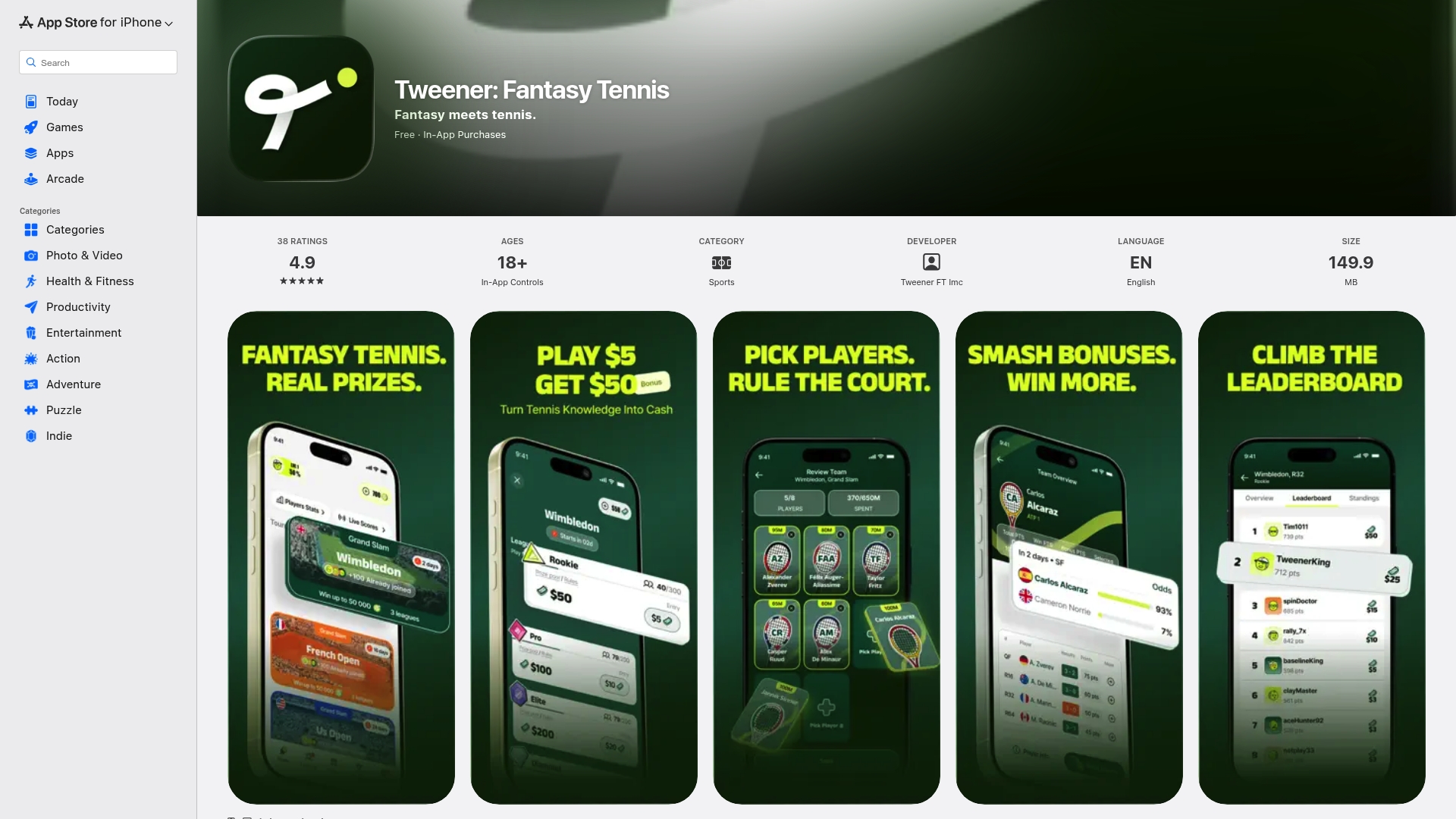
- Private leagues allow competition among groups of friends for major tennis events.
- Scoring updates to reflect actual match results throughout the tournaments.
- Both free and cash play options are available, depending on legal permissions.
Our step-by-step contest guide walks new users through setup. Head to Tweener to start a Draft Mode team or set up a private league before the next tournament window opens.
FAQ
How many tournaments are on the 2026 WTA calendar?
The 2026 WTA calendar lists 57 tournaments, including 10 WTA 1000 events, 17 WTA 500 events, and 22 WTA 250 events. The season runs from early January through the WTA Finals in late November.
How do WTA rankings work across the season?
WTA rankings use a rolling 52-week model where singles points count a player's best 18 results and doubles count the best 12. Points from any tournament expire exactly 52 weeks after that event ends, not at the calendar year's close.
What is the difference between WTA 1000, 500, and 250 events?
The tiers reflect draw size, points on offer, and how many top players are expected to enter, with WTA 1000 events carrying the deepest fields and highest points below the Grand Slams. WTA 500 events draw a strong but incomplete top-10 presence, while WTA 250 events are the developmental tier with smaller draws.
Where can I find the official 2026 WTA schedule?
The WTA's official tournament calendar is the authoritative source for dates, locations, and category details. The 2026 WTA Tour page on Wikipedia offers a cross-checkable, chronological week-by-week view of the same schedule.
Can I play fantasy tennis for the entire 2026 WTA season?
Yes, Tweener supports fantasy contests across the full tour calendar through Draft Mode and Pick'em Mode, letting you build teams for individual tournaments as they come up. Private leagues let you compete with up to nine friends for each Grand Slam, with both free coin play and cash contests available where legally permitted.