
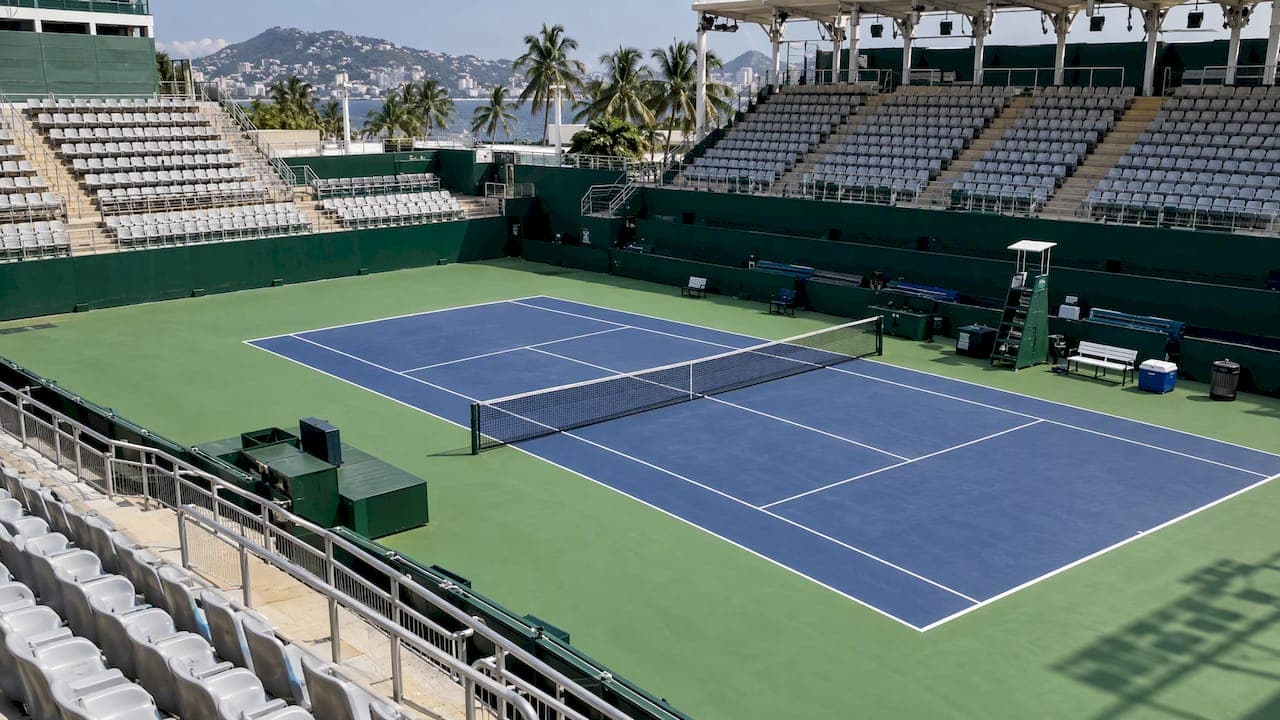
Acapulco is the best February test of a fantasy tennis player's patience. The Abierto Mexicano Telcel is an ATP 500 hard-court event, and it plays nothing like the quick indoor hard courts that come before it or the Sunshine Double that follows. If you want to win a fantasy contest here, you draft for the conditions as much as for the rankings. This guide covers when the next edition runs, who is confirmed, why the court changes your picks, and how to build a lineup for a short, stacked week.
TL;DR
- The 34th edition is scheduled for February 20 to 27, 2027, at the Arena GNP Seguros in Acapulco, Mexico. Check the official tournament page for the current schedule before you lock a lineup.
- Confirmed names so far include Ben Shelton, Flavio Cobolli (defending champion), Frances Tiafoe, Brandon Nakashima, Francisco Cerúndolo and Lorenzo Musetti.
- The court is slow for a hard court, with high bounce and long rallies, so grinders and clay-court-bred players gain value.
- Early-round volatility is the main risk: in a 32-player draw, one upset removes a top pick for the rest of the week.
- Scoring rules differ by platform. Read the rules for your contest before you draft.
Table of Contents
- The tournament at a glance
- Who is in the 2027 field
- Why the Acapulco court changes your picks
- How fantasy tennis games score Acapulco
- A draft strategy for a 32-player draw
- A worked example: weighing two picks
- Playing it with friends
- Where Tweener fits
- Our perspective
- FAQ
- Sources
The tournament at a glance
The Abierto Mexicano Telcel presentado por HSBC is played on outdoor hard courts in Acapulco and sits in the ATP 500 tier. The ATP's calendar lists it with a 32-player singles draw, and in 2026 it ran in week 8 of the season.
For 2027, the 34th edition is scheduled for February 20 to 27 at the Arena GNP Seguros. Dates and start times can move, so use the ATP Tour's Acapulco page for scores, results and draws once the week begins.
The format matters for fantasy. In 2026 the official site showed qualifying starting on the Saturday, with the main draw running Monday through Saturday. The ATP's results archive shows the usual path: qualifying, Round of 32, Round of 16, quarterfinals, semifinals and a singles final on the last Saturday. That is five rounds for a seed with a first-round bye path, or up to six for anyone who qualifies, which caps how many matches a single player can give you.

Who is in the 2027 field
The early 2027 entry list is strong for an ATP 500. The tournament has confirmed Shelton, Cobolli, Tiafoe, Nakashima, Cerúndolo and Musetti. The same report notes that Cobolli is the defending champion, that Cerúndolo won two titles in 2026, and that Shelton was a US Open finalist that season.
Here is how those names read through a fantasy lens.
Flavio Cobolli. He beat Tiafoe in the 2026 final for his first hard-court ATP title. The Italian's game is built on movement and rally tolerance, which is exactly what this court rewards. He will likely be the most-picked player in many contests, so his ownership is a strategic question as much as a talent one.
Ben Shelton. Serve-first players lose some of their edge when the court is slow and the ball sits up. Shelton's raw power still gives him a high ceiling, but his floor against a patient returner is lower here than at a fast indoor event. If you want to know how he handles long hard-court matches, a guide to watching the US Open online is a handy way to find his big-stage matches to rewatch.
Frances Tiafoe. The 2026 finalist already knows how to win here. His shot-making and crowd energy fit a night session in Acapulco well. He can also lose to anyone on a flat day, which is the classic profile of a player to pair with a steadier anchor.
Francisco Cerúndolo. A clay-court-bred player with a strong 2026 title run is a natural fit for a slow hard court. Consider him a top value pick if the salary or draft position treats him as a second-tier name.
Lorenzo Musetti. His one-handed backhand and variety make him dangerous, but his consistency on hard courts has historically been uneven. On a slow surface, the variety is more useful and the pace of the ball is less of a problem.
Brandon Nakashima. Clean ball-striking and a solid return make him a reasonable mid-tier option who rarely gives away cheap points.
The field will change before February. Withdrawals and late entries are common in the weeks after the US Open and the indoor swing, so treat any list as provisional until the draw is published.
Why the Acapulco court changes your picks
Many fantasy players treat "hard court" as one category. That is a mistake, and Acapulco is the best example. Scouting reports describe it as one of the slowest hard courts on tour, with a high bounce and grinding rallies, and note that night sessions with higher humidity slow it further. This kind of surface favors clay-court players, a point made in a tournament preview from an independent tennis analytics blog. Treat that as a scouting view, and confirm it by watching early rounds.
What does a slow, bouncy court do to a fantasy lineup?
- Aces drop and breaks rise. Servers hold less easily, so players who rely on free points from the serve lose value in any scoring system that rewards aces.
- Matches run longer. Longer rallies mean more games and more chances for a player to accumulate points in a scoring system that counts games or sets won, but also more fatigue across the week.
- Return games matter. The best returners and the best defenders gain the most relative to their normal hard-court value.
- Day and night play differently. The same player can look different at 1 p.m. than at 8 p.m. Check the order of play when it is released.
Weather is a smaller factor than the court, but check it. February in Acapulco is generally warm, sunny and dry, with temperatures around 28 to 32°C. Heat can add to fatigue in long matches. Wind, when it appears, makes serving harder and pushes rallies longer. You cannot plan for it, but you can avoid leaning entirely on big servers.
For a broader framework on matching surface to roster, our hard court fantasy strategy guide covers budget splits and surface filters, and the clay court strategy piece explains why clay-bred players travel well to slow hard courts.
How fantasy tennis games score Acapulco
The real question in most searches is how the match results turn into points. Platforms differ, and you should read the rules for your specific contest. In general, there are two broad families.
Draft or salary-style contests. You build a roster of real players, and each earns points from what happens in their matches, such as sets won, games won, match wins and sometimes service or return statistics. Rosters lock at the start of the contest window, so you commit before you see how the draw plays out.
Pick'em contests. You choose winners, often in a set of matches, and score for correct picks. They reward match-level judgment and are well suited to a week with plenty of mismatches and a few coin flips.
Tweener offers both formats for ATP and WTA tennis: Draft Mode and Pick'em Mode. Check the scoring screen for each contest, because the weight on match wins versus sets and games changes how you should treat a grinder against a server.
Two rules differences cause the most confusion:
- Walkovers and retirements. Ask whether a player who retires mid-match or withdraws before it keeps the points earned so far, and what happens to your roster slot.
- Round-by-round versus whole-tournament scoring. In a whole-tournament contest, a player who loses in round one is dead weight. In a round-by-round contest, you can reset between rounds.
Those details decide more contests than a player's ranking.
A draft strategy for a 32-player draw
A 32-player draw is unforgiving. Eight seeds usually get a first-round bye in an event this size, which means the top names play one fewer match and need to win fewer rounds to reach the later stages. Beyond that, the structure creates a few useful rules.
Build around two anchors and two attackers
Pick two consistent players who rarely lose early, then add two higher-variance players with big upside. The anchors protect your floor, and the attackers produce the weeks that win leagues. Our fantasy tennis strategy article breaks this anchors-and-attackers approach down in detail.
Look at the path, not just the player
A seed with an easy quarter is worth more than a higher seed with a brutal one. After the draw comes out, trace each of your candidates to the quarterfinals and ask who they would probably face. Head-to-head records matter most here. A player who has lost repeatedly to a particular style of opponent is a risk even if the ranking gap is large.
Weight recent form over reputation
The weeks before Acapulco include other swings of the early-season calendar. A player who has just won a long run of matches can arrive tired, and a player coming off several early losses can arrive hungry or injured. Look at recent match length, recent opponents and any physical issues. Our guide on how to choose tennis players for fantasy leagues lists the stats we check first.
Check the head-to-head and surface split
Two players with the same ranking can have very different results on slow hard courts. Pull each player's record on slower outdoor hard courts, and compare it with their record on fast indoor courts. The gap is often large, and it is where the edge is. For more on turning data into predictions, read our tennis match prediction strategies.
Respect the defending champion, but not too much
Cobolli's title gives him comfort in the venue, but it also means he carries the heaviest expectations and probably the highest ownership. In a large public contest, a lineup that is identical to everyone else's cannot beat the field. In a small private league with friends, the chalk pick is often right, because you only need to beat a handful of people.
Plan for late changes
If your contest allows swaps before lock, check the order of play, the practice reports and the withdrawals on the morning of the first match. A late withdrawal can leave you with a zero. Keep a bench option you actually trust.
A worked example: weighing two picks
Suppose you are choosing between two mid-priced players for your last roster slot. Player A is a big server with a strong indoor record and a mediocre record on slow outdoor courts. Player B is a baseliner with a good return, strong results on clay, and several long three-set wins in recent weeks.
On a fast court, Player A would be the pick. In Acapulco, the court removes much of A's edge, and B's return games turn into break chances. B's recent three-setters raise one concern, which is fatigue, so check how many matches B has played in the previous fortnight. If the answer is a heavy load, A's quick, short matches might be the safer call. If B is fresh, B is the pick.
This is the kind of reasoning that separates a lineup built on analysis from one built on name recognition. It also explains why tennis rewards the analytical fan more than most sports: the data is public, the conditions are distinctive and the individual matchups are clear.

Playing it with friends
A week of tennis is a great length for a private league. The tournament is short, the matches are easy to follow and there is a clear winner by Saturday night. On Tweener you can run a private league with up to 9 friends for a tournament, which keeps the stakes personal and the trash talk constant.
If you want to see how rosters are built before the event, our top ATP and WTA fantasy tennis picks and fantasy tennis tips articles give you a starting framework. For a more advanced guide to roster construction in a weekly format, see our ATP fantasy picking tips.
Where Tweener fits
Tweener is built for tennis only, with dedicated ATP and WTA contests. You can play free with virtual coins that can be redeemed for rewards such as gift cards, or enter cash contests where legally permitted. Cash play is available in select US states, so check eligibility in your state before depositing.
When the Acapulco draw is released, you can build a team in Draft Mode or make your picks in Pick'em Mode. Get the app or visit tweener.io to see what contests are open.
Our perspective
We built Tweener because tennis fans have always had a data-rich sport and almost nowhere to use the data. Tennis has no shortage of statistics, but the daily fantasy experience that other sports take for granted has been thin. Acapulco shows why a dedicated tennis game matters. The surface plays differently from most hard courts, the draw is small and brutal, and the best pick is rarely the highest-ranked name. A general fantasy platform has no way to reflect that.
We think the fun is in the reasoning. Why is a clay-court player worth more here? Which seed has the soft quarter? Is the defending champion too popular to pick? Fans who ask those questions tend to win, and that is the kind of skill-based play we want to reward. Our advice for Acapulco is simple: watch the first two days, trust the court over the rankings, and keep your lineup a little different from the crowd's.
— Nathan
FAQ
When is the Acapulco tennis tournament in 2027?
The 34th edition is scheduled for February 20 to 27, 2027, at the Arena GNP Seguros. Schedules can change, so confirm start times and the order of play on the official ATP Acapulco page before you lock a lineup.
Who is the defending champion in Acapulco?
Flavio Cobolli won the 2026 title, beating Frances Tiafoe in the final. It was his first hard-court ATP title, and he is among the players confirmed for 2027.
Is Acapulco good for clay-court players in fantasy?
Often, yes. The court is widely described as slow for a hard court, with a high bounce and long rallies. That helps defenders and returners, so players whose game was built on clay tend to hold their value here.
How do fantasy tennis games score Acapulco matches?
It depends on the platform and the contest type. Draft-style games typically award points based on how a player performs in real matches, while pick'em games score correct winners. Read the scoring rules for each contest, especially how retirements and withdrawals are handled.
Sources
- Abierto Mexicano Telcel 2026: draws, history and schedule, ATP Tour
- ATP calendar PDF, 2025-26
- Abierto Mexicano de Tenis confirms three top-10 players for 2027
- Acapulco overview, ATP Tour
- News archive, Abierto Mexicano de Tenis
- Acapulco 2026 results archive, ATP Tour
- Cobolli secures first hard-court title in Acapulco, Tennis Majors
- Acapulco 2026 ATP 500 tournament preview, Tennis Edge
- Acapulco Tennis: complete guide to the Mexican Open