
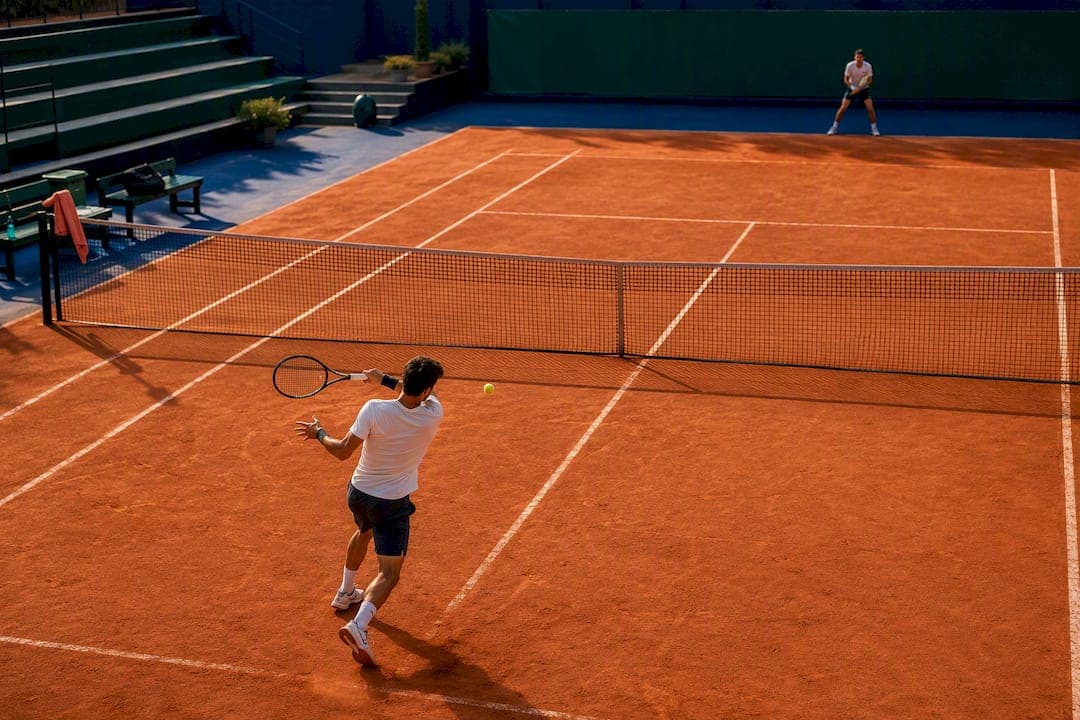
Prioritize clay specialists and clay Elo leaders for captain slots, then pair them with one underpriced clay native for tournament upside. On today's slates, that means players like Jannik Sinner, Carlos Alcaraz, or Casper Ruud anchor your captaincy, while Lorenzo Musetti or a similar clay-adapted grinder fills the volatility slot. Split your roster roughly two-thirds safety, one-third variance.
TL;DR:
- Prioritize clay Elo ratings and recent minutes played on clay over overall rankings when selecting players and captains for better surface-specific forecasts.
- Focus on players with strong return game and stamina, especially those proven capable of handling long matches, rather than relying on serve-dominant statistics.
- Exploit underpriced clay natives with good surface-specific form, as they are often undervalued despite their surface-specialist performance.
- Build rosters with a mix of safer clay specialists and high-variance, high-upside players, emphasizing match-level stacking and diversification.
- Consider surface speed, weather conditions, and cumulative fatigue to gauge player form and physical readiness before finalizing lineups.
Table of Contents
- Why Clay Court Strategy Starts With Player Profile, Not Ranking
- What Clay-Specific Stats Actually Predict Winners
- How to Build a Clay Tournament Roster
- Why Timing and Fatigue Shift Player Value Round to Round
- Three Matchup Examples That Show the Rules Working
- A Quick Workflow You Can Run Before Every Clay Slate
- Physical Conditioning Separates Clay Winners From Everyone Else
- The Mental Game That Separates Clay Contenders From Pretenders
- My Take: The Conventional Wisdom Undersells Clay Data
- Put This Clay Court Strategy to Work on Tweener
- Sources
Why Clay Court Strategy Starts With Player Profile, Not Ranking
Clay court strategy for fantasy contests begins with a blunt fact: the surface rewards a different skill set than hard courts or grass, and the ATP/WTA ranking list doesn't sort players by that skill set. It sorts them by cumulative results across every surface, which buries clay specialists behind players who happen to be more consistent everywhere else.
The heavy topspin baseline game is the clearest signal. Clay's higher bounce lets a good topspin shot climb above an opponent's strike zone, turning routine rallies into extended battles. That directly inflates fantasy scoring categories tied to games played and break points, because longer rallies mean longer service games and more chances for the returner to convert.
Return quality matters more on clay than on any other surface. Clay specialists thrive because the surface amplifies topspin and rewards endurance, which means a player who can consistently get a racket on second serves and turn defense into offense racks up break points other surfaces would never offer them. Stamina and sliding footwork are the physical foundation underneath all of it. A player who slides efficiently conserves energy across a five-set or three-set marathon, and that recovery efficiency is exactly what keeps them competitive in the wear-down sets where fantasy points pile up.
For captain selection, prioritize:
- Elite return games and break point conversion on clay specifically
- Demonstrated stamina across three-hour-plus matches this season
- Comfort constructing points patiently rather than rushing the net
For bench depth, useful but not essential:
- Sliding technique refinement (helps limit injury risk over a long draw)
- Multi-surface adaptability (less relevant for single-tournament clay contests)
Pro Tip: Don't captain a big server on clay just because they're a household name. Serve dominance is reduced on this surface, making serve-related statistics less predictive, and you'll be paying captain-price points for a skill that stops working.
What Clay-Specific Stats Actually Predict Winners
Standard rankings measure a player across hard, grass, and clay combined, which dilutes exactly the signal you need. Clay-specific Elo isolates performance on this surface alone, and it's a sharper predictor here than overall ranking. Surface-specific Elo models weight clay metrics far more heavily than all-surface rankings when forecasting clay outcomes, sometimes by a wide margin over a generic Elo score.
A useful rule of thumb: treat a 60-plus point gap in clay Elo as meaningful, even when the official rankings suggest a mismatch in the other direction. That gap is often where fantasy value hides, since a lower-ranked clay grinder can be functionally favored against a higher-ranked all-court player once you isolate the surface.
Serve-based numbers lose weight on clay. Hold rates on clay run lower than on hard courts, typically reflecting a noticeable increase in break opportunities for the returner, and rallies on clay stretch significantly longer than on hard courts, extending point duration appreciably. That single stat should reset how you value aces and first-serve percentage. They still matter, just less than on a hard court, while return percentage, break points created, and total minutes played across the tournament climb in importance.
Prioritize these when scanning the slate:
- Clay-specific Elo rating, not overall Elo or ranking
- Clay-only head-to-head history between the two matched players
- Recent cumulative minutes on court this event
On clay, a 75 to 80 percent hold rate versus 83 to 86 percent on hard courts means roughly one extra break opportunity per set for the returner. That's the number driving your captain math.
Read more on how surface advantage in tennis changes outcome probability before you lock a slate.
How to Build a Clay Tournament Roster
Roster construction on clay isn't the same puzzle as hard court, and treating it that way costs you points every round.
- Captain a clay specialist over an all-court star whenever their clay Elo gap favors them, even if the star carries the bigger name and higher overall seed.
- Stack at the match level in bracket-based contests by rostering both players in a projected long, tight match, since extended rallies and multiple sets pay out for whichever roster owns both sides.
- Diversify your slate rather than overloading on the tournament favorites, because clay's flatter power structure means low-ownership players convert deep runs more often than on faster surfaces.
- Hunt value on underpriced clay natives whose price reflects a mediocre hard-court season rather than their actual clay-only track record. Markets and predictive models frequently underprice clay specialists when their overall ranking lags their surface-specific ability, and that gap is where cash-game and tournament leverage both live.
- Accept variance deliberately in one roster slot, not accidentally across your whole lineup. One high-upside, clay-native pick is a plan. Five is a gamble.
For a deeper framework on captain math, see this guide to building winning tennis lineups.
Why Timing and Fatigue Shift Player Value Round to Round
Form doesn't read the same in every clay tournament, and treating Monte Carlo, Rome, and Madrid as interchangeable data points is a common mistake. Weight results from Monte Carlo and Rome more heavily than Madrid when projecting Roland Garros readiness, due to surface speed and conditions differences, since Madrid's altitude and faster conditions distort the surface enough to make its results less transferable.
Cumulative minutes matter just as much as recent wins. A player who ground out two three-set battles earlier in the draw carries real fatigue risk into the next round, even against a weaker opponent on paper.
Before locking a late-round lineup, check:
- Total minutes played across the last two rounds, not just the last match
- Any retirement, medical timeout, or injury note from the previous match
- Weather forecast for match day, since cooler or damp conditions slow the ball and favor grinders over attackers
Three Matchup Examples That Show the Rules Working
Concrete cases beat abstract rules, so run through how this plays out on an actual slate.
Clay specialist versus hard-court favorite: if a matchup pits Casper Ruud against a player whose season has been built on hard-court results, check the clay Elo gap before trusting the overall seed. Ruud's clay-only numbers often flip a matchup that looks lopsided on paper, which makes him a captain candidate even against a nominally higher-ranked opponent.
The underpriced clay native: Lorenzo Musetti's game, built around heavy topspin and patient point construction, is tailor-made for clay even in tournaments where his overall seeding undersells him. When his price on the slate doesn't reflect his clay-only track record, he's exactly the volatile, high-upside piece worth rostering alongside your safer captain picks.
Choosing between two elites for captain: Iga Swiatek against Coco Gauff is a genuine coin-flip on paper, but clay Elo and clay-only head-to-head history usually separate them more clearly than the rankings suggest. Swiatek's clay results are historically dominant enough to make her the safer captain choice in most bracket positions, while Gauff becomes the better call specifically when the draw favors her matchup profile. Aryna Sabalenka sits in a similar tier: elite power that translates well enough to clay to make her a strong captain option, but not an automatic one over a true clay-native opponent.
A Quick Workflow You Can Run Before Every Clay Slate
Clay Elo and cumulative minutes are the two numbers I trust most because they cut through noise that ranking points and hard-court reputation can't touch. Clay-specific H2H rather than all-surface history reduces false negatives on clay specialists, and that alone has changed how I set captains.
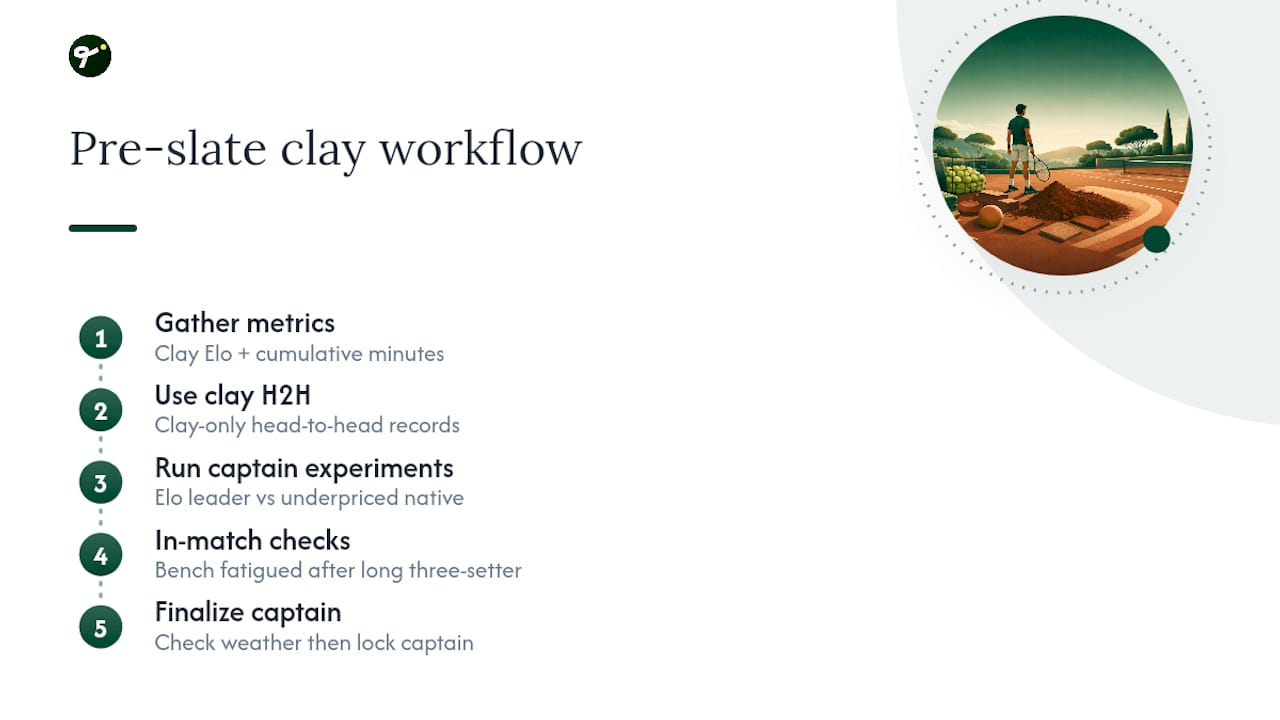
Two experiments worth running on Tweener: captain a clay Elo leader in one league this week, then captain an underpriced clay native in a separate league to see which strategy performs better for your read on the draw. In-match, make two habits automatic. Downgrade or bench a player coming off a long three-setter, and check the weather forecast before locking your final captain.
Physical Conditioning Separates Clay Winners From Everyone Else
Clay demands a different physical toolkit than any other surface, and it shows up directly in fantasy output. Matches run longer because points last longer, and the surface itself adds a layer of physical cost that hard courts and grass simply don't. Sliding into every shot, recovering from a slide, and repeating that motion for three or four hours strains muscles that a serve-and-volley specialist rarely taxes.
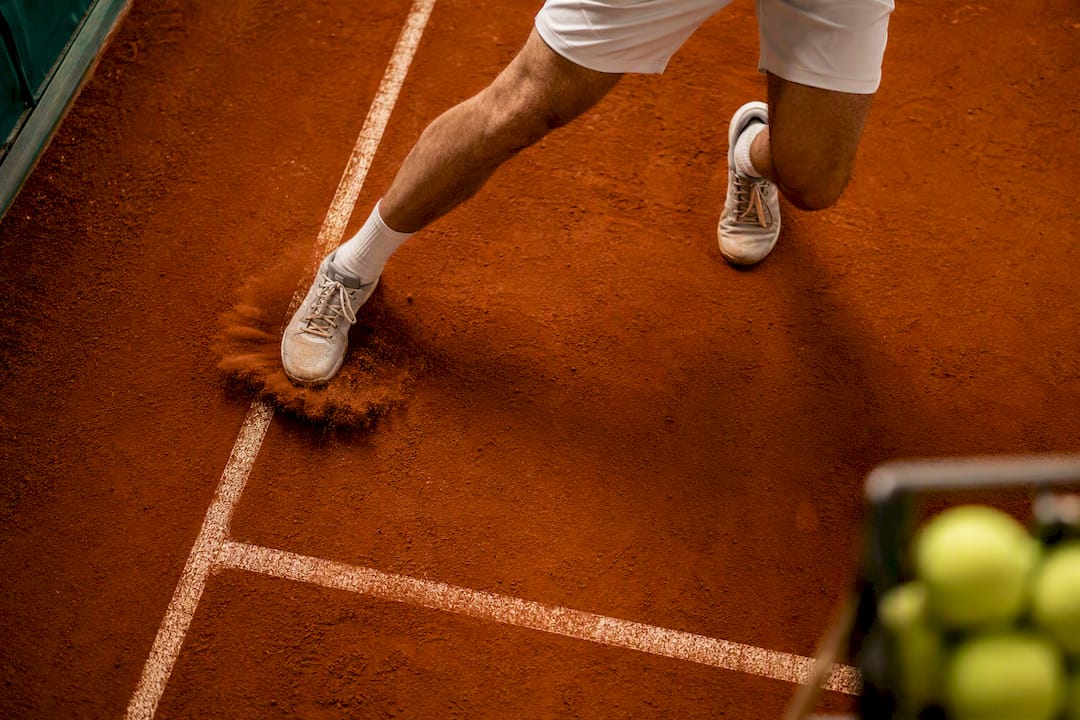
Endurance shows up statistically in a very specific way: players who fade in the third set of a clay match often do so not because their skill declined, but because their legs did. That's why cumulative minutes across a tournament matter more on clay than on a faster surface where matches wrap up quicker.
For fantasy purposes, this means favoring players with a track record of finishing long clay matches strong rather than players who tend to fade. Look at recent match logs for third-set and fifth-set performance specifically. A player who has repeatedly closed out marathon clay matches has demonstrated the conditioning base that keeps producing fantasy points deep into a draw, while a player who has a history of physical fades on this surface is a real downgrade risk in the later rounds, regardless of their seed or reputation.
The Mental Game That Separates Clay Contenders From Pretenders
Clay punishes impatience in a way no other surface does. A player who tries to end points early, the way they might on a faster hard court, often finds themselves overhitting into the net or the tramlines because clay simply doesn't reward that approach. The surface asks players to construct points over eight, ten, twelve shots, and that requires a kind of patience that not every talented player actually has.
This psychological dimension matters for fantasy selection because it's often more stable than form. A player's clay-specific mental approach, their willingness to grind out long rallies without forcing errors, tends to be a consistent trait across a season rather than something that fluctuates week to week. That consistency is valuable when you're projecting performance across a multi-round tournament rather than a single match.
Watch for players who visibly get frustrated during long rallies or who abandon their game plan under pressure on this surface. That frustration usually shows up as unforced errors climbing in the second and third sets, exactly the moments where fantasy points swing hardest. Conversely, players known for even-keeled composure during extended points, the ones who treat a twenty-shot rally as routine rather than a crisis, tend to hold their fantasy value better across a full clay tournament than players whose temperament suits faster, shorter points.
My Take: The Conventional Wisdom Undersells Clay Data
Most fantasy content treats surface as a footnote, a minor adjustment layered onto the same ranking-based approach used for every other tournament. That's backwards. Clay is the one surface where surface-specific data should override your instinct almost every time, because the gap between a player's overall profile and their clay-only profile is often the single biggest edge available on the slate.
The conventional advice, chase seeds, captain the highest name, treats every surface the same. It ignores that hold rates alone shift the entire math of how a match unwinds. What the research actually supports is narrower and more useful: build your captain decision around clay Elo and recent clay-specific minutes first, then let seed and name recognition break ties, not lead them.
If you take one thing from this, prioritize clay-only data when available, as it provides more precise insight into surface-specific player performance before anything else on your screen. The players who look mispriced by their season-long ranking are frequently the ones clay Elo already flagged as live threats.
— Nathan
Put This Clay Court Strategy to Work on Tweener
Tweener is built for exactly this kind of decision-making. It's the platform where clay Elo, clay H2H, and surface-specific form actually matter, because you're drafting real ATP and WTA players into contests scored on their live match performance, not guessing against a sportsbook line.
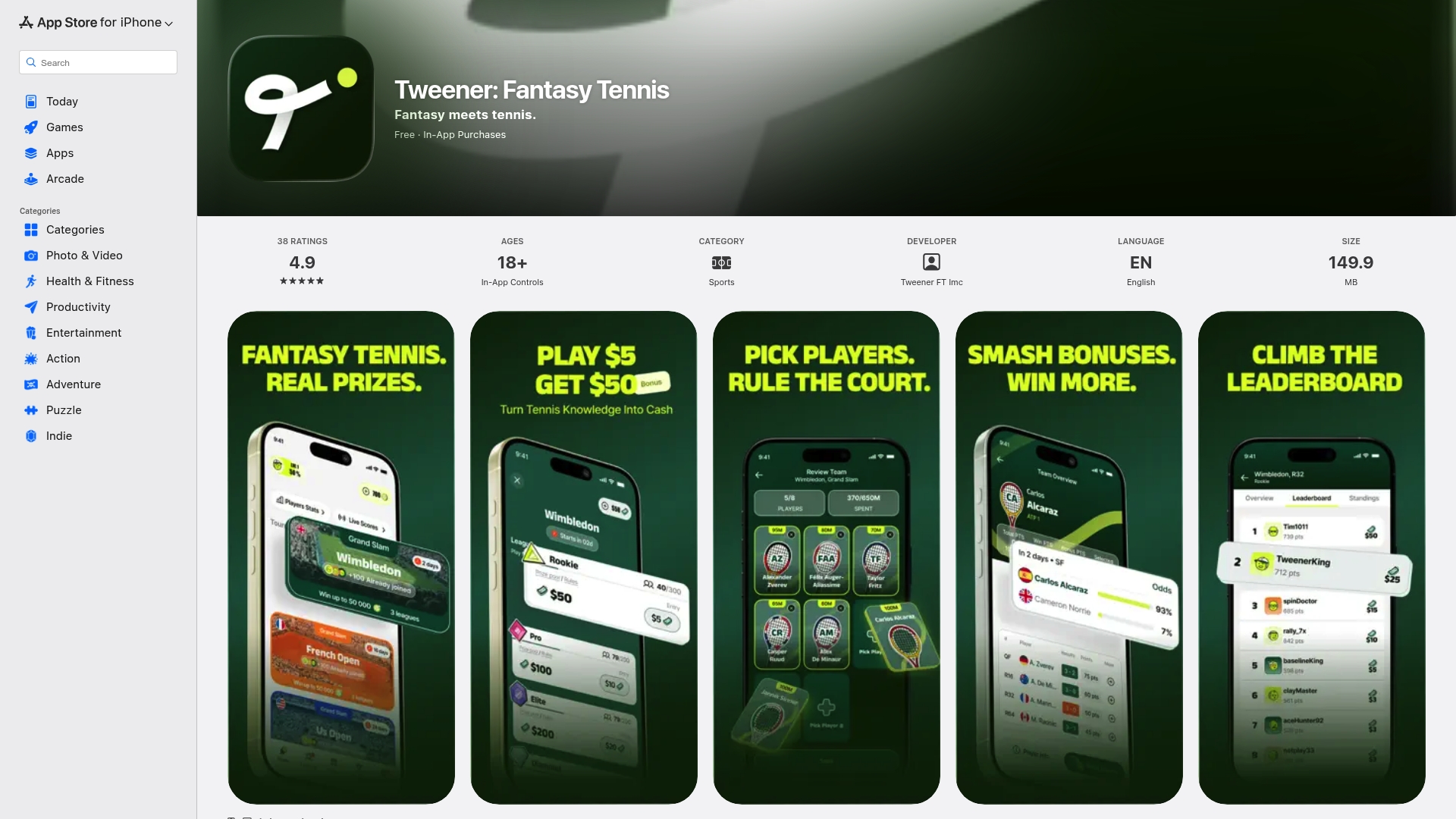
Start in free mode with virtual coins if you want to test a clay Elo captain strategy against an underpriced clay native strategy with zero financial risk, then move into cash mode once you've found an approach that works for your read on the draw. Private leagues let you run these experiments directly against up to nine friends for each clay tournament, which turns a theory into a real head-to-head test. Download the Tweener app and set your first clay captain before the next round locks.