
TL;DR:
- Surface advantage in tennis is a measurable edge that depends on court physics aligning with a player's style. Different surfaces create distinct ball behaviors and movement patterns, favoring certain tactics and physical profiles. Analyzing these factors improves match predictions and strategic decision-making in both professional play and fantasy tennis.
Surface advantage in tennis is defined as the measurable edge a player gains when the physical properties of a court surface align with their playing style. Grass, clay, and hard courts each produce different ball speeds, bounce heights, and traction conditions. Those differences do not affect all players equally. A big server thrives on grass. A patient baseliner dominates clay. Understanding what surface advantage means is the first step toward reading matches more accurately and building smarter fantasy tennis strategy.
What is surface advantage in tennis?
Surface advantage in tennis is the technical term analysts and coaches use to describe how court physics create unequal conditions for different playing styles. The concept is grounded in three measurable variables: ball speed loss after the bounce, bounce height, and player traction. Ball speed, bounce height, and traction collectively dictate whether attacking or defensive tactics succeed on a given surface.
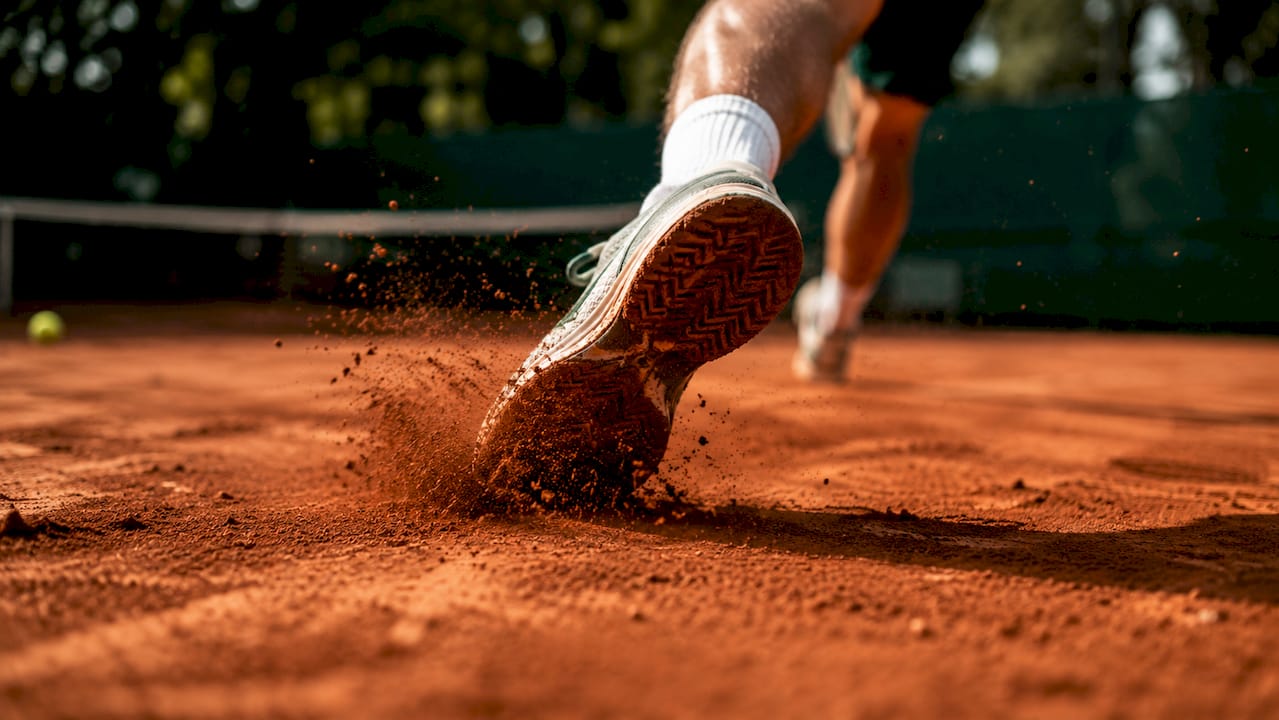
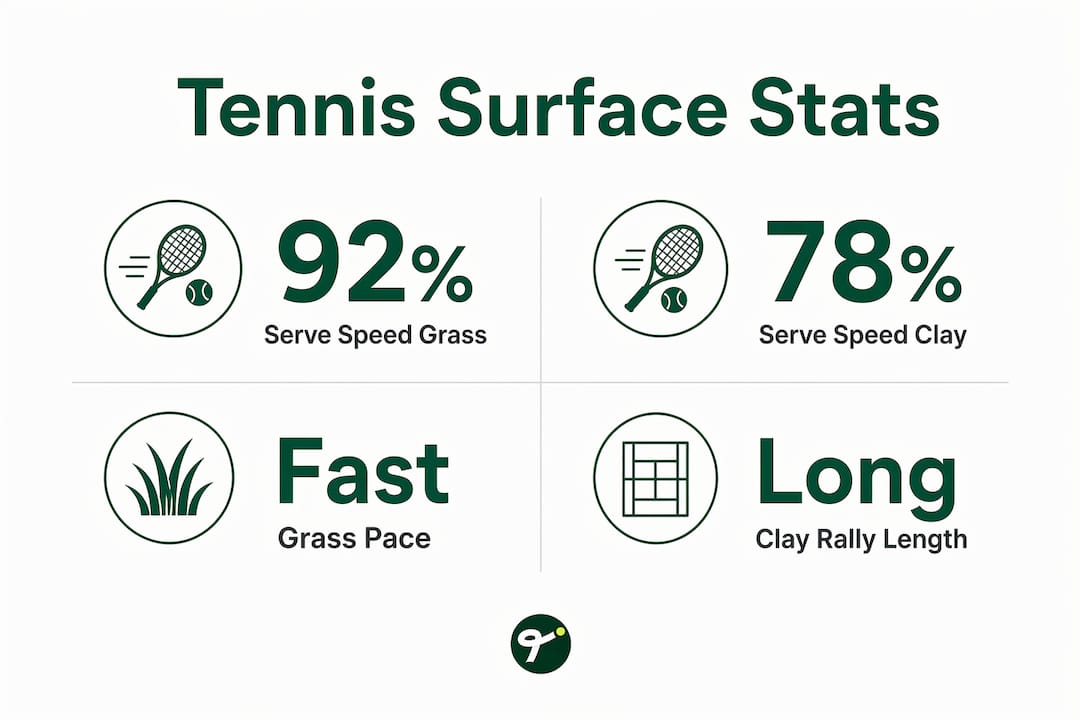
These variables are not minor. A 100mph serve retains 92mph on grass but slows to 78mph on clay. That is a 20% difference in retained pace, with bounce angles shifting from 16 degrees on grass to 20 degrees on clay. A flatter, faster ball gives the returner less time to set up. A higher, slower ball gives them more. Those fractions of a second determine which tactics are viable and which are not.
The three major ATP and WTA surfaces each create a distinct competitive environment. Grass is the fastest surface, producing low skidding bounces that compress rally length. Clay is the slowest, generating high heavy bounces that extend rallies and reward endurance. Hard courts sit in the middle, offering the most consistent bounce of the three. Each surface rewards a different physical and tactical profile, which is why the same player can look dominant one week and ordinary the next.
How do different surfaces affect ball behavior?
The physics of each surface produce fundamentally different matches. Here is how each one behaves:
- Grass courts produce the fastest conditions. The ball skids low and stays close to the turf. Serve-and-volley tactics thrive because the server can follow a flat delivery to the net before the returner has time to recover.
- Clay courts produce the slowest conditions. The ball grips the surface, kicks high, and loses significant pace. Baseline play with heavy topspin becomes the dominant tactic because the court rewards patience over aggression.
- Hard courts produce medium-speed conditions. The bounce is predictable and consistent, which rewards players with clean technique over those who rely on improvisation.
Rally length reflects these differences directly. Matches on clay last 15–25% longer than equivalent hard court matches. That extra time on court is not just a scheduling detail. It signals a fundamentally different physical demand, one that favors players with superior endurance and footwork over those who rely on quick points.
| Surface | Ball speed | Bounce height | Rally length | Dominant tactic |
|---|---|---|---|---|
| Grass | Fast | Low | Short | Serve and volley |
| Clay | Slow | High | Long | Baseline topspin |
| Hard | Medium | Medium | Medium | All-court play |
Pro Tip: When analyzing a matchup, check each player's win rate on the specific surface before looking at their overall ranking. A top-10 player with a poor clay record is a genuine underdog at Roland Garros regardless of their ATP ranking.
Grass courts add another layer of complexity: environmental conditions change the surface mid-tournament. Dry soil firms up grass, increasing ball speed, while moisture lowers and slows the bounce. This means a Wimbledon match played in week one can feel meaningfully different from one played in week two, after the courts have worn down.
How does surface affect player movement and tactics?
Traction is the movement variable that most fans overlook. Each surface grips a player's shoe differently, and that difference forces entirely different footwork patterns.
On grass, traction is low. Players must take short, choppy steps and keep their center of gravity low to avoid slipping. There is no room for the wide lateral slides that clay allows. This rewards players who move efficiently in tight spaces and punishes those who rely on big lateral recoveries.
Clay is the opposite. The surface allows controlled sliding, which lets players extend their reach on wide balls without losing balance. This sliding technique is a learned skill. Players who grow up on clay develop it naturally. Those who train primarily on hard courts often struggle to replicate it under match pressure. Clay courts also carry the lowest injury risk of the three surfaces because the softer surface absorbs more impact on joints.
Hard courts demand steady, planted footwork. The surface does not allow sliding, so players must stop and reset on every wide ball. Hard courts also transmit the most impact to knees, hips, and ankles. The physical toll accumulates across a long hard court season, which is why player injury rates tend to spike during the Australian Open and US Open swings.
Pro Tip: Watch a player's footwork in the first two games of a clay court match. If they are not sliding into their groundstrokes, they are not comfortable on the surface. That discomfort compounds under pressure.
Tactical adjustments follow directly from movement constraints. On grass, players shorten their backswings and flatten their shots to keep the ball low. On clay, they load up with topspin to exploit the high bounce. On hard courts, they rely on clean ball-striking and court positioning because the surface offers no natural amplifier for either style.
How do players specialize and adapt across surfaces?
Player surface specialization is one of the most analytically rich areas in professional tennis. Analysts use a concept called the surface adaptability index to quantify how much a player's win rate varies across surfaces. A large variance signals a specialist. A small variance signals a consistent all-court performer.
Specialists are not a weakness. They are a deliberate product of training environments and physical profiles. A tall player with a heavy serve will rationally invest more practice time on grass and hard courts, where that serve carries maximum value. A smaller, athletic player with elite footwork will build their game around clay, where endurance and movement matter more than power.
The challenge comes during surface transitions. The professional calendar forces players to shift from clay to grass within weeks each year. That transition is among the hardest in sport. Surface transitions force players to relearn movement and shot-making within a very short window, making rapid adaptation an elite skill in itself. The players who handle it best tend to share one trait: they simplify their game during the transition rather than trying to replicate their clay court patterns on grass.
Serve strategy is one of the clearest examples of surface-specific adaptation. Research on elite serve placement shows that outside first serves on hard courts generate higher return value than the same placement on clay. On clay, the higher bounce gives returners more time to handle wide serves, so servers shift toward body and T placements instead. Players who understand this adjust their serve patterns match by match, not just surface by surface.
Here is how top players typically adapt their approach:
- Adjust serve placement. Flat wide serves work on grass and hard courts. Body and T serves become more effective on clay.
- Change rally targets. On clay, players aim higher over the net to generate topspin depth. On grass, they keep the ball flat and low.
- Modify net approach frequency. Grass rewards net approaches after short balls. Clay punishes them because the slower pace gives opponents time to pass.
- Recalibrate risk tolerance. Hard courts reward consistent shot-making. Clay rewards patience. Grass rewards aggression on the right ball.
Why does surface advantage matter for fans and fantasy tennis?
Surface context transforms how you read a match. A player ranked 30th in the world with a dominant clay game is a legitimate threat to a top-10 opponent who has never won a clay title. Without surface context, that matchup looks like a mismatch. With it, the picture changes completely.
Surface-based performance metrics improve prediction accuracy by isolating how players perform under specific conditions rather than averaging across all of them. Win rates, break point conversion, and first serve percentage all shift meaningfully by surface. Fans who track these numbers gain a real analytical edge over those who rely on overall rankings.
For fantasy tennis players, surface advantage is one of the highest-value inputs available. Picking a clay specialist for a hard court tournament is a common and costly mistake. Picking an undervalued grass court server for Wimbledon, when their ranking does not reflect their surface-specific record, is exactly the kind of edge that separates skilled fantasy players from casual ones. [Researching tennis matchups](https://blog.tweener.io/blog/how-to-research-tennis-matchups-a strategic-guide) with surface data at the center of your analysis is the difference between guessing and making informed picks.
Irregular bounces on grass and worn clay also reward improvisers over rigid positioners. This means that on those surfaces, players with high shot variety and fast decision-making outperform their rankings more often. That pattern is predictable and exploitable for anyone paying attention.
Key takeaways
Surface advantage in tennis is a physics-driven, measurable phenomenon that shapes every tactical decision a professional player makes and every pick a fantasy tennis player should make.
| Point | Details |
|---|---|
| Surface physics drive tactics | Ball speed, bounce height, and traction determine which playing styles succeed on each surface. |
| Clay extends matches significantly | Clay matches last 15–25% longer than hard court matches, favoring endurance-based players. |
| Serve strategy shifts by surface | Outside first serves generate higher value on hard courts than on clay due to bounce differences. |
| Adaptation is an elite skill | Players must relearn movement and shot-making within weeks when switching surfaces. |
| Surface context improves predictions | Filtering player stats by surface produces more accurate matchup analysis than using overall rankings. |
The surface variable most analysts still undervalue
Surface advantage is the most underrated variable in professional tennis analysis. I have watched analysts spend hours on head-to-head records and recent form while completely ignoring that one player has a 65% win rate on clay and the other has never won a clay title. That is not a minor detail. That is the match.
What surprises me most is how few fans track the surface adaptability index. A player with a tight variance across surfaces is genuinely rare and genuinely valuable in fantasy tennis. Most players have a clear surface preference, even if their overall ranking obscures it. The calendar forces everyone to play everywhere, but it does not force everyone to perform everywhere.
The grass-to-clay transition window is where I find the most mispriced matchups. Players who struggle on clay often look worse than they actually are in the first week of the clay season, and players who excel on clay often look better than they will be in the first week on grass. Those windows are short, but they are predictable. If you follow tennis analytics closely, you can spot them before the market adjusts.
The future of surface analysis will involve real-time court condition tracking, including moisture levels and wear patterns within a tournament. That data already exists at the elite level. When it becomes widely available, surface advantage will shift from a qualitative concept to a fully quantifiable input. The fans who understand it now will be ahead of the curve when that happens.
— Nathan
Tweener puts surface advantage to work in fantasy tennis
Surface knowledge is only useful if you have a place to apply it. Tweener is a fantasy tennis app built for fans who think analytically about the sport. You pick real ATP and WTA players, compete in public or private leagues, and earn points based on how your picks perform in live tournaments.
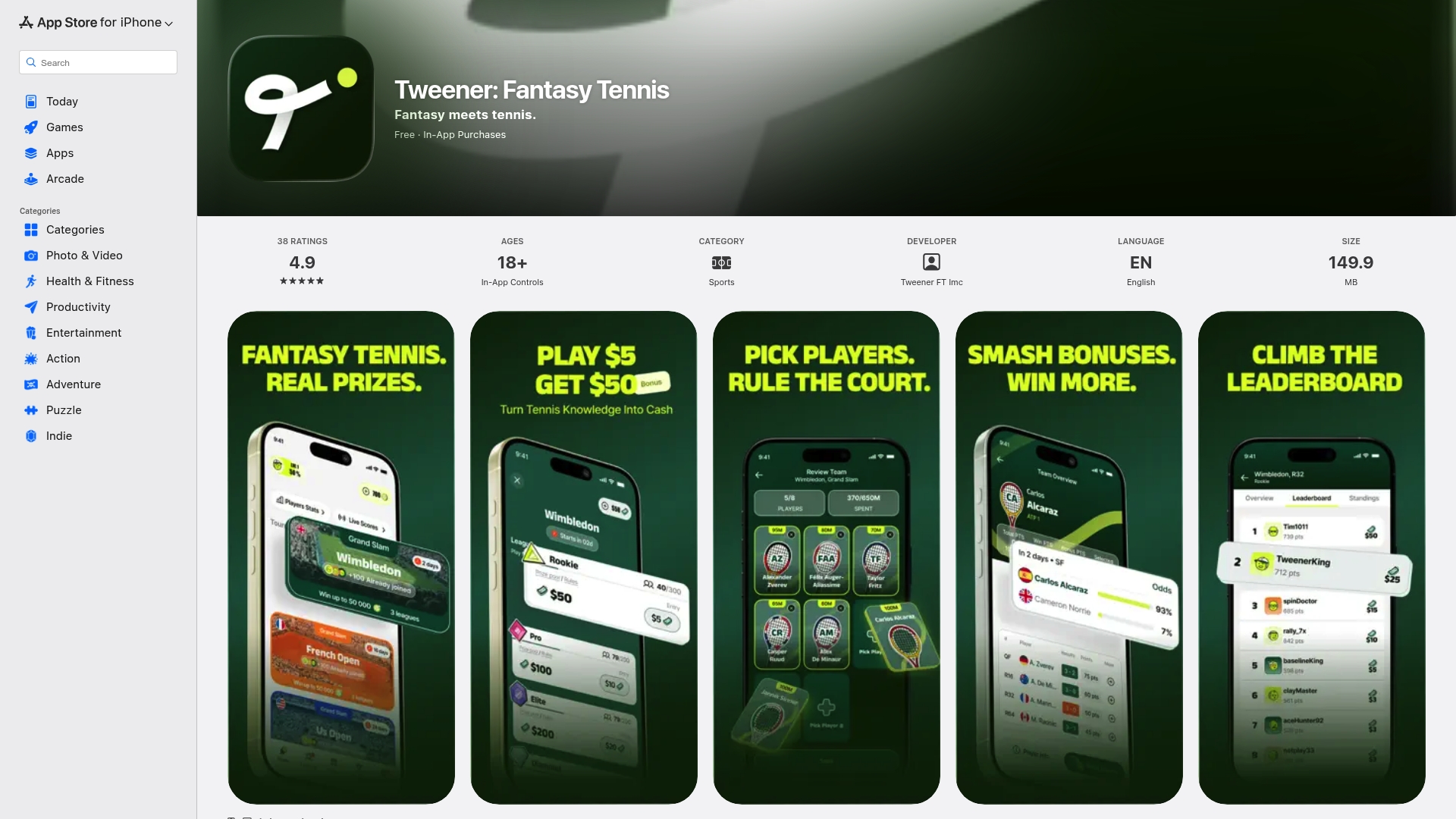
The strategic layer is real. Surface-specific form, head-to-head records, and player fitness all factor into which picks win leagues. Tweener rewards the fans who do their homework, not the ones who pick by name recognition. You can play for free using virtual coins or enter cash contests where legally permitted. If you take surface advantage seriously, Tweener is where that knowledge pays off.
FAQ
What is surface advantage in tennis?
Surface advantage in tennis is the competitive edge a player gains when a court's physical properties, including ball speed, bounce height, and traction, align with their playing style. It is a measurable phenomenon that shapes tactics, match outcomes, and player performance across the ATP and WTA tours.
Why does surface matter so much in professional tennis?
A 100mph serve retains 92mph on grass but only 78mph on clay, a 20% difference that fundamentally changes which tactics are viable. Surface physics determine rally length, shot selection, and movement patterns, making surface one of the strongest predictors of match outcomes.
Which surface is the hardest on a player's body?
Hard courts carry the highest physical toll because they transmit the most impact to joints. Clay courts are the gentlest surface, allowing sliding that reduces stress on knees and hips, which is why clay court specialists often extend their careers longer than hard court specialists.
How do players adapt when switching surfaces?
Players must relearn movement patterns and shot-making within weeks when transitioning between surfaces. The most effective adaptation strategy is simplifying the game during the transition rather than trying to replicate surface-specific patterns that do not transfer.
How can surface data improve fantasy tennis picks?
Filtering a player's win rate, serve percentage, and break point conversion by surface produces far more accurate matchup analysis than using overall rankings. Picking a clay specialist for a hard court draw, or ignoring a grass court server's surface-specific record at Wimbledon, are the most common and costly mistakes in fantasy tennis.