

TL;DR:
- Live scoring transforms tennis viewing by providing real-time data on momentum and tactics.
- For fantasy players, live scores enable quick lineup adjustments and risk management based on current performance.
- Users should be aware of potential system errors and verify data through secondary sources for accurate insights.
Watching a tennis match changes completely when you know what the numbers mean in real time. It's not enough to see the score tick over on a broadcast graphic. The real question is whether you're using that data to understand momentum, anticipate tactical shifts, and make smarter decisions about who to watch and who to pick on your fantasy roster. Live scoring has quietly become one of the most powerful tools available to tennis fans and fantasy competitors alike, and most people are still only scratching the surface of what it can do for them.
Table of Contents
- What makes live scoring essential in tennis?
- Key advantages for tennis fans: Engagement, clarity, and analysis
- Key advantages for fantasy sports players: Dynamic competition and actionable insights
- Limitations and reliability: What to watch out for with live scoring
- Advantage comparison: Fans vs. fantasy players
- Perspective: Why live scoring matters more than you think (and where it falls short))
- Get more from live scoring: Try Tweener for seamless real-time tennis action
- Frequently asked questions
Key Takeaways
| Point | Details |
|---|---|
| Instant engagement | Live scoring makes watching tennis more interactive and insightful by providing real-time updates and analysis. |
| Fantasy strategy boost | Fantasy sports players gain a competitive edge through real-time lineup and pricing decisions informed by live stats. |
| Know the limits | Errors can occur in live scoring systems, so users should cross-reference major plays and planning with multiple sources. |
| Audience-tailored benefits | The strongest live scoring advantages depend on whether you're seeking engagement or fantasy competition success. |
What makes live scoring essential in tennis?
Tennis has always been a sport rich in data. Every point carries weight, and momentum can reverse inside a single game. For decades, though, fans had to wait for post-match summaries to understand what actually happened tactically. Live scoring changed that by delivering data as the action unfolds, turning each point into a trackable signal rather than just a moment that passes.
Live scoring improves tennis-fan engagement by turning matches into trackable, decision-relevant data flows rather than just a broadcast summary, making momentum and tactical shifts easier to follow in real time. That shift from passive to active following is significant. You stop watching a match and start reading it.
Here are the core ways live scoring fundamentally changes how you engage with tennis:
- Momentum tracking: You can see win probability shift point by point, not just game by game.
- Instant stats: First-serve percentage, break-point conversion, and winner-to-error ratios update continuously.
- Context for decisions: A player's second-serve performance in a pressure tiebreak becomes visible in real time, not just in retrospect.
- Decision relevance: For fantasy players especially, live data ties directly to lineup choices that affect real outcomes.
- Tactical pattern recognition: Watching how tennis scoring works in combination with live stat feeds reveals patterns that a score alone never could.
"The shift from passive viewing to active, data-driven engagement is the biggest transformation in how tennis fans experience the sport today. Live data is the bridge between watching and understanding."
That quote captures why live scoring matters at a foundational level. It's the difference between following a story and understanding the plot.
Key advantages for tennis fans: Engagement, clarity, and analysis
For fans who simply love the sport, live scoring opens up a layer of the game that used to be reserved for coaches and analysts. You don't need a background in statistics to benefit. The tools are intuitive, and the insights arrive exactly when they're most useful.
The most immediate benefit is understanding momentum. A player who wins five straight points on their opponent's serve hasn't just won points. They've shifted psychological weight. Live stats let you quantify that shift by showing serve speed dropping, errors climbing, or first-serve percentage falling in the third set. These are signals that something real is happening on court, and live scoring makes them visible.
Fans can track momentum shifts and tactical changes during matches using real-time statistics rather than waiting for post-match recaps, and the result is a more interactive viewing experience. When you know a player's second-serve win rate has dropped from 55% to 38% in the third set, you understand why the commentator is talking about nerves. You're not just hearing analysis. You're seeing it.
Key engagement benefits live scoring delivers for tennis fans include:
- Better understanding of tactics: You can see when a player shifts from aggressive baseline play to a defensive retriever role in real time.
- Context for momentum: A run of points lands differently when you can see the accompanying stat trajectory.
- Thrill of data-driven fandom: Platforms built around tennis prediction games let you act on what you're seeing, adding a competitive dimension to every match.
- Reduced reliance on commentators: You stop needing someone to tell you what's happening and start reading it yourself.
- Greater access to interactive sports apps that layer stats, visualizations, and predictions over live action.
Pro Tip: During live matches, watch for swings in second-serve win rate rather than just aces or double faults. A player whose second-serve win rate drops below 45% in a critical set is under serious pressure, even if the score doesn't reflect it yet. That's the kind of signal that separates engaged fans from casual observers.
While tennis fans enjoy these real-time insights, fantasy players take things to another level, where live data isn't just informative but decisive.
Key advantages for fantasy sports players: Dynamic competition and actionable insights
Fantasy tennis is a different kind of engagement. The stakes are higher, the decisions are more frequent, and a single live data point can change what your optimal lineup looks like. That's what makes live scoring so powerful for fantasy competitors. It compresses the decision cycle from days or weeks down to hours or even minutes.

For fantasy tennis players, live or near-live scoring creates a more dynamic competition loop, where lineup decisions can be re-optimized as new performance signals arrive. In practice, that means the gap between informed players and uninformed ones grows wider as a tournament progresses.
Here are the key advantages live scoring creates for fantasy players:
- Make smarter lineup changes. When a player you've selected starts struggling with their serve or is clearly nursing an injury, real-time stats give you the signal before the match ends. You react, not after the fact.
- Track bargain players vs. trap players. Live form data reveals when a low-ranked player is outperforming their seed or when a high-priced favorite is coasting. Pricing tied to real-time rankings shifts opportunity windows.
- React to volatility faster. Tennis is inherently volatile. A top seed dropping a set to an unseeded qualifier changes expected point totals. Live scoring lets you reassess before your competitors notice the pattern.
- Leverage historical patterns against live signals. Combining surface-specific win rates from fantasy sports strategy resources with live performance gives you a more complete picture than either source alone.
- Use live data for risk management. If a player you're considering has a pattern of collapsing in tiebreaks and you're watching them head toward one live, that context changes how much risk you assign to that pick.
Using predictive analytics strategies alongside live stats creates a layered edge. You're not guessing. You're pattern-matching in real time.
Pro Tip: Don't make lineup changes purely based on a single bad game. Look for sustained stat degradation across at least four or five consecutive service games before assuming a player is in real trouble. Single-game blips happen to every player. Trends are what matter.
Limitations and reliability: What to watch out for with live scoring
No tool is perfect. Live scoring systems are fast, but speed and accuracy don't always coexist comfortably. Understanding where the data can go wrong protects both your enjoyment as a fan and your outcomes as a fantasy player.
Operationally, real-time scoring systems can fail, creating edge cases where replay or correction is required. Accuracy depends on correct event detection and system uptime and settings. A Wimbledon quarterfinal, one of the highest-profile matches in tennis, illustrated this when electronic linecalling malfunctioned mid-match, creating confusion for players, officials, and everyone tracking the data downstream.
Common limitations to watch for include:
- Point boundary misclassification: The system records a point before it's actually complete, creating a temporary error in score feeds.
- System outages: High-traffic moments during major tournaments can overwhelm data pipelines, causing delays.
- Incorrect stat attribution: Winners can be logged as forced errors and vice versa, skewing performance metrics.
- Delayed corrections: Even when errors are caught, downstream platforms like broadcast graphics or fantasy scoring engines may not update immediately.
- The need to track player performance across multiple sources, not just one live feed, to verify unusual stat spikes.
| Error type | Real-world example | Impact on users |
|---|---|---|
| Point boundary misclassification | Electronic line system firing early | Temporary incorrect score on all feeds |
| System outage | Data pipeline overload at Grand Slams | Delayed updates for several minutes |
| Stat misattribution | Winner logged as forced error | Skewed analytics and fantasy scoring |
| Correction latency | Fixed score not updated on third-party apps | Users acting on outdated data |
"Even reputable live scoring pipelines can produce incorrect classifications at point boundaries, so downstream systems including broadcast graphics, fantasy triggers, and win-probability models must plan for corrections and replays."
The lesson here is practical: treat live scoring as a high-quality signal, not infallible truth. Knowing where to check live tennis predictions against secondary sources adds a layer of confidence before you commit to a decision.
Advantage comparison: Fans vs. fantasy players
Weighing these strengths and pitfalls, it helps to see clearly how live scoring benefits each audience differently. The advantages overlap, but the emphasis shifts considerably depending on what you're trying to get out of the experience.
| Benefit | Tennis fans | Fantasy players |
|---|---|---|
| Real-time momentum tracking | Core engagement tool | Informs substitution timing |
| Stat context (serve %, errors) | Deepens tactical understanding | Drives pricing and lineup logic |
| Volatility visibility | Adds drama and suspense | Triggers risk reassessment |
| Correction awareness | Minor frustration | Can affect scoring accuracy |
| In-game decision support | Optional enhancement | Often decisive for outcomes |
Methodology nuance for fantasy competitors: when fantasy pricing or incentives are linked to live rankings or live-form proxies, strategy should explicitly incorporate volatility risk. Lineup moves may change drastically after one tournament's results.
Best practices for each group:
- Fans: Use live stats to build tactical literacy, not just to track scores. Focus on serve patterns and break-point frequency.
- Fantasy players: Cross-reference live stats with historical surface data before making lineup changes. Speed matters, but accuracy matters more.
- Both groups: Maintain at least one backup data source to verify unusual stat movements before treating them as real.
- Fantasy players specifically: Explore fantasy team competitions that incorporate live pricing adjustments, since those create the most dynamic decision environments.
Perspective: Why live scoring matters more than you think (and where it falls short)
Here's a view that most content on this topic won't give you: live scoring's greatest strength is also its greatest trap. The immediacy of real-time data creates an illusion of certainty. You see a stat change and you act. But the act of acting quickly on a single data point is exactly what separates reactive players from strategic ones.
The most effective users of live scoring, whether they're fans building tactical literacy or fantasy players competing for real outcomes, treat the data as a layer of evidence rather than a verdict. They use it to confirm what they already suspect based on deeper research, not to replace that research. A tennis analytics insights approach means entering every match with a hypothesis about how it might unfold, then using live data to test and refine that hypothesis in real time.
The danger is in the opposite approach: opening a live scoring feed cold, with no prior context, and treating every stat fluctuation as a signal. That leads to overreaction. You pull a fantasy player after one bad game. You write off a momentum shift that turns out to be a temporary blip. You miss the bigger story because you're focused on the last five minutes.
Even reputable live scoring pipelines can produce incorrect classifications at point boundaries, so downstream systems including broadcast graphics, fantasy triggers, and win-probability models must plan for corrections and replays. Smart users build that awareness into how they consume the data. They know that a sudden spike in error count or an unexpected shift in win probability might reflect a system glitch as much as a real tactical change.
The real competitive edge in live scoring isn't speed. It's context. Fans who combine real-time data with historical knowledge of player tendencies, surface preferences, and head-to-head patterns make better sense of what they're seeing. Fantasy players who do the same make better decisions, with fewer regrets when the tournament ends.
Pro Tip: Build your match-watching habit around a pre-match checklist. Before the first point, review each player's last three matches on the surface, their break-point save rate, and any recent injury news. Then let the live scoring confirm or challenge what you already know. That combination is far more powerful than live data alone.
Get more from live scoring: Try Tweener for seamless real-time tennis action
Knowing the advantages of live scoring is one thing. Having the right platform to put them into practice is another. Tweener brings together everything this article covers, real-time match tracking, player performance data, and a competitive fantasy layer, all in a single mobile app built specifically for professional tennis fans.
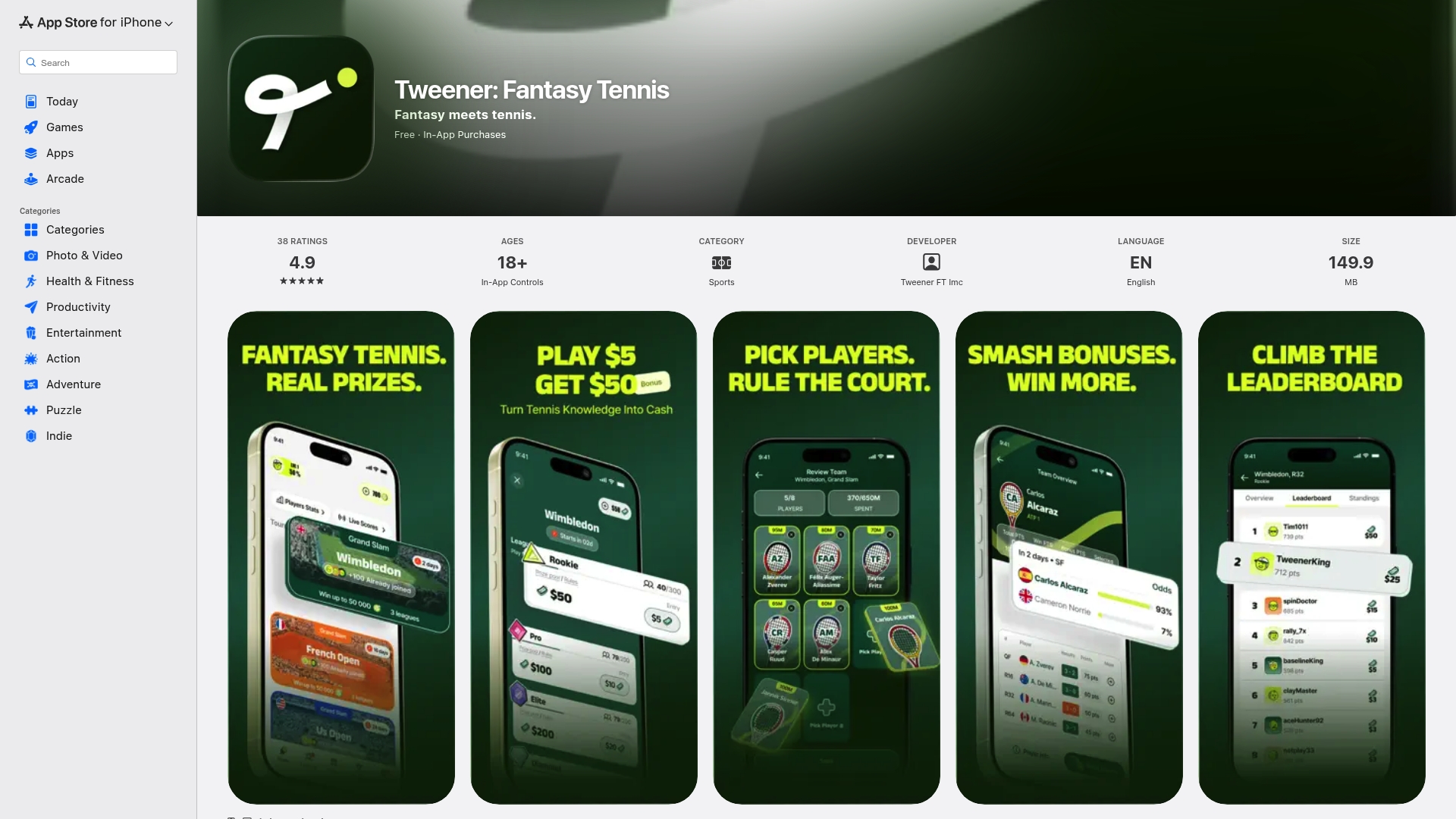
With Tweener, you can build fantasy teams from real ATP and WTA players, join public leagues or compete privately with friends, and earn points based on how your selected players perform in live tournaments. The free mode lets you compete using virtual coins, redeemable for rewards, while the cash mode opens up real-money competitions where legally permitted. Every element of Tweener live scoring is designed to make your match-watching smarter, more social, and more rewarding. If you're ready to move from passive fan to active competitor, the easiest first step is to download the Tweener app and see how quickly live data changes the way you watch tennis.
Frequently asked questions
How does live scoring improve my tennis viewing experience?
Live scoring lets you track momentum, tactical swings, and instant stats during the match, making every moment more engaging. Live scoring improves tennis-fan engagement by turning matches into trackable, decision-relevant data flows rather than just a broadcast summary.
What are the risks of relying on live scoring in fantasy sports?
System errors or real-time classification mistakes can lead to inaccurate updates, so always double-check critical moments with a secondary source. Real-time scoring systems can fail, creating edge cases where replay or correction is required.
Can live scoring really boost my fantasy team performance?
Yes, using real-time data enables timely lineup adjustments and helps you capitalize on volatile player pricing before your competitors react. Live or near-live scoring creates a more dynamic competition loop where lineup decisions can be re-optimized as new performance signals arrive.
Where can I find reliable live tennis scoring?
Platforms like Tweener and major tournament websites offer accurate, timely live scores with in-depth stats and analysis for both casual fans and serious fantasy competitors.