

Prioritize hard-court form over ranking when you draft. Filter for first-serve win percentage, low unforced-error rate, and break points won over each player's last three to six hard-court events, not their career numbers. Players like Coco Gauff, Aryna Sabalenka, and Carlos Alcaraz belong on your shortlist because their recent hard-court results back up the underlying stats, not just their seeding. Open Tweener, run that surface-and-form filter, and cut your pool down to six or eight real candidates before you touch a budget slider.
TL;DR:
- Prioritize recent hard-court performance over career averages, focusing on players with strong results in their last three to six events.
- Emphasize first-serve success and low unforced-error rates as key predictors, especially on hard courts where quick points and aggression matter most.
- Avoid drafting players based solely on season-long rankings; instead, consider their form within the last few events and draw situations.
- Adjust your player selection for court speed differences, favoring big servers and aggressive baseliners on fast courts and returners on slower ones.
- Monitor late injury updates and fatigue levels closely, keeping a backup ready to replace any scratches or retirements before lineup lock.
Table of Contents
- Your 24 to 72-Hour Pre-Lock Checklist
- How Hard-Court Dynamics Change Fantasy Scoring
- Which Stats Actually Predict Hard-Court Fantasy Points
- Building Your Roster: Budget Allocation That Works
- Fatigue and Late-Breaking News: Your Risk Checklist
- Review Every Tournament to Sharpen Your Edge
- Picking Players by Hard-Court Surface Fit
- What Recent Hard-Court Events Reveal About Player Form
- Adjusting Lineups for Court Speed Differences
- Playing Styles That Translate Best to Hard Courts
- Mistakes That Sink Hard-Court Lineups
- Nathan's Take: Why Surface Awareness Wins Titles
- Run This Strategy Inside Tweener
- Sources
Your 24 to 72-Hour Pre-Lock Checklist
The window before lineup lock is where fantasy tennis rosters get won or lost, mostly because people skip steps under time pressure. Run this in order, every time.
- Filter your pool to players with strong results in their last three to six hard-court events, not their overall season.
- Check withdrawal lists and reporter updates on official tour sites and credible beat reporters before you finalize anyone.
- Scan the draw for soft early rounds. A player with a clean path to the fourth round carries more expected fantasy points than a similarly ranked player facing a seeded opponent in round two.
- Adjust for fatigue. Fade players coming off a deep run at the prior event, especially if they played multiple three-set matches in the last ten days.
- Hold back a slice of budget for a late value pivot once the draw and injury news settle.
Pro Tip: Set an alert on your top five targets the night before lock. A single retirement announcement two hours before matches start can wreck a lineup that looked airtight the day before, and a systematic surface-and-form routine catches most of these before they cost you.
How Hard-Court Dynamics Change Fantasy Scoring
Hard courts play faster than clay and slower than grass, and that middle-ground speed rewards a specific kind of player. Rallies stay short and first-serve effectiveness climbs, reaching a notably higher first-serve effectiveness in studies of Grand Slam point sequences on hard courts compared with clay. That single number should reshape how you weigh players.
Two rules follow directly from this. First, favor first-serve effectiveness and a low unforced-error rate over flashy winner totals alone. Second, prefer aggressive baseliners and big servers over grinders who rely on long rallies to wear opponents down, since those extended points simply happen less often on hard courts.
Random-forest modeling of surface-specific winning factors backs this up: unforced-error rate carries more predictive weight on hard courts than it does on clay or grass, where retrieving and rally construction matter more. Consistency, not just aggression, separates the players who convert good form into fantasy points.
This is also where headline rankings mislead you. Surface effects are real, and analysis of Grand Slam results from 2013 to 2019 found meaningful performance differences by surface even after accounting for rank and opponent strength. A few concrete comparisons:
- A No. 25 player riding a 12-4 hard-court stretch with a strong first-serve percentage often outscores a top-five seed grinding back from injury.
- A big server with a modest overall record can outproduce a more decorated all-court player if the draw sets up short matches and few break points against.
- Rankings reflect 52 weeks of results across three surfaces; your fantasy pool only cares about the next nine days on one surface.
Statistic to remember: first-serve effectiveness on hard courts sits meaningfully above clay-court rates, which is exactly why serve-heavy profiles score better than pure retrievers once the tournament moves onto concrete.
Which Stats Actually Predict Hard-Court Fantasy Points
Not every stat on a broadcast graphic deserves your attention. Here's what to check, ranked by how much it should move your decision:
- First-serve win rate — the single strongest predictor across surfaces, and the first number to check.
- Second-serve win rate — nearly as predictive; a weak second serve gets exposed more often on hard courts because return position is more aggressive.
- Unforced-error rate — carries extra weight on hard courts specifically, since short points punish sloppy shot selection fast.
- Winner rate — matters, but only alongside a low error rate. High winners with high errors is a volatile, boom-or-bust profile.
- Break points won — a cleaner read on clutch performance than total points won, since it isolates pressure situations.
Weight the last three to six hard-court events more heavily than career averages. Players change coaches, adjust their serve motion, or simply enter a hot stretch, and recent surface-specific form outpredicts long-term averages more often than not.
A simple composite works better than eyeballing a stat sheet: add first-serve win rate and second-serve win rate, subtract unforced-error rate, and add break points won as a percentage. Rank your shortlist by that number, not by ATP or WTA ranking.
Pro Tip: If you're picking with five minutes on the clock, check just two numbers: first-serve win rate over the last month and whether the player has a three-set match in their last 72 hours. Those two alone catch most of the bad picks.
Building Your Roster: Budget Allocation That Works
Split your budget roughly 60% on proven stars and 40% on value picks, a ratio Tweener's own tournament preview data supports for hard-court events. Push closer to 70/30 in cash contests where variance hurts you, and closer to 50/50 in large-field tournaments where you need a differentiated roster to separate from the pack.
Your value picks should fit a specific profile, not just "cheap and hoping":
- Ranked between roughly No. 20 and No. 60, where price tags drop but talent doesn't.
- Showing a positive hard-court trend over their last three to six events, not just a decent career mark.
- Sitting in a draw with at least one round of favorable matchups before facing a top seed.
- Healthy, with no red flags in recent match withdrawals or retirements.
Before you lock anything, run three final checks: confirm no late injury news, glance at each opponent's playing style to make sure it doesn't neutralize your pick's strengths, and have a backup selected in case a late scratch forces a swap. Templates for full roster construction are worth bookmarking if you want a repeatable structure to plug new players into each tournament.
Fatigue and Late-Breaking News: Your Risk Checklist
Fatigue is measurable, not a gut feeling. Track match minutes over the last two weeks, count how many three-set or five-set matches a player has logged, and note travel between events.
- Fade a player who played three matches over three hours in their last event and now faces a tough second-round draw.
- Keep a player who won in straight sets and had a bye or walkover recently, even if the surface stats aren't spectacular.
- Check tour injury reports and reliable beat reporters within a few hours of lock, not the night before.
- Have one backup ready per star pick so a scratch doesn't force a rushed decision.
Pro Tip: Real-time monitoring in the hours before matches start catches most retirements and late scratches before they wreck a locked roster.
Review Every Tournament to Sharpen Your Edge
Log four things after every event: the player, the surface, predicted points versus actual points, and the likely cause of any big miss (injury, upset, bad matchup read).
- Calculate your hit rate on star picks versus value picks separately. Most drafters overestimate how often their stars actually justify the price.
- Run one controlled change per tournament, like shifting the weight on unforced-error rate in your composite score, so you can tell what actually moved the needle.
- Update your checklist with anything that cost you points twice. If a fatigue miss burns you two events in a row, that's a rule, not bad luck.
Small, consistent adjustments compound. A drafter who tracks this for a full season out-drafts one who resets their thinking every tournament.
Picking Players by Hard-Court Surface Fit
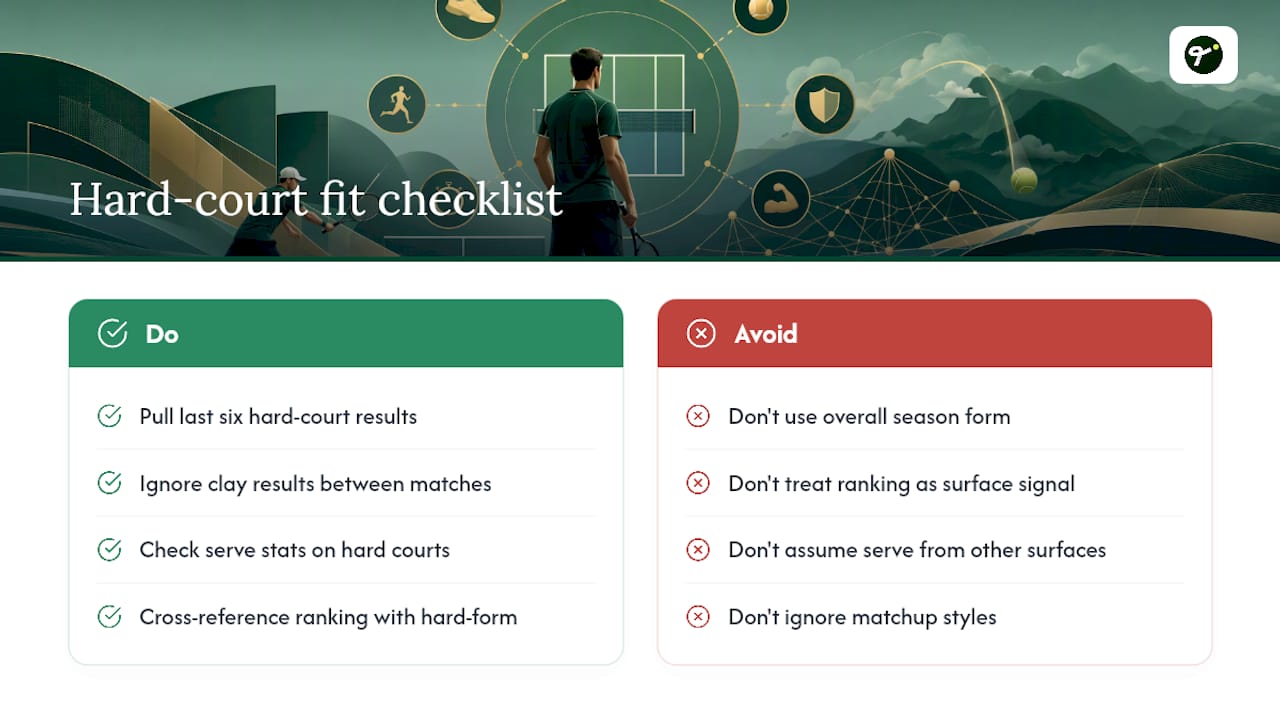
Surface fit isn't about who has the best overall season. It's about who has shown, specifically on hard courts, that their game translates into points. Start by pulling each candidate's last six hard-court results and ignoring everything they did on clay in between.
Look for players whose serve numbers hold up against comparable competition on hard courts specifically. A player who serves well on grass but struggles with return depth on hard courts is a different fantasy profile entirely, even if the box score looks similar. Gauff's hard-court results, for instance, have leaned on movement and return depth more than raw serve power, which matters when you're pairing her with a big server elsewhere on your roster for balance.
Cross-reference ranking with recent hard-court results rather than treating them as the same signal. A player ranked in the top ten but 2-4 in their last six hard-court matches is a worse pick than a No. 30 player who's 5-1 over the same stretch on the same surface. This is where matchup-level analysis earns its keep, since it tells you not just whether a player is in form, but whether their specific style beats what they'll actually face in the draw.
What Recent Hard-Court Events Reveal About Player Form
Court speed and conditions shift year to year even at the same venue, and those shifts change who scores well. The Australian Open and US Open both play as hard-court Grand Slams, but their conditions aren't identical. Heat, humidity, and ball selection all affect rally length and serve dominance differently at each event.
Analysis of Grand Slam outcomes from 2013 to 2019 found real performance differences by tournament even after adjusting for ranking, which tells you conditions matter beyond just "hard court" as a single category. A player who thrived at a fast indoor hard-court event in the fall doesn't automatically repeat that form at a slower outdoor hard-court major in humid conditions.
Practically, this means checking recent match reports for mentions of court speed before you assume a player's last result transfers directly. A big server who dominated on a fast surface may see his advantage shrink if the next event's courts play noticeably slower. Watch practice reports and first-round match stats from the tournament itself, since early-round conditions often preview how the rest of the draw will play.
Adjusting Lineups for Court Speed Differences
Not all hard courts are the same speed, and that variation should shift your player weighting event to event. Indoor hard courts tend to play faster, rewarding big servers and flat hitters. Outdoor hard courts, especially in humid conditions, slow the ball down and give returners and grinders more time to set up.
Check tournament history before you draft. If an event has a reputation for playing slow, discount pure serve-and-forehand players slightly and bump up players with strong return games and lower unforced-error rates. If it's known for fast conditions, the opposite adjustment applies.
A practical adjustment: keep two versions of your composite ranking, one weighted more toward serve stats for fast conditions and one weighted more toward error rate and return stats for slow conditions. Swap between them based on the specific tournament rather than using one static formula all season. This small habit separates drafters who treat "hard court" as one category from those who treat it as a spectrum, and the spectrum is where the real edge sits.
Playing Styles That Translate Best to Hard Courts
Aggressive baseliners with a reliable first serve tend to be the safest hard-court fantasy profile. Short points mean fewer opportunities for unforced errors to pile up, and a strong serve converts directly into free points. Alcaraz fits this mold well: his combination of serve power and shot-making translates cleanly to hard-court conditions because he can end points quickly without needing a long rally to set up a winner.
Big servers with limited return games are boom-or-bust picks. They score heavily against weaker returners but can get exposed against elite return specialists, so check the specific matchup before locking them in as a safe play.
Counterpunchers and pure retrievers are the riskiest profile on hard courts. Their game depends on extended rallies, and shorter average points on hard courts mean fewer chances to grind opponents down. Sabalenka's game splits the difference well for fantasy purposes: heavy first-strike hitting paired with enough return consistency to still generate break points, which is exactly the profile the stats above reward. Match each player's style against their draw, not just against the field average, before you finalize a roster spot.
Mistakes That Sink Hard-Court Lineups
The most common error is drafting by season-long ranking instead of recent hard-court form. A player having a great clay swing tells you almost nothing about how they'll perform once the tour shifts to hard courts.
The second mistake is ignoring the draw entirely. A talented player facing a brutal second-round matchup is a worse value than a modest player with two winnable rounds ahead, regardless of who looks better on paper.
Third, drafters chase last week's box score instead of a multi-event trend. One big performance can be noise; three to six events of consistent first-serve and error numbers is signal.
Fourth, people skip the fatigue check entirely. A player who just played a five-set marathon two days before their next match is a fade candidate even if their underlying stats look great, and skipping that check is how strong-looking rosters lose to injuries nobody saw coming.
Finally, over-committing your budget to two or three stars leaves no room to pivot when news breaks late. Keep that reserve, every time.
Nathan's Take: Why Surface Awareness Wins Titles
Most fantasy tennis advice treats every hard-court event the same, and that's the gap Tweener was built to close. Nathan's strategy work keeps coming back to one point: surface-specific form beats season-long reputation, every time it's tested. Tweener's filters let you sort by exactly that, layering H2H data and recent form on top of raw rankings. One user last season swapped a struggling top-five seed for a hot mid-ranked server using this exact filter combo before an Australian Open lineup lock, and it turned a mediocre roster into a real contender.
— Nathan
Run This Strategy Inside Tweener
Tweener is built around exactly the filters this article just walked through: surface-specific form, head-to-head history, and recent-event weighting, all in one place instead of six open browser tabs. It's the closest thing tennis has to a Fanduel or DraftKings-style DFS experience, and it's built specifically around the stats that actually predict hard-court scoring.
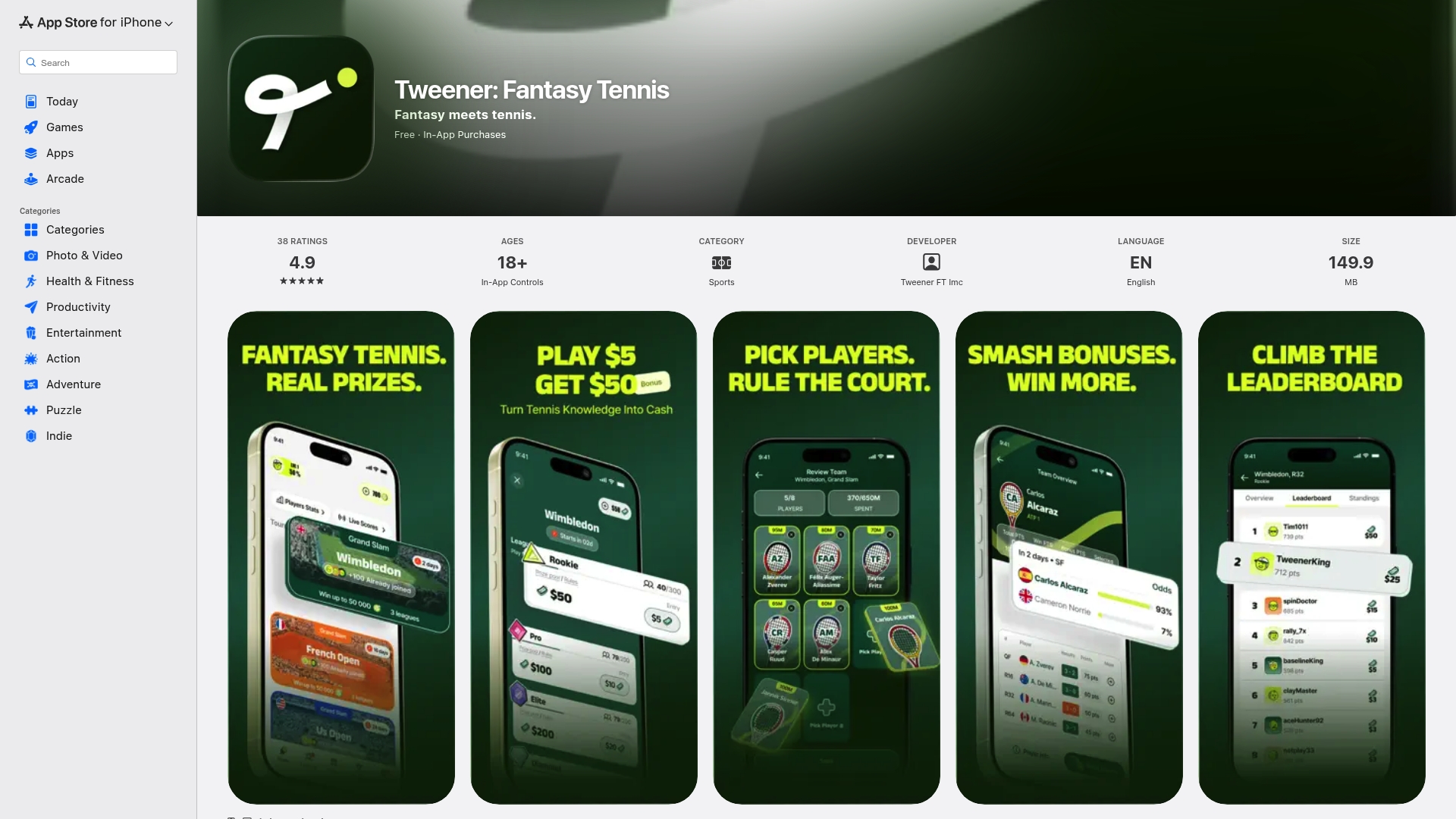
Beyond the surface filters, Tweener lets you set up private leagues with up to nine friends for Grand Slam events like the Australian Open and US Open, so your hard-court strategy gets tested against people you actually know, not just an anonymous leaderboard. For those looking to personalize your fantasy experience further, check out How to Pick a Fantasy Team Name for creative ideas to name your league and teams. Play free with virtual coins redeemable for rewards, or step into cash contests where the skill edge you just built actually pays off. If you're ready to put this checklist to work on the next hard-court draw, download Tweener and set up your first surface filter before the next tournament locks.
Sources
- Examining differences in match outcomes across Grand Slams (2013–2019)
- Match analysis in women's tennis on clay, grass and hard courts
- Analyze tennis winning factors across different surfaces using random forest