

A qualifier is a player who won their way into the main draw through a separate pre-tournament event. In fantasy tennis, that makes them a cheap, high-variance pick. They arrive with match toughness and nothing to lose, but they often face a seed in round one. The best use of a qualifier is a calculated bet on a good matchup, not a hunch about a famous name.
This guide covers what the "Q" beside a name means, how qualifiers differ from wildcards and lucky losers, when they become available to pick, and how to decide whether one belongs on your roster.
TL;DR
- A qualifier (marked "Q" in the draw) earned a main-draw spot by winning the qualifying event. A wildcard was invited, and a lucky loser lost in qualifying but got in after a withdrawal.
- Qualifiers usually enter the picture late: you often see them only once qualifying finishes and the main draw is set. Plan your lineup timing around that.
- Qualifiers carry real upside because they have already won matches on-site, but their first-round draw is often brutal. Check the opponent, surface and recent form before you commit.
- Withdrawals, retirements and walkovers can wipe out a pick fast. Read your contest's rules on those cases before the lock.
- Tweener offers Draft Mode and Pick'em Mode for ATP and WTA tournaments, so you can use qualifiers as a lineup edge or leave them out.
Table of Contents
- What "qualifier" means in tennis
- Can you pick qualifiers in fantasy tennis?
- Why qualifiers can be a fantasy edge
- Why qualifiers can also sink your lineup
- A five-question checklist before you draft a qualifier
- A worked example: weighing two qualifiers
- Withdrawals, walkovers and retirements
- Where qualifiers fit in each Tweener mode
- Perspective
- Try it on the next draw
- FAQ
- Sources
What "qualifier" means in tennis
Every big tournament has more hopefuls than main-draw spots. Qualifying is a mini-tournament played just before the main event, and the winners of its final round earn a place in the main draw. In the draw sheet, those players are tagged with a "Q". Our full guide to the qualifying round goes deeper on the format, but here is the short version.
Three labels get mixed up constantly, and the difference matters for fantasy:
| Entry type | How they get in | What it tells you as a fantasy player |
|---|---|---|
| Qualifier (Q) | Wins the qualifying rounds | Has played and won matches on-site, on the same courts |
| Wildcard (WC) | Invited directly by the tournament | Often a local or rising player, or a veteran returning; no match play guaranteed beforehand |
| Lucky loser (LL) | Lost in the last round of qualifying, then replaces a withdrawn player | Gets in late, sometimes the day of the match |
Those definitions line up with how a tennis equipment retailer's explainer describes the three routes, and the lucky loser rule sits in the official sport rulebooks. The Grand Slam rule book covers lucky losers replacing players who withdraw on-site, including how prize money works for them once they play.
How hard is it to qualify?
It is a grind. At a Grand Slam, 128 men and 128 women compete in qualifying, and only 16 men and 16 women advance to the main draw at the US Open. That means a qualifier typically has to win three straight matches against players ranked just outside the main-draw cutoff, often in heat and on outer courts.
Smaller events work the same way with smaller fields. At a WTA 1000 such as Cincinnati, the official qualifying draw is a standalone singles bracket, and getting through it earns ranking points before the player has even entered the main draw.
For a fantasy player, the takeaway is simple: a qualifier is not a random name. They are usually a ranked professional ranked a bit below the main-draw line who just proved they can win on this exact surface in these exact conditions.

Can you pick qualifiers in fantasy tennis?
It depends on the game and, more precisely, on timing. Qualifiers are only known once qualifying ends, which is usually shortly before the main draw begins. If a contest locks its player pool before then, qualifiers cannot be picked at all. If a contest opens or updates its pool after the draw is made, they appear alongside everyone else.
So the practical rule is to check the player pool for each tournament instead of assuming. In Tweener, you can see which players are available for the event you are entering, and the rules for each contest are shown in the app. If you want a quick refresher on how contests are built before you pick, our guide to how fantasy tennis points are calculated covers the scoring logic.
The draw-timing trap
Grand Slams are the clearest example. The main draw is made after qualifying finishes, so the full field, including every Q, wildcard and lucky loser, is not set until that point. Entering a contest early means you are picking from a partial picture. Entering late means you see the real draw, with matchups, but you have less time to think.
A useful habit: build your core players first, then leave one or two roster spots flexible until the draw is final. Qualifiers with a soft opener are often where the value hides.
Why qualifiers can be a fantasy edge
They arrive match-sharp
A qualifier has just played up to three matches on the same courts and in the same conditions. A top seed might have had a week off. In round one, that gap sometimes shows up as a cold start for the seed and a warm one for the qualifier.
They are usually cheap or lightly picked
In salary or popularity terms, qualifiers are typically the least-owned players in a field. In a head-to-head contest or a small private league, a low-owned player who wins is a differentiator. If everyone in your league has the same four stars, one qualifier who strings together two upsets can decide the standings.
Their scoring ceiling is the same as everyone else's
Once a qualifier is in the main draw, they earn the same prize money and ranking opportunities as any other player who reaches that round. Fantasy scoring based on real match results works the same way: a main-draw win is a main-draw win, whichever door the player came through.
Why qualifiers can also sink your lineup
The other side is variance. A qualifier often draws a seeded player in round one. If that seed is healthy and on form, the qualifier's most likely outcome is an early exit and a very low score.
Fatigue is also real. A qualifier who went three rounds in three days may have less in the tank for a best-of-five match at a Slam. And a qualifier who survived on a few tiebreaks is not necessarily playing better than the rankings suggest. Our explainer on tiebreak scoring in fantasy tennis shows why close sets matter to the scoring.
A five-question checklist before you draft a qualifier
- Who is the first-round opponent? A qualifier against a seed ranked outside the top 20, or against another qualifier or wildcard, is a very different bet than one facing a top-10 player.
- What is the surface record? A clay specialist who qualified at a hard-court event is not the same as a hard-court regular. Look at the last 12 months on the specific surface, not the overall ranking.
- How did they get through qualifying? Straight-set wins suggest health and rhythm. Three-setters in every round suggest the opposite.
- What is the head-to-head, if any? Qualifiers often have played main-draw opponents on the Challenger circuit. A prior win is a meaningful data point.
- Is there any injury or withdrawal risk? Look for recent retirements, medical timeouts or a late scratch from a previous event.
If a qualifier passes four of five, they are worth a roster spot. If they pass two, play the stars. For more on building around data like this, see our guide to player selection in fantasy tennis.
A worked example: weighing two qualifiers
Imagine two qualifiers in the men's draw at a hard-court Masters event.
Qualifier A won three qualifying matches in straight sets, is ranked in the 90s, has a winning record on hard courts this season, and faces a seed ranked in the high 20s who just returned from a minor injury.
Qualifier B won through qualifying in three sets each time, sits just outside the top 150, has a clay-heavy record, and faces a top-10 seed.
Qualifier A is a reasonable upside pick: good form, favorable surface, a beatable opponent. Qualifier B is the kind of name that looks tempting because it is cheap or unowned, but the matchup points to a likely one-and-done. Same entry label, very different expected value.

This is the core idea behind thinking about fantasy tennis as a skill game. You are not betting on a label; you are estimating how likely a player is to win rounds, and how many points each win is worth. Our piece on fantasy tennis strategy builds on this with an anchors-and-attackers approach: stable stars as your base, and a couple of higher-risk picks, qualifiers among them, to swing the result.
Withdrawals, walkovers and retirements
Tennis has one unusual feature that fantasy players need to respect: a match is not always played to completion. A player can withdraw before the match, receive a walkover, or retire mid-match. A qualifier or lucky loser who replaces a withdrawn player can also shift the draw after you have set your lineup.
How each case is scored is set by the specific contest, so read the rules before the lock and not after. In Tweener, the contest rules explain how results are handled; if you are unsure, check them in the app before entering a paid contest. For the live side of this, how live tennis results shape your fantasy strategy walks through reacting as matches unfold.
A general principle holds everywhere: a pick who cannot play cannot score. Diversify so that one withdrawal does not take down your whole lineup. In some fantasy formats, rostering two players who may face each other is also a poor idea, since one of them has to lose; the DFS tennis basics from FTN Fantasy explain why players lose points for games and sets lost.
Where qualifiers fit in each Tweener mode
Tweener is built exclusively for tennis, with ATP and WTA tournaments, so these questions are the daily reality of the game.
- Draft Mode: You build a roster of real players. Qualifiers are your value picks, the players who can outscore their cost or their popularity.
- Pick'em Mode: You pick match winners. A qualifier facing another qualifier, or a wildcard, is often a coin flip where research gives you the edge. A qualifier facing a top seed is usually a pass.
Both modes score off real match results, and both let you play against friends in private leagues. For a Grand Slam, you can set up a league with up to 9 friends and see whose read on the draw was best.
Perspective
We built Tweener because tennis never had its own serious daily fantasy game. Football and basketball fans have had polished platforms for years, and tennis fans have mostly been left with spreadsheets and group chats.
Qualifiers are where that gap shows. They are the most information-rich and least understood part of a draw. A fan who watched qualifying, checked who won in straight sets, and noticed a soft first-round matchup has a real edge over someone who picks only names they know. That is skill, not luck.
This is why we think fantasy tennis is a better home for analytical fans than a simple wager. You are not guessing at one outcome. You are building a lineup, reading surfaces, head-to-heads and form, and managing risk across a whole tournament. Our free mode lets you practice that with virtual coins, and where cash contests are legally available, the same skills carry over.
Nathan
Try it on the next draw
The next time qualifying wraps up, open the draw, find the Qs with a favorable opener, and build a lineup around two or three stable stars plus one qualifier you can defend with data. Tweener lets you do that in free play with virtual coins, or in cash contests where they are legally permitted. Cash play is currently limited to select US states, and contest availability depends on where you live.
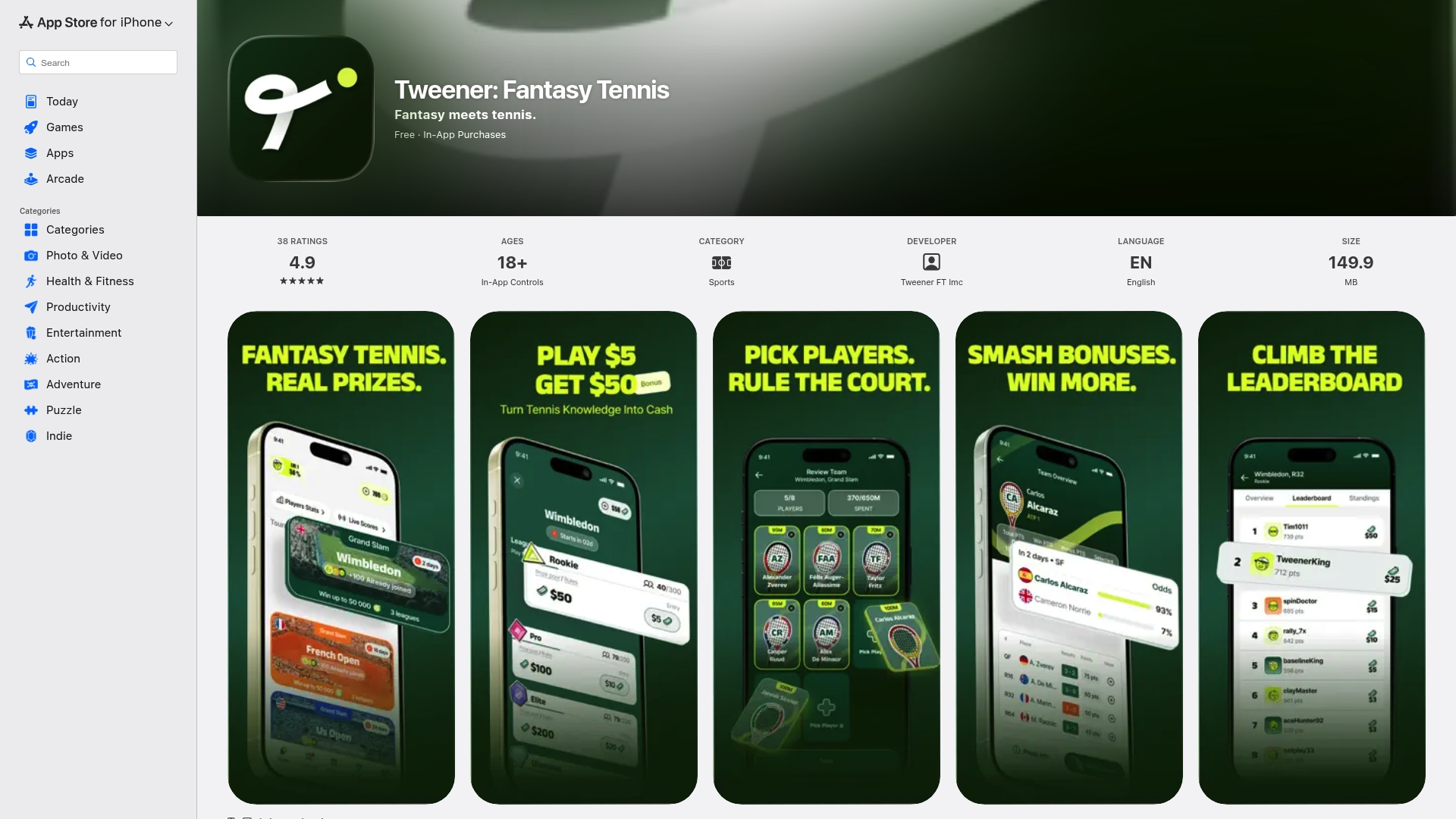
You can download the Tweener app to try Draft Mode and Pick'em Mode, or see how it all works on the Tweener home page. If you want to sharpen your lineup first, start with our guide to building a winning fantasy tennis lineup.
FAQ
What does Q mean next to a tennis player's name?
It marks a qualifier: a player who won the qualifying event to earn a main-draw spot. A wildcard is marked WC and a lucky loser LL. The label tells you how the player got in, not how well they are playing.
Is a qualifier a good fantasy tennis pick?
Sometimes. A qualifier who has just won several matches on-site, with a favorable surface and a beatable first-round opponent, can be excellent value. A qualifier drawn against a top seed is a risky pick. Judge each one by matchup, form and surface.
What is the difference between a lucky loser and a qualifier?
A qualifier wins the final round of qualifying and earns a main-draw place outright. A lucky loser loses that final round but is promoted when a main-draw player withdraws. Lucky losers often get in very late, so they rarely appear in a lineup before the lock.
What happens if my qualifier withdraws or gets a walkover?
That depends on the contest rules, so read them before you enter. In general, a player who does not play cannot score, which is why spreading your picks across several players protects you. Check the rules in the Tweener app for the specific contest.
Can I use qualifiers in a private league?
Yes, if they are in the player pool for that tournament. Qualifiers are often the most interesting picks in a private league because they are less likely to be shared by everyone, which can separate you from your friends.
Sources
- What Is a Qualifier, Wildcard, and Lucky Loser?
- US Open qualifying format and how it works
- US Open 2026 draw, schedule and qualifying overview
- Official Grand Slam Rule Book
- Cincinnati Open singles qualifying draw
- Tennis 101: Breaking down the DFS basics