

TL;DR:
- Effective fantasy tennis lineup construction requires understanding role fit, surface suitability, and matchups beyond just rankings. Selecting players who generate consistent break points and possess chemistry in doubles enhances scoring potential and stability. Adapting to the scoring model and continuously updating based on form and conditions maximizes success across tournaments.
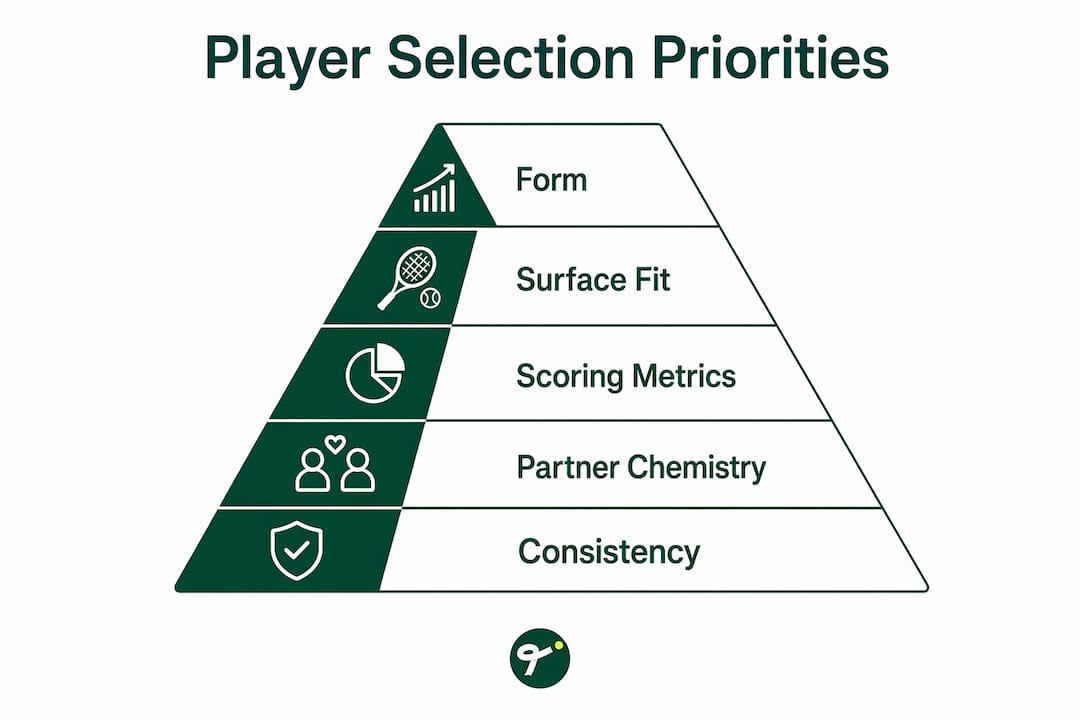
Most tennis fans assume picking the best players is obvious. Find the highest-ranked names, lock them in, and watch the points roll in. But anyone who has competed seriously in a fantasy tennis league knows that thinking breaks down fast. The importance of player selection goes well beyond grabbing whoever sits atop the ATP or WTA rankings. It is about role fit, variance management, tactical matchups, and understanding how your picks translate into actual scoring. Get those factors right, and you build a lineup that holds up across an entire tournament. Get them wrong, and your "star-studded" roster collapses in the second round.
Key takeaways
| Point | Details |
|---|---|
| Talent alone is not enough | Role fit, consistency, and system compatibility often matter more than raw rankings. |
| Variance management wins | Build a stable floor with reliable servers before adding high-upside, volatile picks. |
| Break points drive scoring | Players who create and convert break point chances generate the most fantasy value. |
| Doubles chemistry matters | Communication and defined roles outperform individual skill in doubles team selection. |
| Format shapes your criteria | Real-team selection and fantasy selection share principles but differ in key priorities. |
The importance of player selection beyond raw talent
Tennis fantasy managers tend to overvalue the ranking number. It feels logical. A top-10 ATP player should outscore a top-50 player, right? Not necessarily, and understanding why changes how you approach every lineup decision.

The concept of talent assessment in professional sports has evolved significantly. Coaches now talk about role suitability as a separate quality from individual skill. Thomas Tuchel's World Cup squad philosophy made this explicit: he prioritized social fit and supporting roles over pure star power, specifically to maintain squad harmony and consistent preparation. The same logic applies directly to tennis.
In fantasy tennis, poor player choices often come from ignoring a player's role within their own game style. A big server like John Isner might look attractive, but if the scoring format rewards return points and break conversions heavily, that same player becomes a trap pick. You are selecting someone whose greatest strength does not align with how your contest actually scores.
Here is what genuine talent assessment looks like in practice:
- Consistency vs. ceiling: Reliable floor players (think Casper Ruud on clay or Caroline Garcia on fast courts) give you a predictable points base. High-upside picks like Nick Kyrgios can deliver monster scores or crash out in round one.
- Health and form: A fully fit player ranked 30th who just won back-to-back matches often outscores a top-10 player returning from injury.
- Surface alignment: Picking players whose game fits the tournament surface is one of the highest-leverage decisions you can make.
- Schedule and travel: Players crossing multiple time zones before a hard-court swing routinely underperform their ranking suggests.
Pro Tip: Before selecting any player, check their last three tournament results on the same surface. Form on the specific surface is a stronger predictor than overall ranking, especially in the first two rounds.
Star-filled rosters struggle when players do not fit the system. In fantasy, that system is your scoring model. Matching your picks to that model is the starting point for everything else.
Doubles selection and partner compatibility
If you play fantasy formats that include doubles events, or if you follow competitive team tennis, the significance of team selection gets even more nuanced. Doubles is not two singles players sharing a court. It is a distinct discipline where chemistry and communication frequently outweigh individual pedigree.
Great doubles teams succeed through agreed serve patterns, poaching signals, and mutual anticipation built over time. Bob and Mike Bryan did not dominate doubles for 16 years because they were the most athletically gifted players available. They won because they operated as a single unit, with instinctive reading of each other's positioning and zero hesitation on split-second decisions. Long-standing partnerships consistently outperform talent-stacked but unfamiliar pairings because trust eliminates the half-second of doubt that costs points.
For mixed doubles specifically, research on elite-level paired competition has surfaced a counterintuitive finding: male players contribute roughly 53% of match variance compared to 39.7% for female players in mixed team formats. That 1.3x impact ratio suggests you should prioritize the male partner's form and matchup when evaluating mixed doubles pairings for fantasy purposes.
The table below compares what drives doubles success between chemistry-first and talent-first approaches:
| Selection approach | What it prioritizes | Typical outcome |
|---|---|---|
| Chemistry-first | Communication, role clarity, trust | Consistent performance, fewer unforced errors in clutch moments |
| Talent-first | Individual rankings, shot quality | High ceiling but prone to coordination breakdowns under pressure |
| Role-defined | Defined serve/return positions, agreed poach signals | Best long-term results; scales with tournament length |
Pro Tip: When picking doubles fantasy selections, check how many tournaments the pair has played together. Even 4-5 shared events produces measurably better team coordination than a debut pairing, regardless of both players' individual rankings.
Fantasy tennis scoring strategy
This is where the impact of player choices gets genuinely technical, and where most casual fantasy managers leave points on the table.
Different fantasy tennis platforms use different scoring models. Understanding yours before you build your lineup is not optional. It is the most important strategic step you can take.
Here is a practical process for aligning your picks to how your specific contest actually scores:
- Map your scoring model. Identify whether your format rewards service holds, break conversions, total games won, or a combination. Some models heavily weight return points, which shifts value dramatically away from pure servers.
- Identify break-point generators. Players who create break chances per set, win high percentages of second-serve return points, and convert break opportunities at above-average rates are your highest-value targets. This is measurable and repeatable, unlike highlight-reel winners.
- Check the matchup draw. A player facing a big server in round one is less likely to generate break chances than the same player facing a baseline grinder. Draw position matters enormously.
- Layer upside on a stable base. Build your lineup with consistent, healthy players who have strong floor scores before adding one or two volatile ceiling picks.
- Account for surface and conditions. Clay courts produce longer rallies and more break opportunities. Fast hard courts favor servers. Align your break-point attacker picks with surfaces where they can actually generate those chances.
The data on this is clear. Focusing on repeatable pressure metrics such as break chances created and second-serve return percentages predicts fantasy scoring far better than relying on a player's recent wins or media coverage.
| Metric | Why it matters for fantasy |
|---|---|
| Break points created per set | Directly generates scoring opportunities in most models |
| Second-serve return points won | Predictive of break conversion; measurable across surfaces |
| Break point conversion rate | Identifies clutch performers rather than just aggressive players |
| First-serve percentage | Indicates server stability; lower % means more pressure on second serve |
Practical tips for your fantasy tennis roster
You now have the framework. Here is how to put it into practice when you actually sit down to build your team.
- Start with your "hold machines." These are players with high first-serve percentages and consistent service hold rates. They rarely get broken, which protects your floor score even when the rest of your lineup underperforms.
- Monitor injury reports aggressively. Tennis injuries change fast. A player nursing a wrist issue at one tournament can withdraw before the next. Roster management is a continuous activity, not a one-time decision at lineup lock.
- Ignore the hype cycle. A player who won the previous tournament draws enormous fantasy attention and gets selected at inflated rates. Unless their form and matchup genuinely support continued success, you are paying a premium for last week's performance.
- Check playing conditions. Wind on an outdoor court neutralizes big servers and creates chaos for anyone relying on clean winners. Rain delays disrupt rhythm. These factors influence outcomes far more than most fantasy managers account for.
- Balance your "ceiling attackers." One or two volatile, high-upside picks are appropriate in most lineup constructions. Three or more creates too much variance. You need the floor players to guarantee a competitive score regardless of how the ceiling picks perform.
Pro Tip: Cross-reference your picks against their head-to-head records in the specific round of the draw they are scheduled to play. Some players consistently underperform against certain styles regardless of their ranking.
Real team selection vs. fantasy team selection
The role of player evaluation differs when you compare professional coaching decisions to fantasy lineup construction. Both share core principles, but the priorities diverge in meaningful ways.
In real team settings such as Davis Cup or Billie Jean King Cup squads, social cohesion and role clarity are non-negotiable. Coaches avoid frequent late changes because disrupting the established lineup hierarchy undermines preparation routines and player confidence. The goal is a stable group that performs consistently across a multi-day team event, not a collection of individually brilliant names.
Fantasy selection operates differently. You are not responsible for locker room dynamics. Your focus is statistical output and scoring mechanics. But the overlap is real: both contexts reward picking players who fit the system rather than players who merely look impressive on paper.
| Selection context | Top priority | Secondary priority | What to avoid |
|---|---|---|---|
| Real team (Davis Cup style) | Role fit and chemistry | Form and surface suitability | Disruptive late changes |
| Fantasy singles | Scoring model alignment | Break point metrics and matchup | Chasing rankings or hype |
| Fantasy doubles | Partnership chemistry | Surface and serve-return dynamic | Debuting unfamiliar pairings |
Tournament length also shapes both contexts. A Grand Slam rewards players with physical depth and the ability to sustain performance over seven matches. A 250-level event favors specialists who peak over three or four matches. Matching your selection strategy to the tournament format is one of the clearest edges available.
My take on what most people get wrong
I have watched fantasy tennis managers obsess over rankings while ignoring the one number that actually predicts outcomes: second-serve return points won. In my experience, the players who quietly win fantasy leagues are not the ones picking Novak Djokovic or Carlos Alcaraz every week. They are the ones who found a consistent break-point creator in the draw's softer half and built a stable floor around them.
The myth that the best players always win is persistent because it feels logical. But tennis is a game decided by margins. A player ranked 15th who specializes in grinding down opponents' second serves on clay can outscore a top-5 player who is dealing with a physical issue or a tough early-round draw.
Chemistry is the other factor people chronically underestimate. I have seen fantasy managers select mixed doubles pairings purely on individual rankings, only to watch those players struggle with positioning and serve coordination throughout the match. The communication and role definition between partners produces visible, scoreable results. It is not soft analysis. It is strategy.
The players who have made me the most points over time were rarely the flashiest names. They were the ones whose game style aligned with the scoring model, who were healthy, and who were playing familiar opponents on a familiar surface. Think beyond the leaderboard.
— Nathan
Build smarter lineups with Tweener
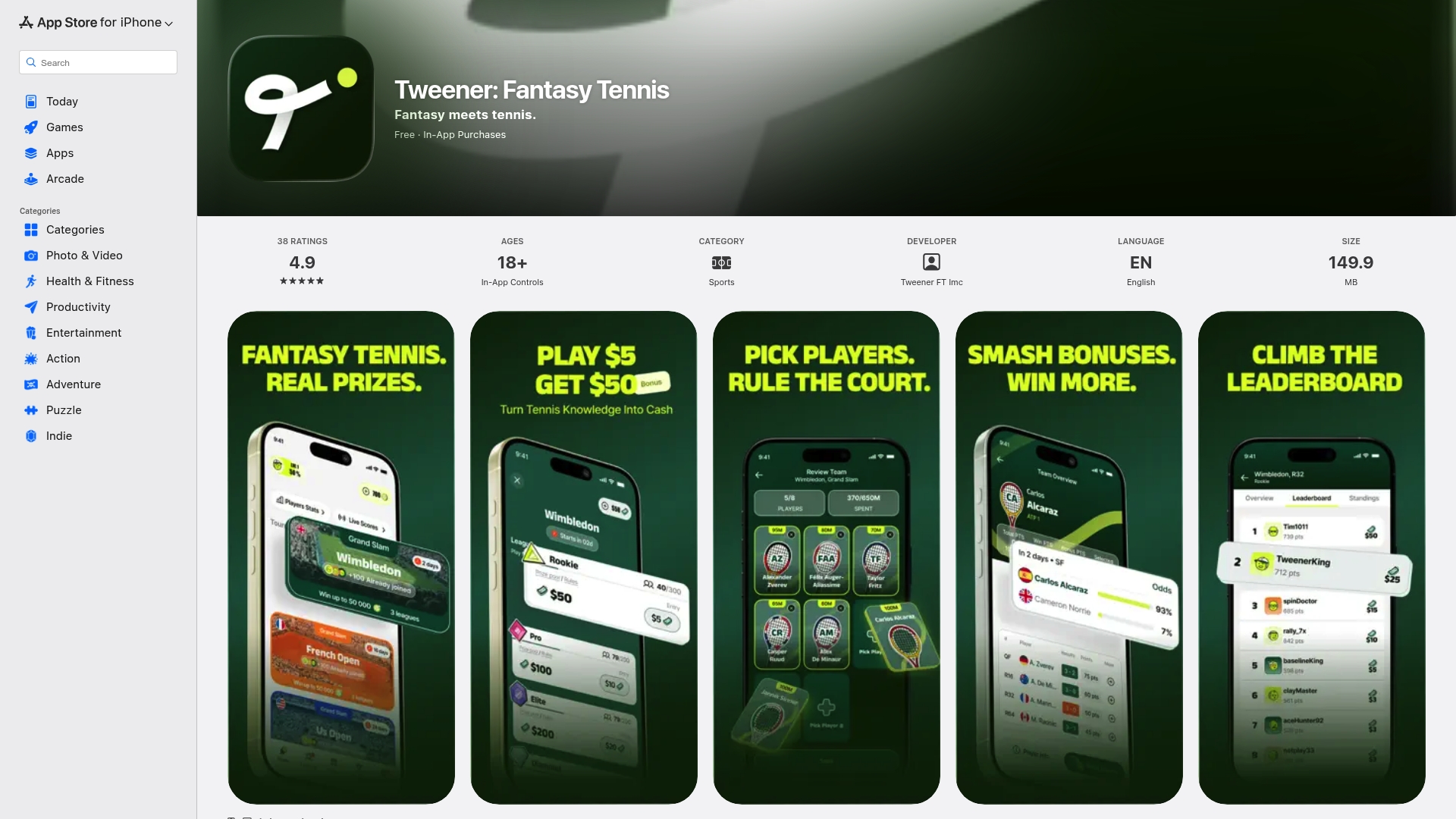
Understanding the nuances of player selection is one thing. Having the right platform to act on those insights is another. Tweener is the only fantasy tennis app built specifically for fans who want to compete at a strategic level, with real ATP and WTA players, live tournament scoring, and matchup data that informs every pick you make. You can join public leagues or create private leagues with friends for Grand Slams and other major events, competing in a format where skill and preparation actually determine who wins. Whether you play in free mode with virtual coins or compete for real-money payouts in cash contests, Tweener gives you the arena to put everything you have learned about player selection to the test.
FAQ
What is the most important factor in fantasy tennis player selection?
Aligning your picks to your contest's specific scoring model is the single biggest lever. Players who generate and convert break point chances consistently tend to score well across most formats.
Why don't the highest-ranked players always win fantasy tennis contests?
Rankings reflect long-term performance averages, not current form, surface fit, or matchup dynamics. A top-10 player returning from injury or facing a tough draw can easily underperform a healthy, well-matched player ranked outside the top 20.
How does doubles selection differ from singles selection?
Doubles success depends heavily on partnership chemistry and role clarity between partners, not just individual rankings. Pairs with shared tournament history typically outperform higher-ranked debut pairings.
What metrics should I track for fantasy tennis player evaluation?
Focus on break points created per set, second-serve return points won, break point conversion rate, and first-serve percentage. These four metrics predict fantasy scoring output far more reliably than overall match win-loss records.
How often should I update my fantasy tennis roster during a tournament?
Continuously. Monitor injury updates, check draw positions after each round, and adjust for emerging form trends. Static rosters built at lineup lock and never revisited are one of the most common reasons fantasy managers fall behind mid-tournament.