

TL;DR:
- Qualifying rounds in tennis determine which lower-ranked players earn spot in the main tournament through a separate knockout event. They consist of three rounds, with 128 players competing for 16 main-draw positions based on merit, often under intense physical and psychological pressure. Successful qualifiers arrive in the main draw with momentum, ranking points, and prize money, highlighting their crucial role in the sport's competitive structure.
A qualifying round in tennis is a separate pre-tournament knockout event that decides which lower-ranked players earn the final entry spots into a professional tournament's main draw. This system is the sport's merit-based gateway, and understanding it changes how you read a draw sheet, follow a tournament, and appreciate the depth of professional tennis. Whether you're watching the Australian Open, Wimbledon, or a standard ATP Tour event, qualifying rounds shape the field before the first main-draw ball is struck.
What is a qualifying round in tennis?
A qualifying round is defined as a separate bracket, played before the main draw, for players not ranked high enough for direct acceptance. It is not a warmup. It is a standalone knockout competition with real consequences, real prize money, and real ranking points on the line.

The format exists because Grand Slam main draws and ATP/WTA events have fixed sizes. At a Grand Slam, the main draw holds 128 players. The top-ranked players fill most of those spots automatically. The remaining spots go to wildcards and qualifiers. Qualifying is how the sport fills those final positions on pure competitive merit.
This structure matters for fans because it means the draw you see on tournament week is not the complete picture. Several players in that bracket fought through a separate competition just to get there. They arrive with momentum, fatigue, or both.
How are tennis qualifying rounds structured?
Qualifying draws operate as separate brackets held at the same venue, typically in the week before the main tournament begins. The standard format across Grand Slams is a three-round knockout. Win all three matches, and you earn a main-draw spot. Lose once, and you are eliminated unless a lucky loser opportunity appears.
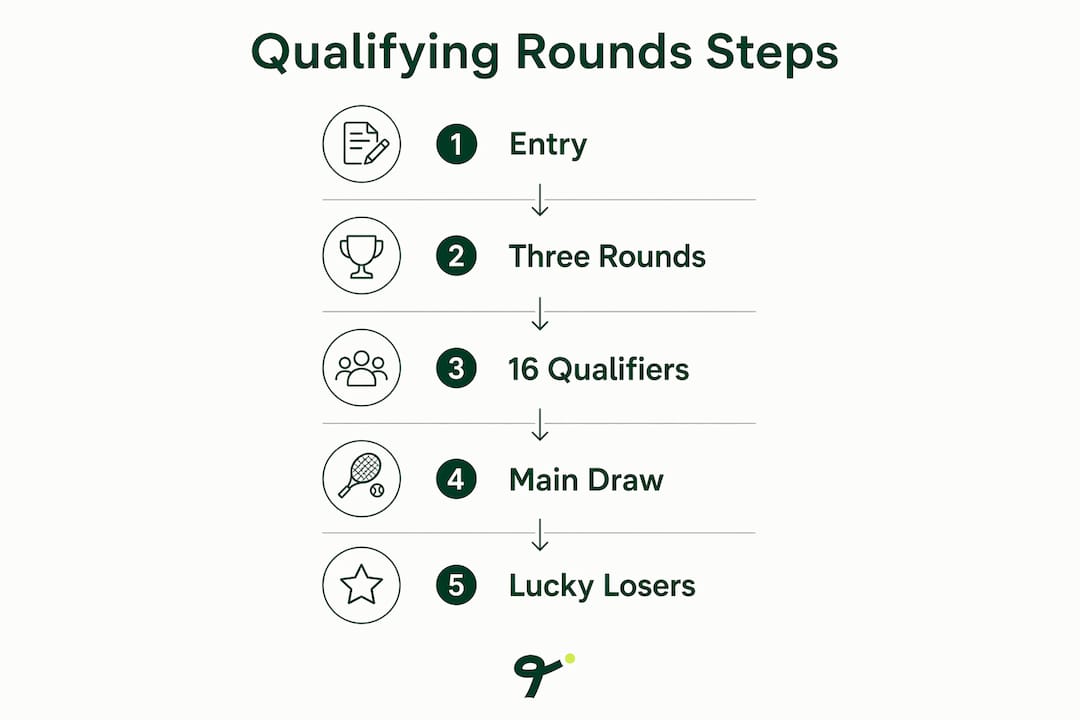
The three-round knockout path
The three-round structure is unforgiving by design. Here is how it plays out at a Grand Slam:
- Round 1: The full qualifying field competes. Half are eliminated immediately.
- Round 2: Winners advance. Another half are cut.
- Round 3 (Final Qualifying Round): Winners earn main-draw entry. Losers become lucky loser candidates.
At the Australian Open, 128 players start qualifying and 16 earn main-draw spots by winning three consecutive matches. That is a 12.5% success rate from a field of professionals. The competition is fierce at every round.
Qualifying schedules across grand slams
| Tournament | Qualifying Draw Size | Spots Awarded | Rounds | Timing |
|---|---|---|---|---|
| Australian Open | 128 players | 16 spots | 3 rounds | Week before main draw |
| Wimbledon | Not fixed | 16 spots | 3 rounds | Monday to Thursday, week prior |
| Roland-Garros | 128 players | 16 spots | 3 rounds | Week before main draw |
| US Open | 128 players | 16 spots | 3 rounds | Week before main draw |
Wimbledon qualifying, for example, runs Monday through Thursday the week before the main event begins. Players must be available, on-site, and ready to compete across four days with minimal recovery time between matches.
Pro Tip: If you want to scout emerging players before a Grand Slam, watch the qualifying draw. Players who win three matches in four days arrive in the main draw with match sharpness that seeded players, who may not have played in weeks, often lack.
Who competes in qualifying rounds?
Direct acceptance for Wimbledon requires a ranking higher than 104 at the entry cutoff. Players outside that cutoff must qualify or receive a wildcard. This ranking threshold shifts slightly by tournament, but the principle holds across all Grand Slams and most ATP/WTA events.
The typical qualifying field at a Grand Slam includes players ranked roughly 105–232 in the world. These are not amateurs. They are full-time professionals who are one ranking tier below automatic entry. The qualifying field at a Grand Slam is, by itself, a competitive professional tournament.
Who you'll find in the qualifying draw
- Ranking-bubble players: Professionals just outside the direct acceptance cutoff, often ranked 105–200.
- Injury returnees: Players coming back from long absences whose rankings have slipped below the cutoff during recovery.
- Young players: Rising talents who have not yet accumulated enough ranking points for direct entry.
- Surface specialists: Players whose ranking does not reflect their ability on a specific surface, such as clay or grass.
Wildcards are separate from qualifying. Tournament organizers award wildcards at their discretion, often to local favorites, past champions, or commercially valuable players. A wildcard skips qualifying entirely. A qualifier earns their spot by winning matches.
The lucky loser mechanism
The lucky loser system fills main-draw vacancies that open after the draw is made. When a main-draw player withdraws after the draw is published, the highest-ranked players from the final qualifying round who lost become eligible. One is selected randomly to fill the vacancy. This means a player who lost their final qualifying match can still enter the main draw. Grand Slam rules require qualifiers and lucky loser candidates to remain on-site and available on short notice for exactly this reason.
Why qualifying rounds matter more than most fans realize
Qualifying matches are treated as high-stakes finals by the players competing in them. Winning three matches is the only path to the Grand Slam main event for players outside the direct acceptance cutoff. There is no second chance, no consolation bracket, and no partial credit.
The physical demand is significant. Players compete in three matches across four days, often in the same conditions as the main event but with less recovery time and lower-quality practice facilities. Arriving in the main draw as a qualifier means you have already played three competitive matches before your first-round opponent has hit a single ball in anger.
"Each qualifying match is critical. Players must treat it as a championship match to advance." — Roland-Garros Qualifying Preview
The psychological pressure is equally intense. A player ranked 150th in the world who wins three qualifying matches earns a Grand Slam main-draw spot, ranking points, and prize money. Qualifiers earn ranking points and prize money at every stage, making qualifying a genuine career-building exercise, not just a formality.
From an operational standpoint, qualifying creates a scheduling challenge for tournament organizers. Because main draw placeholders are used when qualifying is not yet complete at draw time, the official bracket contains "qualifier" and "lucky loser" labels until results are confirmed. This is standard practice, not an error.
Pro Tip: When you see "Q" next to a player's name in a draw sheet, that player won three qualifying matches to get there. They are often in better match shape than their seeded opponents. Do not automatically discount them.
How qualifying formats compare across major tournaments
The core structure is consistent across Grand Slams: 128-player qualifying draw, three rounds, 16 spots awarded. The differences lie in timing, surface, and scheduling logistics.
| Tournament | Surface | Qualifying Venue | Notable Feature |
|---|---|---|---|
| Australian Open | Hard | Melbourne Park | Qualifying held same week as lead-up events |
| Wimbledon | Grass | Roehampton (Bank of England Club) | Only Grand Slam held at a separate qualifying venue |
| Roland-Garros | Clay | Stade Roland-Garros | Qualifying on same courts as main event |
| US Open | Hard | USTA Billie Jean King National Tennis Center | Qualifying runs alongside qualifying for other draws |
Wimbledon is the outlier. Its qualifying tournament is held at Roehampton, not the All England Club. Players compete on grass courts at a separate facility, then travel to Wimbledon for the main draw. This adds a logistical layer that no other Grand Slam replicates.
For fans tracking the tournament bracket, here is what to know about qualifier labels:
- "Q" next to a player's name means they won three qualifying matches.
- "LL" means lucky loser, a player who lost their final qualifying match but entered the main draw after a withdrawal.
- "WC" means wildcard, a player who received direct entry at tournament discretion.
Understanding these labels gives you a real read on how a player arrived in the draw and what kind of form they carry into the main event. A qualifier with three wins in four days is a different proposition than a wildcard who has not competed recently.
Key takeaways
Qualifying rounds are the competitive backbone of professional tennis tournament structure, separating players who earn their spot from those who receive it.
| Point | Details |
|---|---|
| Definition of qualifying | A pre-main-draw knockout event for players outside direct acceptance by ranking. |
| Standard format | Three consecutive wins required across a 128-player bracket to earn a main-draw spot. |
| Eligibility cutoff | Players ranked outside roughly the top 104 must qualify or receive a wildcard. |
| Lucky loser rule | Final-round qualifying losers remain eligible for main-draw entry if a player withdraws post-draw. |
| Career significance | Qualifying earns ranking points and prize money, making it a real career-building stage. |
The part of tennis most fans skip (and shouldn't)
Qualifying is where I think the most honest tennis happens. There are no comfortable seeds, no protected rankings to lean on, and no margin for a bad day. You win or you go home. That simplicity creates a competitive intensity that the main draw, with its byes and walkovers, rarely matches in the early rounds.
I've watched players ranked 180th in the world dismantle opponents ranked 60th in qualifying matches, simply because the lower-ranked player had nothing to lose and everything to gain. That dynamic is real, and it shows up in results more often than casual fans expect.
From a fantasy tennis perspective, qualifiers are genuinely undervalued. A player who wins three matches in qualifying arrives in the main draw with match rhythm that a top-10 seed who last played two weeks ago simply does not have. If you're building a fantasy team on Tweener and you see a qualifier facing a rusty seed in round one, that is a matchup worth analyzing seriously.
The tennis tournament formats guide on the Tweener blog breaks down how qualifying fits into the broader structure of professional events. Reading it alongside a live draw sheet changes how you watch the first week of any Grand Slam.
Qualifying rounds also matter for the sport's health. They give players ranked 150th a real path to a Grand Slam stage, ranking points, and prize money. Without qualifying, the gap between the top 100 and everyone else would be nearly impossible to close. The system is not perfect, but it is the most merit-based entry mechanism professional tennis has.
— Nathan
Follow qualifying rounds more closely with Tweener
Qualifying rounds add a layer of strategy to every Grand Slam that most fans never tap into. Tweener is built for exactly this kind of deeper engagement.

On Tweener, you build fantasy teams from real ATP and WTA players and earn points based on their live match results. That includes tracking how qualifiers perform once they reach the main draw, which players carry momentum, and which seeds look vulnerable after a long break. The game rules on Tweener cover how tournament structures, including qualifying, factor into scoring and team selection. You can join public leagues or set up a private league with up to nine friends for any Grand Slam. Download the Tweener app and start building your team before the next major begins.
FAQ
What is a qualifying round in tennis?
A qualifying round is a pre-main-draw knockout tournament for players not ranked high enough for direct acceptance. Players must win three consecutive matches to earn a main-draw spot at a Grand Slam.
How many rounds are in tennis qualifying?
Grand Slam qualifying uses a three-round knockout format. A player must win all three matches to advance to the main draw.
What does "q" mean in a tennis draw?
"Q" next to a player's name means they qualified through the pre-tournament qualifying rounds. They won three matches to earn their main-draw entry.
What is a lucky loser in tennis qualifying?
A lucky loser is a player who lost in the final qualifying round but enters the main draw when a main-draw player withdraws after the draw is made. The highest-ranked final-round losers are eligible, and one is selected randomly.
Do qualifying players earn ranking points?
Yes. Qualifying earns ranking points and prize money at each stage, making it a meaningful career step for players outside the top 100.