

TL;DR:
- Tennis tournament formats, such as single elimination and round robin, determine match structure, scheduling, and player strategy. Modern formats like Tie Break Tens and Fast4 prioritize speed and audience engagement, influencing gameplay tactics. Understanding these formats enhances fans' strategic insights and helps fantasy players optimize their roster choices based on event type and scoring systems.
A tennis tournament format is the competitive structure that determines how players progress, who they face, and ultimately who wins. Format shapes everything from match scheduling to player strategy to the drama fans experience watching live. Whether you're tracking Jannik Sinner through a Grand Slam draw or picking ATP Finals players for your fantasy roster, knowing the full list of tennis tournament formats gives you a real analytical edge. This guide covers every major format used across professional and recreational tennis, with clear examples and honest pros and cons for each.
1. List of tennis tournament formats: single elimination
Single elimination is the most widely used format in professional tennis. One loss ends your tournament. The draw is set before play begins, and players advance through successive rounds until one player remains undefeated.

Most professional tournaments use single elimination because it is simple to schedule and produces a clear winner efficiently. Draw sizes at ATP and WTA events typically run 28, 32, 48, 56, 64, or 128 players depending on the event tier. A 128-player draw requires seven rounds to crown a champion.
The format's biggest strength is clarity. Fans always know what a loss means. The weakness is equally obvious: one bad day, one injury, and a top contender is gone. Rafael Nadal's early exits at Wimbledon due to injury are a sharp reminder that single elimination offers no safety net.
Pro Tip: When building a fantasy tennis team on Tweener for single elimination events, prioritize players with strong head-to-head records against likely early opponents rather than just overall ranking. Early draw matchups matter more than season form.
Key characteristics of single elimination:
- One loss equals elimination
- Efficient scheduling, minimal court time required
- Produces high-stakes, must-win pressure every match
- Used at Wimbledon, the US Open, Roland Garros, the Australian Open, and most ATP/WTA Tour events
2. How round robin format works in tennis
Round robin format places players into groups where each participant plays every other player in the group. Advancement to the knockout stage depends on win-loss record within the group, sometimes with sets or games as tiebreakers.
The ATP Finals and WTA Finals both use a group-stage round robin before knockout rounds, a structure that confuses some fans who expect straight elimination from the start. Eight players are split into two groups of four, each playing three round robin matches before the top two from each group advance to the semifinals. This hybrid design is what makes the ATP Finals feel strategically different from any other event on the calendar.
Round robin format guarantees more matches per player before any elimination occurs, which produces fairer results and more data for fans and analysts. The tradeoff is time. Running full round robin stages across large fields requires significantly more court time and scheduling complexity than single elimination.
| Format | Matches guaranteed | Elimination risk | Best used for |
|---|---|---|---|
| Single elimination | 1 minimum | After first loss | Large professional draws |
| Round robin | Equal to group size minus 1 | After group stage | Small elite fields, year-end finals |
Round robin is also common in Davis Cup and Billie Jean King Cup group stages, where nations compete in pools before advancing to knockout rounds.
3. Understanding double elimination in tennis
Double elimination requires a player to lose twice before being eliminated. Players who lose in the main bracket drop into a consolation or "losers" bracket, where they can continue competing for a path back to the final.
This format is rare in professional tennis but appears in some club competitions, junior events, and recreational leagues. The appeal is fairness. A single bad match, a lucky opponent, or an off day does not end your tournament. Players get a genuine second chance to prove their level.
The drawback is scheduling complexity. Running two parallel brackets roughly doubles the number of matches required compared to single elimination. For large draws, this becomes logistically difficult. Professional tennis rarely uses double elimination because the tour calendar is already packed and venues cannot accommodate the extra court time.
Double elimination works best for:
- Club-level tournaments with smaller draws (8 to 16 players)
- Junior development events where match experience matters more than efficiency
- Team tennis formats where player development is the priority
- Recreational leagues with flexible scheduling
4. The Swiss system: tennis competition formats for large fields
The Swiss system is a format where no player is eliminated. Instead, players are paired each round against opponents with similar win-loss records. After a set number of rounds, final standings determine the winner or who advances.
This format handles large player pools efficiently without requiring every player to face every other player, which makes it ideal when you have 50 or 100 participants and limited time. It is used in some ITF junior events, club championships, and team competitions. The Swiss system produces a clear ranking of all participants by the end, which is useful for seeding future events or awarding prizes across multiple placements.
The format's weakness is that the final standings can feel anticlimactic. Because no one is eliminated, the drama of a sudden-death match is absent. Players who lose early rounds still compete, which can reduce intensity in later rounds for those out of contention for top spots.
Pro Tip: If you play in a Swiss system club tournament, your early round results matter more than they feel. Losing round one means you face weaker opponents throughout, which limits your ranking ceiling regardless of how well you play later.
5. Exploring Tie Break Tens, Fast4, and modern alternative formats
Tie Break Tens is an ITF-recognized short-format knockout event where matches consist entirely of a single 10-point tiebreak. Players alternate serves every two points, and ends change after six points. The format typically features a $250,000 prize pool and is designed for broadcast efficiency and fan entertainment. A full match takes roughly 20 minutes, making it ideal for prime-time television slots.
Fast4 is another short format developed by Tennis Australia. It uses four-game sets, no-ad scoring, and a tiebreak at three games all. No-ad scoring eliminates deuce by playing a sudden-death point at deuce, with the receiver choosing which side to receive. This cuts match time significantly and keeps the action moving.
Tournament organizers adopt these formats to control match length and improve viewer engagement, driven by broadcast scheduling and audience preferences. A three-hour match is hard to schedule in a two-hour broadcast window. Tie Break Tens and Fast4 solve that problem directly.
The impact on player strategy is real. In a 10-point tiebreak, there is no margin for a slow start. Players who excel at tiebreaks, like Novak Djokovic historically, have a structural advantage in these formats. For fantasy tennis fans, this means player selection logic changes completely depending on which format an event uses.
Key modern formats at a glance:
- Tie Break Tens: Single 10-point tiebreak per match, knockout draw, ITF-recognized
- Fast4: Four-game sets, no-ad scoring, tiebreak at 3-3
- Super tiebreak: Replaces third sets in professional doubles, first to 10 points, widely used on ATP and WTA tours
- No-ad scoring: Common in club and recreational tennis to speed up match completion
6. How professional tournament levels connect to format and ranking points
Professional tennis operates as a pyramid: ITF circuits at the base for player development, Challenger events for the transition tier, and ATP/WTA Tours at the elite level. Each tier uses single elimination as its core format but differs in draw size, match format, and ranking points awarded.
Grand Slams award 2,000 ranking points to winners and feature 128-player draws. This is the highest point value in tennis and reflects the prestige and difficulty of winning seven best-of-five matches in two weeks. Best-of-five format can extend match duration beyond four hours, making endurance as important as skill.
Understanding the ATP and WTA tour structure helps fans recognize why format knowledge matters for fantasy strategy. A player who thrives in best-of-three formats at ATP 250 events may struggle in best-of-five at a Grand Slam.
| Event tier | Draw size | Match format | Points to winner |
|---|---|---|---|
| Grand Slam | 128 | Best of 5 (men's singles) | 2,000 |
| ATP/WTA 1000 | 96 | Best of 3 | 1,000 |
| ATP/WTA 500 | 48 to 56 | Best of 3 | 500 |
| ATP/WTA 250 | 28 to 32 | Best of 3 | 250 |
| Challenger | 32 to 48 | Best of 3 | Up to 125 |
For fantasy tennis players on Tweener, this hierarchy is the foundation of smart roster decisions. A player peaking at a Masters 1000 event earns you far more points than the same performance at a 250-level event.
Key takeaways
Tennis tournament formats directly determine player progression, match volume, and competitive fairness, making format literacy a genuine strategic advantage for fans and fantasy players alike.
| Point | Details |
|---|---|
| Single elimination dominates | Most professional events use it for scheduling efficiency and clear stakes every match. |
| Round robin rewards consistency | ATP Finals and WTA Finals use group stages to guarantee more matches and fairer results. |
| Modern formats prioritize speed | Tie Break Tens and Fast4 cut match time for broadcast and audience engagement. |
| Ranking points scale with format | Grand Slams offer 2,000 points and best-of-five sets; lower tiers offer fewer points and shorter matches. |
| Format changes player strategy | Fantasy picks should account for format type, not just player ranking or recent form. |
Why format knowledge is the most underrated edge in tennis fandom
Most tennis fans can name the top 10 players on the ATP and WTA tours. Far fewer can explain why the ATP Finals produces different results than a standard Masters 1000 event, or why Tie Break Tens specialists are not necessarily the same players who dominate Grand Slams.
I've spent years watching how format shapes outcomes in ways that raw rankings never capture. The round robin group stage at the ATP Finals is the clearest example. A player can lose two matches and still advance if results fall right. That dynamic rewards tactical thinking over pure aggression, and it consistently produces upsets that single elimination events rarely deliver.
The rise of short formats like Tie Break Tens reflects something real about how tennis is evolving. Broadcast windows are shrinking. Casual fans have shorter attention spans. The sport is adapting, and the players who adapt fastest, those who can flip a switch and play ultra-aggressive tiebreak tennis on demand, are building a new kind of competitive edge.
For fantasy tennis specifically, ignoring format is like ignoring surface. You would never pick a clay specialist for Wimbledon without thinking twice. The same logic applies to format. A player who grinds out five-set wins at the Australian Open may be a liability in a Tie Break Tens knockout where the first 10 points decide everything.
The tennis tournament schedule is your roadmap. Format is the terrain. Learn both, and you stop watching tennis passively and start analyzing it.
— Nathan
Put your format knowledge to work with Tweener
Understanding the different tennis competition formats is one thing. Using that knowledge to outcompete other fans is where Tweener comes in.
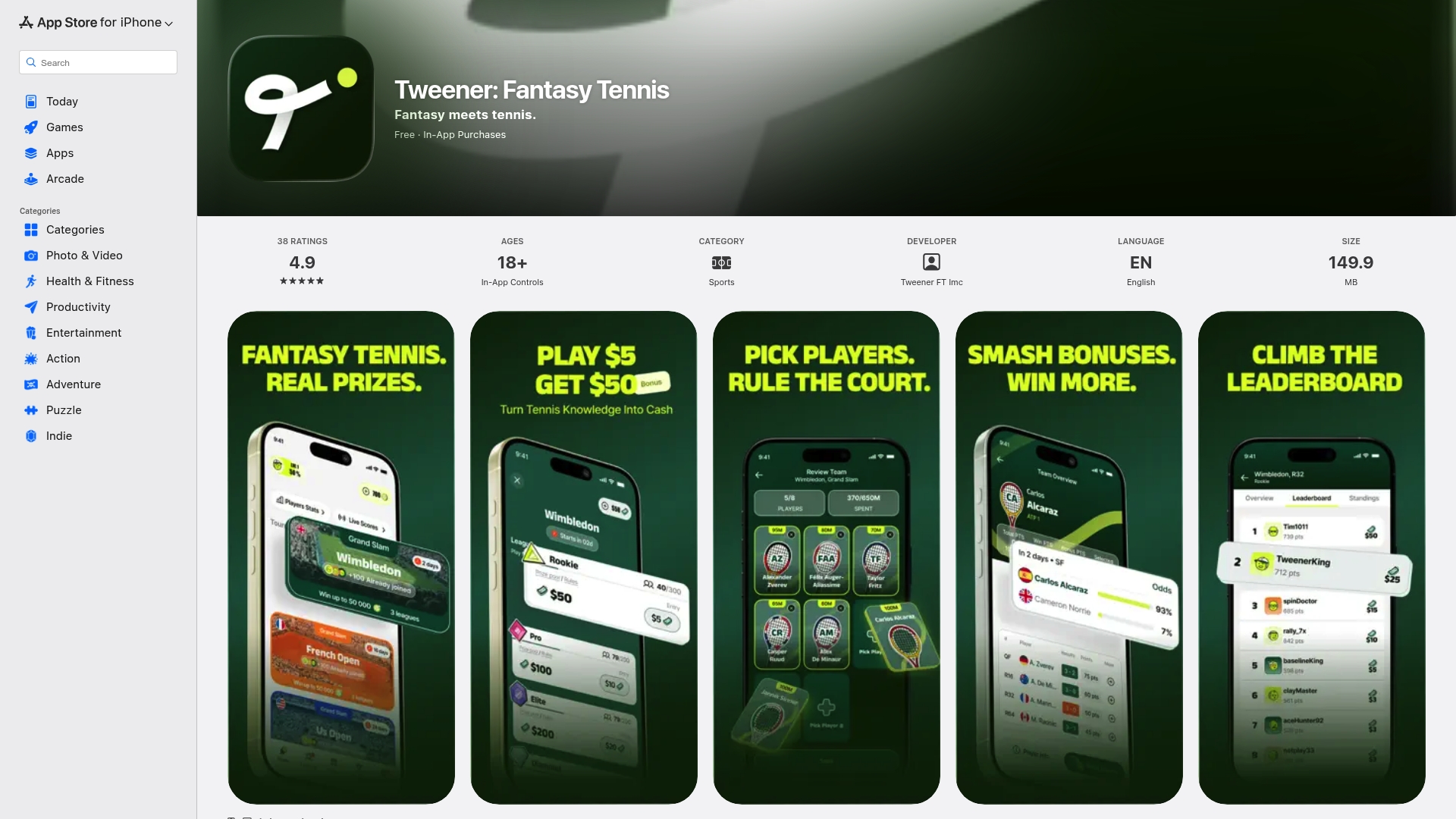
Tweener is the only high-quality fantasy tennis app built around real ATP and WTA tournament results. You pick players, join leagues, and earn points based on actual match performance across every tournament format covered in this article. Whether it's a Grand Slam best-of-five grind or a fast-format event, your roster decisions reflect real strategic thinking. Create a private league with up to nine friends for the next Grand Slam, or jump into a public contest and test your format knowledge against the broader community. Download Tweener and turn every tournament into a competition you're actually part of.
FAQ
What is the most common tennis tournament format?
Single elimination is the most common format across professional tennis, used at Grand Slams, ATP Tour, and WTA Tour events. One loss ends a player's tournament, making every match high stakes.
How does the ATP Finals format differ from other tournaments?
The ATP Finals uses a round robin group stage before knockout semifinals and a final. Eight players are split into two groups of four, with each player guaranteed three matches before any elimination occurs.
What is Tie Break Tens in tennis?
Tie Break Tens is an ITF-recognized format where each match is a single 10-point tiebreak. It is a knockout competition designed for broadcast efficiency, with players alternating serves every two points.
How many ranking points does a Grand Slam winner receive?
Grand Slam winners receive 2,000 ranking points, the highest award in professional tennis, reflecting the 128-player draw and best-of-five match format.
What is the Swiss system in tennis tournaments?
The Swiss system pairs players against opponents with similar records each round without eliminating anyone. Final standings after a set number of rounds determine the winner, making it useful for large recreational or junior fields.