

Most fantasy tennis players spend hours researching player stats, surface records, and head-to-head matchups. But they skip one decision that shapes everything else: which contest format they're playing. That single choice changes which players you should pick, how much risk to take, and what a winning score even looks like. Mobile tennis fantasy leagues now offer more format variety than ever, and understanding each one is the fastest way to go from guessing to genuinely competing.
Table of Contents
- Why contest formats matter in fantasy tennis
- Types of contest formats in tennis fantasy sports
- How scoring systems and contest rules shape strategies
- Expert strategies for each contest format
- Applying contest format insights to improve your game
- Transform your fantasy tennis experience with Tweener
- Frequently asked questions
Key Takeaways
| Point | Details |
|---|---|
| Contest format shapes outcomes | Choosing the right contest format in fantasy tennis directly affects your strategy and results. |
| Scoring methods influence lineups | Salary caps, rotisserie stats, and tournament points require tailored player selection. |
| Expert strategies boost success | Using format-specific tactics like diversifying from chalk and surface insights leads to more wins. |
| Tweener enhances player experience | Tweener’s app gives access to multiple contest formats for strategic success in fantasy tennis. |
Why contest formats matter in fantasy tennis
Contest format is the rulebook underneath your lineup. It defines how points are awarded, how winners are selected, and what kind of skill actually gets rewarded. Two players can pick the exact same roster and finish in completely different positions simply because they entered different contest types.
Think about it this way: a chess player and a speed-chess player both know the same game, but the clock changes everything. Fantasy tennis works the same way. Season-long formats reward players who track the full ATP and WTA calendar, understand surface rotations, and manage rosters over months. Daily Fantasy Sports (DFS) formats reward fast research, sharp instincts, and the ability to read a draw in minutes.
Mobile fantasy apps add even more layers. Tennis-specific scoring uses ranking points by tournament round, rotisserie stats like aces and breaks, and salary caps with tier-based transfers. Each mechanic shifts the value of individual players dramatically.
Here's a quick look at what separates the major format mechanics:
- Salary cap systems: Every player has a price; you build the best team within a budget
- Tier-based transfers: Players are grouped by ranking or form; you pick from each tier
- Rotisserie scoring: Points accumulate across multiple stat categories over time
- Head-to-head matchups: Your team score is compared directly against one opponent
Understanding how tennis scoring works in real matches is the foundation. But layering in fantasy tennis industry terms like "chalk," "ceiling," and "floor" is what separates casual players from consistent winners.
"Tennis-specific scoring uses ranking points by tournament round reached, rotisserie stats like aces and breaks, and salary caps with tier-based transfers. Each mechanic changes which players deliver real value."
Types of contest formats in tennis fantasy sports
Not all contests are built the same. Here's a breakdown of the four core formats you'll encounter in mobile tennis fantasy leagues and what each one demands from you.
| Format | Duration | Skill rewarded | Best for |
|---|---|---|---|
| Season-long | Full tennis year | Deep knowledge, roster management | Dedicated analysts |
| DFS | Single tournament or day | Quick research, fast decisions | Casual and active players |
| Head-to-head | Varies | Consistent lineup building | Competitive one-on-one players |
| GPP | Single event | Risk-taking, differentiation | Players chasing big prizes |
Season-long contests run across the entire tennis calendar. You manage a roster through Grand Slams, Masters events, and smaller tournaments. The player who wins here understands fatigue cycles, surface transitions, and which players peak in the second half of the season.

DFS contests reset with every tournament or even every match day. You build a fresh lineup, compete for immediate rewards, and move on. For fantasy team competitions during a Grand Slam, DFS is the most accessible entry point.
Head-to-head contests strip everything down to one question: is your lineup better than one other person's? There's no crowd to beat, just one opponent. Consistency matters more than ceiling here.
GPP (Guaranteed Prize Pool) contests are large-field events where only the top scores win. The prize pool is guaranteed regardless of how many people enter. These are high-variance, high-reward, and they require a completely different approach than cash games.
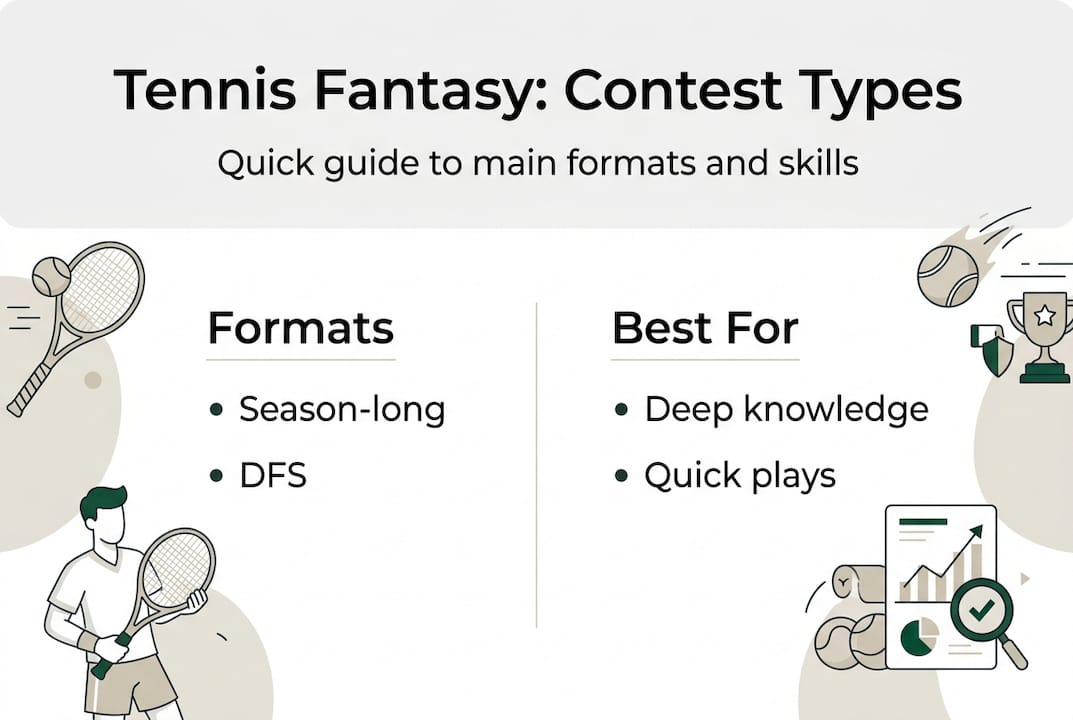
For gameweek scoring in mobile apps, season-long formats reward deep knowledge while DFS is ideal for quick plays during Masters events and Grand Slams.
Pro Tip: Match your contest format to your actual tennis knowledge and available time. If you follow the tour closely all year, season-long is your edge. If you only tune in for the big events, DFS gives you a competitive window without the long-term commitment.
How scoring systems and contest rules shape strategies
Scoring systems are where format theory becomes lineup reality. The same player can be a must-start in one format and a liability in another, purely based on how points are calculated.
Here's how the main scoring types affect your decisions:
| Scoring type | What it rewards | Strategic impact |
|---|---|---|
| Ranking points | Deep tournament runs | Favor top seeds with draw advantages |
| Rotisserie stats | Aces, breaks, games won | Value big servers and aggressive baseliners |
| Salary cap | Budget efficiency | Target underpriced players in good form |
| Surface-specific | Clay, grass, hard court bonuses | Prioritize surface specialists |
Contest rules add another layer. Transfer limits mean you can't constantly chase form. Player tiers lock you into certain price ranges. Surface-specific scoring means a clay-court specialist at Roland Garros might outscore a higher-ranked player who struggles on red dirt.
Here's a step-by-step approach to adapting your strategy to any contest's rules:
- Read the scoring breakdown first. Before picking a single player, understand exactly how points are earned and lost.
- Identify the highest-value stat category. In rotisserie formats, one stat category often separates winners from the field.
- Check transfer rules and tier limits. Know how many moves you have and plan them in advance.
- Map the draw. A player with an easy path to the quarterfinals is worth more than their ranking suggests.
- Assess surface fit. Cross-reference player form with the tournament surface before finalizing your lineup.
In large GPP contests, high-ownership chalk players lead to ties at the top of the leaderboard. Match-sharp qualifiers and players returning from rest are systematically undervalued in DFS pricing. That's your edge.
Pro Tip: In GPPs, avoid building a lineup that mirrors what 40% of the field will submit. One or two differentiated picks, especially qualifiers or surface specialists, can separate your score from a crowded pack. Check ATP tennis prizes to understand what's at stake in competitive events.
When you're ready to build a winning lineup, the scoring system should be your first filter, not your last. And building tennis lineups with contest rules in mind is what separates reactive players from proactive ones.
Expert strategies for each contest format
Knowing the formats is one thing. Knowing how to play each one is where real improvement happens. Here's how experienced fantasy tennis players approach each contest type.
Cash games and 50/50s (where roughly half the field wins) demand reliability. You're not trying to hit a home run. You're trying to avoid a disaster. The strategy here is built around "anchors," consistent performers who rarely flame out in the first round. Think top-10 players on their best surface with manageable draws.
GPPs flip that logic entirely. You need upside. A player who goes deep unexpectedly scores far more than a top seed who exits in the quarterfinals as expected. Ceiling chasers with high potential but lower ownership are the key to separating from the field.
Here's a format-by-format strategy breakdown:
- Season-long: Prioritize players with full-season consistency; track injury history and scheduling gaps
- DFS: Focus on the current tournament draw; recent match sharpness matters more than season ranking
- Head-to-head: Pick your most reliable floor players; avoid high-variance picks that could collapse
- GPP: Mix two or three chalk anchors with two or three differentiated value plays; avoid full-chalk lineups
"Balance high-floor anchors for cash games and 50/50s with ceiling chasers for GPPs. Diversify from chalk with value plays and surface-specific picks to maximize your competitive edge in every format."
Don't overlook match-sharp qualifiers. A player who won three qualifying matches before the main draw is in better match rhythm than a seeded player returning from a two-week break. That rhythm shows up in stats, and stats show up in your score.
For ATP and WTA picks that align with these strategies, focus on form over reputation. Learning how to choose tennis players for each specific format is a skill that compounds over time. And if you want to predict tennis outcomes more accurately, start by understanding which format rewards prediction accuracy the most.
Applying contest format insights to improve your game
Reading about strategy is useful. Applying it is where your results actually change. Here's a practical framework for using contest format knowledge in your next mobile fantasy tennis session.
- Assess your tennis knowledge honestly. Do you follow the full tour or just the majors? Your answer should point you toward season-long or DFS respectively.
- Define your goal for each contest. Are you playing for consistent small wins or swinging for a big prize? That determines cash game versus GPP.
- Tailor your lineup to the specific scoring rules. Don't copy a lineup built for a different format. Each contest has its own value hierarchy.
- Manage your risk deliberately. In GPPs, accept variance. In cash games, minimize it. Don't mix these mindsets in the same lineup.
- Test across formats. The fastest way to learn is to play multiple formats during the same tournament and compare your decisions afterward.
Pro Tip: Use surface and form data as your sleeper-pick filter. A player who is 8-1 on clay in the last two months is a legitimate GPP differentiator at a Roland Garros event, even if their overall ranking doesn't scream "must-start."
Season-long contests reward deep knowledge while DFS is best for quick plays. Avoiding overexposure to chalk on favored surfaces is one of the most consistent edges available in mobile fantasy tennis. Revisit your building tennis lineups process after each tournament and note which format decisions paid off.
Transform your fantasy tennis experience with Tweener
Understanding contest formats gives you a real edge. But having the right platform to put that knowledge into action makes all the difference. Tweener is built specifically for tennis fans who want more than a passive viewing experience.
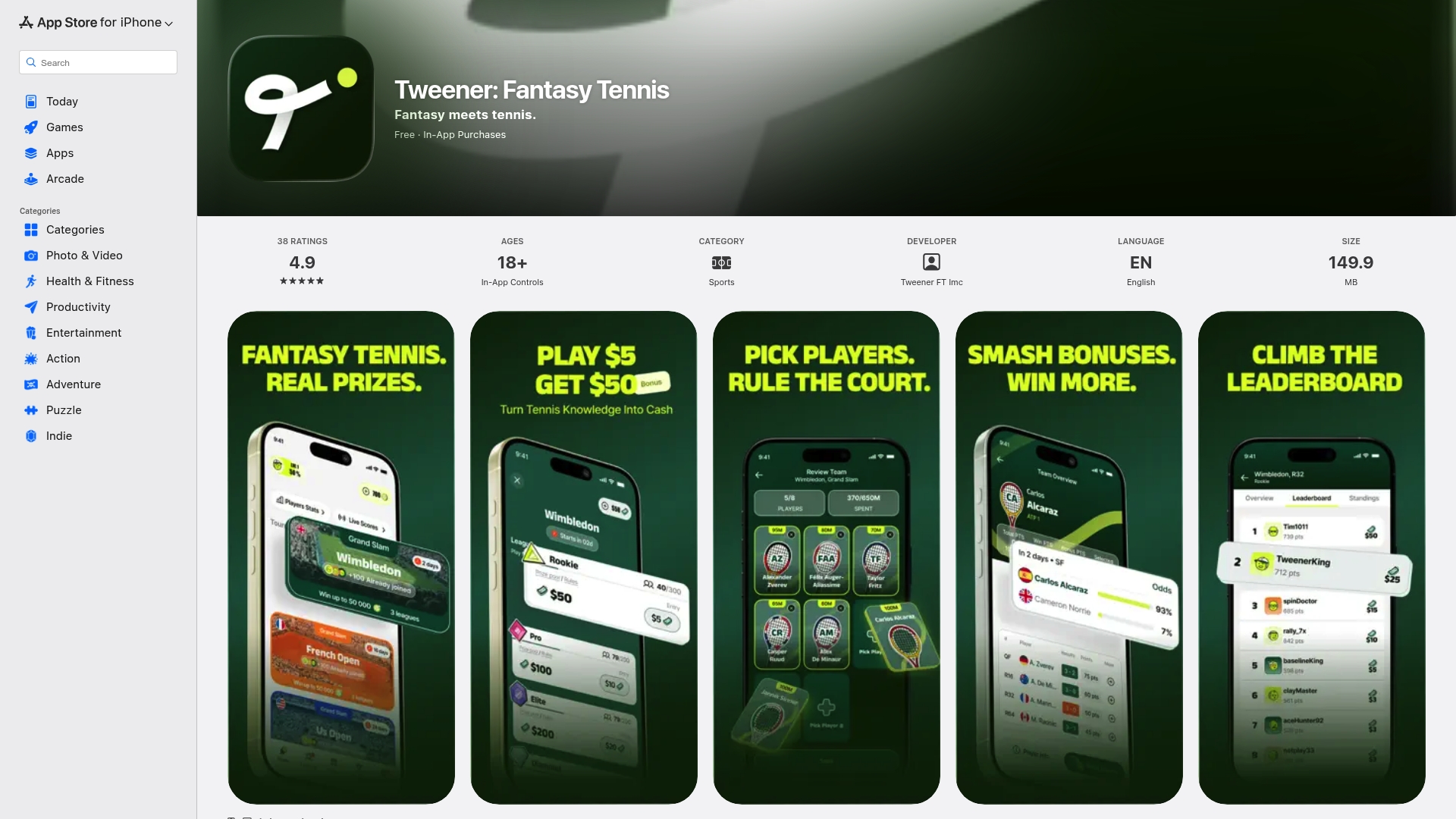
With Tweener, you can compete in DFS-style contests, season-long leagues, and head-to-head matchups, all centered on real ATP and WTA tournament results. The app supports both free play with virtual coins and cash contests where real prizes are on the line. Whether you're testing a new GPP strategy or locking in your anchors for a 50/50, Tweener gives you the format variety to practice every approach covered in this article. Download the Tweener app today and start competing with the contest format knowledge you've just built.
Frequently asked questions
What is the difference between season-long and DFS formats in fantasy tennis?
Season-long rewards sustained tennis knowledge over months of the ATP and WTA calendar, while DFS offers quick, single-tournament contests for immediate results. Season-long suits deep knowledge while DFS fits fast plays during Grand Slams and Masters events.
How do scoring systems affect lineup choices in fantasy tennis?
Scoring based on rotisserie stats, ranking points, or salary caps shifts which players deliver real value, directly shaping which picks belong in your lineup. A big server becomes far more valuable in a format that rewards aces than in one that only counts match wins.
What does 'chalk' mean in tennis fantasy contests?
Chalk refers to highly popular, heavily owned players that most of the field selects. High-ownership chalk can lead to ties at the top of large GPP leaderboards, limiting your upside even when those players perform well.
How can I avoid tying in large fantasy tennis GPPs?
Diversify your lineup by including less popular value plays or match-sharp qualifiers alongside your anchors. Match-sharp players are undervalued in DFS pricing, making them ideal differentiators in large-field GPP contests.