

A 50/50 tennis contest is a paid fantasy contest where the top half of entrants win the same prize and the bottom half lose their entry fee. You do not need to beat the whole field, only more than half of it. That changes how you build a lineup: you want steady, high-floor scoring rather than a long shot that either explodes or goes nowhere.
This guide covers the payout math, how tennis scoring feeds the format, how to pick players for it, and what to know about legality, taxes and limits in the US.
TL;DR
- A 50/50 pays every entrant in the top 50% the same amount, usually a profit roughly equal to the entry. Finish 49th percentile or 1st, and the payout is identical.
- Because first place earns no bonus, the winning approach is consistency: favorites with a high floor, not boom-or-bust upsets.
- Tennis scoring rewards games and sets won, aces and bonuses such as straight-set wins, and a withdrawal typically means zero points for that player.
- Paid contests are regulated state by state, winnings are taxable income, and you should set deposit and time limits before your first entry.
Table of Contents
- How a 50/50 tennis contest pays out
- How tennis scoring feeds your lineup
- Building a lineup for the top half
- Where to use a 50/50 and where not to
- Promo: play tennis fantasy your way on Tweener
- Legality: where paid contests are available
- Taxes on your winnings
- Play within limits
- Perspective
- FAQ
- Sources
How a 50/50 tennis contest pays out
The structure is simple. Everyone pays the same entry fee, the field is ranked by fantasy points, and the top half is paid. According to FantasyPros' contest explainer, all winning entries receive the same amount, while the bottom half lose their entry fee. Tennis.com's daily fantasy primer describes the tennis version the same way: you must finish in the top 50% of entrants, and a win typically earns a profit equal to your entry.
A quick example with round numbers. Say 100 players each enter at $10, so $1,000 goes in. If the top 50 each receive a payout of about $20, you doubled your entry, which is a $10 profit. In real contests the operator keeps a fee, so the payout per winner is somewhat less than double. One football-focused payout breakdown from RotoWire put the share of entry fees returned to winners in 50/50s at about 90% for the operator it covered. Fees differ by platform and contest, so read the rules on the contest page before you enter.

What the format means for ties and the cutoff
The line sits at the halfway mark, and a tie around that line is the one situation where payout rules matter. Operators handle it in different ways, such as splitting the affected payout or paying all tied entries. Our game rules page is where to confirm how Tweener handles scoring and tiebreakers, and any contest page should say the same for its own format.
Why it differs from tournaments
In a large-field tournament, the top prize is huge and only a small slice of entries get paid. In a 50/50, the payout is flat, so there is no reward for finishing first. If you want a closer look at how payouts are shaped across formats, our fantasy tennis payout structures guide lays them side by side.
| Feature | 50/50 | Large-field tournament |
|---|---|---|
| Share of entries paid | Top half | Small top slice |
| Payout shape | Flat, same for every winner | Steeply tiered, big top prize |
| Best lineup style | Safe, high floor | High ceiling, contrarian |
| Typical swing | Lower | Much higher |
How tennis scoring feeds your lineup
Tennis fantasy scoring turns real matches into points. Per Tennis.com, points come from games and sets won or lost, aces, and bonuses such as winning in straight sets. If a player withdraws from their match, you typically get zero points for that slot.
That last point is the hidden risk of a 50/50. A single zero in a six-player lineup can sink you below the cutoff, because you are fighting for the median, not a top spot. If you need a refresher on how a match is actually counted, our tennis scoring guide covers games, sets and tiebreaks.
Three scoring habits worth building:
- Value straight-set favorites. A player who wins 6-2, 6-3 banks game points and often a straight-sets bonus, and the match is over quickly with less injury exposure.
- Respect the best-of-five format. At a Grand Slam, men play best-of-five, which gives more games and sets to score. A favorite who drops a set still keeps accumulating points.
- Check the draw for withdrawal risk. Players returning from injury, or playing back-to-back long matches, carry a risk that a safe pick does not.
Building a lineup for the top half
The consistent advice from experienced daily fantasy writers is the same. RotoGrinders' tennis DFS guide says cash games, 50/50s included, call for a safe, consistent lineup that scores well without needing to take first place, and that you should weigh projections against salary.
Anchors first, then value
Start with two or three anchors: heavy favorites against lower-ranked opponents on the surface where they are strongest. Then fill the remaining slots with value players whose matchup is better than their price suggests. Our fantasy tennis strategy guide goes deeper on the anchor and attacker split, and the lineup-building tips cover the checklist.
The data that matters
- Surface record. A clay specialist at a hard-court event is a risk. Look at results on the same surface over the last 12 months, not career totals.
- Head-to-head. A strong H2H record is useful when it is recent and on a similar surface. A 2019 result tells you very little about 2026.
- Form and workload. Recent straight-set wins signal good form. Long five-setters the round before can mean fatigue.
- Serve and return strength. Big servers rack up aces, which count toward scoring, and grind through service games quickly.
- Round and draw. Early rounds have the most mismatches, which is where safe floors are found. Later rounds are tighter.
A worked example
Imagine a hard-court Masters event with a slate of first-round matches. You pick one top-10 seed against a qualifier, a second top-20 player against a lower-ranked opponent with a weak return record, and a third strong server on a fast court. None of them need to produce a massive score. If each wins in straight sets, you collect solid points across the board. That is what a 50/50 lineup looks like: a stack of probable outcomes rather than one bold call.
Where to use a 50/50 and where not to
It is a good fit when you want lower variance, when you are testing a new strategy, or when the slate has clear favorites. For choosing among contest types in general, our contest selection strategy explains how to match format to bankroll and slate size. If you are new to paying for entries, our guide to cash fantasy contests walks through what changes when real money is involved.
The cash-game mindset is simple: beat half the field consistently, not the whole field occasionally.
Size your entries to match. Our DFS bankroll guide recommends 1 to 3% of bankroll per entry and a 5% daily cap, which keeps a bad slate from becoming a bad month.
Promo: play tennis fantasy your way on Tweener
Tweener is a mobile fantasy app built only for pro tennis, with real ATP and WTA players. You can play in Draft Mode or Pick'em Mode, compete in public leagues, or set up a private league with friends. There is a free mode with virtual coins that can be redeemed for rewards such as gift cards, and a cash mode for paid contests where legally permitted.
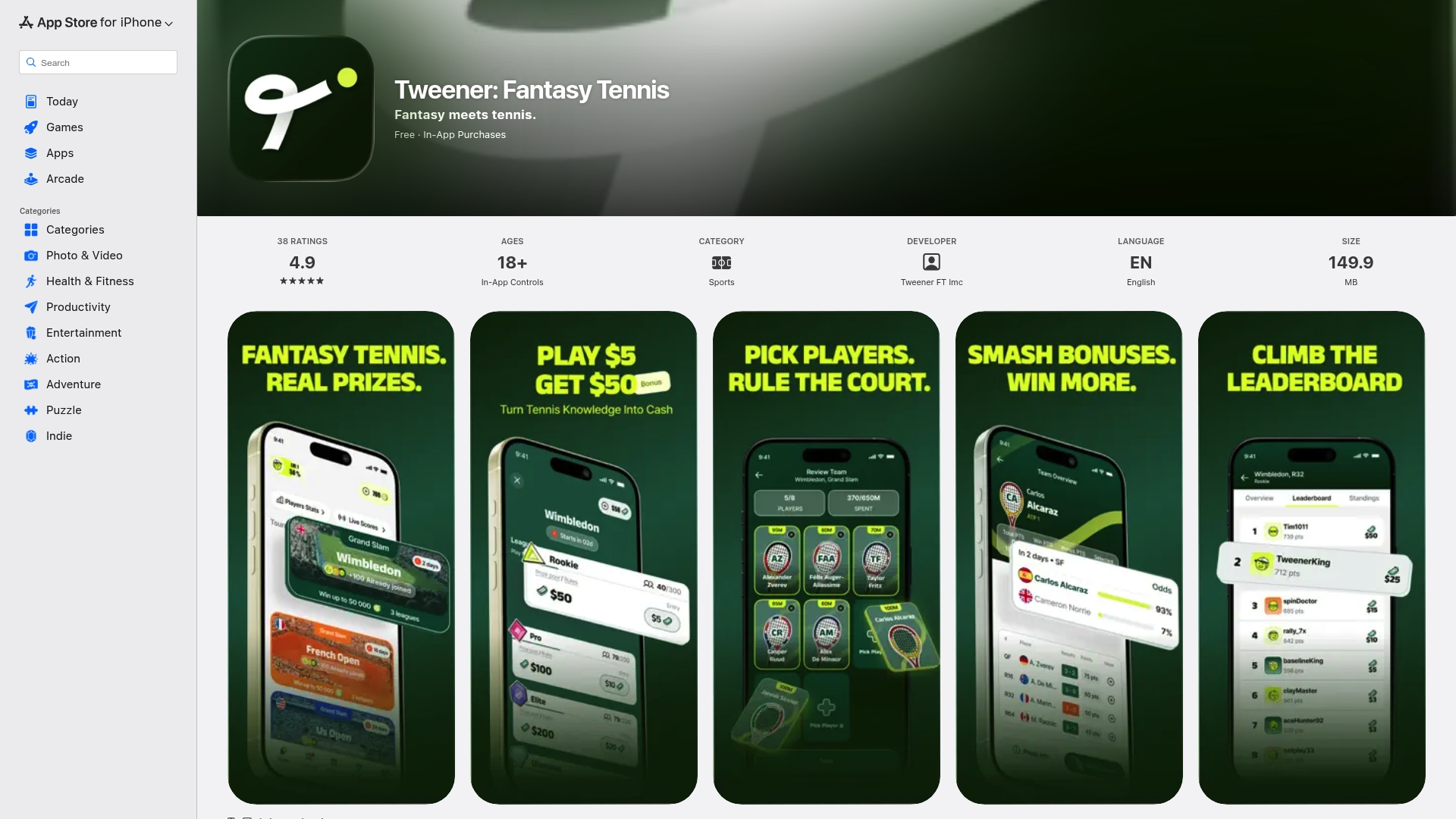
If you want to practice lineup-building before putting money on it, start in the free mode, then move to cash when you are comfortable. Open Tweener to see what is on the slate.
Legality: where paid contests are available
Paid fantasy contests in the US are regulated state by state, and the rules differ on what counts as a legal contest. Tweener's cash play is available for skill-based play in select US states, so availability depends on where you are located. The app checks your location, and a contest that is open in one state may be closed in the next one over. Before you deposit, confirm that cash contests are offered in your state in the app, and read the game rules. If you live somewhere cash play is not offered, the free coin mode still works for competing and earning rewards.
Taxes on your winnings
Profits from paid contests are income. The IRS Form W-2G instructions say gambling winnings are generally reported as other income on Schedule 1 of Form 1040, and that a payer must furnish Form W-2G for winnings subject to federal income tax withholding. The same document notes that taxpayers can deduct 90% of gambling losses as an itemized deduction, up to the amount of their winnings. Whether your contest play counts under those rules, and how your state treats it, is a question for a tax professional. Keep a record of every entry fee and payout. Our fantasy sports tax guide explains the paperwork side, including why a year of small wins and losses can leave you with a tax bill you did not expect.

Play within limits
A 50/50 feels safer than a tournament, but you can still lose your entry on every slate. A 2025 National Council on Problem Gambling survey found that 24% of fantasy sports bettors reported problematic behaviors. The NCPG's Internet Responsible Gambling Standards recommend daily, weekly or monthly limits on deposits and time spent on a platform, and instant access to your history of amounts wagered, won and lost.
Put that into practice:
- Set a monthly deposit limit before your first cash entry, and do not raise it after a losing week.
- Review your totals regularly. If you are chasing losses, stop for the day.
- If play stops being fun, call the National Problem Gambling Helpline at 1-800-GAMBLER.
Perspective
We built Tweener because tennis fans had nothing like the mainstream daily fantasy sites that football and basketball fans take for granted. Tennis is a sport of surfaces, matchups and form, and that is exactly what rewards an analytical player.
We think the 50/50 mindset is the best way to learn the game. You stop hunting for the one miracle upset and start asking a better question: which five or six players are most likely to give me a solid score today? That is skill, and it is repeatable.
It is also why we offer a free mode alongside cash play. You can test your read on a clay swing or a Grand Slam fortnight with coins, build a track record, and decide for yourself when to enter paid contests where they are available. Strategy over luck, from the first serve.
Nathan
FAQ
What does 50/50 mean in fantasy tennis?
It is a contest where the top half of entrants win and the bottom half lose their entry fee. Every winner gets the same payout, regardless of exact rank. The goal is to beat the median, not to finish first.
Do I need the highest score to win a 50/50?
No. You only need to finish in the top 50% of the field. That is why safe, consistent players beat volatile ones in this format.
What happens if one of my players withdraws?
Typically you receive zero points for that player, as Tennis.com notes for tennis DFS lineups. Check the specific contest rules for how an unfinished match is handled. Favor players with no injury concerns when you are playing for the cutoff.
Are winnings from 50/50 contests taxable?
Generally yes, they count as income, and the IRS has specific reporting rules for gambling winnings. Keep a record of entries and payouts, and ask a tax professional how your state and your situation apply.
Can I try this without risking money?
Yes. Tweener's free mode uses virtual coins you can earn through gameplay and redeem for rewards such as gift cards, so you can practice lineup-building first.
Sources
- What is a 50/50 contest? (FantasyPros)
- Tip Sheet Special Edition: Daily Fantasy Sports (Tennis.com)
- Fantasy Football: Contest Types and Payouts (RotoWire)
- How to Play and Win at Tennis DFS (RotoGrinders)
- Form W-2G (IRS)
- National Council on Problem Gambling survey (NCPG)
- Internet Responsible Gambling Standards (NCPG)