

TL;DR:
- Playing larger percentages per entry increases volatility and risk of ruin, especially in tennis where unpredictable events frequently break lineups.
- A 5% daily cap offers a conservative limit, but risking 20% significantly raises the chance of losing a substantial portion of your bankroll over time.
- Tennis's high volatility from retirements, weather delays, and surface variability requires spreading entries across multiple matches and days to mitigate risk.
- Flat sizing and maintaining detailed logs help players identify mistakes, avoid emotional betting, and rebuild bankrolls after losing streaks.
- Applying fractional Kelly sizing, typically halving or quartering the full Kelly, smooths bankroll fluctuations while still protecting long-term growth.
Table of Contents
- What percentage of your bankroll should each DFS entry be?
- How much of your bankroll should you risk per slate?
- How does tennis volatility change your sizing?
- Why flat sizing and logging every entry actually work
- What is fractional Kelly and how does it apply to DFS?
- What are the most common bankroll mistakes?
- How do you actually track a DFS bankroll day to day?
- When should you move stakes up or down?
- A tennis player's take on making these rules stick
- Ready to practice these rules without risking cash?
- Sources
What percentage of your bankroll should each DFS entry be?
On a $100 bankroll, that's $1 to $2 a slate. On $500, you're looking at $5 to $10. On $2,000, you can comfortably play entries sized to survive a long losing streak without threatening your bankroll.
Aggressive players use larger percentages per entry, but that comes with a real trade-off in volatility and risk of ruin. RunsLeft's bankroll math shows this range still tracks reasonably close to what fractional Kelly sizing suggests for a player with a genuine edge, but it also means a rough week can cut your bankroll in half fast. Tennis makes this worse, not better, because of how contests are structured.
Contest type changes the math too:
- Double-ups and head-to-heads carry lower variance, since roughly half the field cashes, so sizing at the top of your range (2% or 5%) is defensible.
- Single-entry GPPs need tighter sizing, closer to 1 to 3%, because payout structures are top-heavy.
- Multi-entry GPPs, where you can enter multiple lineups into the same tournament, should draw from a separate, smaller bucket so one bad slate doesn't eat your whole bankroll in one sitting.
How much of your bankroll should you risk per slate?
Per-entry limits only protect you if you also cap what you're willing to lose across an entire day.
- Set your ceiling first. A 5% daily cap is the conservative standard; FantasyLabs' asset allocation framework treats it as the baseline check before you ever submit a lineup.
- Know what pushing the cap costs you. OddsReference's risk-of-ruin modeling puts the difference at roughly 2 to 3% ruin risk at 5% exposure versus something like 35% at 20% exposure over a long sample. That's not a small gap. It's the difference between a bad month and going broke.
- Split the cap by contest type. On a $1,000 bankroll, a main-slate night might split your bankroll across cash games, GPPs, and satellites within a capped total daily exposure.
- Shrink everything on thin slates. A three-match Tuesday slate with weak player pools deserves half your normal allocation, not your standard number.
How does tennis volatility change your sizing?
Tennis breaks more DFS lineups than any other major sport, and that's not an exaggeration. A retirement in the third set, a rain delay that pushes a match to the next day, or a routine upset from a floater seed can gut a lineup that looked airtight an hour earlier.
- Retirements and injuries happen mid-match with zero warning, unlike a starting pitcher scratch you can react to before lock.
- Weather delays at outdoor Slams like the US Open or Australian Open can push matches across days, scrambling projected minutes and fatigue.
- Surface variability means a clay-court grinder's projection means little on a fast hard court, so form doesn't transfer cleanly between events.
The fix isn't to avoid tennis DFS. It's to spread entries across more matches and more tournament days instead of loading up on one marquee match, a point Tennis Majors makes clearly when breaking down beginner to advanced tennis DFS approaches. Multi-day contests absorb a single retirement far better than single-match slates, and Tweener's own breakdown of multi-day tennis contests covers exactly why that structure suits a sport this unpredictable. Trim your per-entry size on Slam days with rain in the forecast, and lean on the tennis-specific strategy guide for picks that hold up when conditions shift.
Why flat sizing and logging every entry actually work
Flat sizing means you bet the same percentage regardless of whether you won or lost yesterday. It sounds almost too simple, but it's the single behavior that separates players who survive a bad month from players who blow up their bankroll trying to fix it in one slate.
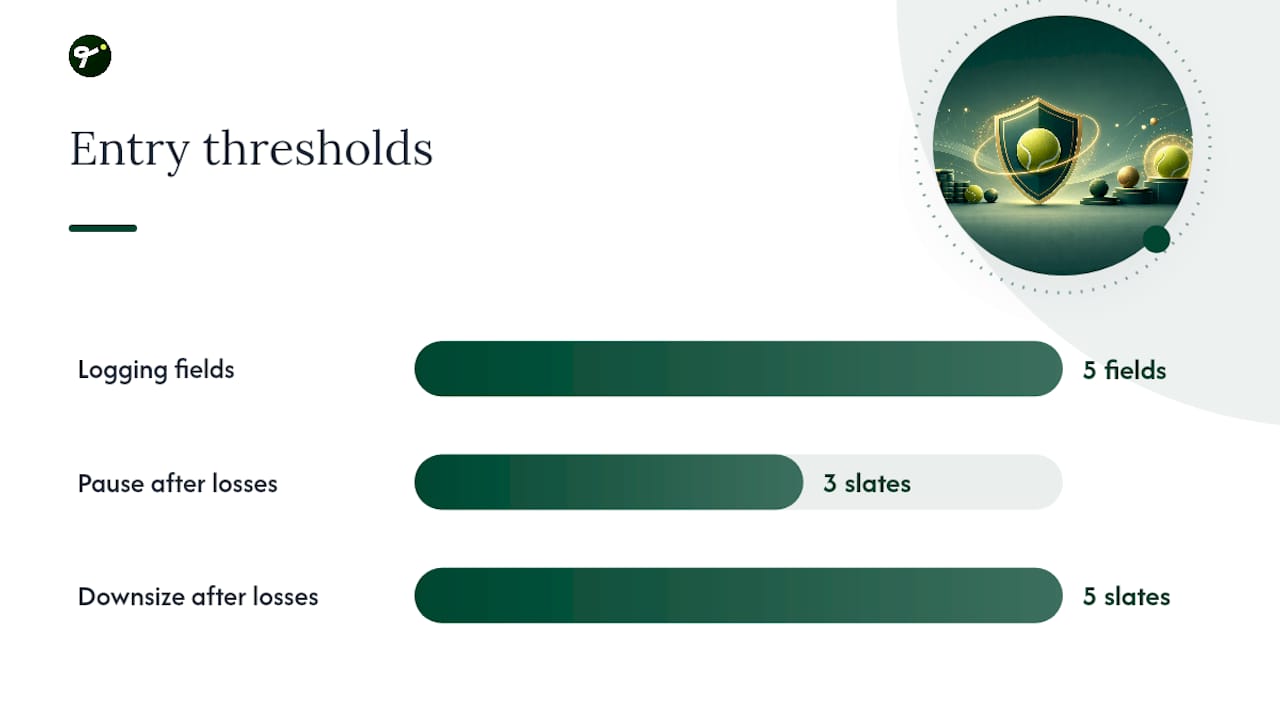
Pair it with a logging habit. A minimal template needs five fields: stake, contest type, players rostered, your one-line rationale, and the outcome. Athlon Sports' breakdown of DFS golf bankroll basics makes the same point across a different sport: players who log entries catch their own mistakes faster than players who just remember how they "felt" about a slate.
- Track stake, contest type, players, rationale, and result for every entry.
- After three or more straight losing slates, pause and review the log before entering again.
- After five or more, downsize to your conservative percentage and consider a few slates in Tweener's free coin mode to rebuild rhythm without risking cash.
Pro Tip: Write your rationale before lineups lock, not after. If you can't explain why a player is in your lineup in one sentence, that's usually the entry you should cut.
What is fractional Kelly and how does it apply to DFS?
The Kelly criterion, at its core, says you should size your bets to maximize long-run growth given your actual edge, and no bigger. Bet too small and you leave growth on the table; bet too big and variance wipes you out even with a winning strategy.
Full Kelly for a typical DFS edge often calculates out well above what feels comfortable, which is exactly why almost nobody plays it straight. RunsLeft's Kelly framework for DFS shows that halving or quartering the Kelly number, known as half or quarter Kelly, lands you right in that familiar 1 to 5% range that beginner and aggressive players already use, while cutting your drawdown swings substantially.
Half Kelly sacrifices some theoretical growth for a much smoother bankroll curve. They're just choosing different fractions.
What are the most common bankroll mistakes?
Two mistakes account for most blowups: resizing your bets after an emotional swing, and pulling money from outside your dedicated bankroll to chase a loss. Both feel reasonable in the moment. Neither is.
- Doubling your entry size after three straight losses to "get it back" fast.
- Dipping into rent money or a paycheck to fund a lineup you're overconfident about.
- Ignoring your own log because the results are uncomfortable to look at.
If you've made either mistake, stop entering cash contests immediately. Log what happened, drop back to your conservative percentage, and play at least 10 to 15 slates in free mode before touching cash again.
How do you actually track a DFS bankroll day to day?
A spreadsheet doesn't need to be complicated to work. The players who stick with tracking long term usually keep it to six or seven columns: date, bankroll before the slate, contest type, stake, stake as a percent of bankroll, result, and bankroll after.

Google Sheets or Excel both handle this fine. Add one formula that flags any entry over your chosen per-entry ceiling in red, and a running total that updates your current bankroll automatically after each result. That single visual cue does more to stop overbetting than any amount of willpower.
A second tab worth building tracks by sport and slate size separately. If you play both fantasy tennis and other daily fantasy sports, your tennis results will look different from your other numbers because of retirement and weather variance, and mixing them into one column hides that. Separate tabs let you see, for instance, that your Grand Slam multi-day results run smoother than your single-match GPP results, which tells you where to lean.
Keep a notes column for context too, things like "rain delay pushed match to Day 2" or "seed retired in set 2." Over 20 or 30 slates, these notes turn a plain log into a pattern you can actually learn from, showing you which contest types and which conditions you handle well and which ones you should avoid.
When should you move stakes up or down?
Bankroll fluctuations are normal. Overreacting to them is the mistake, not the fluctuation itself.
That sample size matters because a five-slate heater tells you almost nothing about whether your edge is real or you just ran good on a couple of upsets.
Moving down works on a faster trigger.
The pattern to watch isn't the bankroll number itself. It's whether your losses cluster around specific conditions, tight slates, rain-affected tournaments, matches you entered on tilt, because that clustering tells you whether to adjust your overall sizing or just avoid a specific situation next time.
A tennis player's take on making these rules stick
Grand Slam nights expose sizing mistakes fast. I've watched a locked-in lineup fall apart when a seed retired in the second set, the kind of thing no amount of pre-match research prevents. The fix isn't better picks. It's smaller bets and more of them, spread across matches and tournament days instead of one big swing.
Track your results by surface, not just overall. A player who crushes on hard courts tells you nothing about your clay-court instincts. Review Tweener's tennis strategy posts before your next Slam entry, and treat your bankroll log as seriously as your player research.
— Nathan
Ready to practice these rules without risking cash?
Tweener is the only daily fantasy platform built specifically around ATP and WTA tennis, which means every sizing rule in this article actually maps to real contest structures instead of getting bent to fit a sport it wasn't designed for. Start in free mode with virtual coins, where you can log entries, test your per-slate cap, and get a feel for tennis volatility with zero cash on the line.
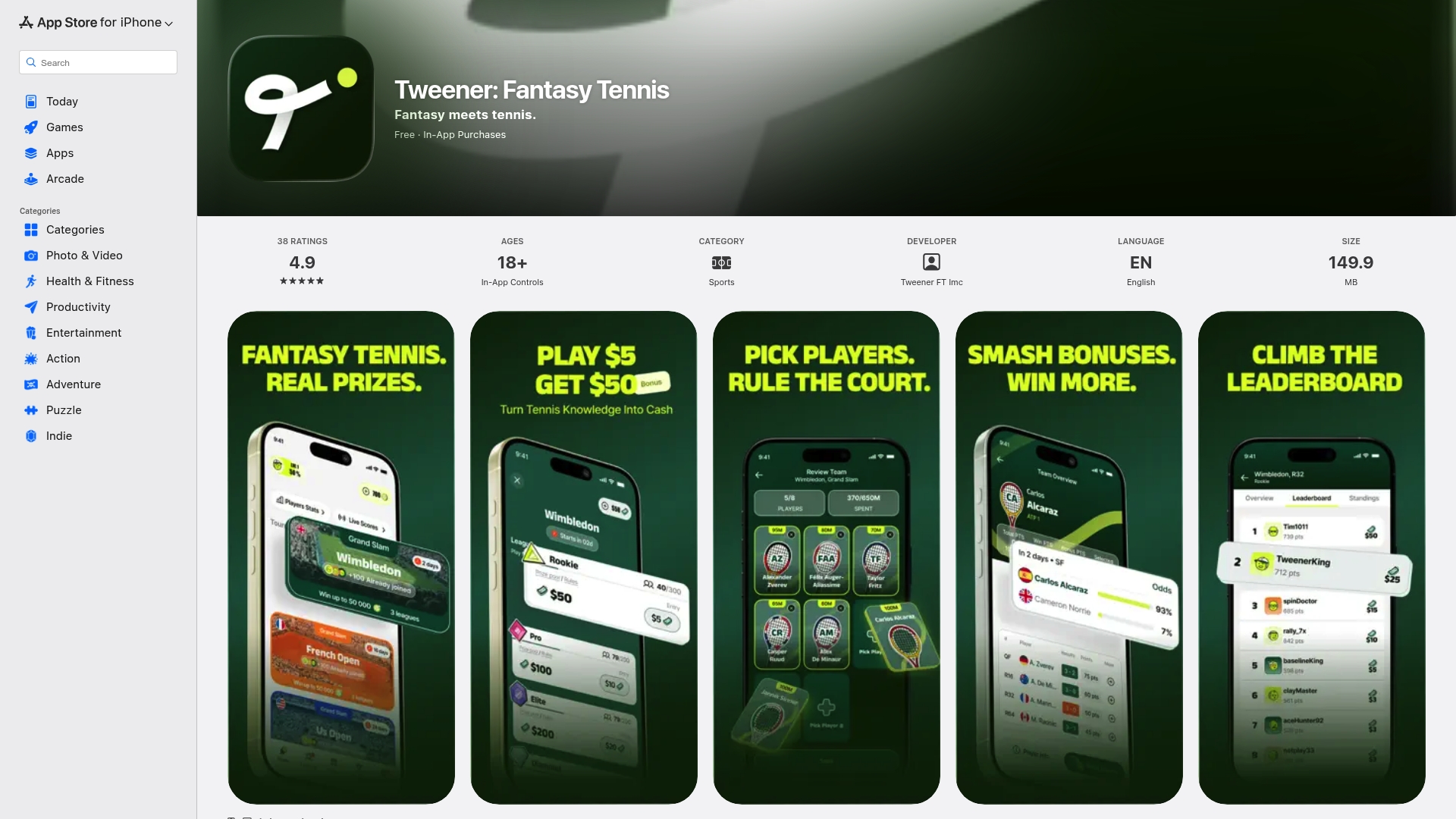
Tweener's private leagues let you compete against up to nine friends during Grand Slams, which is a lower-variance way to test sizing against people you know rather than an anonymous field. Download the app and start logging your first free-mode slate tonight, or head to Tweener to see the current tournament lineup and private league options.
Sources
For the Kelly and risk-of-ruin math behind these rules, see RunsLeft, OddsReference, and FantasyLabs. For tennis-specific contest strategy, read Tennis Majors and Tweener's contest selection guide.
- How to build a winning tennis DFS strategy: From beginner picks to advanced tactics — Tennis Majors
- DFS Bankroll Management for Beginners — RunsLeft
- DFS bankroll management — OddsReference
- DFS Asset Allocation: The secret of bankroll management — FantasyLabs